How to Budget and Invest When You Earn Between ₹15,000 and ₹30,000
By Rajnish
About the Author
An MBA student with an interest in finance and wealth management, contributing insights on mutual funds, investment strategies, market trends, and financial planning to help readers make informed investment decisions.

Learn how to manage a ₹15,000–₹30,000 salary in India, build savings, handle essential expenses and start investing without overstretching your budget.
How to Budget and Invest When You Earn Between ₹15,000 and ₹30,000
A ₹20,000 salary can look very different depending on where you live, whether you pay rent, whether you support your family and whether you have EMIs.
That is why there is no single perfect budget for everyone earning ₹15,000, ₹20,000, ₹25,000 or ₹30,000.
The right starting point is not “What percentage should I invest?” It is “How much money do I actually have available after essential expenses and financial commitments?”
Once that is clear, saving and investing become much easier.
The basic sequence is:
Income → essential expenses → financial commitments → emergency savings → investments → discretionary spending
The exact amounts will change from person to person.
How should you manage a ₹20,000 salary in India?
The first step is to separate your salary into four broad buckets:
Essentials: rent, food, transport, utilities and other necessary costs.
Financial commitments: EMIs, family obligations and other fixed responsibilities.
Savings: money kept available for emergencies and near-term needs.
Investments: money intended for suitable long-term goals.
Discretionary spending: entertainment, eating out, shopping and other wants.
There is no requirement that these categories must have fixed percentages.
A fresher living at home may have much lower housing costs than someone renting a room in Bengaluru, Mumbai or Delhi.
The same ₹20,000 salary can therefore produce completely different financial situations.
What should someone earning ₹15,000 do?
With ₹15,000, the priority should generally be cash-flow stability.
Suppose your essential expenses are ₹10,500.
You have ₹4,500 remaining before considering irregular expenses, savings and investments.
The temptation may be to put ₹3,000 into a SIP because you want to start early.
But first ask:
What happens if I need ₹2,000 unexpectedly?
If you have no accessible savings, investing a large share of your surplus may create unnecessary pressure.
A more sustainable approach could be to focus initially on creating a small emergency buffer and developing a reliable monthly saving habit.
You can still invest a modest amount if your cash flow comfortably allows it.
The exact number is less important than being able to maintain it without repeatedly withdrawing the investment.
What about a ₹20,000 salary?
This is where budgeting becomes especially important.
Imagine an employee earning ₹20,000 after deductions.
Their essential expenses are ₹12,000.
They have ₹8,000 left.
That does not mean ₹8,000 is automatically available for investment.
There may be:
Occasional medical expenses
Travel
Family support
Clothing
Annual payments
Repairs
Gifts
Professional expenses
A monthly budget should account for irregular costs as well.
Suppose the person decides to keep ₹3,000 as savings, ₹2,000 for long-term investing and ₹3,000 for flexible spending.
Those amounts are illustrative, not recommendations.
The important principle is:
Do not build your budget around the assumption that every rupee not spent today can be invested.
Some money needs to remain available for tomorrow.
How should you manage a ₹25,000 salary?
At ₹25,000, the opportunity to build both savings and investments can become larger, but lifestyle can also expand.
This is where many young professionals make a mistake.
Income increases by ₹5,000.
Spending increases by ₹5,000.
The financial position barely changes.
A useful approach is to decide in advance what portion of additional income will go towards future goals.
For example:
Salary increases from ₹20,000 to ₹25,000.
Instead of automatically increasing restaurant spending, subscriptions and shopping, you could direct some of the additional income towards:
Emergency savings
Higher SIP contribution
Debt repayment
Professional development
The exact choice depends on your circumstances.
Kuberzo first-salary guide is a useful companion piece for someone setting up this system for the first time.
How should you manage a ₹30,000 salary?
A ₹30,000 salary can provide more breathing room, but location matters enormously.
Consider two employees.
Employee A lives with family and contributes ₹5,000 towards household expenses.
Employee B rents a room and pays ₹12,000 towards housing and utilities.
Both earn ₹30,000.
Their budgets cannot reasonably be identical.
For Employee A, a larger portion may be available for emergency savings and long-term investing.
For Employee B, housing costs may take up a much larger share of income.
This is why salary budgeting should be expense-led rather than percentage-led.
Is the 50-30-20 rule useful on a small salary?
It can be a starting framework, but it should not become a rigid rule.
The popular 50-30-20 approach divides income between needs, wants and savings/debt repayment.
The problem comes when someone earning ₹15,000 tries to force their life into a formula that does not reflect their actual expenses.
Suppose your rent alone consumes 45% of your income.
You cannot solve that problem simply by declaring that needs should be 50%.
Similarly, someone living with family may have unusually low essential expenses.
A good budget describes your financial reality. It does not hide it.
What should you prioritise before investing?
For someone on a starter salary, consider the following sequence.
First: Know your actual monthly expenses
Track your spending for at least one full month.
Separate necessary spending from lifestyle spending.
Do not rely on memory.
Small expenses become much easier to understand when written down.
Second: Identify financial commitments
Include EMIs, family support, recurring bills and other obligations.
Money committed to these expenses should not be treated as investable surplus.
Third: Build accessible savings
An emergency fund gives you a buffer when something unexpected happens.
RBI's financial education material recommends maintaining an emergency fund covering at least three months of living expenses as a general baseline, with larger buffers potentially appropriate for people with less secure income or other responsibilities.
Fourth: Start investing with sustainable surplus
Only after these priorities are considered should you decide how much long-term investing is appropriate.
Can someone with a low salary start a SIP?
Yes, provided the investment amount is affordable and the underlying mutual-fund scheme is suitable for the investor's goal and risk profile.
A SIP is simply a method of investing periodically into a mutual fund.
It does not make the investment risk-free.
AMFI states that mutual-fund values can rise or fall and that returns are not guaranteed.
So someone earning ₹20,000 does not need to wait until they earn ₹50,000 to learn about investing.
But they also do not need to invest a large percentage of ₹20,000 simply to prove they are disciplined.
Start from sustainable cash flow.
How much should someone earning ₹20,000 invest?
There is no universally correct number.
Imagine three people earning exactly ₹20,000.
Person A pays ₹5,000 towards household expenses and has no debt.
Person B pays ₹10,000 rent and ₹3,000 EMI.
Person C supports parents and has significant monthly family responsibilities.
Their investable surplus will be different.
A useful calculation is:
Take-home salary − essential expenses − required debt payments − planned savings = potential investment surplus
Even this should not be treated as a command to invest the entire surplus.
You may need money for near-term goals and irregular expenses.
Where should emergency savings and investments be separated?
Think of them as two different jobs.
Emergency savings: accessible money for unexpected financial needs.
Investments: money allocated towards longer-term goals, according to your time horizon and risk capacity.
Mixing them can create problems.
Suppose your salary is ₹20,000 and you have ₹15,000 invested in a market-linked fund but almost no cash.
A sudden ₹8,000 expense can force you to withdraw an investment when its value is lower.
An emergency buffer reduces that pressure.
What if you have debt on a ₹20,000–₹30,000 salary?
Debt should be included before calculating your investment budget.
A person earning ₹30,000 with a ₹10,000 EMI is in a different position from another person earning ₹30,000 with no EMI.
This is especially important with expensive consumer debt.
The priority may be to stabilise cash flow and reduce costly debt before significantly increasing long-term investments.
Education loans can require a different analysis because their terms and tax treatment differ. For a detailed comparison, see Kuberzo's article on education loan vs SIP—the decision depends on interest cost, emergency savings and risk rather than simply comparing two percentages.
How do you budget if you earn only ₹15,000?
Do not start by asking, “How much can I invest?”
Start with:
How much do I need to live?
Suppose:
Income: ₹15,000
Essential expenses: ₹9,500
Debt/family obligations: ₹2,000
Remaining cash flow: ₹3,500
Now you know the real decision is about how to use ₹3,500.
You may need to divide it among emergency savings, irregular expenses and investing.
The right choice depends on whether you already have savings.
If you have no emergency fund, building one may deserve higher priority.
If you already have several months of essential expenses saved and your income is stable, long-term investing may become more practical.
What mistakes should people on small salaries avoid?
Mistake 1: Copying someone else's budget
Your friend's rent, family responsibilities and commute may be completely different.
Mistake 2: Treating salary as spendable cash
Salary is income, not permission to spend.
Mistake 3: Investing the emergency fund
Your emergency money has a different purpose from long-term investment capital.
Mistake 4: Choosing a mutual fund based only on recent returns
Past performance does not guarantee future performance.
Mistake 5: Starting too many investments
One manageable investment that you understand can be better than several schemes you cannot explain.
Mistake 6: Ignoring irregular expenses
Annual insurance payments, travel, medical costs and repairs can disrupt a monthly plan if they are ignored.
Mistake 7: Increasing lifestyle costs every time income increases
A salary hike can improve your financial position only when some of the additional income remains available for future goals.
Should you invest or save when earning ₹20,000?
Usually, this should not be an either-or question.
You may need both.
Savings provide liquidity.
Investments are designed for longer-term objectives.
For example:
Money required soon → accessible savings
Money needed several years later → consider appropriate investments
The time horizon matters because market-linked investments can fluctuate.
SEBI's investor education resources specifically encourage investors to understand different fund types, risk and investment horizons before investing.
How can you increase your investments as your salary grows?
Do not wait for a large promotion.
Even a ₹2,000–₹5,000 increase in monthly income can be reviewed carefully.
Suppose your SIP is ₹1,500 when you earn ₹20,000.
Later, your salary becomes ₹25,000.
You might decide that an additional amount can go toward investments after accounting for higher expenses, savings and debt.
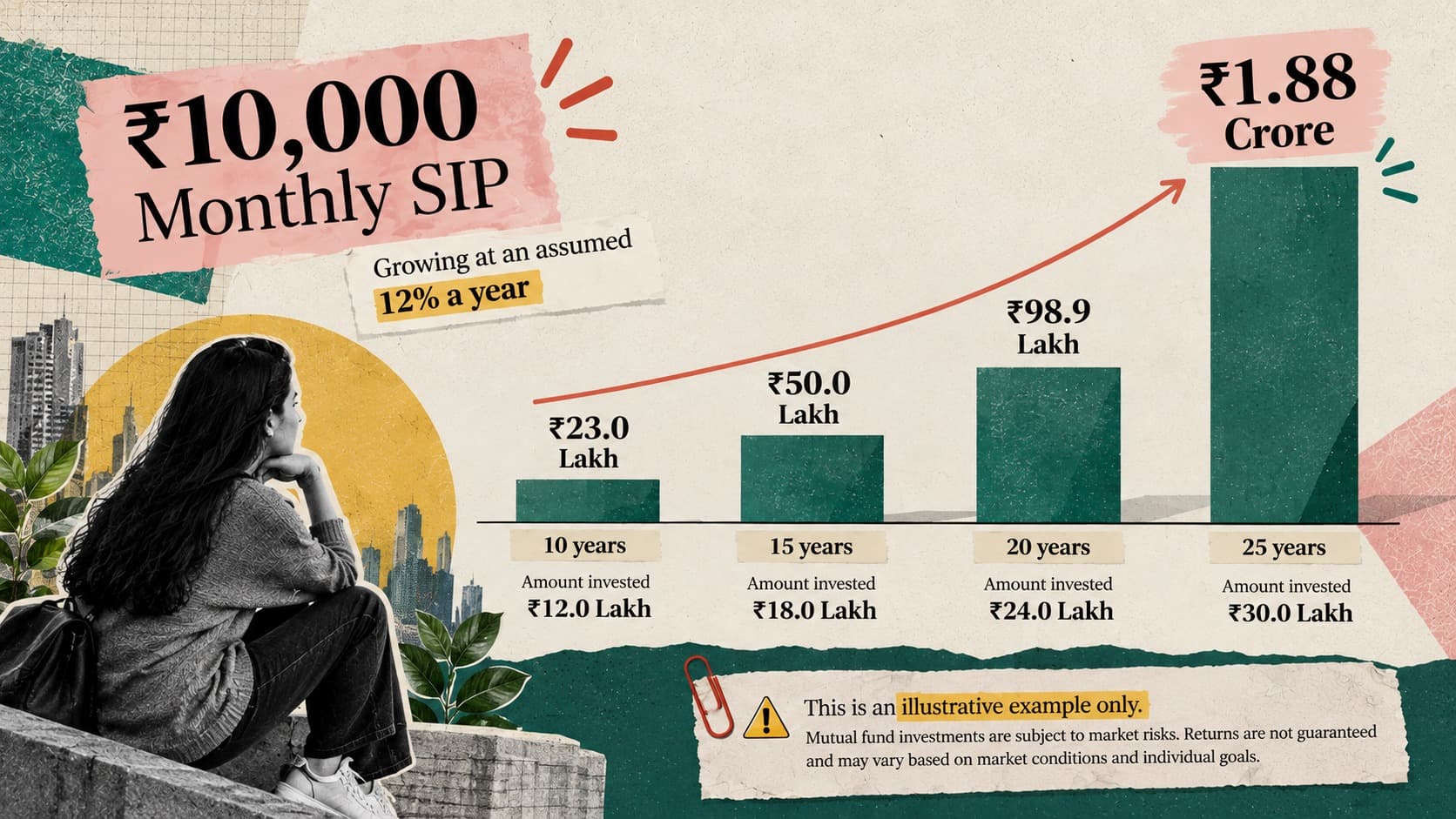
For investors using a SIP, a Kuberzo SIP page can help visualise different monthly investment assumptions.
The numbers shown by a calculator are illustrations. Actual investment results will depend on market performance.
What if your salary is only ₹10,000?
The same principles apply, but investing may not be the first priority.
At ₹10,000 a month, a large unavoidable expense can consume a significant portion of income.
Start by controlling cash flow.
Track expenses.
Build some accessible savings.
Avoid taking unnecessary high-cost debt.
Then consider investing only with a sustainable surplus.
There is no shame in starting with a very small investment or waiting until your financial foundation improves.
Personal finance is not a race to invest the largest amount.
How can you manage a ₹30,000 salary wisely?
A simple monthly system can help:
Salary received
→ Pay essentials
→ Set aside emergency savings
→ Meet debt/family commitments
→ Invest for long-term goals
→ Use the remaining amount for lifestyle spending
The exact order can change depending on your situation.
What matters is that savings and investments are given a deliberate place in the budget rather than being whatever remains at the end of the month.
What should change when your salary crosses ₹30,000?
The goal should not simply be to move into a more expensive lifestyle.
A salary increase is an opportunity to improve multiple areas at once.
You can consider:
Increasing emergency savings
Increasing SIP contributions
Paying down debt faster
Improving health or insurance protection
Saving towards major goals
Building skills that can increase future income
As the portfolio becomes larger, it is also useful to periodically review whether different mutual funds overlap or whether the allocation still matches your goals. Kuberzo Portfolio Review is designed around allocation, fund overlap and goal alignment.
The most important budgeting rule for a small salary
Your budget should answer one simple question:
Where is my money going before I decide where it should go next?
A ₹20,000 salary with controlled expenses can sometimes create more financial progress than a ₹40,000 salary with uncontrolled spending.
That does not mean income is unimportant.
Higher income gives you greater financial capacity.
But the combination that matters is:
Income + spending discipline + savings + suitable investing.
Start with reality.
Know your expenses.
Build a buffer.
Deal with debt.
Then invest what you can genuinely afford to leave invested.
A small SIP, started responsibly, can become more meaningful as your income grows.
And a small salary managed carefully can be the beginning of a much stronger financial system.
Important: This article is for general educational purposes and does not constitute personalised financial advice. The examples are illustrative. Actual budgets depend on rent, city, family responsibilities, debt, insurance, taxes and personal goals. Mutual fund investments are subject to market risks and returns are not guaranteed.
Frequently Asked Questions
How should I manage a ₹20,000 salary in India?
Start by calculating essential expenses, debt obligations and savings needs. The remaining sustainable surplus can then be divided between investments, irregular expenses and discretionary spending.
How should I manage a ₹15,000 salary?
Focus first on cash-flow stability, essential expenses and a small emergency buffer. Invest only an amount that does not make your monthly finances fragile.
How should I manage a ₹25,000 salary?
Track expenses, protect part of the additional income for savings and consider increasing investments when your cash flow permits it.
Is the 50-30-20 rule compulsory?
No. It is a budgeting framework, not a regulatory requirement or universal financial rule.
How much of my salary should I invest?
There is no fixed percentage that suits everyone. Consider essential expenses, debt, emergency savings, goals, income stability and risk tolerance.
Can I start a SIP with a low salary?
Yes. A SIP can be started with an affordable amount, but the suitability of the underlying mutual fund and the investor's financial situation matter.