Education Loan vs SIP: Should You Pay Off Debt First or Start Investing?
By Rajnish
About the Author
An MBA student with an interest in finance and wealth management, contributing insights on mutual funds, investment strategies, market trends, and financial planning to help readers make informed investment decisions.
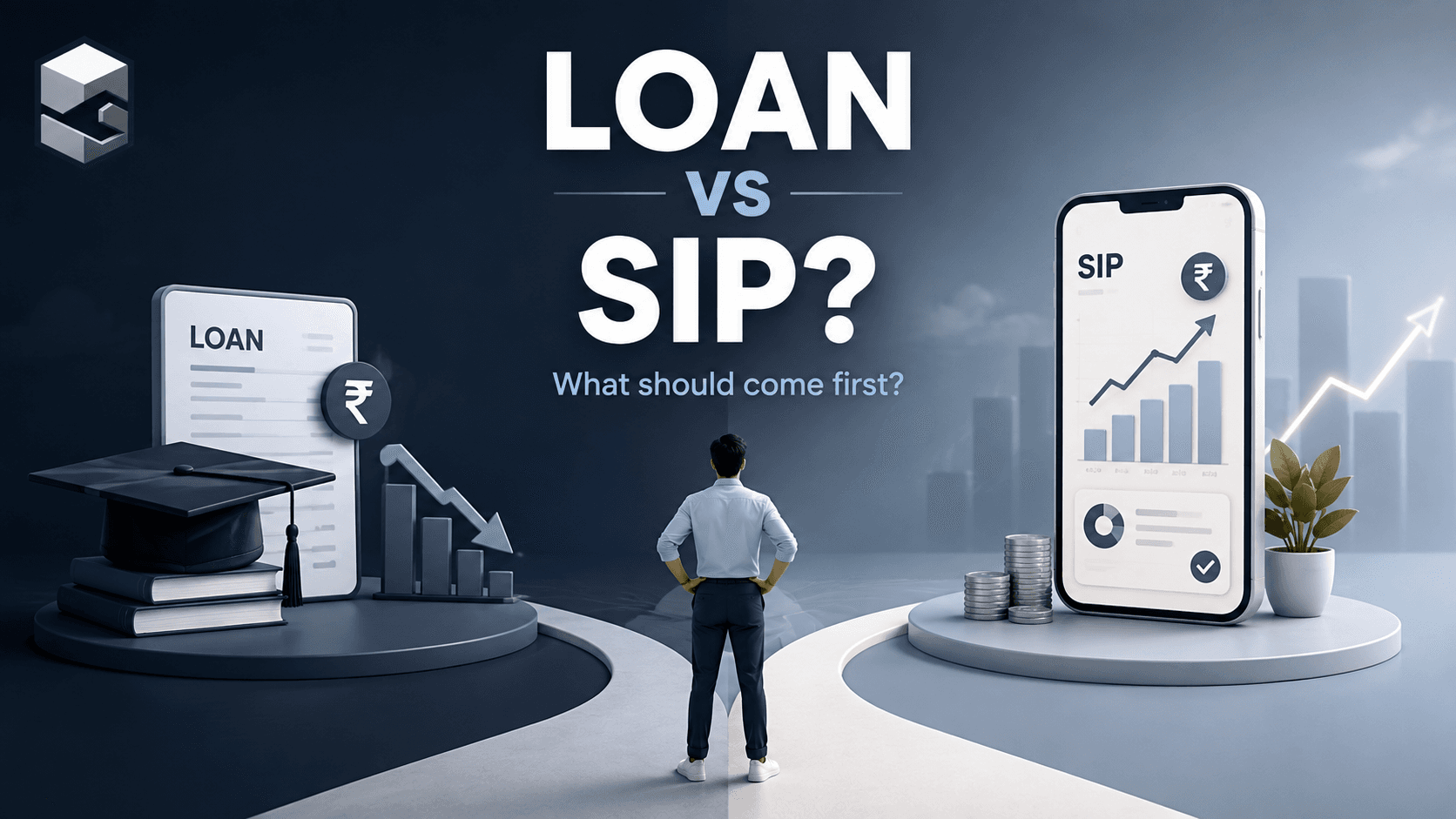
Education loan vs SIP: learn how to decide between loan prepayment and investing after your first job, including interest cost, risk, tax and emergency savings.
Education Loan vs SIP: Should You Pay Off Debt First or Start Investing?
Getting your first salary after college can create a difficult financial choice.
You have an education loan to repay. At the same time, you have heard that starting a SIP early can help you build long-term wealth.
So what should you do?
There is no universal rule that says you must either repay the education loan completely or start investing immediately. The right decision depends on the loan's cost, your income stability, emergency savings, financial goals and ability to handle investment risk.
One principle is especially important: loan interest is a financial cost you are contractually required to pay, while mutual fund returns are uncertain.
That means it is risky to say, “My mutual fund can earn more than my loan rate, so I should always invest instead of repaying the loan.”
The investment may earn less than expected. It may even fall in value when you need the money.
What is the difference between an education loan and a SIP?
An education loan is debt. A SIP is a method of investing.
With an education loan, you borrow money to fund eligible education-related costs and repay the lender according to the loan agreement.
With a SIP, you periodically invest a fixed amount into a mutual fund scheme. The value of that investment can increase or decrease depending on the underlying securities and market conditions.
SEBI and AMFI explicitly state that mutual fund investments involve risk and that returns are not guaranteed. (SEBI; AMFI)
This difference is the starting point for the entire loan-versus-investment decision.
Should you repay an education loan before starting a SIP?
Not necessarily. But if the loan is expensive, your finances are fragile, or you have no emergency savings, repayment may deserve greater priority than aggressive investing.
The opposite can also be true.
Someone with a relatively manageable loan, stable income, a sufficient cash buffer and a genuinely long investment horizon may choose to invest a portion of their surplus while continuing to pay the EMI.
The decision should therefore start with your financial position, not with a generic “debt first” or “invest first” rule.
First ask: how expensive is your education loan?
Your actual loan agreement matters more than a generic education-loan interest rate found online.
RBI states that the Indian Banks' Association's Model Educational Loan Scheme, or MELS, provides broad guidelines to banks and that implementing banks can make changes according to their policies.
This means two borrowers can have different terms.
Check your own loan documents for:
· Outstanding principal
· Current interest rate
· EMI
· Remaining tenure
· Whether the rate is fixed or floating
· Prepayment rules
· Any applicable charges
· Moratorium terms
· Interest accumulated before repayment began
Do not make an investment decision using a loan rate you have only assumed.
Why the loan interest rate matters so much
Suppose, purely as an illustrative example, your education loan costs 11% a year.
An investment may potentially earn more than 11%, but it may also earn less.
The 11% loan cost is part of the debt obligation, while the investment return is uncertain.
That makes the comparison fundamentally different from comparing two guaranteed products.
Think of it this way:
Loan repayment: reducing debt removes future interest expense.
SIP: investing creates an opportunity for future growth, but with market risk.
The more expensive the loan and the lower your financial resilience, the stronger the case for giving debt repayment greater attention.
What if your education loan has a low interest cost?
The decision can be different.
Suppose your loan has a relatively manageable cost and your income is stable.
You have also built an emergency reserve and can comfortably pay the EMI every month.
In that situation, investing some surplus through a SIP can be considered alongside the EMI.
The important word is alongside.
You should not miss loan payments just to maintain an SIP.
Nor should you assume that the SIP will definitely produce a return higher than the loan interest.
AMFI states that mutual fund values can fluctuate with market conditions and that past performance does not guarantee future performance.
What if your education loan interest rate is high?
A high-cost loan changes the calculation.
Suppose you have ₹10,000 of surplus cash each month after essential expenses and your EMI.
You could put the entire amount into a SIP.
Or you could use some or all of it to make an eligible prepayment, subject to the lender's terms.
When you prepay principal, you may reduce the interest that would otherwise accrue on the outstanding amount. The exact benefit depends on the loan structure and the lender's calculations.
For someone carrying expensive debt, reducing the outstanding loan can therefore be financially meaningful.
This is not a guarantee that prepayment will always produce a better outcome than investing. It is a recognition that eliminating a borrowing cost is different from chasing an uncertain investment return.
Should you have an emergency fund before choosing either option?
Yes, this should be part of the decision.
Imagine you earn ₹40,000 a month and have an education-loan EMI of ₹8,000.
You invest almost every rupee left after your regular expenses.
Three months later, your employer restructures your team and your income becomes uncertain.
Now you have both:
A fixed EMI obligation
and
a market-linked investment that may be worth less than what you invested.
That is exactly the situation an emergency fund is meant to help manage.
A separate emergency fund can give you more flexibility to continue meeting essential expenses and debt commitments without immediately selling investments.
Kuberzo's guide on First salary money-management guide provides a broader starting point for budgeting, emergency savings and investing.
Can you split your surplus between the loan and a SIP?
Yes.
This may be a practical middle path for some borrowers.
Suppose your monthly surplus after essential spending and EMI is ₹10,000.
Instead of making the entire ₹10,000 a SIP or the entire ₹10,000 a loan prepayment, you might decide to allocate part of the amount to additional repayment and part to long-term investing.
For example, the split could be:
₹6,000 → additional loan repayment
₹4,000 → SIP
These figures are purely illustrative.
The appropriate allocation depends on your loan cost, emergency savings, income stability, goals and risk tolerance.
The advantage of this approach is psychological as well as financial: you can make progress on the debt while developing an investment habit.
But a split only makes sense if the EMI remains comfortably manageable and the loan agreement permits the relevant prepayment.
Does the education-loan tax benefit change the decision?
It can.
Section 80E allows an eligible individual to claim a deduction for interest paid on a qualifying education loan for higher education. The Income Tax Department states that the deduction can cover the entire interest paid during the relevant financial year, subject to the section's conditions, and is available for a maximum of eight assessment years beginning from the year in which interest repayment starts, or until the interest is fully paid, whichever is earlier.
However, there is an important current tax-regime point.
The Income Tax Department's current AY 2026–27 guidance shows that deductions under Section 80E cannot be claimed when the new tax regime is selected; Chapter VI-A deductions such as 80E are available under the old regime, subject to eligibility and applicable rules.
So do not simply subtract the full education-loan interest from your effective cost without checking your tax regime and eligibility.
For a first-job earner, the actual tax benefit may also be limited by their taxable income and tax liability.
What about government interest-subsidy schemes?
Some education-loan borrowers may qualify for government support.
For example, the Ministry of Education's current information on the Central Sector Interest Subsidy Scheme states that eligible students pursuing specified professional or technical courses can receive full interest subsidy during the moratorium period, subject to conditions including the applicable family-income limit and eligible institutions/courses.
The Ministry has also reported implementation of PM-Vidyalaxmi and the PM-USP Central Sector Interest Subsidy Scheme.
This is important because a borrower eligible for a subsidy may have a different effective debt burden from another borrower.
Do not assume that every education loan qualifies. Check the specific scheme, lender, course and eligibility requirements applicable to you.
Should you invest while paying an education loan if your salary is small?
Be conservative.
Suppose your take-home salary is ₹30,000.
Your essential expenses are ₹17,000.
Your education-loan EMI is ₹7,000.
You have ₹6,000 left.
Putting the full ₹6,000 into a SIP may look disciplined, but it leaves no room for unexpected expenses.
A better starting point may be to establish a basic emergency buffer and then divide future surplus between debt reduction and long-term investing.
The right answer changes as the financial base becomes stronger.
When does investing alongside a loan become more reasonable?
Consider these questions:
Can I pay the EMI comfortably?
If an SIP payment would make the EMI difficult to manage, prioritise financial stability.
Do I have accessible emergency savings?
If not, building a buffer may be more urgent than increasing investments.
Is my income stable?
A stable salary and a highly variable income create different risk situations.
How expensive is the loan?
A higher borrowing cost deserves more attention.
Can I stay invested for the required time?
An equity-oriented mutual fund can experience substantial short-term fluctuations.
Am I investing based on a guaranteed return assumption?
If your decision depends on getting a specific annual return from a mutual fund, the reasoning is flawed.
A simple decision framework
You can think about the decision in four broad situations.
Situation 1: High loan cost + no emergency fund
Debt repayment and emergency savings should generally receive high priority.
There is little value in aggressively investing while your basic financial foundation is weak.
Situation 2: Manageable loan + no emergency fund
Build the emergency reserve first while continuing the required EMI.
Long-term investing can become more meaningful after you have some financial breathing room.
Situation 3: Manageable loan + stable income + emergency fund
A combination of regular EMI, selective prepayment and long-term investing may be considered.
The exact split depends on your objectives.
Situation 4: Loan nearly repaid + strong cash flow
You may have more room to increase long-term investments.
At this stage, the financial decision becomes less about debt survival and more about goal-based investing.
What mistakes should you avoid?
Mistake 1: Comparing the loan rate with an assumed SIP return
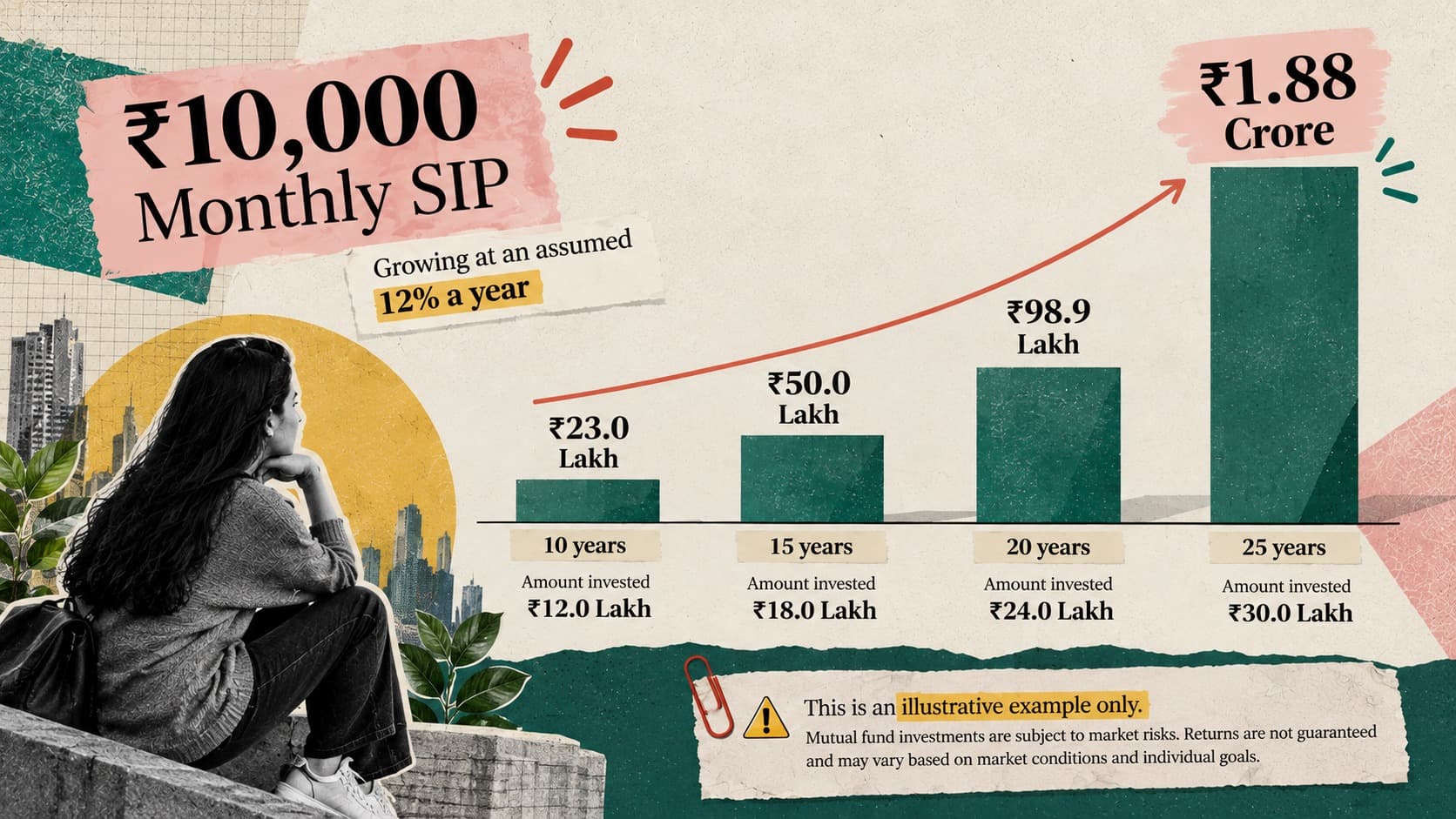
An assumed 12% mutual-fund return is not equivalent to a contractual 12% loan rate.
Mistake 2: Ignoring taxes and costs
The investment return you see in an illustration is not necessarily the return you finally receive after applicable taxes and costs.
Mistake 3: Using emergency money to make a large prepayment
Be careful about making yourself cash-poor.
Reducing your loan balance is useful, but having no accessible money for an emergency can create a new problem.
Mistake 4: Investing only because “starting early is important”
Starting early can be valuable, but financial stability matters too.
Mistake 5: Delaying all investment indefinitely
The opposite extreme can also be problematic.
Once your immediate financial foundation is healthy, consider creating a structured long-term investment plan rather than saying “I will start after the loan is completely finished” without a reason.
Kuberzo SIP planning and calculator can help you understand how regular investments fit into a longer-term plan.
What should happen after the loan is repaid?
Do not allow the old EMI to disappear into lifestyle spending.
Suppose your EMI was ₹8,000.
Once the loan is fully repaid, that ₹8,000 becomes available every month.
You could redirect part or all of that cash flow towards long-term goals, depending on your financial priorities.
This is where the financial benefit of disciplined debt repayment can become powerful: you have not only removed the liability but also created additional future cash flow.
As your investments grow across multiple schemes, Kuberzo's Portfolio review can help you understand allocation and fund overlap.
The real question is not “loan or SIP?”
For most young professionals, the better question is:
How do I balance financial stability today with long-term wealth building?
An education loan is an obligation.
A SIP is an investment strategy.
They should not be treated as two competing products with identical risk.
Start by understanding your loan. Build enough financial resilience to handle uncertainty. Then decide how much of your sustainable surplus can go towards additional repayment and how much can go towards long-term investments.
There is nothing wrong with investing while repaying an education loan.
There is also nothing wrong with prioritising repayment.
The sensible choice is the one that matches your actual loan cost, cash flow, risk capacity and financial goals.
Important: This article is for general educational purposes and is not personalised financial, investment, legal or tax advice. Education-loan terms vary by lender. Mutual fund investments are subject to market risks and returns are not guaranteed. Tax deductions and government schemes are subject to applicable conditions and can change.
Frequently Asked Questions
Is it better to repay an education loan or invest in a SIP?
There is no universal answer. The decision depends on loan cost, income stability, emergency savings, financial goals and risk tolerance.
Can I invest in mutual funds while paying an education loan?
Yes, provided the EMI and essential expenses remain manageable and the investment does not create financial stress.
Is SIP return guaranteed?
No. Mutual fund investments are market-linked and returns are not guaranteed.
Should I build an emergency fund before investing?
For many first-job borrowers, building at least a basic accessible emergency reserve can reduce the risk of having to borrow or sell investments during a financial shock.
What if I lose my job while repaying the loan?
This is one reason emergency savings and conservative cash-flow planning matter. Your ability to meet essential expenses and EMI obligations should not depend entirely on market-linked investments.
Should I prepay my education loan?
Prepayment may make sense when the loan is relatively expensive or when reducing debt is an important financial priority. Check the loan agreement before doing so.