How a Young Investor Could Grow ₹10,000-a-Month SIP Into a ₹1 Crore Portfolio
By Divay Diya
About the Author
Divay Diya is a business and digital marketing enthusiast with expertise in market research, SEO, and strategic planning. She explores business growth, marketing, investing, and financial markets, translating research into actionable insights.
Can a ₹10,000 monthly SIP investment really reach ₹1 crore? Follow a young investor’s journey through year-wise examples, a step-up shortcut, a simple roadmap and the risks to understand before you begin.
Your first salary arrives. You pay your bills, make plans for the weekend and decide to put ₹10,000 aside for the future. It feels like a sensible start, but one question keeps coming back: could this small monthly investment really become ₹1 crore?
For a young investor, a crore can feel impossibly far away. Yet long-term wealth creation often begins with an ordinary habit: setting aside a manageable amount and repeating it. A ₹10,000 monthly Systematic Investment Plan (SIP) could grow towards ₹1 crore over time, depending on investment performance and how long the money remains invested. It is a possibility, not a promise.
The useful question is not simply whether a crore is achievable. It is how the numbers work, what assumptions they depend on, and how you can build a plan that fits your life.
Can a ₹10,000 monthly SIP become ₹1 crore?
Yes, it is mathematically possible over a sufficiently long period if the investments earn positive returns. The time required depends on actual returns, the regularity of contributions and the length of the investment period.
A Systematic Investment Plan lets you invest a chosen amount in a mutual fund at regular intervals, usually monthly. Instead of waiting until you have a large sum available, you contribute smaller amounts from your income. At ₹10,000 a month, you invest ₹1.2 lakh in one year and ₹12 lakh in ten years, assuming every instalment is made.
Your final portfolio value can be higher or lower than the amount you contribute. Investment gains may add to your contributions, while weak markets can reduce the value of your holdings. An SIP is a way to invest regularly; it does not guarantee profit or a particular future corpus.
What could ₹10,000 a month grow to?
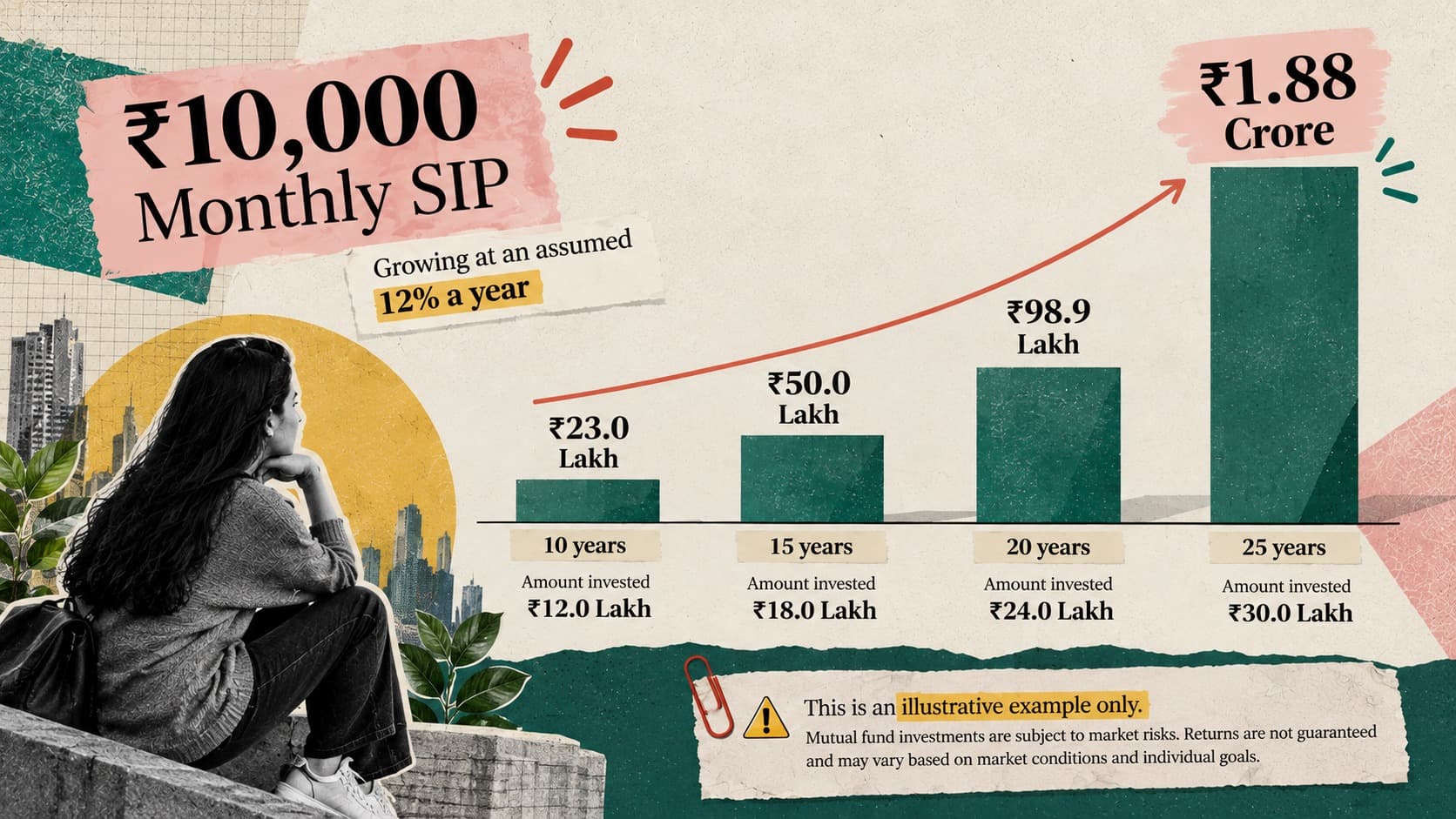
To understand the possibilities, consider a fixed monthly SIP of ₹10,000 under three hypothetical annual return assumptions: 8%, 10% and 12%. The estimates below assume contributions at the end of each month and monthly compounding, using the assumed annual rate divided by twelve.
Investment period | Total contributed | At 8% assumed return | At 10% assumed return | At 12% assumed return |
|---|---|---|---|---|
10 years | ₹12 lakh | ₹18.29 lakh | ₹20.48 lakh | ₹23.00 lakh |
15 years | ₹18 lakh | ₹34.60 lakh | ₹41.45 lakh | ₹49.96 lakh |
20 years | ₹24 lakh | ₹58.90 lakh | ₹75.94 lakh | ₹98.93 lakh |
25 years | ₹30 lakh | ₹95.10 lakh | ₹1.33 crore | ₹1.88 crore |
Illustrative estimates, rounded to two decimal places. These are not forecasts. Taxes, inflation and costs not reflected in the assumed return are not separately deducted.
The difference time makes is striking. At an assumed 10% annual return, the estimated portfolio reaches about ₹20.48 lakh after ten years, ₹41.45 lakh after fifteen years and ₹75.94 lakh after twenty years. By year 25, the estimate rises to approximately ₹1.33 crore.
Across those 25 years, you contribute ₹30 lakh. The difference between that amount and the illustrative portfolio value represents investment growth under the assumption—not guaranteed profit. At an assumed 12% return, the estimate approaches ₹1 crore after twenty years. Actual results may be substantially lower or higher, and investments can lose value.
Why starting young can make a difference
Imagine two people with the same financial goal. One begins investing at 23; the other waits until 33, thinking investing will make more sense once their salary is larger. The first investor has an extra decade in which to contribute and potentially earn returns on money already invested. The second may need to contribute more each month, extend the timeline or adjust the target.
Starting early does not guarantee better returns; it simply gives contributions more time to remain invested and grow over time.
You do not have to wait for a promotion to begin. If ₹10,000 fits your budget after essential expenses, debt obligations and emergency savings, it may be a reasonable starting point. If it would leave you financially stretched, begin with a smaller amount you can sustain. A realistic habit is more useful than an ambitious SIP you stop after a few months.
How compounding works over time
Compounding occurs when gains remain invested and can themselves generate further gains. Future growth may apply to the original investment as well as earlier gains.
With a monthly SIP, this process applies across many contributions. Earlier instalments have more time to grow than later ones. That is one reason a longer investment period can make a meaningful difference, even when the monthly contribution stays the same.
Compounding is not a bonus paid by a mutual fund; it is the cumulative effect of investment performance. If markets fall, portfolio value can decline and losses can affect future growth. Time can help an investment participate in long-term growth, but it cannot remove market risk or guarantee a result.
Should you increase your SIP when your salary rises?
For many young professionals, ₹10,000 is a starting point rather than a permanent contribution. Imagine that you begin investing with your first job. A few years later, you receive a salary increase. You could let the entire increase become additional spending, or direct a manageable portion towards your long-term goal.
A step-up SIP increases your contribution periodically, often once a year. You invest more of your own money, and those additional contributions may also grow if investment performance is positive. A higher contribution can therefore help you work towards a larger target, although the final result remains uncertain.
Before increasing your SIP, consider income stability, essential expenses, family commitments and emergency savings. Do not invest money you may need soon just to reach a target faster. Your plan should adapt as your life changes, not make everyday finances harder.
Kuberzo’s Step-Up SIP Calculator can help you explore how different contribution increases and timelines affect an illustrative corpus. Treat the result as a planning estimate, not a prediction of future returns.
How should a beginner choose a mutual fund?
Choose a fund whose objective, risks and investment horizon suit your circumstances—not simply the one with the highest recent return.
Equity mutual funds invest mainly in shares and can experience substantial fluctuations. Debt mutual funds invest primarily in fixed-income instruments, but they still carry risks, including interest-rate and credit risk. Hybrid mutual funds combine asset classes; their risk depends on their allocation and underlying holdings.
Compare schemes within relevant categories. Review each fund’s investment objective, portfolio holdings, expenses, benchmark performance and Riskometer. Past performance may provide context, but it does not guarantee future returns. A fund that performed well last year may not remain a top performer, and a strong return alone does not establish suitability for your goal.
Think about when you need the money, how much volatility you can tolerate and whether you understand what the scheme owns. If your goal is approaching, the amount of risk you can reasonably take may differ from when you first started investing.
Explore Kuberzo’s guides to Equity Mutual Funds, Debt Mutual Funds and Hybrid Mutual Funds to learn about these broad categories.
Mistakes that can delay your goal
Stopping contributions whenever markets fall. A downturn can feel uncomfortable, but a rushed decision may disrupt a long-term plan. Review whether the investment remains suitable instead of reacting automatically to short-term movements.
Chasing last year’s winner. Strong recent returns do not mean a scheme will continue to outperform. Compare its strategy, risk and performance over relevant periods rather than choosing from a ranking alone.
Taking more risk than you can tolerate. A high-risk fund may be unsuitable if you need the money soon or could not cope with a substantial fall in value. Your age alone does not determine your risk capacity.
Ignoring inflation. ₹1 crore in the future will not buy the same things as ₹1 crore today. Revisit your target as prices, responsibilities and plans change. Kuberzo’s Inflation Calculator can help you explore how inflation affects future purchasing power.
Choosing an unrealistic monthly amount. If your SIP leaves you short for essentials, it may not be sustainable. Start with a contribution that fits your actual budget, then reassess when your circumstances improve.
The aim is not to avoid every market fluctuation. It is to follow a thoughtful plan while recognising that investment values can rise and fall.
A practical plan for getting started
You do not need to solve every financial question at once. Begin with a few manageable steps and revisit them as your circumstances change.
Define the goal. Decide what the money is for and when you may need it.
Check affordability. Account for essentials, debt and emergency savings.
Understand the scheme. Read its documents and assess the risks.
Choose a sustainable contribution. Protect everyday needs.
Automate where appropriate. Make regular investing part of your routine.
Review periodically. Reassess when your circumstances change.
Use calculators thoughtfully. Kuberzo’s SIP Calculator illustrates how contributions and timelines affect a potential corpus; it cannot predict actual returns.
Key takeaway
A ₹10,000 monthly SIP may look modest at the start of a career, but regular contributions over many years can build a substantial portfolio. The outcome depends on how much you invest, how long the money remains invested and the returns your investments actually deliver.
You do not need to predict the perfect fund or the next market rally. Set a clear goal, choose investments carefully, contribute consistently and revisit your plan as life changes. ₹1 crore is a target to plan towards, not a guaranteed outcome.
Disclaimer: This article is for educational purposes only and is not personalised investment advice. Mutual fund investments are subject to market risks. Read all scheme-related documents carefully before investing. Figures are hypothetical illustrations, not promised or forecast returns. Actual outcomes may differ materially.
Frequently Asked Questions
Can a ₹10,000 SIP become ₹1 crore in ten years?
Under the assumptions in the table, a ₹10,000 monthly SIP grows to approximately ₹18.29 lakh to ₹23 lakh over ten years at hypothetical annual returns of 8% to 12%. It does not reach ₹1 crore in these scenarios. A higher contribution, a longer period or different actual investment outcomes would be needed.
How much would I contribute over 20 years?
You would contribute ₹24 lakh over twenty years, assuming twelve instalments each year and no missed payments. The final portfolio value depends on actual investment performance.
Are SIP returns guaranteed?
No. Mutual fund investments are subject to market risks. An SIP encourages regular investing but does not guarantee profits or a particular future value.
Should I increase my SIP every year?
You may increase contributions when your income and financial circumstances allow, provided the revised amount remains affordable. A step-up SIP increases the money you contribute, but it cannot guarantee a particular result.
How often should I review my investments?
Review your portfolio periodically and when your goals, income or responsibilities change. Avoid making frequent changes solely in response to short-term market movements.