How a First-Time Investor Could Build a ₹50 Lakh Mutual Fund Portfolio
By Divay Diya
About the Author
Divay Diya is a business and digital marketing enthusiast with expertise in market research, SEO, and strategic planning. She explores business growth, marketing, investing, and financial markets, translating research into actionable insights.
Building a ₹50 lakh mutual fund portfolio starts with choosing a clear financial goal, understanding different fund categories and managing risk. Learn how first-time investors can compare schemes, diversify investments and review their portfolio without relying solely on past returns.
Imagine receiving your first salary and deciding that, one day, you want to build a ₹50 lakh investment portfolio. It sounds like a meaningful financial milestone: enough to bring you closer to buying a home, funding further education, supporting your family or simply feeling more financially secure.
You open your phone, search for mutual funds and find hundreds of options. Some promise exposure to fast-growing companies, others focus on stability, and many appear attractive because of their recent returns. Before long, you have a watchlist full of funds but no clear idea of where to begin.
This is where many first-time investors get stuck. They spend hours comparing individual schemes without first deciding what their money needs to achieve.
Building a ₹50 lakh mutual fund portfolio is not simply about finding the highest-returning fund. It is about setting a realistic goal, understanding different types of mutual funds, choosing an appropriate mix of investments and staying consistent through market fluctuations.
The good news is that you do not need to understand every mutual fund available in the market. You need a plan that makes sense for your financial situation and the discipline to follow it.
1. Start With a Financial Goal, Not a Mutual Fund
Before choosing a scheme, ask yourself a simple question: What do I actually want this ₹50 lakh to do for me?
The answer matters because the right investment strategy depends on when you need the money and how much risk you can reasonably take.
For example, consider two first-time investors.
A 25-year-old wants to build a portfolio worth ₹50 lakh over the next 15 years. They have a regular income, relatively few financial responsibilities and time to remain invested through market ups and downs.
Another investor wants to accumulate the same amount within three years to make a down payment on a house. For them, a sudden market decline shortly before the purchase could create a serious problem.
Although both investors have the same target, their investment approaches should not necessarily be the same.
Before investing, consider three things:
Your target amount: Is ₹50 lakh the amount you want to accumulate, or the amount you will need after accounting for inflation?
Your investment horizon: How many years do you have before you need the money?
Your financial capacity: How much can you invest without compromising essential expenses, emergency savings or existing financial commitments?
Inflation deserves particular attention. ₹50 lakh today will not have the same purchasing power 10 or 15 years from now. If your goal is far into the future, you may need to revise your target accordingly.
You can use Kuberzo’s Inflation Calculator to understand how rising prices could affect your future financial needs.
Once your goal is clear, it becomes easier to decide which mutual fund categories may be appropriate and how much risk you can afford to take.
2. Understand the Different Types of Mutual Funds
A mutual fund pools money from multiple investors and invests it according to a defined investment objective. Depending on the scheme, the money may be invested in shares, bonds, money-market instruments or a combination of assets.
For a beginner, understanding the broad categories is more useful than memorising the names of individual schemes.
Equity mutual funds: For long-term growth
Equity mutual funds invest primarily in shares of companies. Their returns depend on the performance of the underlying investments and market conditions.
These funds may be suitable for investors with a sufficiently long investment horizon who can tolerate fluctuations in portfolio value. However, equity investments can experience substantial declines, and there is no guarantee that they will deliver positive returns over a particular period.
Different equity funds follow different strategies. Some invest across large, established companies, while others focus on smaller companies, particular sectors or specific investment themes.
A first-time investor should understand these differences before choosing a scheme.
Explore Equity Mutual Fund to learn more about this category.
Debt mutual funds: For a different risk-return profile
Debt mutual funds invest primarily in fixed-income instruments such as government securities, corporate bonds and money-market instruments.
They may serve a different purpose from equity funds within a portfolio, particularly when an investor wants exposure to fixed-income securities.
However, debt funds are not risk-free. Their values can be affected by interest-rate movements, credit quality and liquidity conditions. Different debt fund categories also carry different levels of risk.
Explore Debt Mutual Funds to understand the available options.
Hybrid mutual funds: Combining equity and debt
Hybrid mutual funds invest in a combination of equity and debt, although the allocation varies by scheme.
For example, a hybrid scheme may provide exposure to both shares and fixed-income instruments within a single investment. The actual risk depends on its asset allocation, investment strategy and the securities it holds.
Hybrid funds can be worth exploring for investors who prefer a combined approach, but they should not automatically be considered low-risk investments.
You can learn more about Hybrid Mutual Funds.
The important takeaway: No single mutual fund category is best for everyone. Your choice should follow your financial goal, investment horizon and ability to withstand losses—not simply a fund’s recent performance.
3. How Should You Divide a ₹50 Lakh Portfolio?
Once you understand the main categories, the next question is how to allocate your money.
Asset allocation refers to the distribution of investments across different asset classes. It helps determine how a portfolio behaves when market conditions change.
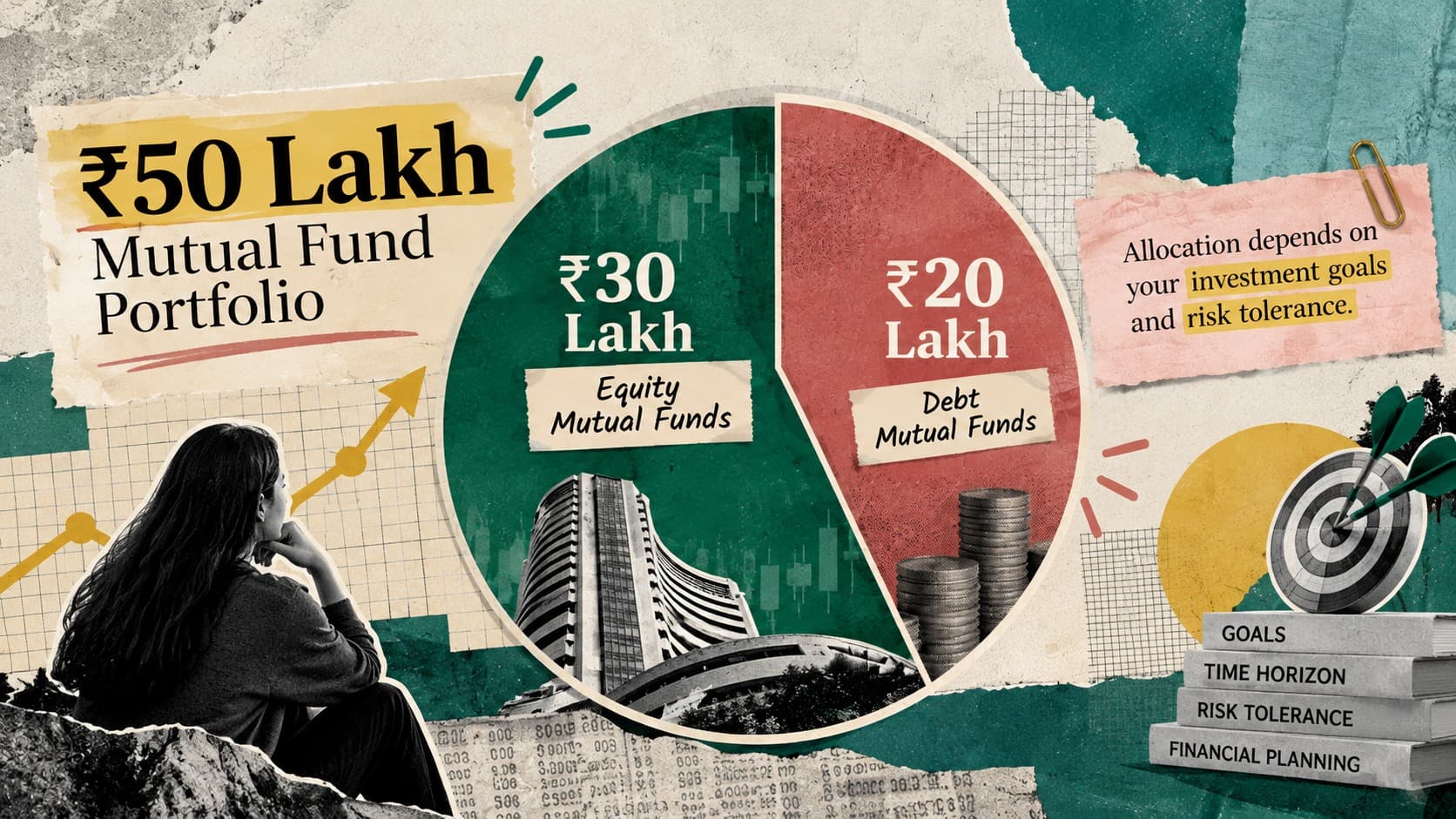
Consider an illustrative portfolio of ₹50 lakh divided as follows:
Investment category | Allocation | Amount |
|---|---|---|
Equity mutual funds | 60% | ₹30,00,000 |
Debt mutual funds | 40% | ₹20,00,000 |
Total | 100% | ₹50,00,000 |
This example demonstrates how a portfolio can be divided between equity and debt. It is not a recommendation that every investor should follow a 60:40 allocation.
An investor with a long investment horizon and a high capacity to tolerate losses may consider a different allocation from someone approaching an important financial goal.
Similarly, an investor who cannot afford a significant temporary decline may need to be more cautious about the proportion allocated to market-linked investments.
The key is to choose an allocation for a reason.
Do not select 60% equity simply because it appears balanced, or 40% debt because it sounds conservative. Understand what each component is expected to contribute to your overall financial plan.
Also remember that diversification does not eliminate investment risk. It helps spread exposure, but the value of mutual fund investments can still fall.
4. How Many Mutual Funds Should You Own?
A common beginner’s mistake is assuming that more mutual funds automatically create a better-diversified portfolio.
An investor might start with one equity fund, add another after reading a positive review, choose a third because it has delivered impressive returns and eventually invest in several schemes with similar underlying holdings.
The result may look diversified on paper without providing much additional diversification in practice.
For instance, owning four equity mutual funds does not necessarily mean your money is spread across four independent investment strategies. If the funds hold many of the same companies, their performance may be influenced by similar market movements.
Instead of asking, “How many funds should I buy?”, ask:
Does each fund have a clear role in my portfolio?
Do the schemes invest in substantially different areas of the market?
Am I duplicating exposure that I already have?
Can I understand and monitor the investments I own?
Does each scheme support my financial objective?
There is no universal number of mutual funds that works for every investor. A well-constructed portfolio should be understandable, manageable and aligned with its purpose.
Start with clarity rather than collecting schemes.
5. How to Compare Mutual Funds Before Investing
Once you have identified the categories that suit your needs, you can begin comparing individual schemes.
This is where beginners often focus too heavily on returns. A fund that has performed exceptionally well over the past year may appear attractive, but recent performance alone does not establish whether it is appropriate for your portfolio.
A more useful comparison considers several factors.
Investment objective and category
Begin by understanding what the scheme aims to achieve.
Compare funds within an appropriate category rather than comparing schemes that follow entirely different strategies. An equity fund and a debt fund have different objectives, risks and return characteristics.
Risk level
Read the scheme’s Riskometer and understand what its risk classification means for you.
SEBI’s Riskometer is designed to help investors understand the risk level associated with a mutual fund scheme. However, a risk label should be considered alongside the scheme’s investment strategy, holdings and your own financial circumstances.
A fund’s risk level is not a promise about how much it can lose.
Historical performance
Look at performance over multiple periods rather than relying exclusively on the latest return figure.
For relevant comparisons, consider how the fund has performed against its benchmark and other schemes in the same category. Understand that market conditions differ across periods, and historical returns do not guarantee future performance.
A fund that performed well during a rising market may behave differently during a downturn.
Expense ratio
The expense ratio represents the annual expenses charged by a mutual fund scheme as a proportion of its assets.
Costs matter because they affect the returns available to investors. However, the lowest expense ratio should not be the only deciding factor. The fund’s category, strategy, risk and suitability also deserve attention.
Portfolio holdings and exit load
Review the scheme’s portfolio to understand where the money is invested and whether the holdings match its stated strategy.
Also check the exit load, if applicable, before investing. This charge may apply when units are redeemed within a specified period.
Finally, read the scheme’s current documents rather than relying entirely on summaries, social media posts or online rankings.
If you already own several schemes, Kuberzo’s Portfolio Review tool can help you approach your portfolio more systematically.
6. Should You Invest Through SIPs or a Lump Sum?
The answer depends on how you receive your money, your existing savings and the way you want to invest.
A Systematic Investment Plan (SIP) allows you to invest a fixed amount at regular intervals, usually monthly. It can be useful for salaried individuals who want to invest part of their income consistently.
For example, someone who starts earning ₹40,000 a month might decide to invest a manageable portion of their salary through an SIP. As their income increases, they can review whether they can afford to increase their contributions.
SIPs also help investors develop a regular investment habit. However, they do not guarantee profits or protect investments from market losses.
A lump-sum investment involves investing a larger amount at once. This may be relevant for someone who already has money available for investment after accounting for emergency savings, near-term expenses and other financial commitments.
Neither approach is automatically superior in every situation. What matters is the suitability of the investment, the timing of the financial goal and the investor’s ability to remain invested.
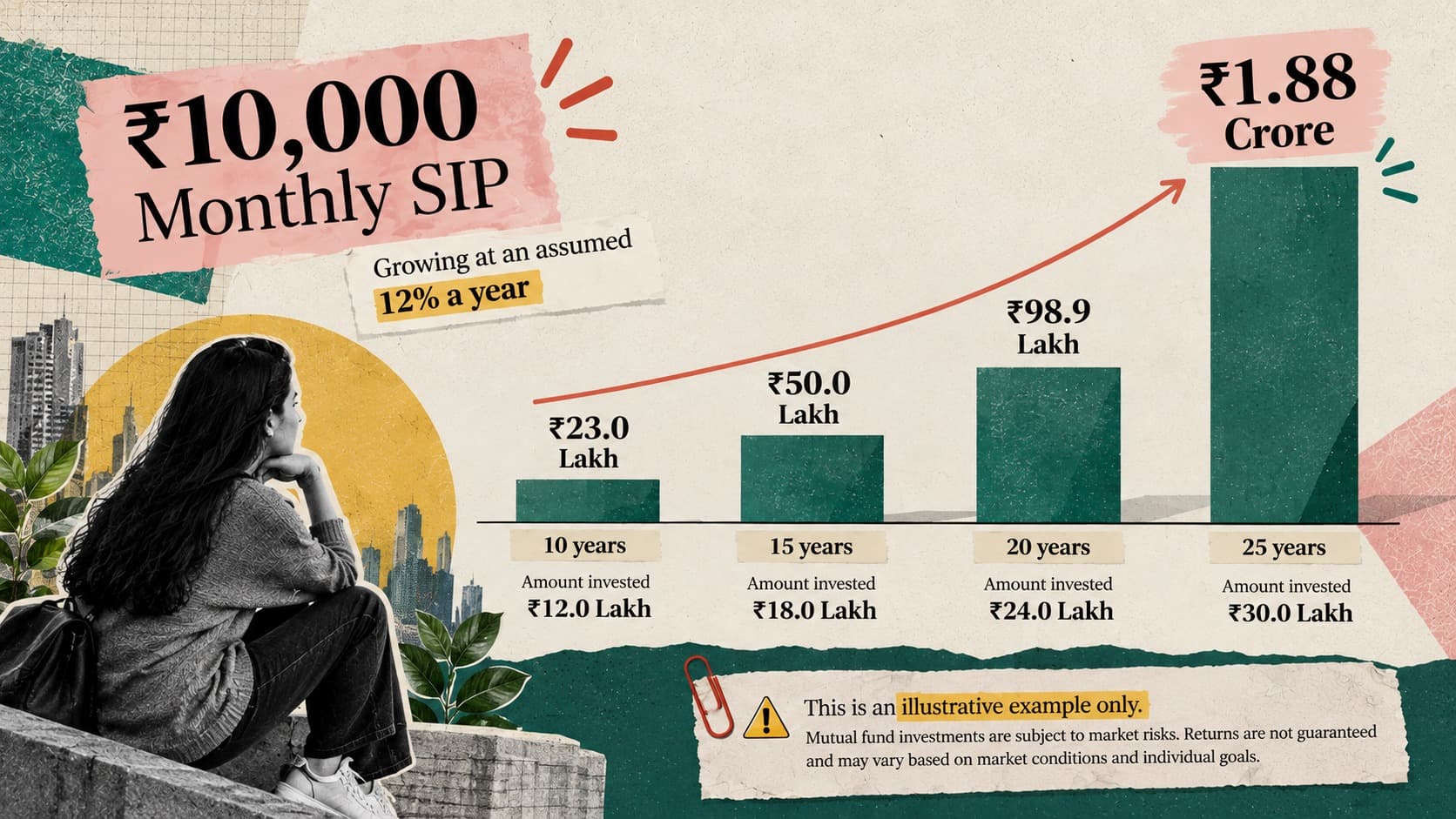
If you are considering regular monthly contributions, use Kuberzo’s SIP Calculator to estimate how different investment amounts and time horizons could affect your potential corpus.
Remember that calculator results are illustrations based on assumptions. Actual mutual fund returns will vary.
7. What Are the Biggest Risks First-Time Investors Should Understand?
Building a substantial portfolio requires more than selecting funds. It also requires understanding what could go wrong and preparing for it.
Market risk: Equity and debt investments can decline in value. A portfolio may be worth less than the amount invested, particularly over shorter periods.
Concentration risk: Investing too heavily in a particular company, sector or investment theme can make the portfolio vulnerable if that area underperforms.
Behavioural risk: Investors sometimes buy after strong market rallies and sell during downturns because of fear. Such decisions can interfere with a long-term investment plan.
Goal-timing risk: A market decline just before you need the money can be especially disruptive. Investors should review their allocation as important financial goals approach.
Return uncertainty: No mutual fund can guarantee that you will achieve a specific corpus by a particular date. Even reasonable-looking return assumptions may differ considerably from actual outcomes.
These risks are reasons to plan carefully, not reasons to avoid investing altogether.
Before investing, maintain appropriate emergency savings, account for essential expenses and avoid committing money that you may need immediately. Review your own capacity for loss rather than assuming that your age alone determines how much risk you should take.
8. Review Your Portfolio Without Reacting to Every Market Move
After investing, it can be tempting to check your portfolio every day. A market rally may make you feel confident, while a decline may leave you wondering whether you chose the wrong funds.
But a change in portfolio value does not automatically mean your investment strategy needs to change.
Instead, review your portfolio periodically and whenever your financial circumstances change significantly.
Ask yourself whether your original goal is still relevant, whether your investment horizon has changed and whether your allocation remains appropriate.
For example, if your equity allocation has increased substantially following a market rally, you may need to assess whether the portfolio still reflects your intended risk level. Rebalancing, where appropriate, can help bring the portfolio back towards its planned allocation.
Likewise, a change in income, family responsibilities or the timing of a financial goal may justify revisiting your investment plan.
Avoid switching funds simply because another scheme has recently delivered higher returns. Frequent changes can create unnecessary costs and encourage decisions driven by short-term market movements.
A good portfolio is not one that never fluctuates. It is one that has been built with a clear purpose and is reviewed with discipline.
Key Takeaway
Building a ₹50 lakh mutual fund portfolio begins long before you select your first scheme. It starts with understanding what you want your money to achieve, deciding how much you can invest and choosing an approach that reflects your financial circumstances.
For a first-time investor, the most useful steps are often the simplest: establish a clear goal, learn the differences between mutual fund categories, compare schemes carefully, diversify sensibly and invest with a realistic understanding of risk.
You do not need to predict which fund will perform best next year. You need to make informed decisions with the information available to you, review those decisions as your life changes and avoid allowing short-term market movements to dictate your entire strategy.
A ₹50 lakh portfolio is a financial target, not a promise of future wealth. Treating it as a long-term planning exercise rather than a race to find the highest-returning fund can help you build a more thoughtful relationship with investing.
Disclaimer: This article is for educational and informational purposes only and should not be considered personalised investment advice. Mutual fund investments are subject to market risks. Read all scheme-related documents carefully before investing. Returns are not guaranteed, and past performance does not assure future results. Choose investments based on your financial goals, investment horizon and risk tolerance.
Frequently Asked Questions
1. How can a beginner start a mutual fund investment?
Start by defining your financial goal, investment horizon and capacity to take risk. Learn about equity, debt and hybrid mutual funds, compare schemes within relevant categories and read their current documents before investing. Begin only after accounting for essential expenses and emergency savings.
Is ₹50 lakh a realistic mutual fund portfolio goal?
It can be a reasonable financial target, but its feasibility depends on your starting amount, regular contributions, investment horizon and actual returns. There is no guaranteed route to accumulating ₹50 lakh through mutual funds.
Which mutual fund is best for building wealth?
There is no single best mutual fund for every investor. Suitability depends on the investment objective, risk level, time horizon, portfolio allocation and other personal circumstances. Past performance alone is not a reliable basis for choosing a scheme.
Are equity mutual funds riskier than debt mutual funds?
Equity funds generally carry substantial market risk because they invest in shares. Debt funds face risks such as interest-rate changes and credit events. The level of risk varies across schemes, so investors should examine the specific fund rather than relying only on its broad category.
Should I invest in multiple mutual funds?
Multiple funds may be useful when they serve distinct purposes, but owning more schemes does not automatically improve diversification. Check for overlapping holdings and ensure that every fund has a clear role in your portfolio.
Do mutual fund returns remain consistent every year?
No. Returns fluctuate with market conditions and the performance of the underlying investments. A fund that performs well in one period may deliver lower or negative returns in another. Historical performance does not guarantee future results.
Can SIPs guarantee that I will reach ₹50 lakh?
No. An SIP helps you invest regularly, but it does not guarantee a particular corpus. The final value depends on your contributions, investment duration and actual returns, which can be higher or lower than expected.
How often should I review my mutual fund portfolio?
Review it periodically and whenever your financial goals, income or investment horizon change significantly. Focus on asset allocation, risk, diversification and suitability rather than reacting to every short-term market movement.