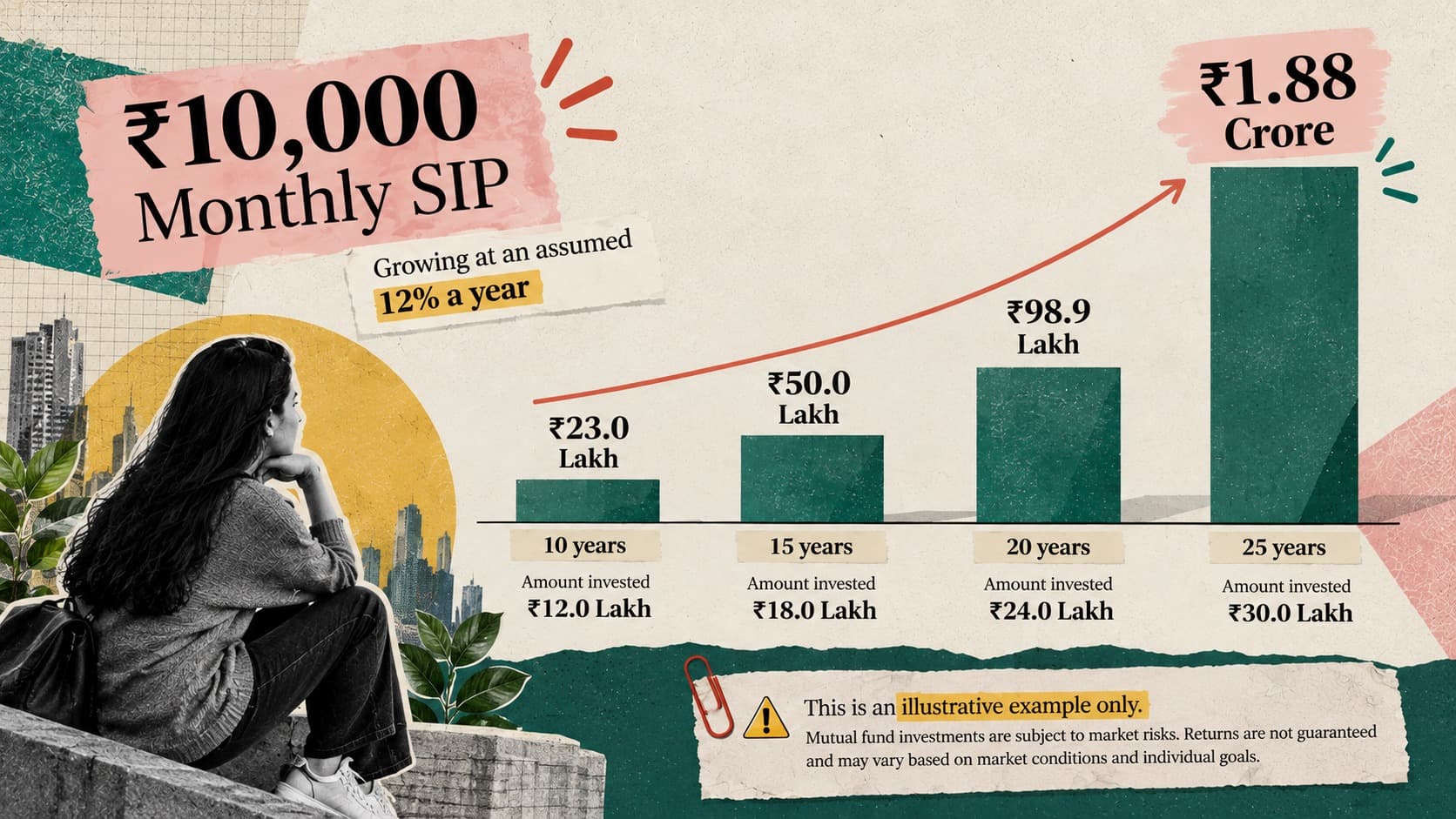
Transitioning from SIP to SWP: Creating Monthly Income from Your Goals
By Saahil Madhogaria
About the Author
Saahil Madhogaria is an MBA student at SOIL Institute of Management with a background in Game Art & Animation and experience as a 3D Artist. He writes about marketing, business, personal finance, careers, and MBA life.
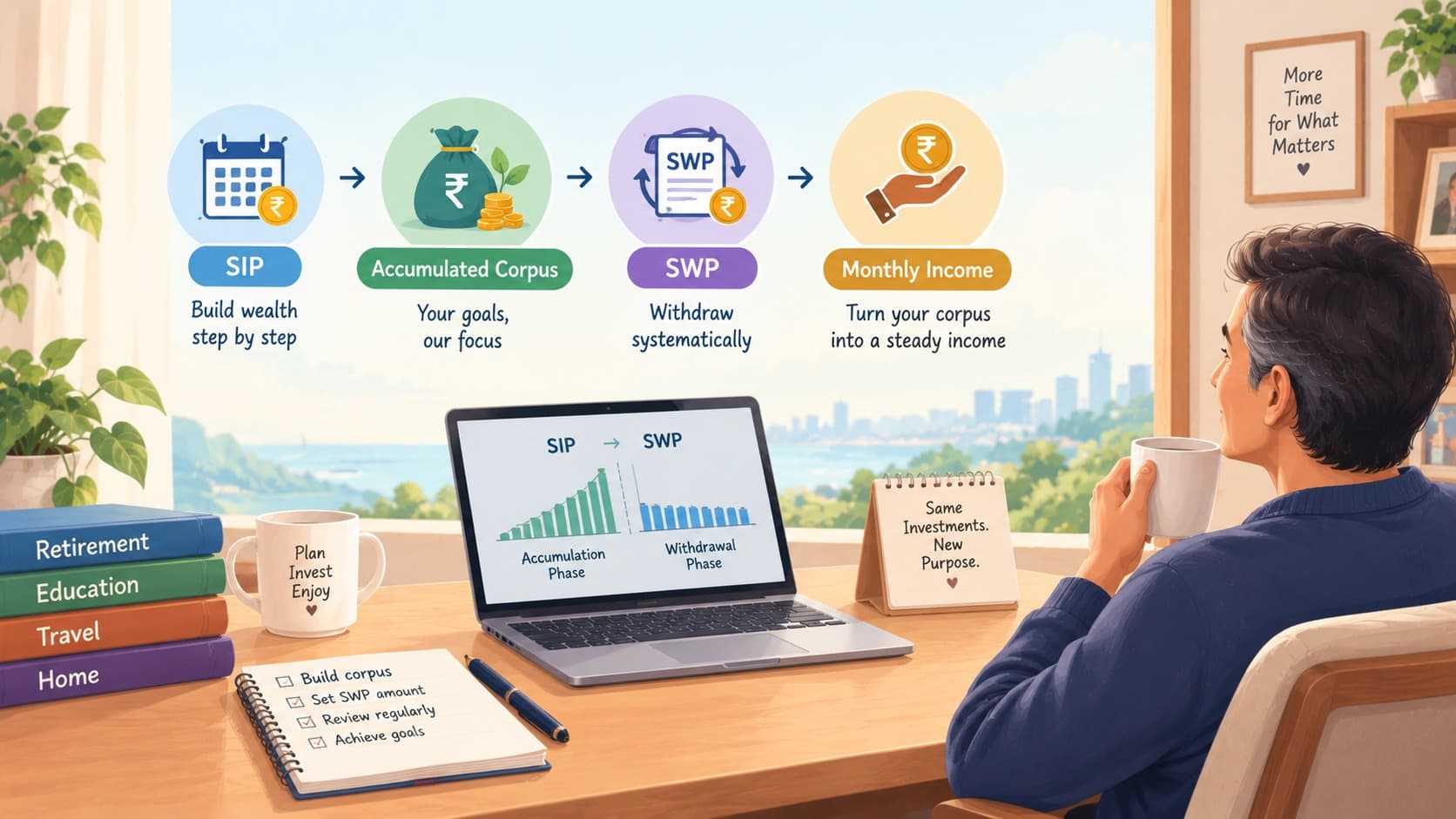
Learn how to transition from SIP to SWP, generate monthly income from your mutual fund corpus, and plan withdrawals for retirement or matured financial goals.
Transitioning from SIP to SWP: Creating Monthly Income from Your Goals
A systematic investment plan (SIP) helps investors build wealth gradually by investing regularly in mutual funds. But what happens when you reach your financial goal? You may need to pay for your child's education, fund your retirement, or generate regular cash flow from the corpus you have accumulated.
This is where a systematic withdrawal plan (SWP) can become useful. While an SIP helps you invest money over time, an SWP allows you to withdraw a specified amount from your mutual fund investment at regular intervals.
A well-planned SIP to SWP strategy can help you move from wealth accumulation to planned withdrawals. However, it is important to understand that an SWP does not guarantee monthly income or protect your capital. The sustainability of withdrawals depends on your corpus, investment returns, withdrawal amount, and market conditions.
1. What Is an SWP in Mutual Funds?
A systematic withdrawal plan allows you to redeem a specified amount from your mutual fund investment at regular intervals, such as monthly or quarterly, subject to the scheme's terms.
For example, suppose you have accumulated ₹30 lakh towards retirement. You could set up an SWP to withdraw ₹15,000 every month to supplement your pension or other income sources.
The mutual fund redeems units to meet each withdrawal. The number of units sold depends on the applicable net asset value (NAV).
An SWP is different from interest or a fixed deposit payout. The amount withdrawn may be predetermined, but it is not necessarily the return earned by your investment. Your withdrawal can include both investment gains and your original capital.
Therefore, a mutual fund monthly income plan through an SWP should be evaluated based on how long the corpus may last—not just the amount received each month.
2. When Should You Move from SIP to SWP?
The transition usually makes sense when your investment objective changes from accumulating wealth to using it.
Common situations include:
Retirement: You want to supplement pension income or other savings.
Education expenses: Your long-term investment has matured, and tuition fees are due periodically.
A financial milestone: You have accumulated money for a planned expense and want to withdraw it in stages.
Regular household expenses: You need to supplement other income sources after reaching a financial goal.
However, reaching a target amount does not automatically mean you should start withdrawing immediately. First, assess your expected expenses, emergency reserves, other income, and the amount that must remain invested.
For goals with fixed payment dates, keep the money required in the near term in suitable lower-volatility instruments rather than relying entirely on market-linked investments.
3. How to Convert SIP to SWP
You generally do not convert an SIP transaction directly into an SWP. Instead, you stop or modify future SIP instalments if required and register an SWP against eligible existing mutual fund units, following the fund house's process.
Here is a practical approach:
Step 1: Calculate your available corpus. Determine the amount accumulated and deduct money already earmarked for immediate expenses.
Step 2: Estimate your monthly requirement. Include essential expenses, healthcare, household costs, and other expected payments. Account for inflation where relevant.
Step 3: Decide the withdrawal amount. Choose an amount that is reasonable relative to your corpus and other income. A larger withdrawal increases the risk of exhausting your money early.
Step 4: Review your investments. Check the fund's risk level, asset allocation, liquidity, and suitability for the withdrawal period.
Step 5: Register the SWP. Follow the mutual fund house or platform's instructions for the amount, frequency, start date, and bank account.
Step 6: Monitor the plan. Review withdrawals, portfolio value, and changing expenses periodically. Adjust the amount if your financial circumstances or market conditions change.
The key is to create a withdrawal plan before setting up the SWP, rather than choosing a monthly amount without understanding its long-term effect.
4. How Much Monthly Income Can Your Corpus Support?
Your sustainable withdrawal depends on several factors, including your initial corpus, investment performance, inflation, taxes, and how long you need the money to last.
Consider a simple illustration: a ₹30 lakh corpus with a monthly withdrawal of ₹15,000 would mean annual withdrawals of ₹1.8 lakh, equivalent to 6% of the initial corpus in the first year.
This is only a withdrawal calculation—not a recommended rate or a return forecast. If the portfolio earns less than expected, experiences market losses, or faces rising withdrawals, the corpus may decline faster than anticipated.
Avoid assuming that a mutual fund will consistently generate enough returns to cover every withdrawal. Market returns are uneven, and withdrawing during a downturn can force you to sell more units at lower prices.
Before deciding on an SWP, model different scenarios, including weaker returns, inflation, and a longer-than-expected retirement.
Kuberzo's SIP Calculator can help investors model different monthly contribution scenarios.
5. Choosing Investments for an SWP
The investment that suited your accumulation phase may not be appropriate for your withdrawal phase. A long investment horizon may allow you to tolerate market volatility, but regular withdrawals create a different set of needs.
Equity funds may provide long-term growth potential but can fall significantly during market downturns. Debt funds may experience interest rate, credit, and liquidity risks. Neither category guarantees income or capital protection.
Your choice should reflect your withdrawal horizon, risk tolerance, and need for stability. Some investors maintain a diversified portfolio and keep near-term expenses in relatively stable, liquid options, while investing the remainder according to their longer-term needs.
Do not select a fund solely because it has recently delivered strong returns or appears to support a particular withdrawal amount.
Kuberzo's guide to different types of mutual funds can help investors understand how equity, debt, hybrid and passive categories differ.
6. Taxes and Common SWP Mistakes
Each SWP instalment generally involves redeeming mutual fund units. Tax may apply to the capital gain component of the redemption, depending on the fund category, acquisition date, holding period, and applicable tax rules. The entire withdrawal is not automatically treated as taxable income in the same way as interest.
Check the current rules and consult a qualified tax professional when needed.
Common mistakes include withdrawing too much, ignoring inflation, keeping no emergency reserve, assuming returns are guaranteed, and failing to review the plan after a market decline.
A Kuberzo SWP income guide should emphasise that successful SIP corpus to SWP planning requires both a suitable investment strategy and disciplined withdrawal management.
Contact us for a more personalised guidance.
Conclusion
Moving from SIP to SWP is a shift from building wealth to using it. An SWP can provide a structured way to access mutual fund investments for retirement or other financial goals, but it does not guarantee monthly income or preserve your corpus.
Estimate your expenses, choose a sensible withdrawal amount, assess investment risks, understand tax implications, and review your plan regularly. A sustainable withdrawal strategy should support your needs while recognising that markets, inflation, and life expectancy can all affect how long your money lasts.
Frequently Asked Questions
Can I convert my SIP into an SWP?
You generally need to stop or adjust future SIP instalments, if appropriate, and register an SWP against eligible existing mutual fund units. The process depends on the fund house or platform.
Does an SWP guarantee monthly income?
No. An SWP provides scheduled withdrawals, but mutual fund returns and capital are not guaranteed. Withdrawals may reduce your invested corpus.
Is an SWP suitable for retirement?
It may help retirees organise withdrawals from their investments. Suitability depends on expenses, corpus size, other income, investment risks, and how long the money needs to last.
Is the entire SWP withdrawal taxable?
Not necessarily. Tax treatment generally depends on the capital gains arising from redeemed units and the applicable rules. Check the current tax treatment for your fund and investment dates.
How much should I withdraw through an SWP every month?
There is no universal amount or withdrawal rate that suits everyone. Consider your corpus, expected expenses, inflation, investment mix, and required income period before setting the withdrawal amount.