
SIP for College Students: How to Start Investing with ₹500 a Month
By Rajnish
About the Author
An MBA student with an interest in finance and wealth management, contributing insights on mutual funds, investment strategies, market trends, and financial planning to help readers make informed investment decisions.
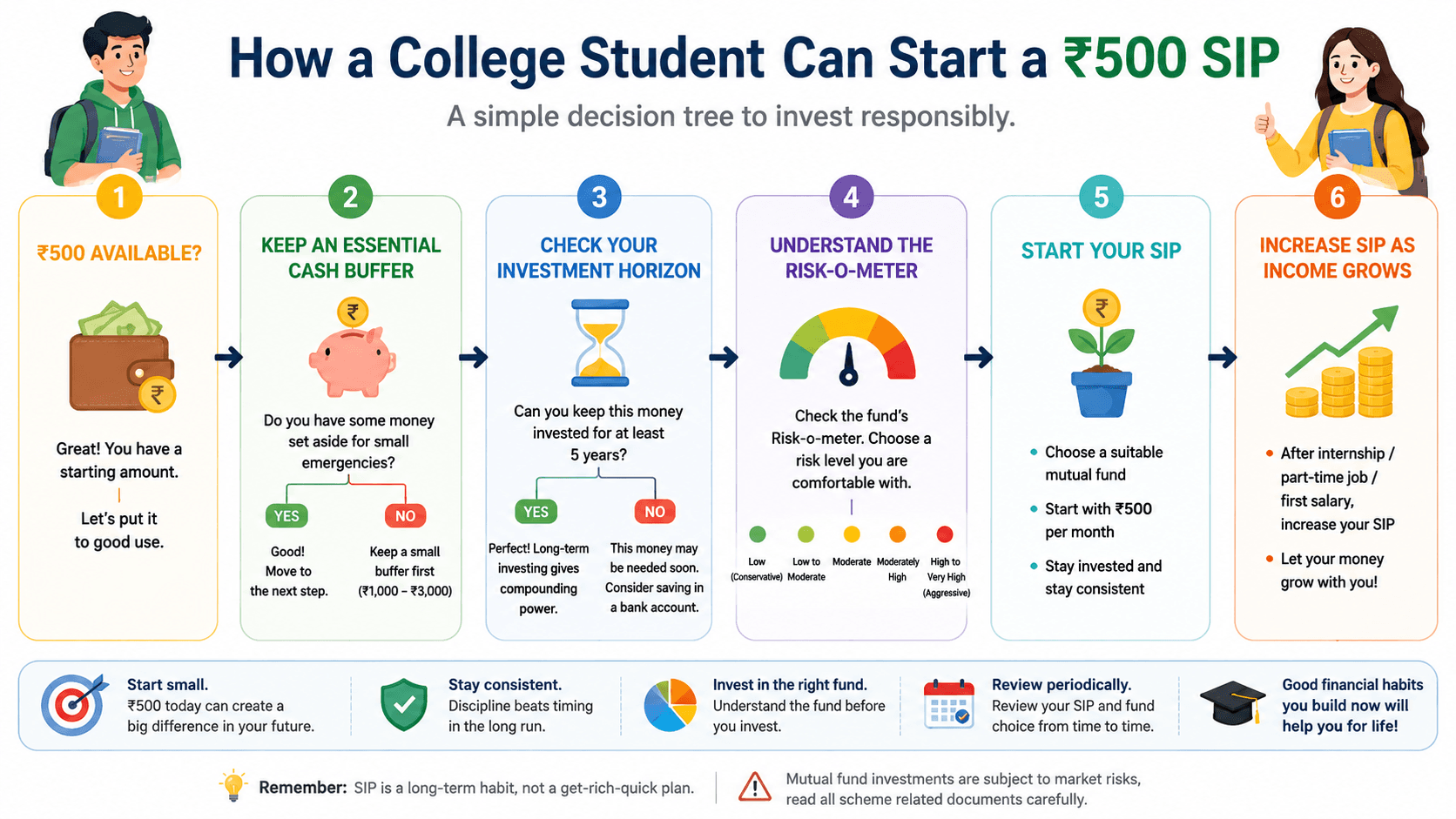
Learn how college students in India can start a SIP with ₹500 a month, understand risks, KYC, fund selection and SIP vs savings options.
SIP for College Students: How to Start Investing with ₹500 a Month
College is often the first time young Indians begin handling their own money. It may come from pocket money, a scholarship, internship, freelance work or a part-time job. A common question is: Can I start investing when I can only spare ₹500 a month?
Yes. A SIP can be started with a small amount, and AMFI states that SIP instalments can be as small as ₹500 per month, while certain Chhoti SIP facilities can go even lower. However, ₹500 should be treated as a starting amount, not as proof that every student should invest ₹500 immediately.
The more important question is whether the money is genuinely available for a long-term investment.
What is a SIP, and why does it make sense for a student?
A Systematic Investment Plan (SIP) is a method of investing a fixed amount into a mutual fund at regular intervals. It is not a separate type of mutual fund.
For example, with a ₹500 monthly SIP, ₹500 is invested according to the selected mutual fund scheme's rules every month.
The main benefit for a student is not the amount. It is the habit.
A small, regular investment can make investing part of your routine before your income increases substantially. SEBI's investor education material describes SIP as a way to invest a fixed amount regularly and highlights disciplined investing and long-term wealth creation.
However, a SIP does not make the underlying investment risk-free. Mutual fund values can rise and fall, and AMFI clearly states that mutual funds do not offer guaranteed returns.
Practical takeaway: A SIP is a disciplined way to invest; the risk depends largely on the mutual fund you choose.
Can a college student start a SIP with ₹500?
For many mutual fund schemes, yes. AMFI currently states that SIP investments can start from ₹500 a month. The exact minimum can differ by scheme, so the relevant scheme documents should always be checked before investing.
But affordability matters more than the advertised minimum.
Suppose a student receives ₹5,000 each month as pocket money and spends around ₹4,300 on transport, food, college expenses and other needs. Investing ₹500 may leave too little cash for an unexpected expense.
In that case, starting with ₹200–₹500 after building a small cash buffer may be more practical than automatically choosing the maximum amount available.
For students who are financially dependent on their parents, the objective should be learning disciplined investing without compromising essential expenses.
Do you need a salary to start investing?
No. A student does not necessarily need a conventional salary simply to invest.
The important issue is whether the investment amount is genuinely available and whether the investor meets the applicable onboarding and KYC requirements.
AMFI states that KYC is mandatory for mutual fund investments, including SIPs, irrespective of the amount invested.
For a student aged 18 or above, the normal investor/KYC process applies.
For a student below 18, mutual fund investments in the minor's name are handled through a guardian under SEBI's applicable process. Current SEBI material also specifies procedures for the account when the minor turns 18.
Where should a student invest the ₹500?
There is no universally best mutual fund for every student.
The choice should depend on:
Why am I investing?(Goal)
When will I need this money?(Time Horizon)
Can I handle the value falling temporarily? (Risk tolerance)
What does the scheme actually invest in? (Fund category)
How much risk does the scheme carry? (Risk-o-meter)
What is the scheme's expense ratio and are there applicable loads? (Costs)
SEBI uses a six-level Risk-o-meter ranging from Low to Very High to help investors understand the risk level of mutual fund schemes.
A student should not choose a fund simply because it showed a high return in the recent past. Past performance does not guarantee future performance.
Students exploring mutual fund categories can also read Kuberzo's beginner guide to different types of mutual funds to understand how equity, debt, hybrid and other categories differ.
What could ₹500 a month become?
An SIP becomes interesting when you consider time rather than just the monthly amount.
Illustrative example: Suppose a student invests ₹500 every month for 10 years. The total amount contributed would be ₹60,000.
If the investment happened to earn an average annualised return of 10% over that period, the illustration would produce a corpus of roughly ₹1 lakh.
That is only a mathematical illustration. Mutual fund returns are market-linked. Actual returns could be substantially lower or higher, and there is no assurance that a 10% return will be achieved. SEBI also cautions that investment calculators are illustrations and market returns cannot be predicted with certainty.
The lesson is not that ₹500 guarantees a particular future amount.
The lesson is that time and regular contributions matter.
You can use the Kuberzo SIP Calculator to compare different monthly amounts and investment periods without manually doing the calculations.
Should a student invest ₹500 or wait until they can invest ₹5,000?
Waiting for a larger amount is not automatically better.
A student who starts with ₹500 may develop the habit of budgeting, tracking investments and understanding market fluctuations. Later, when an internship or job increases income, the SIP can be increased.
At the same time, there is no rule saying every student must start immediately.
If a student has no money available for basic expenses, has expensive short-term debt or is struggling to meet college costs, investing should not take priority over those needs.
A better question is:
“How much can I invest regularly without needing to withdraw it for normal expenses?”
For one student that may be ₹500. For another it may be ₹1,000 or nothing at all for the moment.
What mistakes should college students avoid?
1. Choosing a fund only because it gave high returns recently
A recent return number tells you what happened, not what will happen next.
2. Investing money needed for fees
A SIP should not become a source of money for expenses that are due soon.
3. Chasing small-cap or thematic funds because they sound exciting
Being young does not automatically mean you can tolerate any level of risk. SEBI's Risk-o-meter exists precisely to make scheme risk easier to understand.
4. Assuming SIP means guaranteed returns
It does not. Mutual funds can lose value, particularly over shorter periods.
5. Ignoring costs
Mutual funds have operating expenses reflected through the scheme's Total Expense Ratio (TER), and the applicable expense information should be checked before investing.
6. Treating ₹500 as too small to matter
The amount may be small, but the financial habit can be valuable.
7. Investing without understanding what the fund owns
Before investing, look at the scheme objective, category, risk-o-meter, portfolio and other scheme documents.
What should a student do before starting a SIP?
A simple sequence can prevent many mistakes:
Step 1: Track monthly income or pocket money.
Step 2: Separate essential expenses from optional spending.
Step 3: Keep a small readily available cash buffer.
Step 4: Decide how much money can remain invested for the long term.
Step 5: Understand the mutual fund category and risk-o-meter.
Step 6: Complete KYC and other required formalities.
Step 7: Start with an amount that is comfortable and sustainable.
Step 8: Review the investment periodically instead of reacting to every market movement.
Students who want to understand their investing options can also explore Kuberzo's SIP planning page, which explains SIPs and goal-based investing. Kuberzo SIP Planning
What happens when the student's income increases?
The most useful time to revisit a SIP may be after an internship, scholarship increase, freelance income or first job.
For example, a student could start with ₹500 and later increase the monthly contribution after receiving a regular income.
The objective is not to make a large jump immediately. It is to make the contribution sustainable.
Students can also compare scenarios using a SIP calculator before increasing the amount.
Final answer: Is ₹500 a good starting SIP for a college student?
₹500 can be a sensible starting amount for a college student who has genuinely available money, understands that mutual funds are market-linked and can leave the investment untouched for an appropriate period.
But the correct decision is not simply “₹500 is available, so invest it”.
First protect money needed for essential expenses and near-term education costs. Then understand the mutual fund being selected, its risk level and costs. Start small enough that continuing the SIP does not create financial stress.
For young investors, the biggest advantage of beginning early is not a promise of a particular return. It is the opportunity to build good financial habits while the investment horizon is still long.
Important: Mutual fund investments are subject to market risks. Read all scheme-related documents carefully. Past performance does not guarantee future results. This article is for general educational purposes and is not personalised investment advice.
Frequently Asked Questions
1. Can college students start a SIP with ₹500?
Yes. AMFI states that SIP instalments can be as low as ₹500 per month, although minimum amounts vary across schemes and products.
2. Do I need a salary to start a SIP?
A salary is not the basic requirement. However, you must meet applicable KYC and onboarding requirements, and the investment should come from genuinely available money.
3. Is a SIP safe for students?
A SIP is a method of investing, not a guarantee of safety. The underlying mutual fund is market-linked and can lose value.
4. Which mutual fund is best for college students?
There is no universal best fund. Selection should depend on the student's goal, investment horizon, risk tolerance and scheme characteristics.
5. Can a student stop a SIP later?
SIP contributions are a recurring investment arrangement; stopping future instalments is different from redeeming existing investments. Any redemption should consider the goal, time horizon, applicable costs and taxes.