
How a 25-Year-Old Could Build ₹1 Crore by 40 Through SIP
By Divay Diya
About the Author
Divay Diya is a business and digital marketing enthusiast with expertise in market research, SEO, and strategic planning. She explores business growth, marketing, investing, and financial markets, translating research into actionable insights.
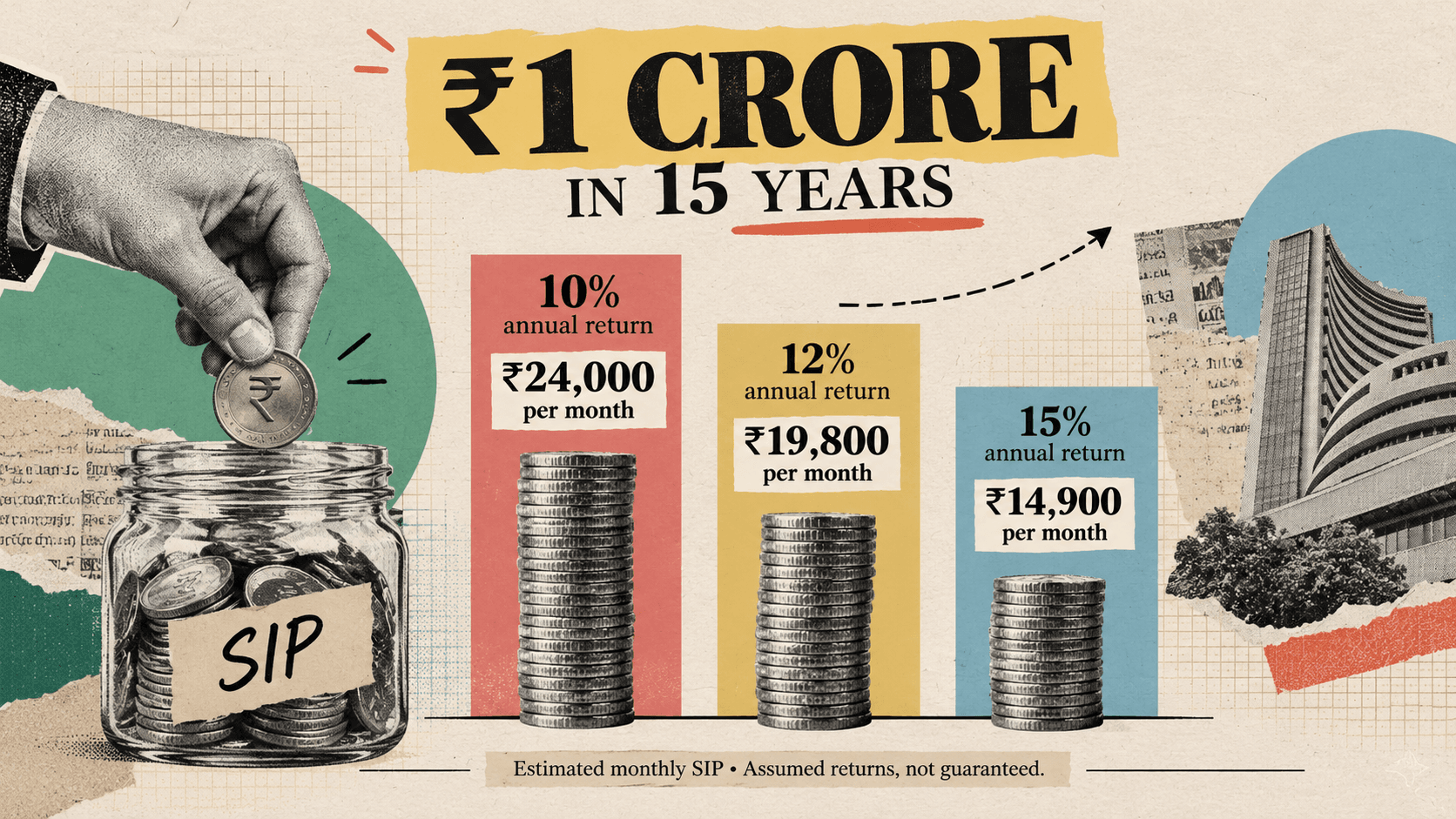
Discover how a 25-year-old could target a ₹1 crore investment corpus by age 40 through an SIP. Explore the monthly investment required under different return assumptions, how a Step-Up SIP works, and the risks young investors should consider when planning for long-term financial goals.
Imagine you are 25, have recently started earning and want to build a ₹1 crore investment corpus by the time you turn 40. You may not have a large amount to invest today, but you have something valuable: 15 years to work towards your goal.
The practical question is how much you need to invest every month to reach ₹1 crore.
A 1 crore SIP plan can help you estimate the monthly investment required, understand the role of compounding and create a long-term investment habit. However, the amount you need depends on the return your investments generate, and mutual fund returns are not guaranteed.
Let’s work through the numbers and explore how a young investor can approach this goal.
How Much SIP Is Required to Reach ₹1 Crore in 15 Years?
A 25-year-old has 15 years, or 180 months, to build a ₹1 crore corpus by age 40.
The following table estimates the monthly SIP required under three assumed annual return scenarios.
Assumed Annual Return | Approximate Monthly SIP | Total Amount Invested | Approximate Investment Gains |
|---|---|---|---|
10% | ₹24,100 | ₹43.38 lakh | ₹56.62 lakh |
12% | ₹20,000 | ₹36 lakh | ₹64 lakh |
15% | ₹15,000 | ₹27 lakh | ₹73 lakh |
Illustrative example. Calculations assume monthly investments at the end of each month, a constant monthly rate equivalent to the stated nominal annual rate divided by 12, and 180 monthly instalments. Figures are rounded. Actual mutual fund returns vary, and these calculations do not account for taxes, inflation or changes in investment value.
The table shows why the assumed return matters. A higher assumed return reduces the monthly amount required to reach the same target. However, it also involves uncertainty: you cannot know in advance which return your investments will deliver.
For planning purposes, avoid relying on the most optimistic scenario simply because it makes the monthly SIP look affordable.
Practical takeaway: Start by identifying an affordable monthly investment. Then test your goal against different return assumptions instead of treating one projected figure as certain.
How Does an SIP Help You Build a Long-Term Corpus?
A Systematic Investment Plan (SIP) is a method of investing a fixed amount in a mutual fund scheme at regular intervals. Instead of investing a large sum at once, you can invest smaller amounts monthly.
Two concepts explain why an SIP can be useful for a long-term goal.
Regular investing: Investing every month creates a routine. You do not need to wait until you have accumulated a large amount before starting.
Compounding: When investments generate returns and those returns remain invested, future growth can occur on both your original contributions and the gains already accumulated. The actual result depends on investment performance.
For example, suppose you invest ₹20,000 every month for 15 years. Your total contribution would be ₹36 lakh. If the investment grows enough to reach ₹1 crore, the difference between the corpus and your contributions would represent investment gains before applicable taxes and other considerations.
That outcome is possible only under the relevant return assumptions; it is not an assurance.
AMFI explains that SIPs support disciplined investing and rupee cost averaging. However, rupee cost averaging does not guarantee profits or protect investors from losses in a falling market.
You can estimate different monthly investment amounts and potential outcomes using Kuberzo’s SIP Calculator.
What If You Cannot Afford a ₹20,000 SIP at Age 25?
You do not necessarily need to begin with ₹20,000 a month. If you are a fresher or have recently started earning, your income may be limited, and your essential expenses may take up a substantial portion of it.
The important thing is to create a realistic starting plan.
Consider a hypothetical investor who begins with a ₹5,000 monthly SIP. Rather than assuming this amount will automatically grow into ₹1 crore, the investor can review the goal each year and increase contributions as income rises.
This is where a Step-Up SIP becomes useful.
A Step-Up SIP increases the investment amount periodically, often annually. For someone whose salary grows over time, this can help increase the total amount invested without requiring the full target contribution from the first month.
How Can a Step-Up SIP Help?
Illustrative example: A young professional starts investing ₹10,000 per month and increases the SIP by 10% every year.
Year 1: ₹10,000 per month
Year 2: ₹11,000 per month
Year 3: ₹12,100 per month
Year 4: ₹13,310 per month
The contribution increases as the investor’s income and capacity to invest potentially improve.
This example illustrates how the contribution changes, not the final corpus. Whether the investor reaches ₹1 crore will depend on the actual investment returns, the increases made, the timing of contributions and the investment period.
A Step-Up SIP is not automatically suitable for everyone. Someone with an unstable income, high-interest debt or limited savings may need to prioritise financial stability before committing to substantial annual increases.
Use Kuberzo’s Step-Up SIP Calculator to explore how different starting amounts and annual increases affect your projected corpus.
Which Mutual Fund Should You Choose for a 15-Year Goal?
There is no single mutual fund that is suitable for every 25-year-old. The right choice depends on your financial situation, risk tolerance, investment horizon and ability to handle market fluctuations.
For a long-term goal, an investor may consider different mutual fund categories, but each has a different risk and return profile.
Mutual Fund Category | What It Generally Invests In | What to Understand |
|---|---|---|
Equity mutual funds | Stocks and equity-related instruments | Market values can fluctuate substantially. |
Debt mutual funds | Fixed-income instruments | They can carry credit, interest-rate and liquidity risks. |
Hybrid mutual funds | A combination of asset classes, commonly equity and debt | Risk depends on the scheme’s allocation and strategy. |
These categories are not interchangeable. A debt fund is not automatically risk-free, and an equity fund is not guaranteed to deliver higher returns over your particular investment period.
Before investing, review the scheme’s investment objective, risk level, costs and other relevant documents. SEBI’s Riskometer helps investors understand the indicated risk level of a mutual fund scheme. It should be considered alongside the scheme’s characteristics and your own ability to bear losses.
The key is to select investments based on your goal and risk tolerance, not simply to choose whichever fund displays the highest past return.
What Risks Should You Consider Before Starting an SIP?
An SIP makes regular investing easier, but it does not remove investment risk.
Before committing to a 15-year plan, consider the following.
1. Returns can be lower than assumed.
If your investments earn less than the rate used in your calculation, the final corpus may fall short of ₹1 crore. You may need to increase your contributions, extend your timeline or revise the goal.
2. Markets can fall close to your target date.
Even after years of investing, your portfolio can lose value during a market downturn. If you need the money at a specific age, do not assume the value will remain stable just because the goal is approaching.
3. Your income and expenses may change.
Job changes, family responsibilities, education expenses and emergencies can affect your ability to continue investing. A plan should leave room for these realities.
4. Inflation reduces purchasing power.
₹1 crore after 15 years will not buy the same amount of goods and services as ₹1 crore today if prices rise. If your actual objective is to fund a future expense, estimate how much that expense may cost by the time you need the money.
5. Costs and taxes affect the amount you retain.
Investment costs and applicable taxes can affect your final proceeds. The illustrative calculations in this article do not account for them.
AMFI cautions that mutual fund schemes are not guaranteed-return products and that past performance does not guarantee future performance.
For this reason, a long-term investment plan should include periodic reviews rather than relying on a single calculation made at the beginning.
How Should You Keep Your ₹1 Crore SIP Plan on Track?
A useful plan is one you can maintain and adjust as your circumstances change.
Here are five practical steps to follow.
1. Set the goal clearly.
Decide whether ₹1 crore is the final amount you want to accumulate or simply a starting target. Consider the future cost of the expense you are planning for.
2. Check what you can afford.
Calculate your monthly income, essential expenses, existing debt and savings. Do not commit to a large SIP if doing so leaves you unable to manage necessary expenses or unexpected costs.
3. Choose an appropriate investment approach.
Compare mutual fund schemes based on their objectives, risks, costs and suitability for your goal. Do not choose solely on the basis of recent returns.
4. Review your contributions annually.
If your income rises, consider increasing your SIP. If your circumstances change, revisit the amount rather than allowing an unrealistic commitment to disrupt your finances.
5. Review your progress and risk.
Compare your actual portfolio value with your goal, but remember that short-term fluctuations do not necessarily indicate whether a 15-year plan will succeed. As the target approaches, consider how much market risk you can afford to take with money you will soon need.
Kuberzo’s Goal-Based Financial Planner can help you organise your investment goals, while its Investment Risk Analyzer can provide another input when assessing risk.
Neither tool can guarantee a particular investment outcome.
Is ₹1 Crore by 40 a Realistic Goal?
It can be a useful financial target, but whether it is realistic for you depends on your income, savings capacity, investment choices, investment horizon and the returns your portfolio actually earns.
A 25-year-old who can invest around ₹20,000 per month may be able to model a ₹1 crore target using a 12% assumed annual return. But that assumption is not a promise, and the outcome may differ significantly.
If ₹20,000 is beyond your current budget, you can start with a smaller amount and review the plan as your financial position changes. A Step-Up SIP may help you increase contributions over time, but it does not eliminate market risk or guarantee that the target will be reached.
The goal is not to find a calculator result that promises success. It is to build a plan based on realistic contributions, a suitable investment approach and regular reviews.
Mutual fund investments are subject to market risks. Read all scheme-related documents carefully before investing. The examples in this article are for educational purposes only and are not a guarantee of returns or personalised investment advice.
Key Takeaway
A 25-year-old has 15 years to work towards a ₹1 crore investment target by age 40. An illustrative calculation suggests that a monthly SIP of around ₹20,000 could reach that amount under a 12% assumed annual return, but actual returns are uncertain.
Start with an amount you can afford, consider increasing contributions as your income grows, choose investments according to your risk tolerance and review your plan regularly. Treat the ₹1 crore figure as a goal to plan for—not an outcome an SIP can guarantee.
Frequently Asked Questions
How Much SIP Is Required for ₹1 Crore in 15 Years?
Under an illustrative calculation assuming a 12% nominal annual return divided into monthly rates, an investment of approximately ₹20,000 per month for 180 months could grow to around ₹1 crore. Actual returns may be higher or lower, and the result is not guaranteed.
Can a ₹5,000 Monthly SIP Become ₹1 Crore?
It depends on the investment period and actual returns. A ₹5,000 monthly SIP should not be assumed to reach ₹1 crore in 15 years without a substantial change in contributions or unusually high returns. Use a calculator to test different assumptions, and treat the results as estimates rather than promises.
What Is a Step-Up SIP?
A Step-Up SIP is an investment plan in which the periodic contribution increases at predetermined intervals, often annually. It may suit investors who expect their income and ability to invest to grow over time
Is a 12% SIP Return Guaranteed?
No. Mutual fund returns are market-linked and can fluctuate. A 12% figure in a calculator is an assumption used to estimate a possible outcome, not a guaranteed rate of return.
Which Mutual Fund Is Best for a 15-Year Investment Goal?
There is no universally best mutual fund. The choice depends on your goal, risk tolerance, financial circumstances and the scheme’s investment objective, costs and risk profile. Review scheme documents before investing.
Should I Start an SIP If I Have Just Begun Earning?
You can consider starting with an affordable amount after accounting for essential expenses, existing debt and emergency savings. Avoid committing to an instalment that you cannot reasonably maintain.
What Happens If I Stop My SIP Before 15 Years?
Stopping future instalments reduces the amount you contribute and may affect your ability to reach the target. Your existing investment remains exposed to market movements unless redeemed, subject to the scheme’s terms. Recalculate your plan if your circumstances change.
Will ₹1 Crore Be Enough When I Turn 40?
That depends on what you intend to use the money for and how prices change over the next 15 years. Inflation can reduce the future purchasing power of ₹1 crore, so estimate your future expenses before deciding whether the target is sufficient.