
Understanding different types of Mutual funds
By Dwarika Verma
About the Author
Dwarika Verma has an academic background in Economics and an interest in personal finance and investing. She contributes to finance-related content, focusing on explaining financial concepts and investment topics in a simple and accessible way.
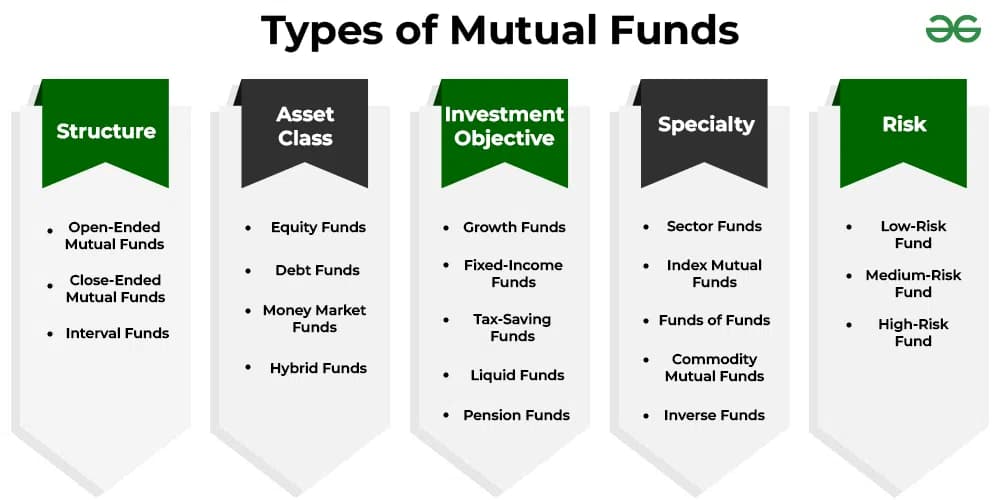
A mutual fund has different types , understanding the types before investing is important.
Investing can often seem confusing, especially for beginners who are just starting their financial journey. One of the most popular and accessible investment options today is mutual funds. They offer professional management, diversification, and flexibility, making them suitable for different types of investors. However, before investing, it is important to understand the various types of mutual funds available in the market.
What Are Mutual Funds?
A mutual fund is an investment vehicle that pools money from multiple investors and invests it in assets such as stocks, bonds, gold, or other securities. These funds are managed by professional fund managers who make investment decisions on behalf of investors.
Mutual funds are categorized based on where they invest and the investment objective they follow.
Types of Mutual Funds
1. Equity Mutual Funds: Equity funds primarily invest in shares of companies. These funds are ideal for investors looking for long-term wealth creation and are willing to take higher risks. Some common types of equity funds include: Large Cap Funds – Invest in well-established companies with stable growth. Mid Cap Funds – Invest in medium-sized companies with higher growth potential. Small Cap Funds – Invest in smaller companies that can generate high returns but carry higher risk. Sectoral Funds – Focus on a particular sector like banking, IT, or pharma. Equity funds are generally suitable for long-term goals such as retirement planning or wealth creation.
2. Debt Mutual Funds: Debt funds invest in fixed-income instruments like government securities, bonds, treasury bills, and corporate debt. These funds are considered relatively safer compared to equity funds. They are suitable for conservative investors seeking stable returns and lower volatility. Examples include: Liquid Funds Short-Term Debt Funds Corporate Bond Funds Gilt Funds Debt funds are often used for short- to medium-term financial goals and emergency fund management.
3. Hybrid Mutual Funds: Hybrid funds invest in a combination of equity and debt instruments. They aim to balance risk and return by offering growth potential along with stability. Popular categories include: Aggressive Hybrid Funds Balanced Advantage Funds Conservative Hybrid Funds These funds are ideal for investors who want moderate risk exposure.
4. Index Funds Index: funds are passive mutual funds that replicate a market index such as the Nifty 50 or Sensex. Since they simply track an index, they usually have lower expense ratios. They are suitable for investors who prefer simple, low-cost, and long-term investing strategies.
5. ELSS Funds: Equity Linked Savings Schemes (ELSS) are tax-saving mutual funds that provide deductions under Section 80C of the Income Tax Act. They come with a lock-in period of three years and primarily invest in equities. ELSS funds are suitable for investors looking to save taxes while creating wealth over time.
Choosing the right mutual fund depends on your financial goals, risk appetite, and investment horizon. Equity funds may help in long-term wealth creation, debt funds provide stability, while hybrid and index funds offer balanced investment opportunities. Before investing, it is always advisable to understand the fund’s objective, risk level, and past performance. A disciplined and goal-based approach can help investors make the most of mutual fund investments over the long term.
To read more about categories of mutual funds, Click here
Connect with Kuberzo team for more info!!
Frequently Asked Questions
1. What are the different types of mutual funds?
Mutual funds are broadly classified into equity funds, debt funds, hybrid funds, index funds, and ELSS (Equity Linked Savings Scheme) funds. Each type has different risk levels, investment objectives, and return potential, making them suitable for different financial goals.
2. Which type of mutual fund is best for beginners?
For beginners, index funds, hybrid funds, and large-cap equity funds are often good options because they offer diversification and are generally less volatile than sectoral or small-cap funds. The right choice depends on your financial goals and risk tolerance.
3. What is the difference between equity, debt, and hybrid mutual funds?
Equity mutual funds invest mainly in stocks for long-term growth, debt mutual funds invest in fixed-income securities for stability, and hybrid mutual funds combine both equity and debt to balance risk and returns.
4. How do I choose the right mutual fund?
Choose a mutual fund based on your financial goals, investment horizon, and risk appetite. Also consider factors such as the fund's investment objective, historical performance, expense ratio, and the experience of the fund manager before investing.
5. What is an ELSS mutual fund, and what are its benefits?
An Equity Linked Savings Scheme (ELSS) is a tax-saving mutual fund that primarily invests in equities. It offers tax deductions under Section 80C of the Income Tax Act and has a mandatory three-year lock-in period, making it suitable for long-term wealth creation and tax planning.
6. Are mutual funds safe for long-term investing?
Mutual funds are subject to market risks, but they can be an effective long-term investment option when chosen according to your financial goals. Diversification, professional fund management, and regular investing through SIPs can help manage risk over time.
7. Should I invest in mutual funds through SIP or a lump sum?
Both options have their advantages. SIPs are ideal for regular investing, reducing the impact of market volatility through rupee cost averaging, while lump-sum investments may be suitable when you have a large amount to invest and favorable market conditions. The choice depends on your financial situation and investment strategy.