Target Maturity Funds vs Traditional Debt Funds: Navigating Interest Rate Cycles
By Amrita Sinha
About the Author
Amrita Sinha is a content strategist with experience in SEO, digital marketing, and financial content. She writes easy-to-understand, research-backed articles on investing, personal finance, taxation, and wealth management for Kuberzo.
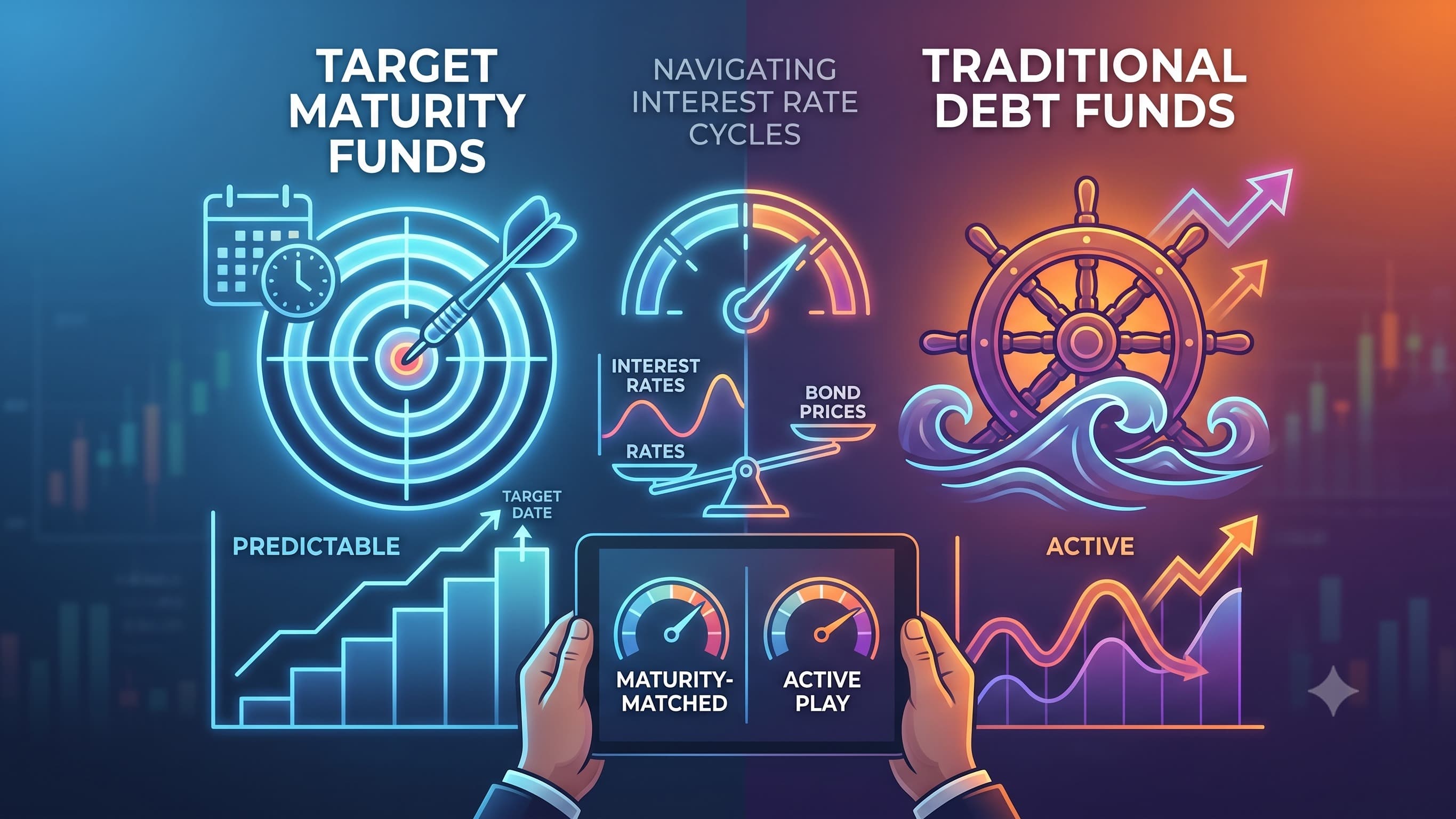
Compare target maturity funds vs debt funds on interest-rate risk, duration, credit quality, returns, taxation and maturity to understand which may suit you.
Debt mutual funds are often considered by investors looking for relatively stable fixed-income exposure without directly buying individual bonds. But within the debt-fund category, different strategies can behave very differently when interest rates change. This becomes particularly important when comparing target maturity funds vs debt funds.
A Target Maturity Fund (TMF) is a type of passive debt fund designed to track a specified bond index and hold securities with maturities broadly aligned to a defined target year. The portfolio typically follows the underlying index rather than relying on a fund manager to actively move between securities based on interest-rate forecasts. SEBI's framework for target maturity debt passive funds also standardises eligible indices and currently limits the target maturity of such schemes to 15 years.
Traditional debt funds, by comparison, can follow different strategies depending on their category. Some focus on short-term securities, some invest across maturities, while dynamic bond funds can actively change portfolio duration based on the fund manager's interest-rate outlook. AMFI notes that dynamic bond funds may increase or decrease the tenor of their portfolios depending on expectations about interest rates.
This distinction matters because interest rates and bond prices generally move in opposite directions. When market interest rates rise, prices of existing fixed-income securities tend to fall. When rates decline, their prices generally rise. The impact is usually greater for portfolios with longer duration.
For investors, therefore, the choice is not simply between a "passive" and an "active" debt fund. It is about deciding how much interest-rate risk, credit risk, maturity uncertainty and portfolio-management flexibility they are comfortable with.
The comparison also raises an important question: Does a target maturity fund behave like a fixed deposit or a Fixed Maturity Plan (FMP)? Not exactly. While the defined maturity profile can make a TMF more predictable than an open-ended debt strategy in some respects, it remains a market-linked mutual fund and does not guarantee a particular return.
What Is A Target Maturity Fund?
A target maturity debt fund is a passive debt mutual fund that aims to replicate a specified bond index with a defined maturity date or target year.
The portfolio is generally constructed around securities included in the underlying index, and the scheme's duration is expected to move closer to the target maturity as time passes. SEBI's framework requires target maturity schemes to follow standardised eligible indices and sets a maximum target maturity of 15 years.
The key idea is therefore relatively simple:
You know the broad maturity profile of the portfolio in advance, rather than relying on a fund manager to continuously change duration.
This can make TMFs useful for investors who have a defined investment horizon and want their debt allocation aligned with a particular period.
However, "target maturity" does not mean the investor is guaranteed to receive a predetermined amount at the target date.
Target Maturity Funds vs Debt Funds: What Is the Difference?
The biggest difference between target maturity funds and debt funds is their investment approach and maturity structure.
Feature | Target Maturity Fund | Traditional Debt Fund |
Management Style | Passive | Can be active or category-driven |
Portfolio | Tracks a specified bond index | Depends on fund category |
Maturity | Defined target maturity | Can vary |
Duration | Generally declines as maturity approaches | Depends on strategy |
Interest-rate strategy | Less dependent on manager forecasts | May actively respond to rate cycles |
Credit exposure | Determined largely by index | Depends on scheme |
Predictability of maturity profile | Relatively higher | Depends on fund |
Market Risk | Present | Present |
Traditional debt funds can include categories such as short-duration, corporate bond, banking and PSU debt, gilt and dynamic bond funds. Their risk and return characteristics can therefore vary significantly.
How Does Interest Rate Risk Affect Target Maturity Funds?
Interest rate risk in target maturity funds is one of the most important concepts investors should understand.
Bond prices generally fall when market interest rates rise and increase when rates decline. The sensitivity depends partly on duration. A longer-duration portfolio is generally more sensitive to changes in interest rates.
For example, suppose a TMF holds bonds with relatively long maturities and market interest rates subsequently rise. The market value of those existing bonds can decline, which can affect the fund's NAV.
If the investor continues holding the fund as the portfolio approaches its target maturity, the impact of interim price movements can be different from that experienced by an investor who sells during the period of volatility.
This is why a TMF should not be treated as a bank FD with a fixed return.
What Happens To A TMF As It Approaches Maturity?
One of the distinguishing characteristics of a target maturity strategy is that the portfolio's residual maturity generally declines as the target date approaches.
This can help align the portfolio with an investor's planned time horizon.
However, the experience depends on the securities held, their prices, reinvestment conditions, credit events and the timing of the investor's purchase and redemption.
AMFI notes that debt securities are exposed to both credit risk and market risk, including price volatility arising from interest-rate movements and market liquidity.
Therefore, the target date should be viewed as a portfolio-design feature, not as a promise of capital protection or a guaranteed maturity value.
Target Maturity Fund Vs Bank FD: Are They Similar?
The target maturity fund vs bank FD comparison can be useful, but investors should understand that these are fundamentally different products.
A bank FD offers a predetermined interest rate according to its terms, while a TMF's NAV fluctuates with the market value of its underlying securities.
A bank deposit with an insured bank may also qualify for DICGC deposit insurance within the applicable limit and conditions. A mutual fund does not receive this type of deposit insurance.
A TMF, however, provides a market-linked portfolio of debt securities and may offer greater flexibility than locking money into a traditional deposit.
The key distinction is:
FD = deposit with a bank and predetermined contractual interest
TMF = mutual fund holding market-linked debt securities
Therefore, investors should not compare the quoted or indicative yield of a TMF directly with an FD interest rate as though they were guaranteed returns. Your choice should also fit into your broader investment planning, including when you expect to need the money.
Target Maturity Fund Vs Debt Fund Returns: What Should Investors Expect?
The target maturity fund vs debt fund returns comparison depends heavily on the interest-rate environment, portfolio duration, credit quality and the point at which the investor enters and exits.
An actively managed debt fund can potentially adjust its duration based on the fund manager's assessment of interest rates.
A TMF generally follows its index instead of making large discretionary duration calls.
This creates a trade-off:
TMF: Greater predictability of portfolio structure, less dependence on active interest-rate calls.
Active debt fund: Greater flexibility to respond to changing market conditions, but outcomes depend more on portfolio management.
Neither approach guarantees superior returns.
TMF Vs Fixed Maturity Plan: Are They The Same?
The TMF vs fixed maturity plan comparison is particularly relevant because both have a defined maturity concept.
An FMP is a closed-ended debt mutual fund designed to invest in securities whose maturity profile broadly matches the fund's tenure. AMFI notes that FMPs are closed-ended schemes and investors generally cannot prematurely redeem units from the fund; liquidity may instead depend on exchange trading.
A target maturity fund, by contrast, is generally structured as a passive index fund or ETF around a specified target maturity and can have different liquidity and redemption characteristics depending on the product.
Neither should be confused with a guaranteed deposit.
Target Maturity Fund Interest Rate Risk Vs Credit Risk
Investors often focus heavily on interest-rate risk and overlook credit risk.
A debt security carries the possibility that its issuer may fail to make principal or interest payments when due. AMFI identifies issuer credit risk as one of the key risks associated with debt securities.
The underlying index therefore matters.
Investors should examine:
Who issued the bonds?
What are their credit ratings?
What is the government or corporate exposure?
What is the maturity of the portfolio?
What is the duration?
Is the portfolio concentrated?
What is the tracking difference?
A passive structure does not eliminate credit risk. Reviewing your mutual fund portfolio can help you assess credit exposure, duration and how your debt investments fit with your other holdings.
Target Maturity Fund Taxation: What Should Investors Know?
Target maturity fund taxation depends on the applicable tax rules for mutual fund units and the investor's circumstances.
Importantly, debt-fund taxation has changed over time, so investors should not rely on older articles that discuss historical indexation benefits.
For investments made under the current tax regime, the classification and holding-period rules applicable to the specific mutual fund investment should be checked before investing. The Income Tax Department confirms that the Income-tax Act, 2025 applies to tax years beginning from 2026-27 onwards.
Because tax treatment can change and may depend on the nature and date of the investment, investors should verify the applicable rules at the time of investment or redemption.
Who May Consider A Target Maturity Fund?
A TMF may be worth considering for an investor who:
Has a defined investment horizon.
Wants passive exposure to a specified bond index.
Understands interest-rate risk.
Wants a more predictable maturity profile than many open-ended debt strategies.
Is comfortable with market-linked returns.
Can remain invested through periods of NAV volatility.
An actively managed debt fund may be more appropriate for investors who prefer a fund manager to actively manage duration and portfolio positioning.
Neither approach is inherently superior.
How Should Investors Choose Between TMF And A Debt Fund?
Before choosing between target maturity funds vs debt funds, consider five questions:
1. What is your investment horizon?
Your horizon should broadly align with the fund's duration and target maturity.
2. How much volatility can you tolerate?
Assessing your investment risk profile can help you understand how comfortable you are with potential fluctuations in your investment value. Longer-duration debt can experience greater NAV movements when interest rates change.
3. What is the credit quality?
Examine the underlying securities rather than assuming all debt funds have similar credit risk.
4. Do you want active management?
If yes, a suitable actively managed debt category may be worth considering.
5. Does the taxation work for your situation?
Check the current tax rules applicable to your investment before making a decision.
Conclusion
The target maturity fund vs debt fund decision is ultimately about how much structure and predictability an investor wants from their debt allocation.
A TMF offers a passive approach with a defined target maturity and index-based portfolio construction. Traditional debt funds can offer a wider range of strategies, including active duration management and different maturity and credit profiles.
Neither eliminates interest-rate or credit risk. A TMF's defined maturity should not be mistaken for a guaranteed return, and an actively managed debt fund's flexibility does not guarantee better performance.
For investors navigating interest-rate cycles, the more important question is not simply which fund can generate the highest return. It is whether the fund's duration, credit quality, maturity profile, taxation and risk level match the investor's time horizon and financial objective.
Disclaimer: This article is for general educational purposes only and does not constitute personalised investment, financial or tax advice. Debt mutual funds are subject to market, interest-rate, liquidity and credit risks. Returns are not guaranteed, and a target maturity fund does not provide the same guarantee or deposit protection as a bank fixed deposit. Tax rules can change, so investors should verify the applicable provisions before investing.
Frequently Asked Questions
What is a target maturity fund?
A target maturity fund is a passive debt mutual fund designed to track a specified bond index with securities that have maturities aligned to a defined target year. The portfolio's residual maturity generally decreases as the target date approaches.
Is a target maturity fund safer than a traditional debt fund?
Not necessarily. A TMF has a defined maturity structure, but it remains exposed to interest-rate, credit and liquidity risks. The risk of a traditional debt fund depends on its specific category, duration and portfolio.
Can a target maturity fund lose money?
Yes. Its NAV can fall because of changes in interest rates, credit events or market conditions. Longer-duration portfolios can be particularly sensitive to interest-rate movements.
Is a target maturity fund the same as a fixed deposit?
No. A bank FD provides a contractual interest rate, while a TMF is a market-linked mutual fund. A TMF does not provide the same deposit protection or guaranteed maturity value as a bank FD.