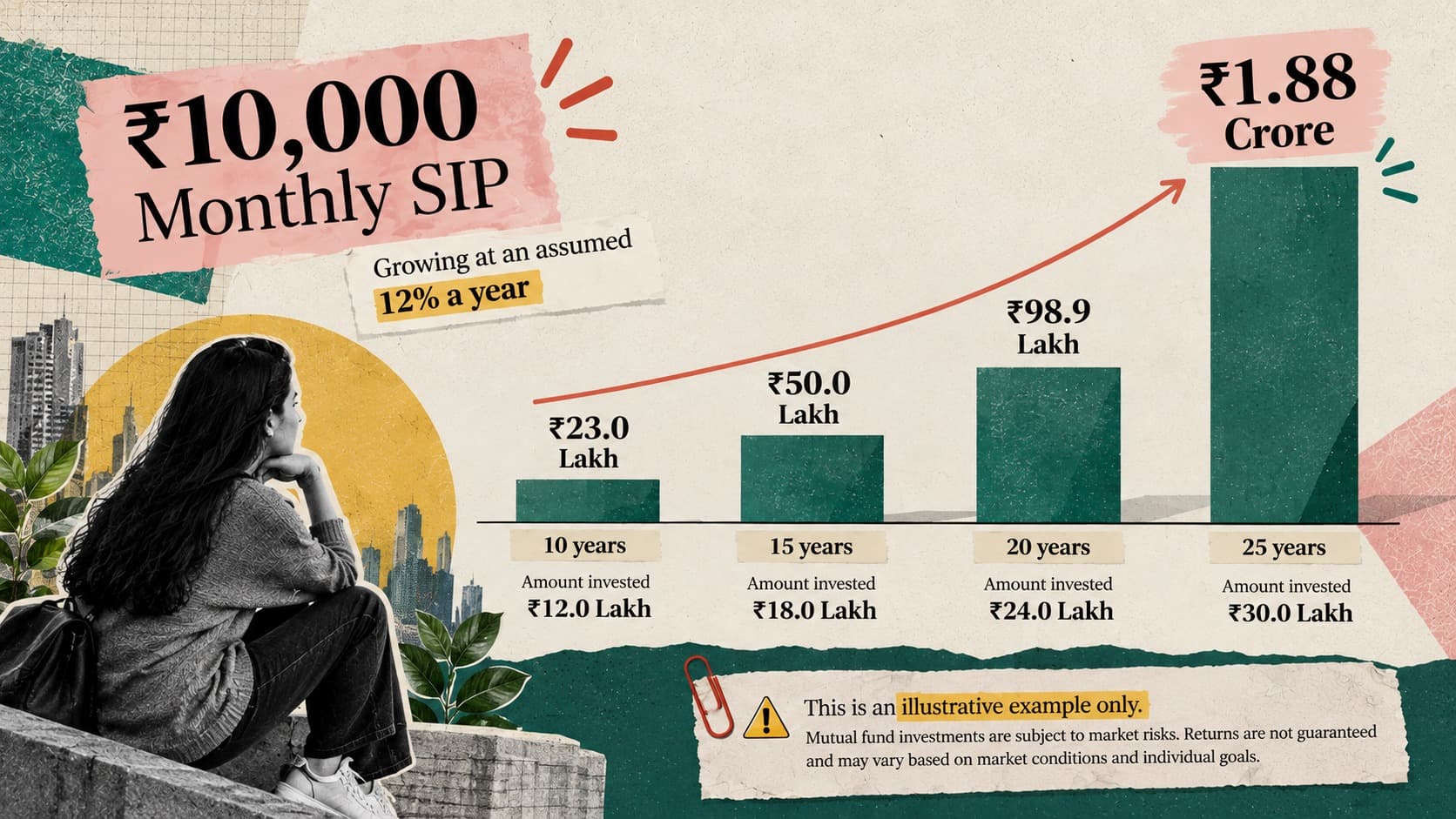
From ₹10,000 a Month to ₹1 Crore: How a Step-Up SIP Could Change the Journey
By Divay Diya
About the Author
Divay Diya is a business and digital marketing enthusiast with expertise in market research, SEO, and strategic planning. She explores business growth, marketing, investing, and financial markets, translating research into actionable insights.
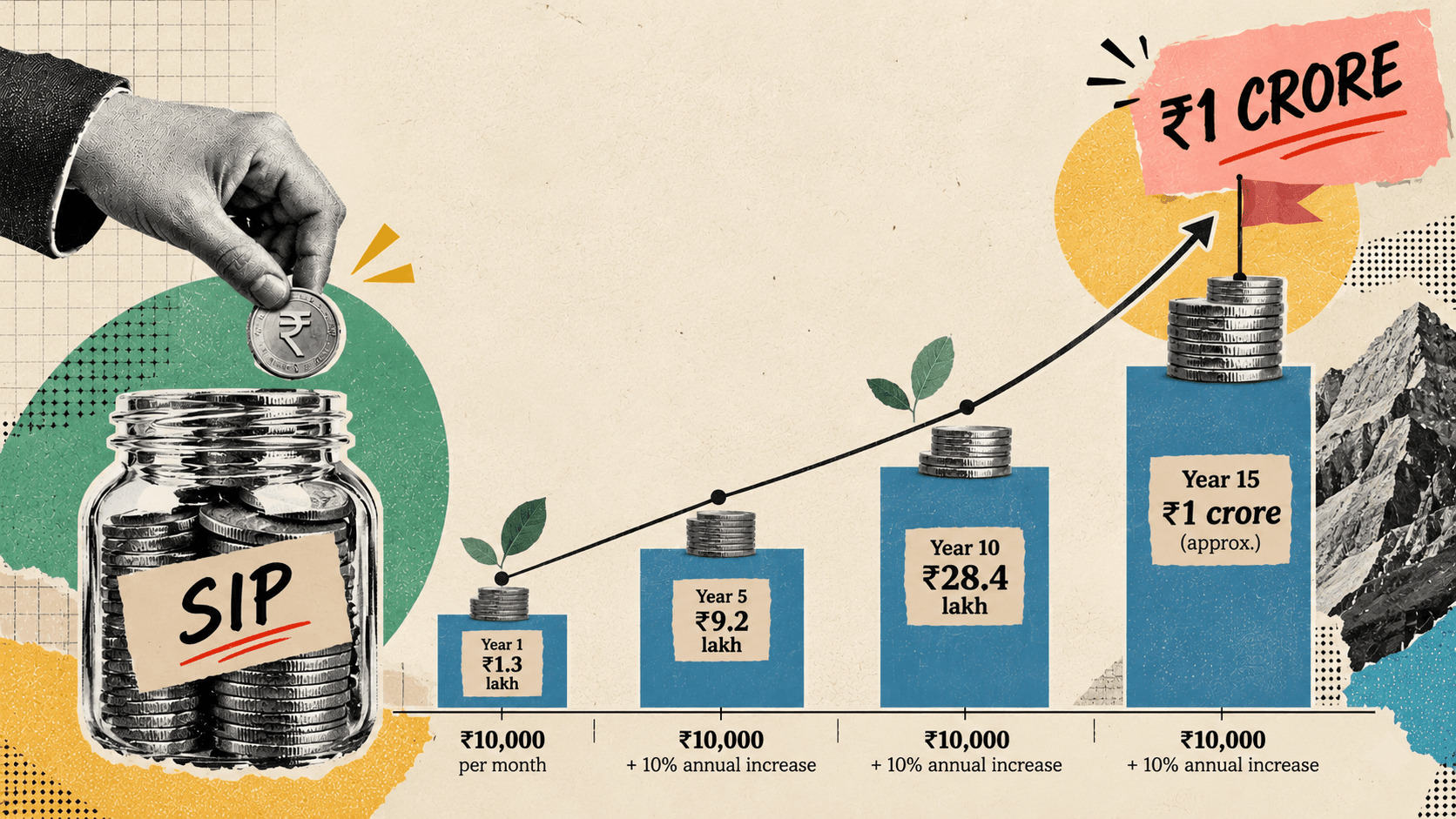
Starting with a ₹10,000 monthly SIP? See how increasing your contribution each year could change your investment journey. Compare illustrative Step-Up SIP scenarios, understand the role of compounding and learn why actual mutual fund returns may differ from projections.
Starting a mutual fund investment with ₹10,000 a month may seem modest compared with a financial goal of ₹1 crore. However, increasing your investment as your income grows could make a meaningful difference over time.
A Step-Up SIP allows you to increase your monthly investment periodically, usually by a fixed percentage or amount. Instead of investing ₹10,000 every month indefinitely, you could increase your contribution by 10% each year as your financial capacity improves.
For example, if you start with ₹10,000 per month and increase the contribution by 10% annually, your monthly SIP would rise to ₹11,000 in the second year and ₹12,100 in the third year.
Over a long investment period, these higher contributions can help build a larger corpus than a fixed SIP, assuming the same investment-return assumptions.
But reaching ₹1 crore is not automatic. Your final corpus depends on your contributions, investment duration and actual mutual fund returns.
1. What Is a Step-Up SIP?
A Step-Up SIP is a systematic investment plan in which you increase your regular investment at predetermined intervals.
In a regular SIP, you might invest ₹10,000 every month for 20 years. In a Step-Up SIP, you could start at ₹10,000 and increase that amount by 5%, 10% or another affordable percentage each year.
This approach can be useful if you expect your salary or business income to grow over time.
For instance, someone starting their career might initially be able to invest ₹10,000 per month. After receiving salary increments, they could gradually raise the SIP instead of allowing their investment contribution to remain unchanged.
The important point is that a Step-Up SIP increases the amount you invest; it does not guarantee a higher rate of return.
The final result still depends on the performance of the mutual fund scheme and the length of time the money remains invested.
2. How Could a ₹10,000 SIP Grow Over 10 or 20 Years?
A ₹10,000 monthly SIP can produce different outcomes depending on the investment period, assumed return and whether you increase your contribution.
Consider an illustrative comparison using a 10% assumed annual return.
The following figures assume monthly investments at the end of each month. In the Step-Up examples, the monthly contribution increases at the beginning of each investment year.
Investment Period | Fixed ₹10,000 SIP | SIP With 5% Annual Step-Up | SIP With 10% Annual Step-Up |
|---|---|---|---|
10 years | ₹20.48 lakh | ₹24.76 lakh | ₹30.21 lakh |
15 years | ₹41.45 lakh | ₹54.54 lakh | ₹73.76 lakh |
20 years | ₹75.94 lakh | ₹1.07 crore | ₹1.60 crore |
Illustrative example: All figures use a hypothetical 10% annual return, converted to a monthly rate of 10% ÷ 12. They are estimates, not predictions or guaranteed outcomes. Actual mutual fund returns fluctuate.
The comparison shows how increasing contributions can affect the estimated corpus.
With a fixed ₹10,000 SIP, the illustrative 20-year corpus is approximately ₹75.94 lakh. With a 5% annual step-up, it rises to approximately ₹1.07 crore under the same return assumption.
A 10% annual step-up produces a larger illustrative corpus because the investor contributes progressively more each year.
However, the investor also contributes more money. Therefore, the difference cannot be attributed entirely to investment returns.
3. How Does a 10% Annual Step-Up Change Your Monthly SIP?
Suppose you start with ₹10,000 per month and increase your SIP by 10% every year.
Your contribution would change as follows:
Investment Year | Monthly SIP |
|---|---|
Year 1 | ₹10,000 |
Year 2 | ₹11,000 |
Year 3 | ₹12,100 |
Year 4 | ₹13,310 |
Year 5 | ₹14,641 |
Year 6 | ₹16,105 |
Year 10 | Approximately ₹23,579 |
Year 15 | Approximately ₹37,975 |
Year 20 | Approximately ₹61,159 |
By the tenth year, the monthly contribution would be approximately ₹23,579. By the twentieth year, it would be approximately ₹61,159.
This is why you should consider affordability before choosing a step-up percentage. An increase that seems manageable in the first few years may become a substantial monthly commitment later.
A Step-Up SIP works best when the planned increases are consistent with your expected income growth and other financial responsibilities.
4. How Much Could You Accumulate With Different Step-Up Rates?
The annual increase you choose can substantially affect your total contributions and estimated corpus.
Consider the following illustrative comparison over 20 years, assuming a starting SIP of ₹10,000 per month and a hypothetical annual return of 10%.
Annual SIP Increase | Monthly SIP in Year 20 | Total Amount Invested | Estimated Final Corpus |
|---|---|---|---|
0% — Fixed SIP | ₹10,000 | ₹24 lakh | ₹75.94 lakh |
5% | Approximately ₹25,265 | ₹39.68 lakh | ₹1.07 crore |
10% | Approximately ₹61,159 | ₹68.73 lakh | ₹1.60 crore |
15% | Approximately ₹1.34 lakh | ₹1.23 crore | ₹2.51 crore |
Illustrative example: The final corpus is calculated using monthly compounding at an assumed annual rate of 10% divided by 12. The SIP increases once every 12 months. Figures are rounded.
The comparison highlights two important points.
First, even a 5% annual increase can materially change the result over a long investment period.
Second, a higher step-up rate requires considerably larger contributions. A 15% increase may produce a much larger projected corpus, but it also requires the investor to commit substantially more money over time.
The best step-up rate is not necessarily the highest one. It is the rate you can sustain without compromising essential expenses, emergency savings or other financial goals.
5. How Can a Step-Up SIP Calculator Help You Plan?
A Step-Up SIP Calculator estimates how your investment could grow when you increase your monthly contribution periodically.
It allows you to change the starting SIP, annual step-up percentage, investment duration and assumed rate of return.
You can use the Kuberzo Step-Up SIP Calculator to explore different investment scenarios.
For a useful comparison, enter the following details:
Starting monthly SIP: Begin with ₹10,000.
Annual step-up: Compare 5%, 10% and 15%.
Investment duration: Check 10-, 15- and 20-year scenarios.
Assumed annual return: Test different assumptions instead of relying on one optimistic estimate.
Investment objective: Decide whether your target is ₹50 lakh, ₹1 crore or another amount.
Review the projected corpus alongside the total amount invested. This helps you understand how much of the estimated result comes from your own contributions and how much represents projected investment gains.
A calculator is a planning aid, not a prediction of market performance. The SEBI Investor SIP Calculator also states that its calculations are illustrative and do not represent actual returns.
6. Is a Step-Up SIP Better Than a Regular SIP?
A Step-Up SIP may be more suitable for investors whose income is expected to rise over time. A regular SIP may be more practical for someone who wants to maintain a stable monthly contribution.
The two approaches differ mainly in how much you invest.
Factor | Regular SIP | Step-Up SIP |
|---|---|---|
Monthly contribution | Remains fixed | Increases periodically |
Planning | Easier when income is stable | Requires planning for future increases |
Total contributions | Usually lower if held constant | Higher when contributions increase |
Potential corpus | Depends on investment and returns | Can be higher due to larger contributions |
Main consideration | Maintaining a regular investment | Affording progressively larger contributions |
Neither approach guarantees better investment performance.
If both strategies invest in the same scheme under identical market conditions, the Step-Up SIP may accumulate a larger corpus because more money is invested over time. However, the actual difference will depend on when the additional contributions are made and how the investment performs.
The decision should be based on your financial circumstances rather than the assumption that a Step-Up SIP is always superior.
7. What If You Cannot Increase Your SIP Every Year?
You do not need to choose a high annual step-up simply because it produces a larger projected corpus.
If your income is irregular or your expenses are likely to rise, choose an investment amount you can maintain comfortably.
You could start with a smaller step-up, increase contributions when your income improves, or review your investment plan periodically.
If you cannot afford a planned increase in a particular year, reassess your budget rather than borrowing money or compromising essential expenses just to maintain the investment schedule.
You should also consider other financial priorities, including an emergency fund, insurance and outstanding high-cost debt.
If your investment goal is important, compare different combinations of monthly contributions and investment duration. A longer timeline may make your target more achievable without requiring an unaffordable monthly contribution.
You can also use the Kuberzo SIP Calculator to compare fixed monthly investment scenarios.
8. Can a Step-Up SIP Guarantee ₹1 Crore?
No. A Step-Up SIP cannot guarantee that you will accumulate ₹1 crore.
The SIP determines how much and how frequently you invest. It does not determine the returns generated by the underlying mutual fund.
Market movements, interest rates, economic conditions and the performance of the securities held by the scheme can all affect your investment value.
The Association of Mutual Funds in India explains that mutual fund schemes are not guaranteed or assured-return products and that past performance does not guarantee future performance. You can read its mutual fund risk information.
Before choosing a scheme, review its investment objective, portfolio, costs and Riskometer. SEBI explains how the Riskometer helps investors understand the risk level of a mutual fund scheme.
Avoid choosing a fund solely because its historical returns make your ₹1 crore target appear easier to achieve.
Instead, use conservative planning assumptions, understand the possibility of losses and review your progress periodically.
Final Takeaway
Starting with ₹10,000 per month does not automatically put ₹1 crore within reach, but increasing your SIP as your income grows can change the investment journey.
Under the illustrative assumptions used in this article, a ₹10,000 monthly SIP with a 5% annual step-up could grow to approximately ₹1.07 crore over 20 years, assuming a constant annual return of 10% converted to a monthly rate.
That outcome is a mathematical illustration, not a promise of investment performance.
Before starting, choose a realistic step-up percentage, understand the risks of your chosen mutual fund and check whether your contributions remain affordable over time. Use a Step-Up SIP Calculator to compare scenarios, but make decisions based on your actual financial circumstances rather than a projected corpus alone.
Disclaimer: This article is for educational and informational purposes only. Mutual fund investments are subject to market risks, including the possible loss of principal. All return assumptions and corpus projections are illustrative and do not guarantee future performance. Read the scheme-related documents carefully before investing.
Frequently Asked Questions
What is the best annual step-up percentage for a ₹10,000 SIP?
There is no universally best percentage. A 5%, 10% or 15% annual increase may produce different outcomes, but the appropriate rate depends on your income growth and ability to afford larger contributions.
Can a ₹10,000 monthly SIP become ₹1 crore?
It is possible under certain combinations of investment duration, contribution increases and investment returns. For example, an illustrative calculation with a 5% annual step-up and a 10% assumed annual return produces approximately ₹1.07 crore over 20 years. Actual returns are not guaranteed.
How does a Step-Up SIP Calculator work?
It estimates the future value of your investments using your starting monthly SIP, annual increase, investment duration and assumed return. Its output is an estimate based on those inputs, not a guaranteed corpus.
Is a Step-Up SIP better than a fixed SIP?
A Step-Up SIP can result in a larger corpus because the investor contributes more over time. However, it also requires greater financial commitment. The right choice depends on your income, expenses and goals.
Does increasing an SIP guarantee higher returns?
No. Increasing your SIP increases the amount invested, not the rate of return. The final value remains dependent on the performance of the underlying mutual fund.
What if I cannot increase my SIP every year?
Choose a sustainable contribution and reassess your plan when your financial circumstances change. You can consider smaller increases or a longer investment period rather than committing to an unaffordable step-up.
Should I use past mutual fund returns in my calculations?
ast returns may help you understand a scheme’s historical performance, but they do not reliably predict future results. Test different assumptions and remember that actual returns may be lower or higher than the figures used in a calculator.