What Is Risk Appetite in investment and Why Does It Matter?
By Anand
About the Author
Anand contributes to finance and personal finance content, with a particular interest in mutual funds, SIPs, financial planning and wealth creation. His work explores investment concepts and emerging trends in personal finance.
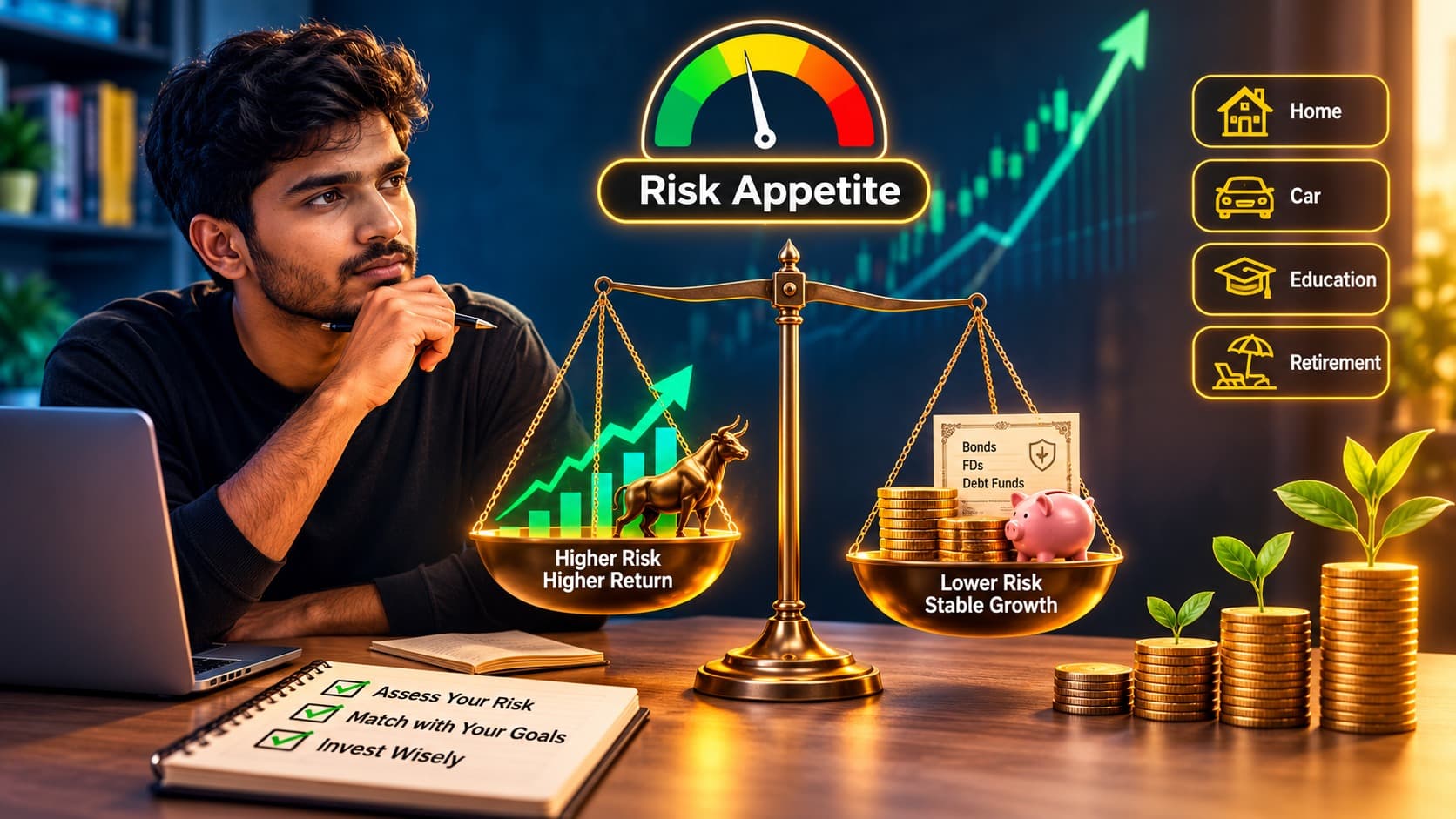
Understand how risk appetite influences investment choices, portfolio decisions, and financial planning—and why knowing your comfort with risk matters before you invest.
What Does Risk Appetite Mean?
Risk appetite refers to the level of investment risk an investor is willing to accept while pursuing a financial objective.
In simple terms, it answers:
“How much investment risk am I comfortable taking?”
An investor with a higher appetite for risk may be more comfortable with investments that can experience significant fluctuations in value. A more conservative investor may prefer investments with lower levels of volatility, even if that means accepting lower growth potential.
However, being comfortable with risk does not mean that an investor can afford unlimited losses.
That distinction is important.
Risk Appetite vs Risk Tolerance: Are They the Same?
The terms are related, but they are not exactly identical.
Risk appetite describes how much risk an investor is willing to take.
Risk tolerance is more closely related to how much loss or fluctuation an investor can withstand financially and emotionally.
For example, someone may say:
“I am comfortable taking high risk because I want higher returns.”
But if that person needs the invested money within a few months and cannot afford a significant loss, their actual ability to tolerate risk may be much lower.
This is why investment decisions should consider both willingness and ability to take risk.
What Is a Risk Profile?
Your risk profile provides a broader picture of your overall relationship with investment risk.
It can take into account factors such as:
- Financial situation
- Income stability
- Investment horizon
- Financial goals
- Existing investments
- Liabilities
- Ability to withstand losses
- Emotional response to market volatility
- Willingness to take risk
A risk profile can therefore help connect your financial circumstances with the level of risk that may be appropriate for your investment plan.
Check your risk profile now using this Risk Analyser calculator
Why Does Risk Appetite Matter in Investing?
Risk appetite matters because different investments carry different levels and types of risk.
For example, equity investments can experience significant short-term price fluctuations. AMFI notes that equity-oriented investments can be volatile in the short term and are generally associated with investors who have higher risk appetite and longer investment horizons.
This means an investment should not be selected simply because it has delivered attractive returns in the past.
The more important question is:
Does the investment's risk level fit my financial situation and objective?
How Does Risk Appetite Affect Investment Choices?
Consider two investors.
Investor A
- Stable income
- Long investment horizon
- Strong emergency savings
- Can tolerate market fluctuations
- Does not need the invested money soon
This investor may have greater capacity to consider investments with higher market risk.
Investor B
- Irregular income
- Limited emergency savings
- Needs the money for an important goal soon
- Becomes uncomfortable when investments fall
The same high-risk investment may be unsuitable for this investor.
The difference is not simply age. Financial circumstances, goals, time horizon, and ability to handle losses all matter.
Can Your Risk Appetite Be High but Your Risk Capacity Be Low?
Yes.
This is one of the most important concepts investors should understand.
Imagine someone who enjoys taking investment risks but has very little savings and needs the money for a house down payment next year.
Their willingness to take risk may be high, but their financial capacity to absorb a loss may be low.
Taking high risk in this situation could create a serious financial problem.
A sound investment plan should therefore consider both willingness to take risk and ability to withstand losses.
What Factors Influence Risk Appetite?
Several factors can influence an investor's attitude toward risk.
1. Financial Goals
Your goal can significantly influence the amount of risk you can reasonably consider.
Money required for a near-term goal may need a different approach from money being invested for a long-term objective.
2. Investment Horizon
The amount of time available can affect your ability to handle market fluctuations.
A long investment horizon may give an investor more time to manage periods of volatility, although it does not eliminate investment risk.
3. Income Stability
Someone with stable income may have a different financial capacity from someone whose income fluctuates significantly.
4. Existing Savings
Emergency savings and other financial resources can influence how much investment volatility you can realistically handle.
5. Debt and Liabilities
Large loan obligations can affect how much financial risk you can comfortably take.
6. Investment Experience
Someone who understands market fluctuations may react differently to volatility than someone investing for the first time.
7. Emotional Response
Two people with similar financial situations may react very differently when their portfolio falls.
Understanding your own behaviour during market declines is therefore important.
How Can You Assess Your Risk Appetite?
A proper risk assessment should consider more than simply asking whether you are comfortable with risk.
Ask yourself:
- How long can I remain invested?
- When will I need this money?
- How stable is my income?
- Do I have an emergency fund?
- How much loss could I financially withstand?
- How would I react if my portfolio declined significantly?
- Do I have existing loans or other financial commitments?
- What are my investment goals?
These questions can help you understand whether your willingness to take risk matches your financial capacity.
For mutual fund investors, the Riskometer is designed to help investors understand the level of risk associated with a scheme. AMFI explains that mutual fund schemes display risk levels ranging from low to very high.
You can also use kuberzo risk analyser tool to assess your risk appetite.
Does a Higher Risk Appetite Mean Higher Returns?
Not automatically.
Higher-risk investments may offer greater potential for returns, but they can also experience larger losses.
There is no investment that guarantees a higher return simply because it carries higher risk.
AMFI states that mutual fund investments involve risks, including the potential loss of principal, and that past performance does not guarantee future performance.
Therefore, investors should avoid thinking:
Higher risk = guaranteed higher return
A better way to think about it is:
Higher potential return usually comes with greater uncertainty and risk.
How Does Risk Appetite Affect Mutual Fund Selection?
Mutual funds cover different investment categories and risk levels.
For example, equity-oriented schemes can be more volatile, while certain debt-oriented schemes may have different risk characteristics. Hybrid funds combine equity and debt exposure, with the level of risk depending partly on the allocation to each asset class.
This means an investor should not select a mutual fund solely because it has generated strong historical returns.
Instead, consider:
- Scheme objective
- Risk level
- Portfolio composition
- Investment horizon
- Financial goal
- Your own risk profile
The fund's Riskometer and scheme documents can provide useful information when evaluating suitability.
Risk Appetite Should Match Your Investment Strategy
Your investment strategy should reflect your financial circumstances rather than being copied from another investor.
For example, a friend may be comfortable investing heavily in equity because they have a long investment horizon and strong financial reserves.
That does not automatically make the same allocation appropriate for you.
A suitable strategy should consider:
Goal → Time horizon → Risk capacity → Risk appetite → Asset allocation → Investment selection
This creates a more structured approach to investing.
What Happens If You Take More Risk Than You Can Handle?
Taking excessive risk can create problems even if the investment itself is legitimate.
Suppose an investor puts money needed for an important short-term goal into a highly volatile investment.
If the market falls just before the money is required, the investor may be forced to sell at an unfavourable time.
Another problem is emotional decision-making.
An investor who cannot tolerate losses may panic and exit an investment after a significant decline.
This can turn temporary market fluctuations into an actual realised loss.
Can Risk Appetite Change Over Time?
Yes.
Your risk appetite and financial circumstances are not necessarily fixed throughout your life.
They may change when you:
- Get married
- Change jobs
- Experience a major income change
- Take on a home loan
- Have children
- Start a business
- Approach retirement
- Reach an important financial goal
For this reason, investment planning should be reviewed periodically rather than treated as a one-time exercise.
Common Mistakes Related to Risk Appetite
Mistake 1: Choosing Investments Based Only on Returns
Investors may choose a product because it delivered strong historical performance.
Better approach: Look at risk, objective, time horizon, and suitability as well.
Mistake 2: Copying Someone Else's Portfolio
A friend's investment strategy may not match your financial situation.
Better approach: Build your strategy around your own goals and circumstances.
Mistake 3: Confusing Risk Appetite With Risk Capacity
Being willing to take risk does not mean you can afford a large loss.
Better approach: Consider both willingness and financial ability.
Mistake 4: Ignoring Your Investment Horizon
Taking significant risk with money needed soon can create unnecessary financial pressure.
Better approach: Match the investment approach with the time available.
Mistake 5: Changing Strategy During Every Market Decline
Market volatility can test an investor's actual risk tolerance.
Better approach: Understand potential volatility before investing and review whether your original financial assumptions have changed.
How Risk Appetite Fits Into Financial Planning
Good financial planning connects your investments with your broader financial situation.
Before selecting investments, consider:
- Income
- Expenses
- Emergency savings
- Existing debt
- Financial goals
- Investment horizon
- Risk capacity
- Risk appetite
- Existing investments
- Required liquidity
This approach helps prevent investment decisions from being made in isolation.
A Simple Risk-Assessment Checklist
Before making an investment decision, ask:
Goal: What am I investing for?
Time: When will I need the money?
Risk: How much loss can I realistically handle?
Emotion: How will I react if the investment falls?
Capacity: Can my finances withstand a significant decline?
Fit: Does the investment match my risk profile?
Review: When should I reassess my plan?
If these questions are not clear, it may be better to understand your financial position before taking additional investment risk.
Conclusion
Risk appetite is an important part of investment planning because it helps investors understand how much risk they are willing to accept.
But willingness alone is not enough.
A sound approach should also consider risk tolerance, financial capacity, investment horizon, financial goals, and existing commitments.
The right investment is not necessarily the one with the highest potential return. It is one whose risks you understand and that fits your financial circumstances and objectives.
As your income, goals, responsibilities, and financial situation change, your investment strategy may also need to change.
Understanding your risk before choosing an investment can help you make more informed and disciplined financial decisions.
Call to Action
Want to understand your investment risk better and make more informed financial decisions?
Visit Kuberzo to explore financial insights, investment education, and practical tools designed to help you plan your investments with greater clarity.
Frequently Asked Questions
What is risk appetite in investing?
Risk appetite is the level of investment risk an investor is willing to accept while pursuing financial goals.
Is risk appetite the same as risk tolerance?
No. Risk appetite describes willingness to take risk, while risk tolerance is more closely related to how much volatility or loss an investor can emotionally withstand.
Does a high risk appetite mean I should invest in equity?
Not necessarily. Your investment decision should also consider your financial capacity, goals, investment horizon, and overall risk profile.
Can my risk appetite change over time?
Yes. Changes in income, family responsibilities, financial goals, debt, or proximity to a major financial goal can affect your approach to risk.
How can I assess my investment risk?
Consider your financial goals, investment horizon, income stability, emergency savings, liabilities, ability to withstand losses, and emotional response to market volatility. For mutual funds, also review the scheme's Riskometer and relevant scheme documents.
Are high-risk investments guaranteed to provide higher returns?
No. Higher-risk investments may have higher return potential, but returns are uncertain and losses are possible. Mutual fund returns are not guaranteed.