STP vs SIP: Best Strategy to Deploy a Lump Sum into Equity
By Amrita Sinha
About the Author
Amrita Sinha is a content strategist with experience in SEO, digital marketing, and financial content. She writes easy-to-understand, research-backed articles on investing, personal finance, taxation, and wealth management for Kuberzo.
Compare STP vs SIP for deploying a lump sum into equity. Understand how each strategy works, the risks, taxation and when to use STP instead of SIP.
Investing a large lump sum in equity can be uncomfortable, even for investors who are convinced about the long-term potential of the stock market. The challenge is not always deciding whether to invest, but deciding how quickly to deploy the money. Putting the entire amount into an equity mutual fund on one day exposes the investor to the market level on that particular date. Waiting indefinitely for a better entry point, however, can also leave money sitting on the sidelines.
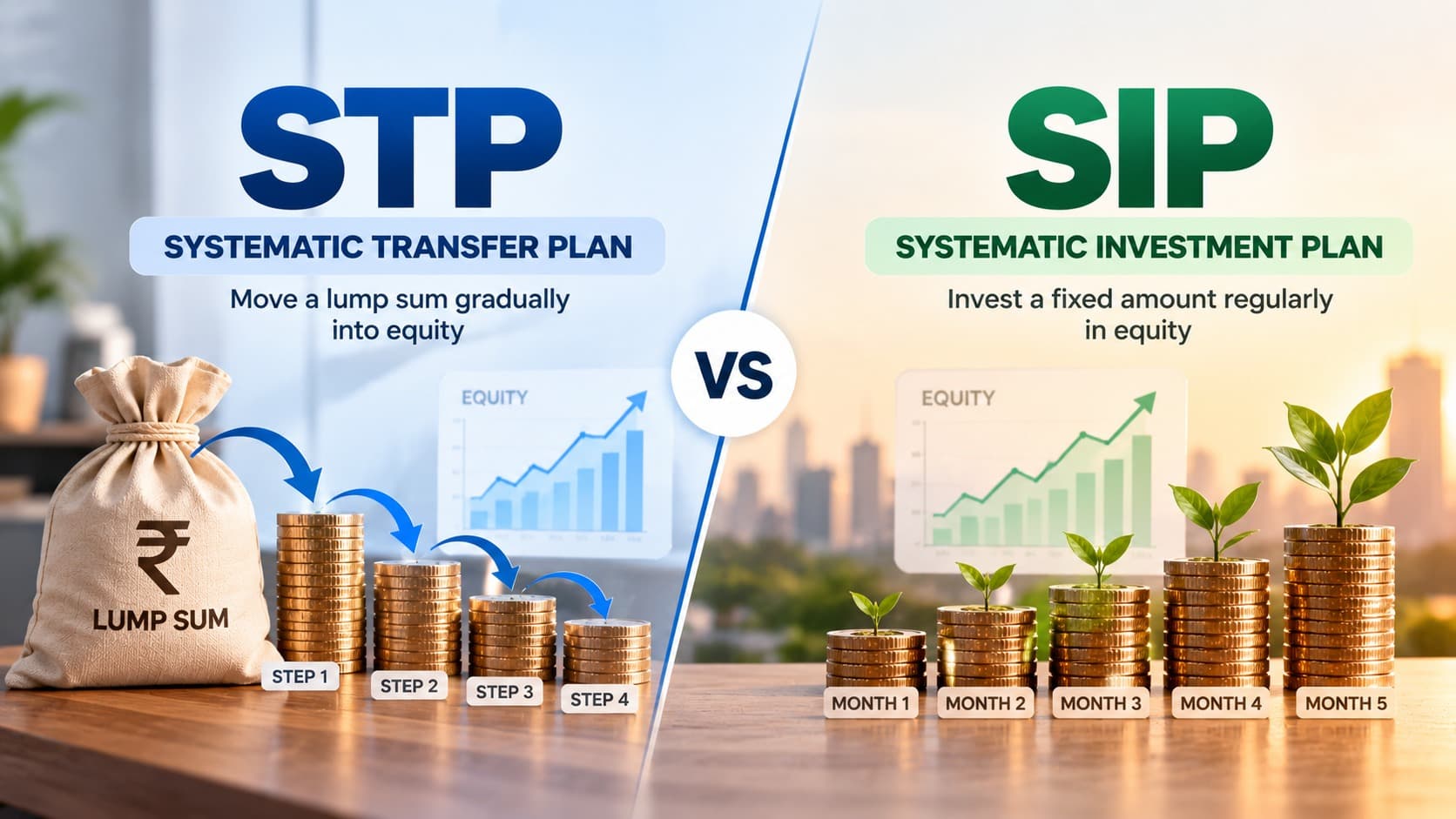
This is where the comparison of STP vs SIP becomes useful. Both are systematic ways of investing, but they are designed for different situations. A Systematic Investment Plan (SIP) generally involves investing a fixed amount into a mutual fund at regular intervals, usually from an investor's bank account. A Systematic Transfer Plan (STP), on the other hand, involves moving money periodically from one mutual fund scheme to another.
The distinction becomes particularly important when an investor already has a lump sum and wants to gradually move it into equity. An STP can allow the investor to first place the lump sum in a suitable source scheme and then systematically transfer specified amounts into an equity-oriented target scheme. A conventional SIP, by contrast, is generally more suitable when the investor has a regular income or periodic surplus that can be invested over time.
So, when comparing STP vs SIP for lump sum, there is no universally superior strategy. The appropriate approach depends on where the money is currently held, the investor's time horizon, risk tolerance, cash-flow pattern and preference for immediate versus staggered equity exposure.
What Is The Difference Between STP And SIP?
The key difference between STP and SIP is where the money comes from.
With an SIP, an investor periodically invests a predetermined amount into a mutual fund. With an SIP investment, an investor periodically invests a predetermined amount into a mutual fund. AMFI describes SIP as a methodology that allows investors to invest a fixed amount at regular intervals rather than making a lump-sum investment.
With an STP, an investor already has money invested in a mutual fund scheme and instructs the fund house to transfer a specified amount periodically from a source scheme to a target scheme. The source investment is redeemed, and the proceeds are invested in the target scheme at the applicable NAV.
Feature | SIP | STP |
Primary Purpose | Invest periodically | Move an existing lump sum gradually |
Source of Money | Usually bank account/regular surplus | Existing mutual fund investment |
Target | Usually one mutual fund scheme | Another eligible mutual fund scheme |
Best suited for | Regular income | Existing lump sum |
Equity Deployment | Gradual | Gradual |
Source Investment | Not required | Required |
Market Timing Risk | Spread across instalments | Spread across transfers |
When Does STP Make More Sense Than SIP?
The question of when to use STP instead of SIP becomes straightforward when you consider the investor's cash flow.
Suppose an investor receives a ₹12 lakh bonus and wants long-term equity exposure but does not want to invest the entire amount in an equity fund immediately.
One possible approach is to invest the amount in an appropriate source mutual fund and establish an STP that transfers a predetermined amount into the equity fund every month.
This is different from an SIP because the investor already possesses the ₹12 lakh. An SIP would typically involve investing fresh money periodically rather than systematically moving an existing investment.
Therefore:
Existing lump sum → STP can be relevant
Regular monthly surplus → SIP can be relevant
The choice should also consider the risk and return characteristics of the source investment during the transfer period.
How Does A Liquid Fund To Equity STP Work?
A commonly discussed approach is liquid fund to equity STP.
In this structure, an investor first places the lump sum in a liquid fund and then transfers predetermined amounts into an equity mutual fund at regular intervals.
For example, an investor with ₹6 lakh could theoretically structure a six-month STP of ₹1 lakh per month from the source fund into an equity scheme.
This creates staggered investing via STP rather than putting the entire ₹6 lakh into equity on one day.
However, investors should not assume that a liquid fund is completely risk-free. Mutual fund investments, including liquid funds, are subject to investment risks. The source scheme's returns during the transfer period can also affect the overall outcome.
More importantly, an STP is effectively a switch involving redemption from the source scheme and investment into the target scheme. Therefore, investors should check applicable exit loads and tax implications before setting one up.
STP Vs SIP Returns: Which Can Generate Higher Returns?
There is no fixed answer to STP vs SIP returns because returns depend primarily on market movements, the timing of investments and the underlying schemes selected.
Consider an illustrative example.
An investor has ₹6 lakh available for equity investment.
Option A: Lump sum:
The entire ₹6 lakh is invested in equity immediately.
Option B: STP:
₹1 lakh is transferred to equity every month for six months.
If equity markets rise sharply throughout those six months, the lump-sum approach could potentially outperform because more money was invested in equity earlier.
If markets decline after the initial investment, the staggered approach could potentially provide better entry prices for subsequent transfers.
This illustrates an important point: STP does not guarantee higher returns. It primarily changes the pattern and timing of market exposure.
Similarly, SIP helps spread investments across different market levels, but AMFI notes that rupee-cost averaging does not guarantee profits or protect investors against losses in declining markets.
STP Or SIP For Lump Sum: What Should An Investor Choose?
For an investor specifically asking STP or SIP for lump sum, STP is structurally more aligned with the situation because it is designed to transfer an existing investment between mutual fund schemes.
An SIP would make more sense if the investor does not yet have the entire amount and expects to generate the investable surplus periodically through salary or business income.
However, there is another question: Does the investor actually need to stagger the lump sum?
If the investor has a long investment horizon, high risk tolerance and is comfortable with short-term market fluctuations, investing the lump sum directly may also be considered. Staggering the investment can reduce the discomfort associated with entering the market at one point, but it also means some money remains outside equity for longer.
Therefore, an STP should not automatically be viewed as a "safer" or "better-return" alternative to lump-sum investing.
What Are The Tax Implications Of STP?
Taxation is an important consideration that investors sometimes overlook when choosing an STP from a liquid fund to equity.
An STP involves redeeming units from the source scheme. This means the transfer is not simply an internal movement of money with no tax consequences; the redemption from the source scheme can have capital-gains implications depending on the type of fund, holding period and applicable tax rules.
The investor should therefore evaluate the tax impact before setting up an STP, particularly when the source investment has appreciated.
The applicable tax treatment can also change with tax laws. Investors should verify the current rules applicable to their specific mutual fund and circumstances before executing an STP.
What Are The Risks Of Staggered Investing Via STP?
Staggered investing via STP can help manage the psychological discomfort of deploying a large amount at once, but it comes with trade-offs.
Market Risk
The target equity fund remains exposed to market fluctuations. An STP does not protect the investor from losses.
Opportunity Cost
If equity markets rise during the STP period, money that has not yet moved into equity may miss some of that upside.
Source-Fund Risk
The money waiting to be transferred remains invested in the source scheme and is therefore exposed to that scheme's own risks and returns.
Tax And Exit Costs
Redemption from the source scheme can have tax implications and potentially an exit load, depending on the scheme's terms.
Timing Risk
The selected STP duration is itself a market-timing decision. A six-month STP, for example, may produce a different outcome from a 12-month STP.
STP Vs SIP: Which Strategy Is Better?
The STP vs SIP decision should begin with the investor's cash-flow situation rather than with a search for the strategy that promises higher returns.
Choose SIP when:
You earn and invest regularly.
You want to invest a fixed amount periodically.
You are building your portfolio gradually.
You do not have a large lump sum available today.
Consider STP when:
You already have a substantial lump sum.
You want to gradually move it into another mutual fund scheme.
You prefer staggered equity deployment.
You understand the risks and tax implications of the source investment.
For investors with a lump sum, the broader decision is actually among lump-sum investing, STP and holding the money outside equity. Each approach has different implications for market exposure, potential returns, liquidity and risk.
Conclusion
The difference between STP and SIP is ultimately about the source and purpose of the investment.
An SIP is primarily a disciplined way to invest fresh money periodically, while an STP is a mechanism for transferring an existing mutual fund investment from one scheme to another over time.
For someone holding a large lump sum and wanting to gradually increase equity exposure, an STP from a liquid fund to equity or another suitable source scheme can be one approach to consider. It can spread the deployment of capital across multiple dates rather than relying on a single entry point.
However, an STP does not guarantee better STP vs SIP returns, eliminate market risk or ensure that an investor buys at the lowest prices. Its primary advantage is the systematic deployment of an existing corpus.
Ultimately, the appropriate strategy depends on the investor's financial situation, investment horizon, risk tolerance and the purpose of the money. The objective should be to choose a method that is consistent with the overall investment plan rather than trying to predict the market's next move.
Disclaimer: This article is for general educational purposes only and does not constitute personalised investment, financial or tax advice. Mutual fund investments are subject to market risks, and returns are not guaranteed. STP transactions may involve redemption from the source scheme and can have applicable tax and exit-load implications. Investors should review the scheme documents and current tax rules before investing.
Frequently Asked Questions
What is the main difference between STP and SIP?
An SIP involves investing a fixed amount into a mutual fund at regular intervals, generally using fresh money. An STP transfers money periodically from an existing mutual fund scheme to another scheme.
Is STP better than SIP for a lump sum?
For an investor who already has a lump sum invested or available to deploy, STP is structurally more relevant because it allows gradual transfers from a source scheme to a target scheme. An SIP is generally designed for periodic investments from regular cash flows.
Can I use a liquid fund to invest gradually in equity through STP?
Yes, subject to the specific mutual fund's STP facility and scheme rules, an investor can transfer money periodically from an eligible source scheme into an equity-oriented target scheme. Investors should check applicable exit loads, taxation and scheme conditions.
Does STP guarantee better returns than lump-sum investing?
No. An STP does not guarantee higher returns. If equity markets rise consistently during the transfer period, investing the entire amount earlier could potentially perform better. If markets fall, staggered deployment may result in lower average purchase prices for later instalments.