Debt, Liquid & Large Cap Mutual Funds for Stable Retirement Income
By Aviral Singh
About the Author
Aviral Singh is an MBA student at IIM Guwahati and a CSIR NET (JRF) qualifier with an M.Sc. from Hansraj College. A former Physics Wallah educator, he creates content on campus life and writes on finance, investments, businesses and education.
Debt, liquid and large cap mutual funds explained for retirees. Compare returns, taxation, liquidity and risk to build a stable retirement income portfolio.
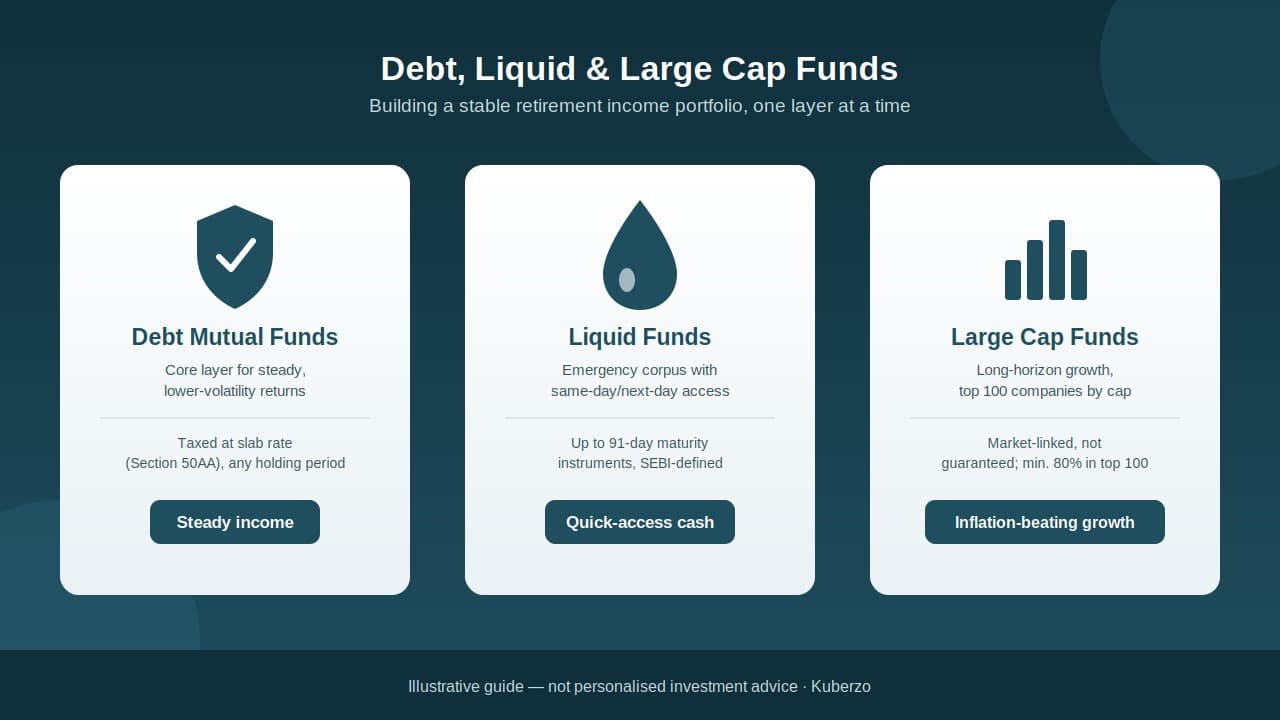
The direct answer: a stable retirement portfolio isn't built from one fund type — it's layered. Debt mutual funds anchor steady returns, liquid funds hold your emergency cash for instant access, and large cap funds provide the long-horizon growth layer that keeps pace with inflation.
Each of these plays a different role. Treating them as competing choices, rather than complementary layers, is where most retirees go wrong.
What are debt mutual funds?
Debt mutual funds invest in bonds, government securities, corporate debt and money-market instruments rather than equities. Returns come from interest income and, to a smaller extent, price movements in the underlying bonds.
A debt fund is not the same as a guaranteed fixed deposit — its NAV can still move with interest rates and credit conditions.
For units purchased on or after 1 April 2023, all debt fund gains are taxed at your income tax slab rate under Section 50AA, regardless of how long you hold them — there is no separate long-term capital gains rate or indexation benefit anymore.
What are liquid funds?
Liquid funds are a SEBI-defined category of debt fund that can only hold instruments maturing within 91 days — treasury bills, commercial paper, certificates of deposit. This short maturity keeps their NAV unusually stable.
Liquid funds typically deliver annualised returns in the 6–7% range, meaningfully higher than a savings account, with same-day or next-day redemption and little to no exit load after the first few days.
One clarification worth making: "Liquid BeES" (Nippon India ETF Nifty 1D Rate Liquid BeES) is actually an overnight-rate ETF traded on the exchange, not a conventional liquid mutual fund. Its returns track the overnight call-money rate and have recently run lower (roughly 4–5% annualised) than the broader liquid fund category, because it holds only 1-day instruments rather than up to 91-day paper.
What are large cap mutual funds?
Large cap funds are equity schemes that must invest at least 80% of assets in India's top 100 companies by market capitalisation, as defined by SEBI. This gives exposure to established, liquid businesses with historically lower volatility than mid or small cap funds.
Large cap funds are market-linked and not guaranteed — the category's 5-year average return has historically been in the 10–13% range, but this varies by market cycle and is not a forecast. For more on how large cap compares with mid and small cap, Kuberzo's Large Cap vs Mid Cap vs Small Cap guide breaks down the full spectrum.
Debt vs liquid vs large cap: the basic comparison
Factor | Debt Funds | Liquid Funds | Large Cap Funds |
|---|---|---|---|
Role in portfolio | Steady income core | Emergency/short-term cash | Long-term growth |
Underlying assets | Bonds, corporate debt, G-Secs | Instruments maturing ≤91 days | Top 100 companies by market cap |
Typical return range | Varies by duration and credit quality | ~6–7% p.a. | ~10–13% p.a. (5-yr category average, not guaranteed) |
Volatility | Low to moderate | Very low | Moderate to high |
Liquidity | T+1 typically | Same-day/next-day | T+1, but value can be down on exit day |
Taxation | Slab rate, any holding period (Sec. 50AA) | Slab rate, any holding period (Sec. 50AA) | LTCG above ₹1.25 lakh at 12.5% |
Ideal holding period | Months to a few years | Days to a few months | 7+ years |
This table is a starting point for comparison, not a personalised recommendation.
Why does a retiree need all three, not just one?
Imagine a retiree with a ₹50 lakh corpus beyond what SCSS and LIC already cover.
If all of it sits in a large cap fund, a market downturn right when they need to withdraw could force selling at a loss. If all of it sits in a liquid fund, it stays safe but barely beats inflation over time. If all of it sits in a debt fund alone, it misses both the liquidity of a liquid fund and the growth potential of equity.
Splitting the corpus — some in liquid for near-term needs, a larger base in debt for steady income, and a smaller long-horizon slice in large cap for growth — is how each layer does the job it's actually suited for. Kuberzo's Debt Fund vs Equity Fund guide goes deeper into the debt-versus-equity risk trade-off behind this split.
Are debt funds safer than large cap funds?
Generally yes, in terms of short-term volatility — but "safer" doesn't mean risk-free. Debt funds carry interest-rate, credit and liquidity risk; large cap funds carry market risk. Neither guarantees returns or protects capital the way SCSS or a bank FD does.
Is a liquid fund better than a savings account?
For money you won't need for daily transactions, generally yes — liquid funds have historically outperformed savings account interest while remaining highly accessible. For comparison with other low-risk options retirees consider,Kuberzo's Fixed Deposit vs Mutual Fund guide is a useful companion read.
A practical way to allocate across the three
Example 1: Emergency reserve
Suppose ₹3–5 lakh needs to stay accessible for medical emergencies or unplanned expenses. A liquid fund is built for exactly this — stable NAV, fast redemption, no lock-in.
Example 2: Monthly expense top-up
Suppose SCSS and LIC cover most monthly needs, but a retiree wants a buffer with slightly better post-tax flexibility than another SCSS account (which is capped at ₹30 lakh). A debt fund, used with a systematic withdrawal plan (SWP), can supplement this. Kuberzo's SWP Calculator can help model what a monthly withdrawal from a debt fund corpus would look like.
Example 3: Long-horizon legacy or growth corpus
Suppose a retiree has money earmarked for 10+ years out — perhaps for a grandchild's future. A large cap fund allocation, sized to the retiree's comfort with volatility, fits this horizon better than debt or liquid funds, which aren't designed to outpace inflation by much.
Common mistakes when using these three fund types
Mistake 1: Assuming debt funds are tax-free or low-tax like the old rules. Since April 2023, all debt fund gains are taxed at your slab rate, regardless of holding period.
Mistake 2: Confusing Liquid BeES with a standard liquid fund. Liquid BeES is an overnight-rate ETF; its returns are structurally different from a typical liquid fund's 91-day-maturity portfolio.
Mistake 3: Keeping the entire retirement corpus in a liquid fund "to be safe." This protects capital but does little to beat inflation over a long retirement.
Mistake 4: Treating large cap funds as risk-free because they're "blue chip." They are equity investments and can still see meaningful drawdowns.
Mistake 5: Ignoring expense ratio and credit quality when comparing debt funds. Two debt funds with similar names can carry very different risk profiles.
So, which should a retiree actually use?
There is no single winner — each fund type does a different job.
Debt funds provide the steady middle layer of a retirement portfolio, more flexible than a fixed-tenure scheme like SCSS.
Liquid funds hold the money that must stay accessible on short notice.
Large cap funds carry the smaller, long-horizon slice meant to outpace inflation over many years.
Kuberzo's Risk Analyser Tool can help determine how much of a retiree's corpus reasonably belongs in each layer based on risk tolerance.
Contact us for personalised guidance.
Financial disclaimer
This article is for general education and does not constitute personal investment or tax advice. Debt, liquid and large cap mutual fund returns are market-linked and not guaranteed. Tax rules can change and may vary by individual circumstances. Consult a qualified financial or tax professional before making investment decisions.
Frequently Asked Questions
Are debt mutual funds taxed differently from equity funds?
Yes. Debt fund gains are taxed at your income tax slab rate regardless of holding period (Section 50AA), while equity fund LTCG above ₹1.25 lakh is taxed at 12.5%.
What returns can I expect from a liquid fund?
Liquid funds have typically delivered around 6–7% annualised returns, though this varies with interest rate conditions and isn't guaranteed.
Is Liquid BeES the same as a liquid mutual fund?
No. Liquid BeES is an overnight-rate ETF traded on the exchange, tracking 1-day instruments, which is structurally different from a conventional liquid fund holding up to 91-day paper.
What is the SEBI definition of a large cap fund?
A large cap fund must invest at least 80% of its assets in India's top 100 companies by market capitalisation.
Can large cap funds lose money?
Yes. They are equity investments and their NAV can decline during market downturns, despite investing in established companies.