Balanced Advantage, Multi-Asset & Gold Funds: Diversify Your Retirement Portfolio
By Aviral Singh
About the Author
Aviral Singh is an MBA student at IIM Guwahati and a CSIR NET (JRF) qualifier with an M.Sc. from Hansraj College. A former Physics Wallah educator, he creates content on campus life and writes on finance, investments, businesses and education.
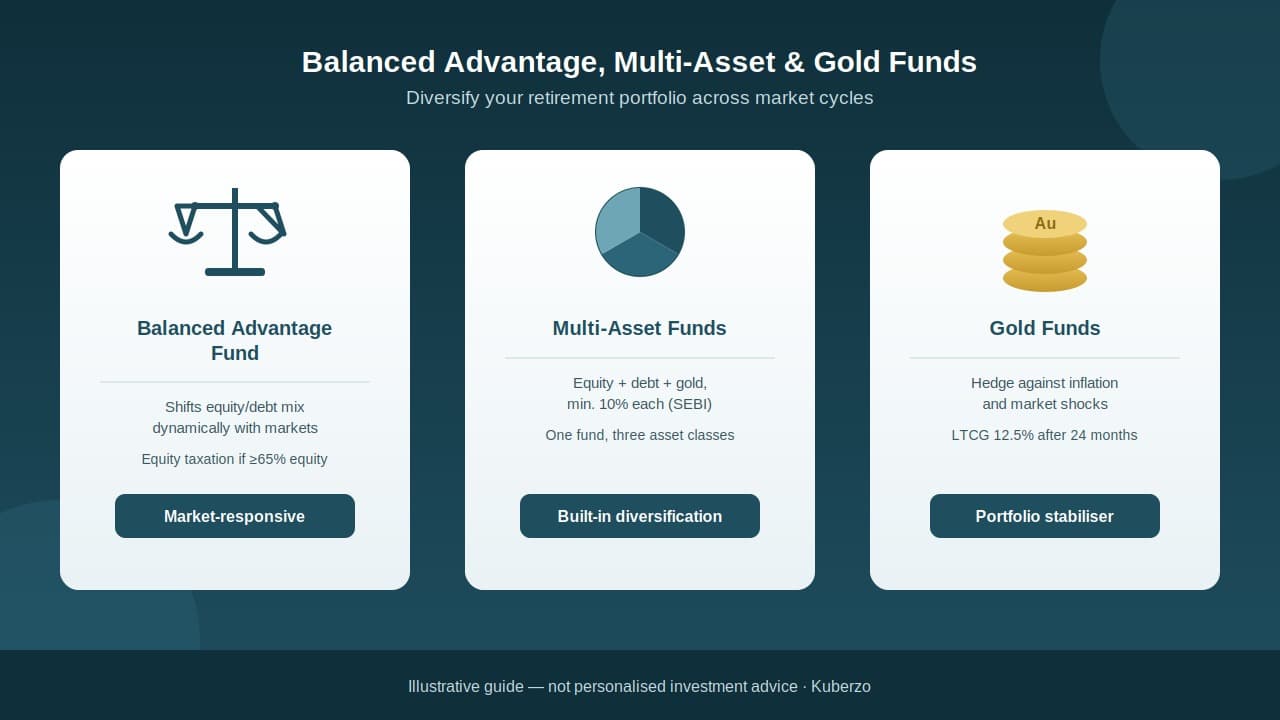
Balanced advantage, multi-asset and gold funds explained for retirees — how dynamic allocation, built-in diversification and a gold hedge work together in one portfolio.
The direct answer: balanced advantage, multi-asset and gold funds each solve a different diversification problem. Balanced advantage funds adjust equity exposure automatically as markets move. Multi-asset funds bundle equity, debt and gold into one SEBI-mandated structure. Gold funds add a hedge that often moves differently from both equity and debt. Together, they reduce how much a retiree's portfolio depends on any single market call.
What is a balanced advantage fund?
Also called a dynamic asset allocation fund, a balanced advantage fund shifts its equity-to-debt ratio based on market valuations — increasing equity when markets look attractively priced and reducing it when they look expensive, rather than holding a fixed ratio.
Most balanced advantage funds, including HDFC Balanced Advantage Fund, aim to keep effective equity exposure at or above 65% (often using hedged/arbitrage positions) specifically to qualify for equity taxation — LTCG above ₹1.25 lakh taxed at 12.5%, rather than debt-fund slab-rate taxation. If a fund's equity exposure falls below that threshold, it may instead be taxed as a debt fund.
What is a multi-asset fund?
A multi-asset fund is a SEBI-defined category that must invest in at least three distinct asset classes — typically equity, debt and gold — with a minimum of 10% allocated to each at all times. This structural requirement is what separates it from a regular hybrid fund, which usually mixes only equity and debt.
Funds like ICICI Prudential Multi Asset Fund combine these three asset classes in one portfolio so a retiree doesn't need to separately manage equity, debt and gold exposure. Taxation depends on the fund's actual equity allocation: funds maintaining 65%+ equity get equity taxation, while others are typically taxed as "other" (non-equity, non-debt) funds — 12.5% LTCG after 24 months, slab rate before that.
What is a gold fund?
Gold mutual funds (often called gold savings funds, such as Nippon India Gold Savings Fund) are fund-of-funds that invest in an underlying gold ETF, giving exposure to gold prices without needing a demat account.
Gold funds are not equity-oriented, so they don't get the ₹1.25 lakh LTCG exemption. For gold fund units (unlisted FoF structures), short-term gains (held 24 months or less) are taxed at slab rate; long-term gains (held over 24 months) are taxed at 12.5% without indexation. If you're weighing gold against another low-risk diversifier. Kuberzo's Debt Fund vs Equity Fund guide is a useful companion read.
Balanced advantage vs multi-asset vs gold: the basic comparison
Factor | Balanced Advantage | Multi-Asset | Gold Funds |
|---|---|---|---|
Structure | Dynamic equity/debt mix | Equity + debt + gold (min. 10% each) | Fund-of-fund investing in gold ETF |
Role in portfolio | Market-responsive core | Built-in diversification | Inflation/shock hedge |
Volatility | Moderate | Moderate (dampened by gold/debt) | Moderate, moves with gold price |
Taxation | Equity rate if ≥65% equity | Depends on fund's equity %; often 12.5% after 24 months | Slab rate ≤24 months; 12.5% LTCG after 24 months |
Suitable allocation role | Core growth with downside control | Single-fund diversification | Smaller satellite hedge (5–15%) |
This table is a starting point for comparison, not a personalised recommendation.
Why do retirees need a hedge like gold at all?
Gold has historically moved differently from equity and debt during periods of market stress or currency weakness — it doesn't guarantee gains, but it can reduce how much a portfolio falls when equity markets fall sharply. For a retiree, that matters more than for a younger investor, since there's less time to recover from a large drawdown right before a planned withdrawal. Kuberzo's Risk Analyser Tool can help gauge how much gold or multi-asset exposure fits your overall risk comfort.
Is a balanced advantage fund safer than a pure equity fund?
Generally yes, in terms of smoother returns — the dynamic allocation is designed to pull back equity exposure when valuations look stretched. It isn't risk-free, though; during sharp or sudden market moves, the fund's model may not reduce equity fast enough to avoid a drawdown.
Does a multi-asset fund remove the need to pick funds separately?
Largely, yes, for the specific three-asset mix the fund maintains. It doesn't remove market risk, and different multi-asset funds hold very different equity-debt-gold ratios beyond the SEBI minimum, so two multi-asset funds can behave quite differently.
A practical way to use these three
Example 1: Core portfolio with less manual rebalancing
A retiree who doesn't want to actively shift between equity and debt themselves can use a balanced advantage fund as a core holding — the fund's model does the rebalancing.
Example 2: One-fund diversification
A retiree who wants equity, debt and gold exposure without managing three separate funds can use a multi-asset fund like ICICI Prudential Multi Asset Fund as a simpler single holding.
Example 3: Adding a small gold hedge
A retiree already holding SCSS, debt funds and some equity can add a 5–15% gold fund allocation (such as Nippon India Gold Savings Fund) as a portfolio stabiliser, without it becoming the dominant holding. Kuberzo's Goal Based Planner can help size this allocation against overall retirement goals.
Common mistakes when using these three fund types
Mistake 1: Assuming a balanced advantage fund is always taxed like equity. It depends on the fund actually maintaining ≥65% effective equity exposure — check the fund's allocation, not just its name.
Mistake 2: Over-allocating to gold "for safety." Gold is a hedge, not an income source — most allocations suggest keeping it as a smaller satellite position, not a core holding.
Mistake 3: Treating all multi-asset funds as identical. Each fund sets its own allocation ranges beyond SEBI's 10% minimum, so returns and risk can differ meaningfully across funds in this category.
Mistake 4: Mixing up gold ETF and gold fund (FoF) taxation. Gold ETFs qualify for LTCG after 12 months; gold mutual fund FoFs need 24 months — they're not taxed identically.
Mistake 5: Ignoring expense ratio layering in FoF structures. Gold funds and some multi-asset funds carry costs at both the underlying fund and FoF level — check the total expense ratio, not just the headline one.
So, which should a retiree actually use?
These aren't competing choices — they typically work best as complementary layers.
Balanced advantage funds offer a managed, less manual way to hold growth-oriented exposure.
Multi-asset funds offer built-in diversification in a single holding.
Gold funds offer a smaller hedge against equity and currency shocks, not a primary return driver.
Kuberzo's Large Cap vs Mid Cap vs Small Cap guide is a useful read if you're deciding how much of your equity sleeve (inside a balanced advantage or multi-asset fund) should lean large cap versus mid/small cap.
Contact us for personalised guidance.
Financial disclaimer
This article is for general education and does not constitute personal investment or tax advice. Balanced advantage, multi-asset and gold fund returns are market-linked and not guaranteed. Tax treatment depends on each fund's actual portfolio composition and can change. Consult a qualified financial or tax professional before making investment decisions.
Frequently Asked Questions
Is a balanced advantage fund always taxed like an equity fund?
No. It depends on whether the fund maintains at least 65% effective equity exposure; if it doesn't, gains may be taxed as a debt fund instead.
What's the minimum SEBI requires for a multi-asset fund?
At least three distinct asset classes — typically equity, debt and gold — with a minimum 10% allocation to each at all times.
How are gold mutual funds (fund-of-funds) taxed?
Units held 24 months or less are taxed at slab rate; units held over 24 months get LTCG at 12.5% without indexation, with no ₹1.25 lakh exemption.
Is a gold fund the same as a gold ETF for tax purposes?
No. Gold ETFs qualify for LTCG after 12 months, while gold mutual fund FoFs need 24 months — the holding periods differ.
How much of a portfolio should go into gold?
There's no universal number, but gold is generally used as a smaller hedge (often cited in the 5–15% range) rather than a core holding, since it doesn't generate income.