SCSS vs LIC vs ELSS: Best Savings Scheme for Senior Citizens
By Aviral Singh
About the Author
Aviral Singh is an MBA student at IIM Guwahati and a CSIR NET (JRF) qualifier with an M.Sc. from Hansraj College. A former Physics Wallah educator, he creates content on campus life and writes on finance, investments, businesses and education.
Compare SCSS, LIC annuity plans and ELSS for senior citizens on returns, safety, tax benefits and payout structure to find the best savings scheme for your needs.
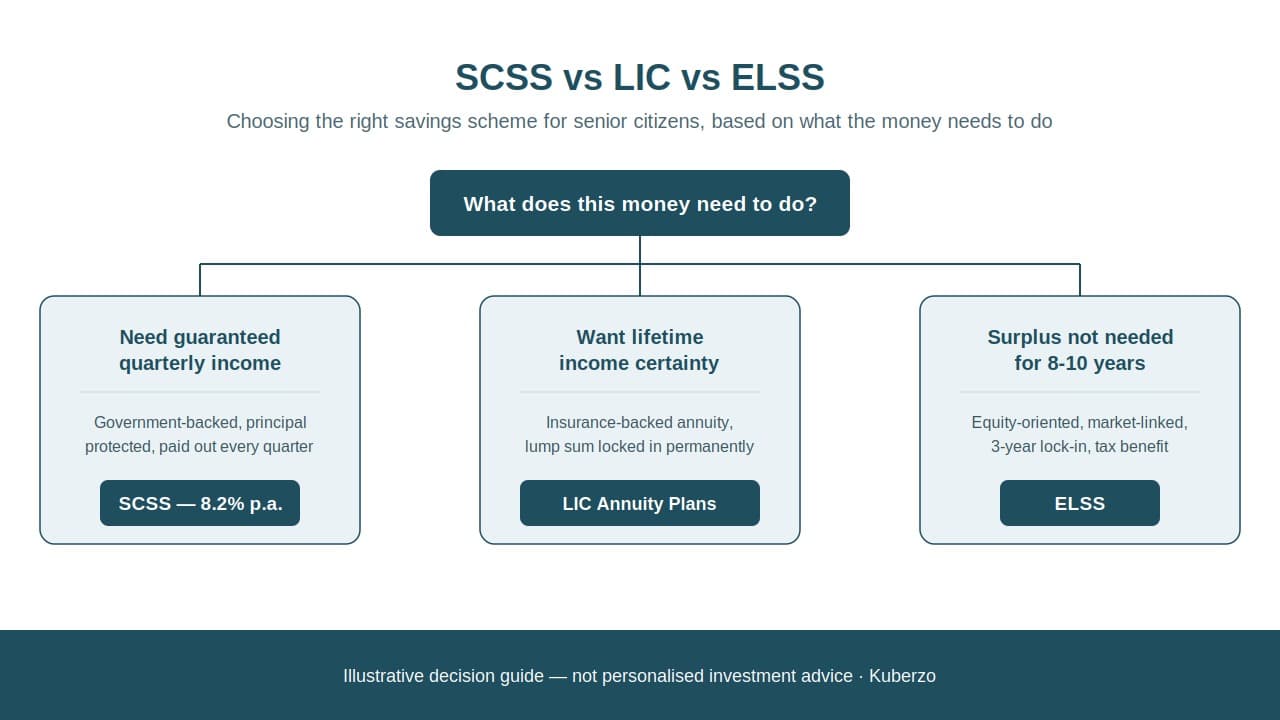
The direct answer: the choice between SCSS, LIC and ELSS should start with what the money needs to do for you — provide guaranteed income, provide lifetime income certainty, or grow over the long term — not with which one advertises the highest number.
SCSS is a government-backed fixed-income scheme. LIC pension plans are insurance-backed annuity products. ELSS is an equity mutual fund with a tax benefit attached. These are three structurally different instruments, so "which is best" depends entirely on the job you need the money to do.
An investor who needs quarterly income to cover monthly expenses has a very different requirement from an investor who wants to grow a surplus for the next decade.
What is SCSS?
The Senior Citizen Savings Scheme is a government-backed small savings scheme, available through post offices and authorised banks.
The interest rate is reviewed by the Finance Ministry every quarter and applies to fresh deposits made during that quarter; once locked in at account opening, that rate holds for the full tenure. For the July–September 2026 quarter, SCSS offers 8.2% per annum, among the highest in the small savings basket.
SCSS is backed by the Government of India, which is why it is generally treated as one of the safest fixed-income options available to retirees.
What is a LIC monthly income / pension plan?
LIC does not currently sell a scheme literally titled "monthly income scheme." What most searches refer to are LIC's annuity plans — primarily LIC Saral Pension Yojana (immediate annuity) and LIC New Jeevan Shanti (deferred annuity).
A LIC annuity plan is not the same as a bank FD or SCSS.
Both convert a one-time "purchase price" into a guaranteed pension, payable monthly, quarterly, half-yearly or annually, at a rate fixed when the policy is purchased.
One clarification matters here: the older Pradhan Mantri Vaya Vandana Yojana (PMVVY), which offered a fixed 7.4% return, closed to new subscriptions on 31 March 2023. Existing policyholders continue receiving their locked-in pension until maturity, but it cannot be purchased fresh today.
What is ELSS?
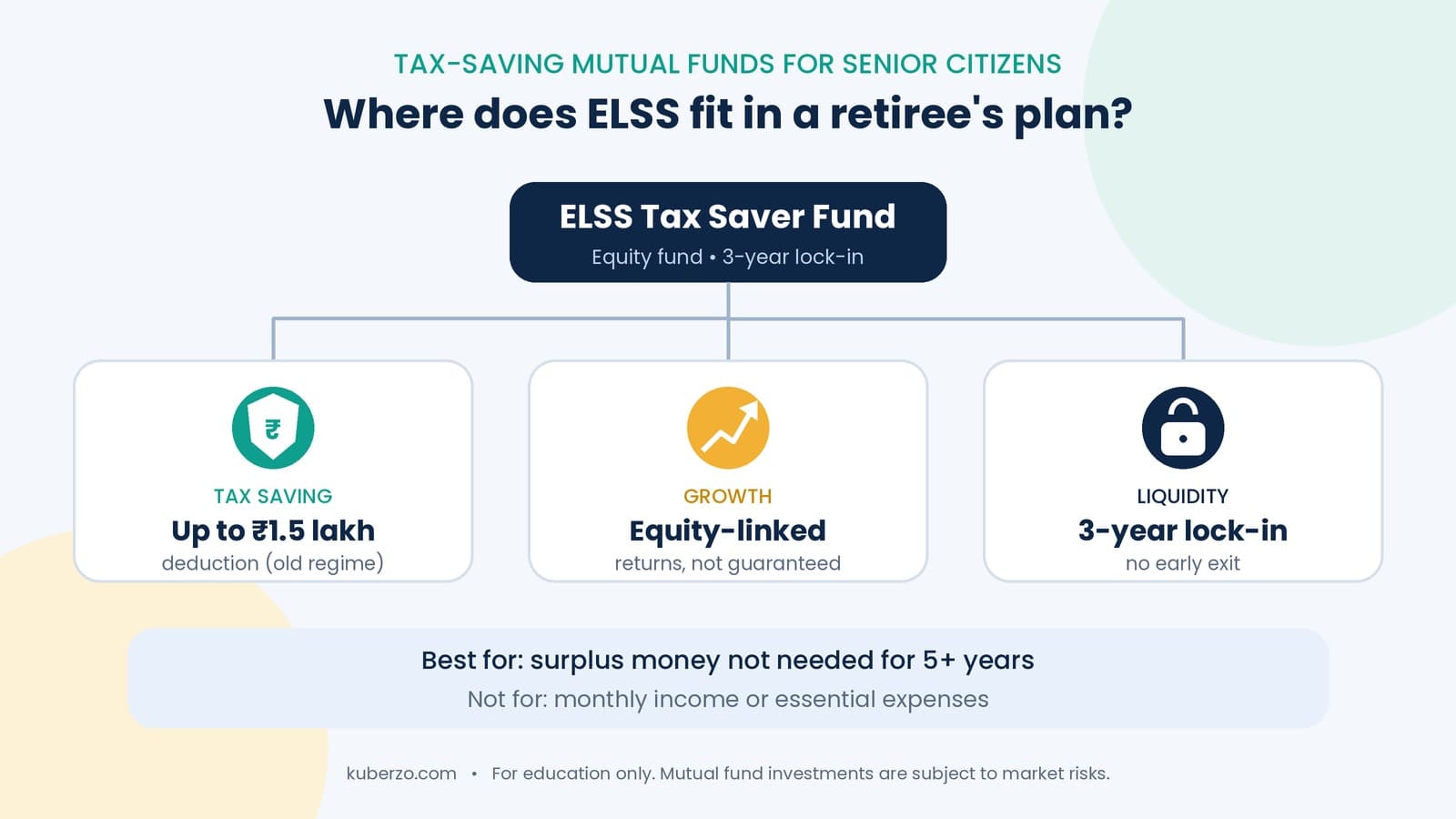
Equity Linked Savings Scheme funds are equity mutual funds carrying a 3-year lock-in — the shortest among Section 80C tax-saving instruments.
Because ELSS invests predominantly in equities, its value moves with the market. If you want to understand how equity exposure compares with safer fixed-income options before considering ELSS, Kuberzo's Debt Fund vs Equity Fund guide breaks down the risk difference in detail.
ELSS therefore is a tax-saving and growth tool, not an income tool.
SCSS vs LIC vs ELSS: the basic comparison
Factor | SCSS | LIC Annuity Plans | ELSS |
|---|---|---|---|
Structure | Govt-backed savings scheme | Insurance-backed annuity | Equity mutual fund |
Indicative rate/return | 8.2% p.a. (Q2 FY2026-27) | Roughly 6.5%–7.5% p.a., fixed at purchase | Market-linked, not guaranteed |
Lock-in | 5 years, extendable by 3 | Effectively permanent/lifetime | 3 years |
Capital guarantee | Principal protected (sovereign-backed) | Purchase price generally protected under policy terms | No guarantee |
Payout frequency | Quarterly | Monthly/quarterly/half-yearly/annual, as chosen | On redemption, not periodic |
Section 80C benefit | Yes, up to ₹1.5 lakh (old regime) | Yes, up to ₹1.5 lakh (old regime) | Yes, up to ₹1.5 lakh (old regime) |
Tax on payout | Interest fully taxable at slab rate | Pension generally taxable at slab rate | LTCG above ₹1.25 lakh taxed at 12.5% |
This table is a starting point for comparison, not a personalised recommendation.
Why does investment purpose matter more than the rate?
Imagine two retirees.
Retiree A needs ₹25,000 every quarter to cover household expenses and cannot absorb any drop in that amount.
Retiree B has enough pension income already and has a ₹5 lakh surplus she doesn't need for at least eight years.
Recommending the same product to both makes little sense. Retiree A's requirement is capital safety and predictable payout — SCSS or a LIC annuity fits that job. Retiree B has room to accept short-term fluctuation in exchange for long-term growth — a modest ELSS allocation can fit that job.
This is why "which is best" is the wrong first question. "What is this money for" is the right one.
Is SCSS risk-free?
SCSS carries sovereign backing, which is why it is treated as one of the lowest-risk options for retirees. It is not, however, free of tax drag — interest is fully taxable, unlike the tax-free maturity many retirees assume applies to all government schemes.
Are LIC annuity plans guaranteed for life?
Yes, the pension rate is fixed at the time of purchase and continues for the chosen term or for life, depending on the plan and option selected. The trade-off is liquidity: once purchased, the lump sum is generally locked in permanently, and current annuity rates tend to run lower than SCSS's rate. For a broader look at guaranteed retirement income options, Kuberzo's NPS vs PPF guide compares two other common retirement instruments on the same parameters.
Is ELSS suitable for a retiree's core income?
No. ELSS is equity-oriented, so its value can decline over any given period, including years at a time. It is unsuitable as a source of predictable income and should only carry money a retiree does not need to draw on in the near term.
A practical way to choose
Ask, in order: What is this specific portion of money for? Then: When will I need to draw on it? Then: Can I tolerate this portion losing value temporarily, or does it fund essential monthly expenses?
Example 1: Core monthly expense fund
Suppose ₹20 lakh of a retiree's corpus is meant to generate the household's monthly grocery, utility and medical budget.
This money needs predictable quarterly payout and near-zero risk of loss. SCSS, up to its ₹30 lakh limit, is a natural fit here — ELSS is not, regardless of its potential returns.
Example 2: Lifetime income floor
Suppose a retiree wants a guaranteed income stream that continues for as long as they live, independent of how long the corpus lasts.
A LIC annuity plan is designed for exactly this — it trades liquidity for lifetime certainty, which SCSS's fixed 5+3 year tenure does not offer.
Example 3: Long-horizon surplus
Suppose a retiree has ₹3 lakh beyond what SCSS and LIC already cover, and does not anticipate needing it for 8–10 years — perhaps it's intended for a grandchild's education.
A small ELSS allocation can be considered here, since the horizon is long enough to potentially absorb short-term market swings. This is not a guarantee of positive returns. Readers deciding between a lump-sum ELSS investment and a staggered approach may find "Kuberzo's SIP vs Lump Sum guide" useful before investing the surplus.
Common mistakes when comparing these three
Mistake 1: Assuming SCSS interest is tax-free. It is not — interest is taxed at your income slab.
Mistake 2: Buying a LIC annuity for the entire corpus. Doing so removes liquidity permanently; most retirees benefit from splitting across instruments.
Mistake 3: Treating ELSS as a monthly income product. It has no scheduled payout; income only comes from redeeming units, which crystallises market risk at that moment.
Mistake 4: Assuming PMVVY is still available. It closed to new investors in March 2023; current LIC options are Saral Pension Yojana and New Jeevan Shanti.
Mistake 5: Claiming ₹1.5 lakh 80C deduction on each instrument separately. The ₹1.5 lakh Section 80C limit is combined across all eligible investments in a year, not per product.
So, SCSS vs LIC vs ELSS: which is better?
There is no universal winner.
SCSS is designed for guaranteed, government-backed quarterly income and is generally the first building block for a retiree's income plan.
LIC annuity plans add lifetime income certainty, at the cost of permanent liquidity, and work well alongside SCSS rather than instead of it.
ELSS has no role as an income source — its role, if any, is long-term growth for money the retiree genuinely does not need soon.
The right mix depends on how much guaranteed income you need, how much liquidity you're willing to give up, and how much of the corpus is truly surplus. Once you know roughly how much quarterly income you need, Kuberzo's SWP Calculator can help you model a systematic withdrawal plan alongside SCSS and LIC payouts, and Kuberzo's Goal Based Planner can help size the SIP or lump sum needed for any long-term ELSS portion.
Contact us for personalised guidance.
Financial disclaimer
This article is for general education and does not constitute personal investment, insurance or tax advice. SCSS and LIC annuity rates are subject to change and apply as fixed at the time of investment. Mutual fund returns, including ELSS, are market-linked and not guaranteed. Tax rules can change and may vary by individual circumstances. Consult a qualified financial or tax professional before making investment decisions.
Frequently Asked Questions
Is SCSS interest taxable?
SCSS interest is added to total income and taxed at the applicable slab rate; TDS applies above the prescribed threshold.
Can I claim Section 80C on SCSS, LIC and ELSS all in the same year?
You can invest in all three, but the combined 80C deduction across all eligible instruments is capped at ₹1.5 lakh total, not per product.
Is the Pradhan Mantri Vaya Vandana Yojana still available?
No. It closed to new subscriptions on 31 March 2023. Existing policyholders continue receiving their locked-in pension until maturity.
Does ELSS guarantee returns like SCSS or LIC?
No. ELSS is equity-oriented and market-linked; it offers no guarantee of returns or capital protection.
Can SCSS be closed early if I need the money?
Yes, premature closure is allowed after 1 year, subject to a penalty deducted from the principal.