Large Cap vs Mid Cap vs Small Cap: Understanding Market Cap Categories
By Rajnish
About the Author
An MBA student with an interest in finance and wealth management, contributing insights on mutual funds, investment strategies, market trends, and financial planning to help readers make informed investment decisions.
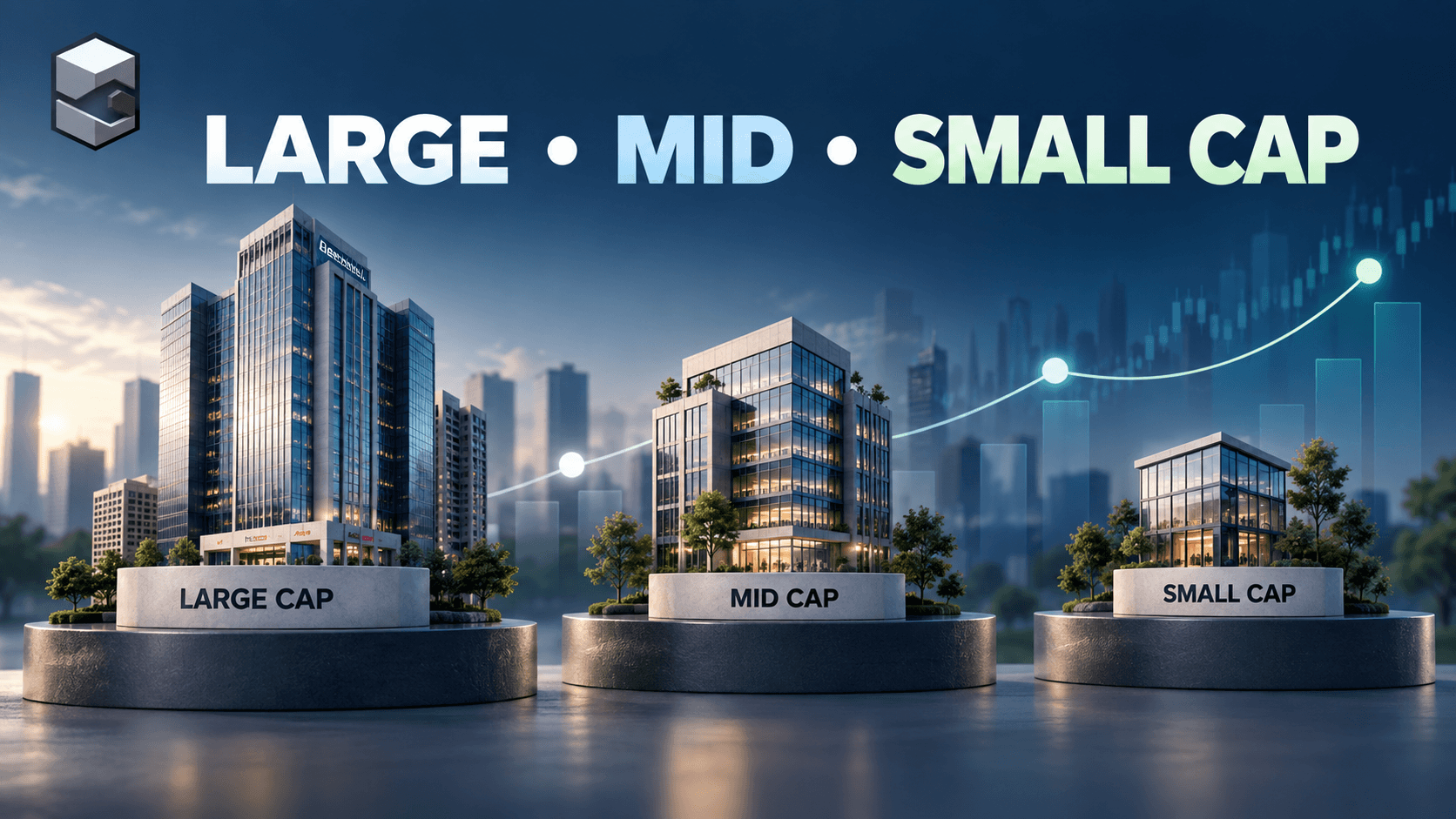
Understand large cap, mid cap and small cap mutual funds, their SEBI definitions, risk, growth potential and how to choose between them.
Large Cap vs Mid Cap vs Small Cap: Understanding Market Cap Categories
One of the first questions investors face after entering equity mutual funds is:
“Should I invest in large cap, mid cap or small cap?”
The answer should not be based only on which category delivered the highest return recently.
Large-cap, mid-cap and small-cap companies occupy different parts of India's equity market. Because their businesses, valuations and market behaviour can differ, the risk and return experience can also differ.
SEBI currently defines:
Large cap: companies ranked 1st to 100th by full market capitalisation
Mid cap: companies ranked 101st to 250th
Small cap: companies ranked 251st onwards
SEBI requires mutual funds to use the applicable AMFI list for these classifications, with the list updated periodically.
So when an investor asks about large cap mid cap and small cap, they are really comparing three different segments of the equity market.
Large cap vs mid cap vs small cap at a glance
Feature | Large Cap | Mid Cap | Small Cap |
|---|---|---|---|
Market-cap ranking | 1–100 | 101–250 | 251 onwards |
Typical business maturity | Generally more established | Growing / established | Often smaller businesses |
Volatility | Generally lower than mid/small | Higher than large | Generally highest |
Growth potential | More established growth profile | Higher growth potential may exist | Potentially high, but with higher risk |
Suitable horizon | Long term | Long term | Usually requires a high tolerance for volatility |
Key risk | Valuation / market risk | Business + valuation risk | Higher volatility, liquidity and business risk |
These are broad characteristics, not guarantees about every company or every mutual fund.
What is a large-cap company?
A large-cap company is currently defined by SEBI as one of the top 100 companies by full market capitalisation.
These companies are generally among the more established businesses in the market.
That can make large-cap funds attractive to investors who want equity exposure but may not be comfortable with the higher volatility associated with smaller companies.
However, large-cap does not mean risk-free.
A large company can still face:
economic slowdowns
industry disruption
falling earnings
regulatory changes
valuation declines
broad market corrections
An investor should therefore think of large cap as relatively more established equity exposure, not as a guaranteed-return category.
What is a mid-cap company?
Mid-cap companies are currently ranked 101st to 250th by full market capitalisation under SEBI's classification.
Mid-cap businesses sit between the large and small segments.
They can have greater room to expand than mature large companies, but investors generally accept greater uncertainty in return.
This creates a trade-off:
More growth potential can come with more volatility.
That is why mid-cap funds often need a longer investment horizon than investors may initially expect.
What is a small-cap company?
Small-cap companies are ranked 251st onwards under the current SEBI definition.
Small-cap businesses can include companies that are still relatively small compared with India's largest listed companies.
Their future outcomes can vary widely.
Some businesses can grow rapidly.
Others may struggle with:
competition
financing conditions
economic slowdowns
weaker liquidity
business-model problems
This is why small-cap funds can experience sharper price movements.
Kuberzo's blogs also highlights higher volatility and liquidity risk as important considerations for investors.
Is small cap always better because it has higher growth potential?
No.
This is one of the most common mistakes.
The fact that a company is smaller does not mean it will automatically become larger or generate higher returns.
The potential for faster growth comes with greater uncertainty.
Imagine two companies.
Company A is already a very large business.
Company B is much smaller.
For Company A to double in size, it needs to add a very large amount of business.
For Company B, rapid percentage growth may be easier.
But Company B may also have fewer resources, a smaller customer base or higher sensitivity to economic conditions.
So:
Small size creates potential, not certainty.
Large cap vs mid cap: what is the difference?
The biggest difference is the position of the companies in the market-cap hierarchy.
Large caps are the top 100.
Mid caps are 101–250.
From an investor's perspective, the practical question is risk.
Large-cap exposure may be easier to hold through market volatility because the underlying businesses are generally more established.
Mid-cap exposure introduces a higher degree of growth and business risk.
This does not mean mid caps will outperform large caps in every period.
Market leadership changes over time.
Mid cap vs small cap: which is riskier?
Small caps generally involve greater volatility and uncertainty than mid caps.
This is not simply because their stock prices move more.
Smaller companies can also face greater business, liquidity and financing risks.
Therefore, an investor considering a small-cap fund should be prepared for periods in which the investment falls significantly.
A SIP can help investors invest systematically, but a SIP does not remove investment risk.
Large cap vs small cap: which should a beginner choose?
A beginner should not choose solely based on age.
“I'm 25, so I should invest in small cap” is not a complete investment argument.
Risk capacity depends on much more than age.
Consider:
income stability
emergency savings
debt
financial obligations
investment horizon
experience
emotional tolerance for losses
SEBI's Riskometer is intended to help investors understand scheme risk, while a broader personal risk assessment should consider the investor's own financial circumstances.
Kuberzo's Portfolio Review also focuses on allocation, fund overlap, category selection and whether a portfolio is aligned with financial goals.
Do you need separate large-cap, mid-cap and small-cap funds?
No.
This is another common misconception.
You can potentially use one appropriately selected diversified category rather than buying three funds simply because the market has three segments.
The right number of funds depends on the investor's overall portfolio.
Adding more funds does not automatically create better diversification.
Two funds can hold many of the same stocks.
Kuberzo highlights fund overlap as a portfolio issue because multiple schemes can end up investing in similar securities.
What is flexi cap vs multi cap?
This is where the roadmap's primary keyword becomes relevant.
A Flexi Cap Fund is an equity scheme that can invest across large-, mid- and small-cap stocks. Under SEBI's current category framework, flexi-cap funds must invest at least 65% of total assets in equity and equity-related instruments and can move across the market-cap spectrum.
A Multi Cap Fund must invest at least 75% of total assets in equity and equity-related instruments, with at least 25% each in large-cap, mid-cap and small-cap stocks under the current framework.
So the major distinction is:
Flexi cap = greater freedom to change market-cap allocation.
Multi cap = mandatory minimum exposure to all three major market-cap segments.
That is why flexi cap vs multi cap is an important comparison for an investor who wants exposure to multiple market-cap categories through one fund.
Flexi cap vs multi cap: which is better?
Again, there is no universal winner.
A flexi-cap fund gives the fund manager more flexibility to decide where to allocate across large, mid and small companies.
A multi-cap fund must maintain minimum exposure to each of those segments.
For an investor who wants a more explicitly diversified market-cap structure, a multi-cap fund may be attractive.
For an investor who prefers a manager to have greater freedom to adjust allocation, a flexi-cap fund may be more suitable.
The important point is that you should understand the category rules before comparing fund performance.
Can one fund replace all three categories?
Potentially, yes.
An appropriately selected flexi-cap or multi-cap fund can provide exposure across multiple market-cap segments.
But that does not mean every such fund is identical.
Portfolio construction, concentration, risk, valuation and fund-manager decisions still matter.
Investors should therefore avoid assuming:
“Multi cap = automatic diversification = no risk.”
Diversification reduces concentration in one segment but does not eliminate equity-market risk.
What happens during a market crash?
This is where category differences become easier to understand.
Suppose the equity market declines sharply.
A large-cap portfolio can fall.
A mid-cap portfolio can fall.
A small-cap portfolio can also fall, potentially with greater volatility.
There is no rule that says a small-cap fund must fall every time the large-cap index falls.
But the investor should be prepared for greater fluctuations in smaller companies.
This is particularly important when the investor may need the money soon.
How long should you invest in these categories?
Equity investing should generally be approached with a long-term mindset, particularly when using higher-volatility segments.
The exact horizon should depend on the investor's goal rather than a universal number.
For example:
Illustrative example
Neha needs ₹5 lakh for a house down payment in 18 months.
Putting that money into a highly volatile small-cap investment simply because she wants higher returns may be inappropriate for the goal.
Now consider Arjun, who is investing for retirement 25 years away.
Arjun can potentially absorb more short-term volatility because his goal is much further away.
The same small-cap fund can therefore be unsuitable for one goal and potentially relevant for another.
Which category has the highest risk?
Broadly:
Large cap → lower relative volatility
Mid cap → higher volatility
Small cap → highest relative volatility
But these are broad tendencies, not guarantees.
A highly concentrated large-cap fund can also carry meaningful risk.
Similarly, a particular small-cap fund may behave differently from another small-cap fund.
Therefore, category alone should not be the final selection criterion.
Common mistakes investors make
Chasing the previous year's winner
A category that performed exceptionally well recently may not repeat that performance.
Assuming young age means unlimited risk capacity
Age helps with time horizon, but financial responsibilities and behaviour matter too.
Buying three funds for the sake of diversification
More funds can create overlap rather than useful diversification.
Ignoring valuation
A good company can still be an expensive investment.
Treating small-cap as a shortcut to high returns
Higher potential comes with higher uncertainty.
Ignoring the goal
A retirement investment and a three-year goal should not necessarily have the same equity exposure.
How should you choose between large, mid and small cap?
Use a simple sequence.
Step 1: Start with the goal
Ask when the money will be required.
Step 2: Assess risk capacity
A portfolio should fit both your financial situation and ability to tolerate losses.
Step 3: Decide the role of equity
Do not select a cap category before deciding how much equity exposure the overall portfolio should have.
Step 4: Select the category
Choose between large, mid, small, flexi and multi cap according to the role the investment needs to play.
Step 5: Check the actual portfolio
Two funds within the same category may have very different portfolios.
Step 6: Review, don't react
Market-cap leadership changes.
Portfolio decisions should not be based on every short-term market movement.
What should a long-term investor remember?
The question is not:
“Which cap has the highest return?”
It is:
“Which level of market-cap exposure can I hold through difficult periods without abandoning my investment plan?”
A category that looks attractive in a bull market may feel very different during a correction.
The ability to stay invested can matter as much as choosing the category.
Frequently Asked Questions
What is large cap, mid cap and small cap?
SEBI currently classifies companies as large cap if they rank 1–100 by full market capitalisation, mid cap if they rank 101–250, and small cap from 251 onwards.
Which is safer, large cap or small cap?
Large-cap exposure is generally less volatile than mid- and small-cap exposure, but no equity category is risk-free.
Which has higher growth potential?
Mid- and small-cap companies can have greater growth potential, but potential is accompanied by greater uncertainty and volatility.
Is small cap suitable for beginners?
It depends on the investor's financial situation, time horizon and ability to tolerate large fluctuations. Being young alone does not make small caps automatically suitable.
Can a flexi-cap fund replace separate large, mid and small-cap funds?
It can provide broad exposure through one fund, but investors should still examine its actual portfolio, concentration and risk characteristics.
Is SIP safer for small-cap funds?
SIP changes the investment method, not the underlying risk of the small-cap fund. Market fluctuations can still affect the investment.