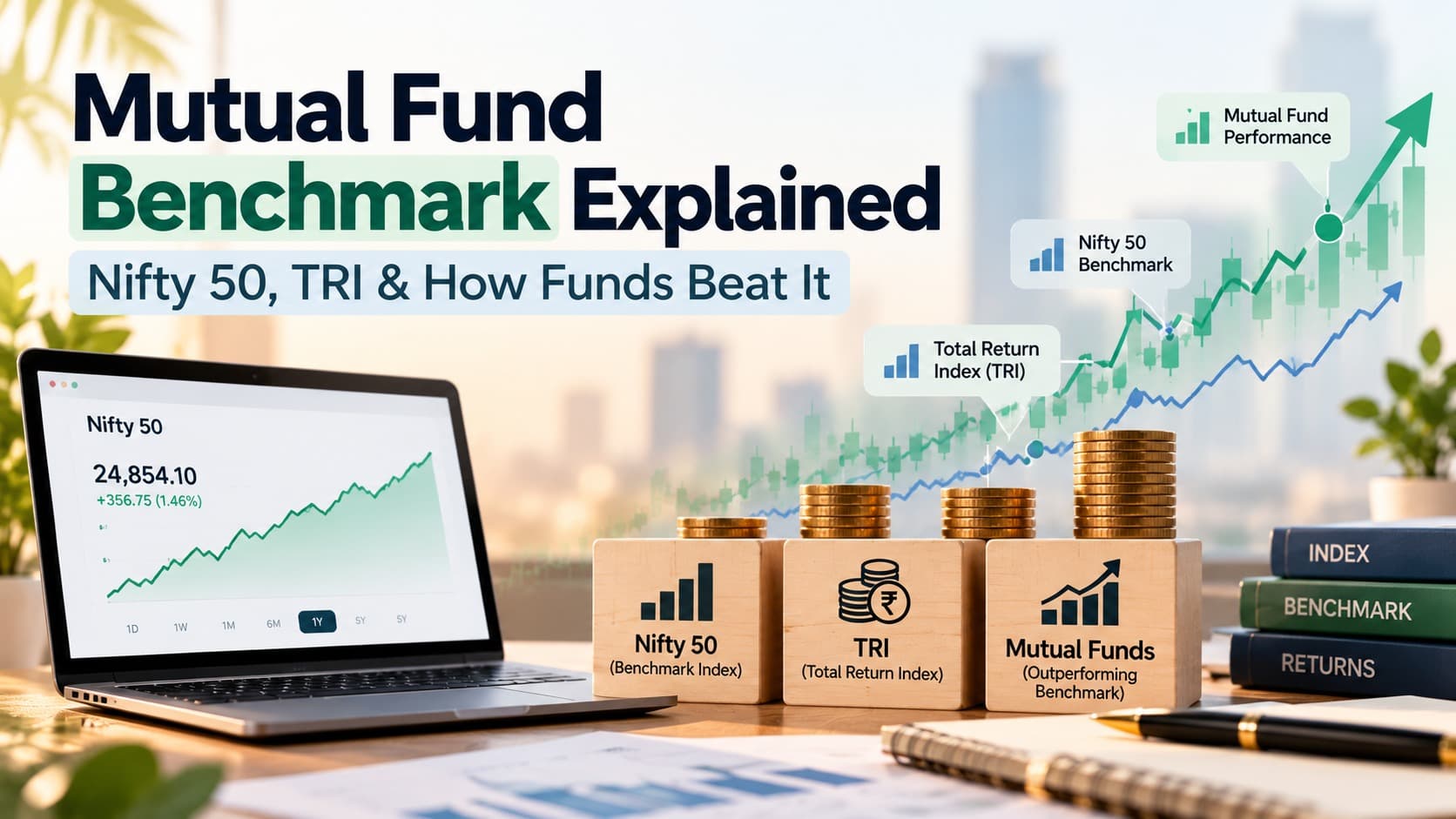
Mutual Fund Benchmark Explained: Nifty 50, TRI & How Funds Beat It
By Amrita Sinha
About the Author
Amrita Sinha is a content strategist with experience in SEO, digital marketing, and financial content. She writes easy-to-understand, research-backed articles on investing, personal finance, taxation, and wealth management for Kuberzo.
Learn what a mutual fund benchmark is, how the Nifty 50 and Total Return Index work, and how to compare fund performance against its benchmark.
When evaluating a mutual fund, investors often focus on its returns. A fund delivering 15% annual returns may appear attractive, but is that performance actually good? The answer depends partly on how the broader market performed during the same period.
This is where a mutual fund benchmark becomes important. A benchmark provides a reference point against which a fund's performance can be evaluated. For example, an equity fund investing primarily in large Indian companies may use an appropriate market index to assess whether it has added value through its investment strategy.
However, comparing returns requires more than looking at two percentages. Investors need to understand the index being used, the role of the Total Return Index (TRI), the fund's investment category and the period being evaluated.
Understanding what a benchmark is in mutual fund investing can help investors make more informed comparisons instead of selecting funds based only on their recent returns.
What Is a Benchmark in a Mutual Fund?
A benchmark is an index or reference measure used to evaluate a mutual fund's performance. It represents a defined group of securities or an investment strategy against which the fund can be compared.
For example, a large-cap equity fund may use a broad-market or large-cap index as its benchmark. A debt mutual fund, on the other hand, may use a suitable bond index based on its investment category and portfolio characteristics.
The benchmark helps answer a practical question: did the fund perform better or worse than the market segment it aims to represent?
A benchmark does not guarantee returns or indicate whether a fund will perform well in the future. It is a comparison tool that provides context for evaluating investment performance.
How Does the Nifty 50 Benchmark Index Work?
The Nifty 50 benchmark index tracks the performance of 50 major companies listed on the National Stock Exchange of India, selected according to the index's methodology.
It is widely used as a reference for large-cap Indian equities and can help investors understand how a portfolio performs relative to this segment of the market.
For example, suppose an equity mutual fund delivers a return of 12% over a particular year, while its relevant benchmark delivers 10% over the same period. The fund has outperformed its benchmark by 2 percentage points before considering whether the comparison uses matching return conventions and periods.
However, the Nifty 50 is not the appropriate benchmark for every mutual fund. A small-cap fund, international equity fund or debt fund has a different investment universe and should generally be compared with a benchmark suited to its strategy.
The key is to compare like with like.
What Is Total Return Index (TRI)?
The Total Return Index (TRI) is an important concept when comparing mutual fund returns with benchmark returns.
A price index measures changes in the prices of its constituent securities. A Total Return Index also accounts for reinvested dividends, subject to the index's methodology.
This distinction matters because dividends contribute to the overall return generated by equities. Comparing a mutual fund's total return with only the benchmark's price return can make the fund's performance appear stronger than it actually is.
For a fairer comparison, investors should generally compare a fund's returns with the appropriate TRI benchmark over the same period.
For example, if a fund earns 13% over a year and its TRI benchmark earns 12%, the fund has delivered 1 percentage point of outperformance for that period. This comparison is meaningful only if the return periods, calculation methods and relevant benchmark are consistent.
TRI is therefore an essential part of evaluating benchmark vs mutual fund performance.
How Do Mutual Funds Beat Their Benchmark?
Investors often want to understand how mutual funds beat benchmark indices. Active mutual funds attempt to outperform their benchmarks through investment decisions made by the fund manager.
These decisions may include:
Stock selection: Choosing securities that the fund manager expects to perform better than the broader market.
Sector allocation: Holding relatively more or less exposure to particular industries based on the investment strategy.
Portfolio positioning: Adjusting investments according to valuations, earnings expectations and other research.
Risk management: Managing concentration and exposure within the scheme's mandate.
Cash management: Holding cash when permitted by the scheme's strategy, although this can also reduce returns when markets rise.
However, active management does not guarantee outperformance. A fund may underperform because of incorrect stock selection, unfavourable sector allocation, higher expenses or market conditions that do not favour its investment approach.
A fund's performance should therefore be evaluated over suitable periods, not just during a short rally or market correction.
Why Does a Benchmark Matter in Mutual Funds?
Understanding why a benchmark matters in mutual funds helps investors separate absolute returns from relative performance.
Consider two hypothetical equity funds:
Performance Measure | Fund A | Fund B |
One-year fund return | 14% | 11% |
Relevant benchmark return | 16% | 9% |
Outperformance or underperformance | -2 percentage points | +2 percentage points |
A mutual fund portfolio review can help you evaluate your existing holdings, diversification and exposure to different market segments.
Fund A delivered a higher absolute return, but it underperformed its benchmark. Fund B earned less in absolute terms but outperformed its benchmark.
This does not automatically make Fund B the better investment. Investors must also consider risk, consistency, costs, investment objectives and whether the funds are being compared over the same period.
Benchmark comparison adds context to returns and helps investors assess whether a fund's strategy has delivered value relative to its intended market exposure.
SEBI Rules on Mutual Fund Benchmarks
The SEBI rules on mutual fund benchmark selection are intended to support meaningful performance comparison and disclosure.
Mutual fund schemes disclose their benchmarks in scheme-related documents and periodic reporting. The selected benchmark should be appropriate to the scheme's investment objective and strategy, allowing investors to evaluate performance against a relevant reference.
Investors should check the scheme's current benchmark and any changes disclosed by the asset management company. They should also review whether the benchmark is a price index or a TRI when comparing returns.
Regulatory requirements and disclosure practices may evolve, so investors should refer to the latest applicable SEBI regulations, circulars and scheme documents rather than relying on outdated information.
How to Track Mutual Fund Performance Against an Index
Tracking mutual fund against index performance involves comparing the scheme's returns with its relevant benchmark over consistent periods.
Here are five factors to consider:
Choose the correct benchmark: Ensure the index reflects the fund's investment category and strategy.
Compare matching periods: Use the same start and end dates for the fund and benchmark.
Use TRI where appropriate: Compare total returns with total returns, including reinvested dividends.
Review multiple periods: Examine one-year, three-year and five-year performance where available, rather than relying on a single period.
Consider costs and risk: Review the expense ratio, portfolio risk and consistency of performance.
It is also useful to distinguish active funds from index funds. An active fund generally aims to outperform its benchmark, while an index fund aims to track its benchmark as closely as possible, subject to costs and tracking differences.
For passive funds, tracking difference and tracking error can provide additional insight into how closely the fund follows its index.
Conclusion
A mutual fund benchmark provides an essential reference point for understanding investment performance. The Nifty 50 can be useful for evaluating certain large-cap equity strategies, while other funds require benchmarks that reflect their own investment universe.
The Total Return Index is especially important because it includes reinvested dividends, making it more suitable for comparing total investment returns with a fund's total return.
Ultimately, strong mutual fund evaluation goes beyond identifying which scheme has delivered the highest return. Investors should compare the fund with an appropriate benchmark, examine performance across multiple periods and consider risk, costs and investment objectives.
Benchmark performance should also be considered alongside your long-term financial goals, investment horizon and ability to tolerate market fluctuations. A benchmark is not a prediction of future performance. It is a tool that helps investors understand what their fund has delivered relative to the market it is designed to represent.
Frequently Asked Questions
What is a benchmark in a mutual fund?
A benchmark is an index or reference measure used to evaluate a mutual fund's performance. It helps investors understand whether a scheme has outperformed or underperformed the market segment it represents.
Why is the Nifty 50 used as a mutual fund benchmark?
The Nifty 50 tracks 50 major companies listed on the NSE and serves as a reference for certain large-cap equity strategies. However, the appropriate benchmark depends on the mutual fund's investment objective and portfolio.
What is the difference between a price index and a Total Return Index (TRI)?
A price index measures changes in the prices of its constituent securities. A TRI also accounts for dividends reinvested according to the index methodology, making it useful for comparing total investment returns.
Can a mutual fund consistently beat its benchmark?
Some funds outperform their benchmarks over certain periods, but consistent outperformance is not guaranteed. Results depend on investment decisions, market conditions, expenses and the fund's strategy.
How often should I compare my mutual fund with its benchmark?
Reviewing performance periodically, such as quarterly or annually, can help you assess a fund's progress. Longer-term comparisons across consistent periods can provide useful context, but short-term underperformance alone does not necessarily justify switching funds.