How to Manage Your First Salary in India: A Complete Beginner's Guide
By Rajnish
About the Author
An MBA student with an interest in finance and wealth management, contributing insights on mutual funds, investment strategies, market trends, and financial planning to help readers make informed investment decisions.
Learn how to manage your first salary in India with simple budgeting, emergency fund tips, and smart investing. Perfect guide for freshers starting their financial journey.
How to Manage Your First Salary in India: A Complete Beginner's Guide
Getting your first salary is a big moment. But many young Indians feel confused about what to do next. Should you save? Should you invest? Should you send money home? This guide answers those questions with simple, practical steps.
What Is the Best Way to Manage a First Salary?
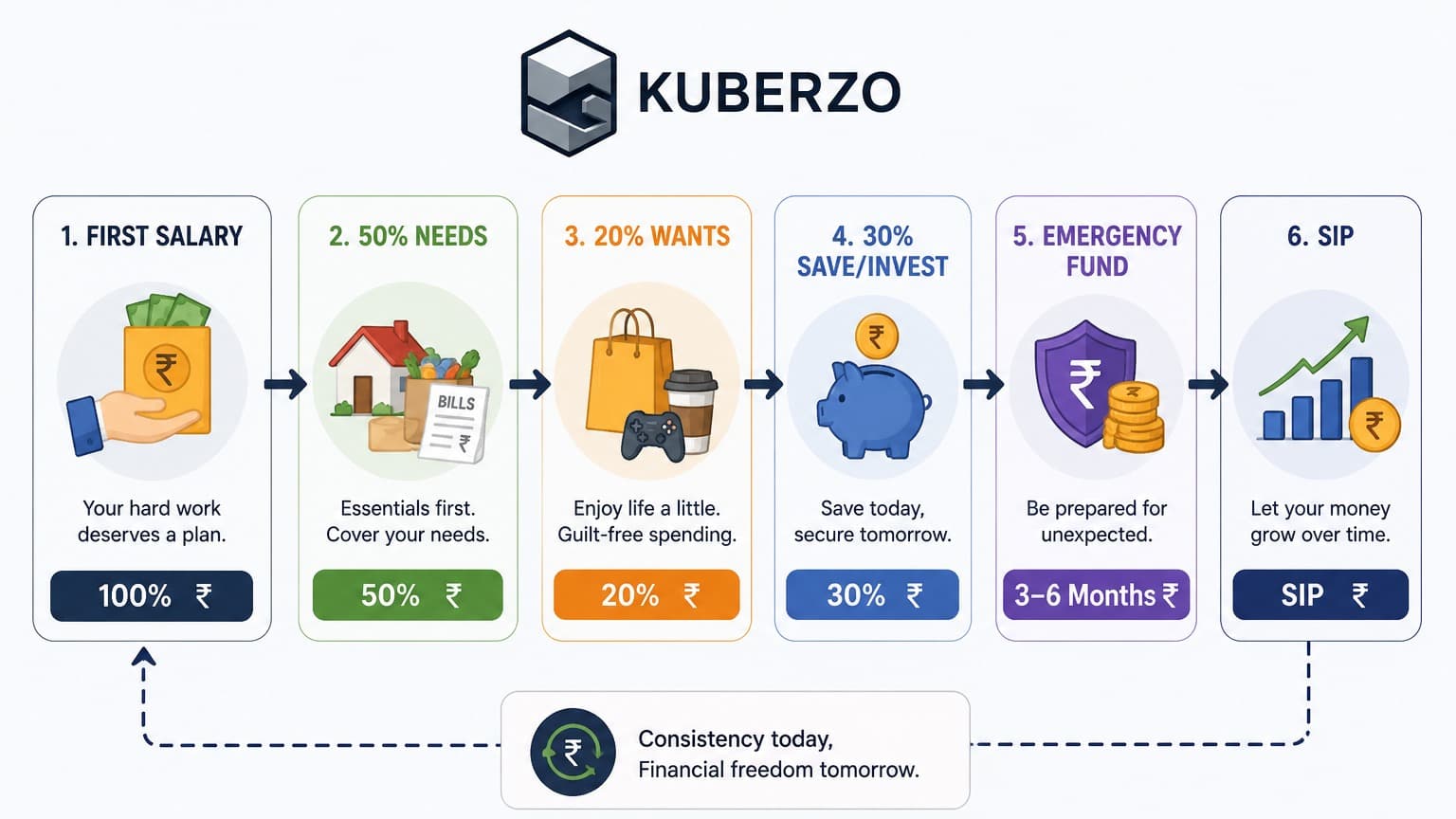
There is no single perfect way. But a simple rule works for most beginners: divide your salary into three parts — needs, wants, and future. A popular method is the 50-30-20 rule, where 50% goes to needs, 30% to wants, and 20% to savings and investments. For Indian freshers, we suggest a modified version: 50% needs, 20% wants, 30% savings and investments. This higher savings rate helps you build a safety net early.
Before spending anything, transfer your savings portion out of your salary account on the day you get paid.
Step 1: Track Where Your Money Goes
Most first-jobbers have no idea where their salary disappears. The first step is not budgeting — it is tracking.
Spend one month noting every expense. Use a simple notebook or an expense tracking app.
Explanation: When you track expenses, you see patterns. You might spend ₹8,000 on food delivery without realising it. Awareness comes before control.
Illustrative example: Rahul earns ₹35,000 per month. After tracking, he finds: rent ₹10,000, food ₹8,000, transport ₹3,000, entertainment ₹6,000, miscellaneous ₹3,000. That leaves only ₹5,000 unaccounted for. Tracking showed him that "miscellaneous" was mostly impulse online shopping.
Use the Kuberzo SIP Calculator to see how much even ₹2,000 per month can grow over time. This visual motivates you to control spending.
Step 2: Build a Mini Emergency Fund First
Before investing, save at least one month of essential expenses in a separate savings account. Eventually, build this to three months.
Explanation: SEBI's investor education guidelines recommend building an emergency fund of at least 3 to 6 months of essential expenses as a financial planning baseline for salaried households in India.
For a fresher, even one month is a good start. This fund prevents you from borrowing or selling investments during emergencies.
Illustrative example: Priya's essential expenses are ₹18,000 (rent, food, transport, phone bill). Her first goal: save ₹18,000 in a digital savings account offering 4-6% interest. She puts aside ₹4,500 per month and reaches this in 4 months.
Keep this money in a separate account. Do not mix it with your spending money.
Step 3: Start a Small SIP
Yes, you can start investing with your first salary, even ₹500 per month.
Explanation: A Systematic Investment Plan (SIP) allows you to invest a fixed amount regularly in mutual funds. You can start with as little as ₹500 per month in many mutual fund schemes
. The power of compounding works best when you start early.
Illustrative example: If you start a ₹2,000 monthly SIP at age 22 and continue until age 50, assuming a 12% average annual return, you could accumulate approximately ₹63 lakh. If you delay by just 5 years and start at 27, the same SIP grows to only about ₹34 lakh. Starting early matters more than starting big.
Start with ₹500 or ₹1,000. Increase it by 10% every year when you get a salary hike. Use Kuberzo's Top-Up SIP Calculator to plan this increase.
Step 4: Understand Your Tax Situation
Under the new tax regime for FY 2026-27, income up to ₹12 lakh is tax-free for resident individuals, and up to ₹12.75 lakh for salaried individuals after the standard deduction of ₹75,000
.
Explanation: Most freshers earning under ₹12 lakh per year pay zero tax under the new regime. This means you do not need to rush into tax-saving investments like ELSS or PPF unless your income crosses this limit or you choose the old tax regime.
If your CTC is under ₹12 lakh, focus on growth-oriented investments rather than tax-saving ones. You can revisit tax planning when your income grows.
Step 5: Avoid Lifestyle Inflation
Lifestyle inflation means spending more simply because you earn more. It is the biggest enemy of wealth building.
Explanation: Many first-jobbers upgrade their phones, shift to expensive flats, or start eating at costly restaurants within months of getting a job. This habit eats into money that could have been invested.
Follow the "one-month rule": wait one month before any purchase above ₹5,000. If you still need it, buy it. Most impulse desires fade within days.
Step 6: Set One Clear Financial Goal
Pick one goal for your first year — not five.
Explanation: Trying to save for a car, a Europe trip, a house, and retirement all at once leads to confusion and inaction. Pick one. For most freshers, the first goal should be: "Build a 3-month emergency fund and start one SIP."
Write your goal down. "By December 2026, I will have ₹60,000 in my emergency fund and a running SIP of ₹3,000 per month." Specific goals get achieved.
Key Takeaway for First Salary Earners
Managing your first salary is not about perfection. It is about building three habits: tracking expenses, saving before spending, and starting small with investments. Get these three right, and you will be ahead of most people by the time you turn 30.
Frequently Asked Questions
Is my salary too low to start investing?
No. You can start a SIP with ₹500 per month. What matters is consistency, not the amount.
Should I build an emergency fund or start an SIP first?
Build at least a 1-month emergency fund first. Then start an SIP alongside building the fund to 3 months.
How much should I send home from my first salary?
This depends on your family situation. Budget for this as a "need" if it is a genuine family obligation. Do not borrow to send money home.
Should I buy life insurance with my first salary?
If you have no financial dependents, term life insurance is not urgent. Focus on health insurance first.
Can I stop my SIP if I need money?
Yes, but this breaks your compounding journey. That is why an emergency fund is important — it protects your SIP.
What if my employer does not give me a salary slip?
Ask for one. You need it for KYC, tax filing, and loan applications in the future.
Is it okay to spend on enjoyment?
Yes. Budget for it. The 50-30-20 rule includes "wants." The problem is unplanned spending, not planned enjoyment.