How to Build a 3-Month Emergency Fund on a Starter Salary
By Rajnish
About the Author
An MBA student with an interest in finance and wealth management, contributing insights on mutual funds, investment strategies, market trends, and financial planning to help readers make informed investment decisions.
Learn how to build a 3-month emergency fund in India on a starter salary, calculate essential expenses, choose where to keep it and save faster.
How to Build a 3-Month Emergency Fund on a Starter Salary
Starting your first job can create a strange financial situation. Your income is finally regular, but your expenses also increase. Rent, food, transport, EMIs, phone bills, family responsibilities and daily spending can quickly absorb most of a starter salary.
That creates a common question:
How can I build an emergency fund when I don't have much money left after my monthly expenses?
The answer is to start smaller than the final target.
For many people, a useful starting point is an emergency fund covering around three to six months of essential expenses. NISM explains that the purpose of an emergency fund is safety and liquidity rather than chasing high returns, while noting that many financial advisers suggest three to six months of household expenses.
Kuberzo's own recent financial-planning guidance similarly uses three to six months of essential expenses as a common starting point.
If you're starting your first job, you do not need to produce the full amount in one month.
You need a plan to build it.
What exactly is a 3-month emergency fund?
A three-month emergency fund means having enough readily accessible money to cover approximately three months of essential expenses.
It does not necessarily mean three months of salary.
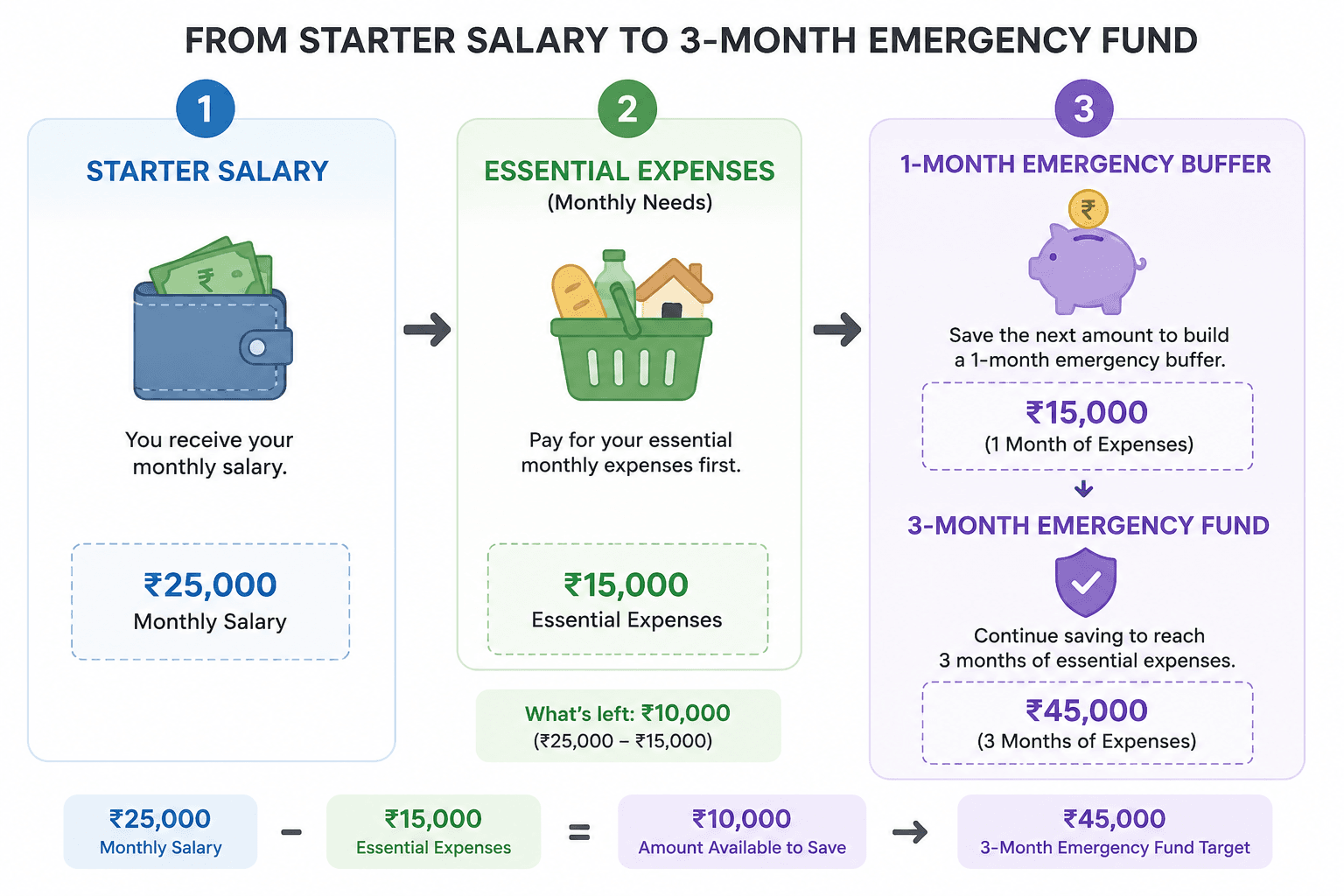
Suppose your monthly take-home salary is ₹25,000, but your essential monthly expenses are ₹15,000.
Your three-month target would be:
₹15,000 × 3 = ₹45,000
The emergency fund is based on the spending that you would need to continue even during a financial shock.
Expenses that may count
Rent or essential housing costs
Groceries
Electricity and utilities
Necessary transport
Minimum loan obligations
Basic insurance premiums
Essential medical or family expenses
Expenses that generally should not determine the minimum target
Eating out
Weekend entertainment
Non-essential shopping
Luxury subscriptions
Vacations
Upgrading gadgets
Kuberzo's current financial-planning guidance also recommends calculating the reserve from essential monthly expenses rather than simply using income as the target base.
Why do beginners need an emergency fund?
An emergency fund is not an investment designed to maximise returns.
It is a financial buffer designed to stop an unexpected event from becoming a financial crisis.
NISM highlights situations such as loss of employment, loss of income and unexpected urgent expenses and explains that income can stop while expenses continue.
Imagine two freshers earning ₹30,000.
Both have ₹15,000 of essential monthly expenses.
The first has no emergency fund. The second has ₹45,000 in accessible savings.
If the first person suddenly loses their job, they may need to borrow, use a credit card or sell an investment during an unsuitable market period.
The second person has three months of essential expenses available while looking for another income source.
That is the real purpose of the emergency fund.
How much should you save on a starter salary?
There is no single percentage that works for every salary.
A better method is:
Monthly essential expenses × desired number of months = emergency-fund target
Here are some illustrative examples:
Starter salary Essential expenses 3-month target
₹15,000 ₹10,000 ₹30,000
₹20,000 ₹13,000 ₹39,000
₹25,000 ₹15,000 ₹45,000
₹30,000 ₹18,000 ₹54,000
These are illustrative examples, not recommendations for every household.
The actual target depends on job stability, dependents, debt, housing situation and other responsibilities.
For someone with unstable income or significant family responsibilities, a larger buffer may be appropriate. NISM notes that some advisers use higher targets, including six to twelve months, in situations where greater resilience is needed.
Should you aim for one month first or jump straight to three months?
For a beginner on a tight salary, aiming immediately for ₹45,000 or ₹60,000 can feel impossible.
A better psychological and practical approach is to build the fund in stages.
Stage 1: Build a mini emergency buffer
Start with a smaller amount that can cover an immediate unexpected expense.
For example, set an initial milestone of ₹5,000–₹10,000 depending on your circumstances.
The purpose is to stop every small surprise from becoming new debt.
Stage 2: Reach one month of essential expenses
If your essential expenses are ₹15,000, your first major milestone becomes ₹15,000.
Stage 3: Build towards three months
Once one month is complete, continue until you reach ₹45,000.
This approach does not change the ultimate target. It simply makes the journey manageable.
How much should you save each month?
Your monthly contribution should fit your cash flow.
Suppose your salary is ₹25,000 and essential expenses are ₹15,000.
You have ₹10,000 remaining before considering discretionary spending and other financial goals.
You might decide to direct ₹4,000 every month towards the emergency fund.
At that pace:
₹45,000 ÷ ₹4,000 = 11.25 months
So the three-month target would take roughly 12 months, ignoring interest.
That may look slow, but it is better than setting an unrealistic target that forces you to borrow money midway.
The alternative is to increase the contribution when you receive a bonus, tax refund, freelance payment or salary hike.
Should you stop investing until the emergency fund is complete?
Not always.
For someone with no emergency savings at all, building a basic financial safety net usually deserves priority before making aggressive long-term investments.
At the same time, Kuberzo's current guidance notes that saving and investing can sometimes happen together, depending on income, expenses and circumstances.
Consider two situations.
Situation A: You have ₹0 saved, unstable income and high monthly obligations.
Here, building emergency savings should probably receive most of the available surplus.
Situation B: You already have one month of essential expenses saved and have a stable job.
You may choose to continue building the emergency fund while also making a manageable long-term investment contribution.
The key is not to empty your emergency savings in the name of investing.
Where should you keep the emergency fund?
The priority is accessibility and stability, not maximum returns.
NISM explicitly states that the primary objectives of an emergency fund should be safety and liquidity. It notes that bank savings and other accessible avenues can be used and that some investors may also use liquid mutual funds.
Savings account
A savings account is easy to access and simple to understand.
For many beginners, keeping at least part of the emergency fund here can make practical sense.
Fixed deposit
An FD may provide a structured way to keep savings separate from everyday spending. The investor should consider premature-withdrawal rules and accessibility before using it for emergency money.
Liquid mutual fund
Some investors use liquid mutual funds for emergency reserves. However, they are mutual funds, not bank deposits, and are not covered by DICGC deposit insurance. NISM specifically notes liquid mutual funds as one possible avenue while emphasising that safety and liquidity are the objective.
For a beginner, the priority should be understanding the product rather than selecting an option simply because it may offer a higher expected return.
Is bank deposit insurance relevant to an emergency fund?
Yes, especially as your savings grow.
DICGC currently insures eligible bank deposits such as savings and fixed deposits up to ₹5 lakh per depositor per bank, covering principal and interest within the applicable limit. Deposits maintained in different branches of the same bank are aggregated for this purpose.
This does not mean investors should automatically split every emergency fund across banks. It simply means that the deposit-insurance limit is worth understanding when a cash reserve becomes substantial.
Mutual funds, stocks and bonds are not covered by DICGC deposit insurance.
What if your emergency fund target is ₹60,000 and your salary is only ₹20,000?
This is where realistic budgeting matters.
Suppose:
Salary: ₹20,000
Essential expenses: ₹13,000
Available balance: ₹7,000
Rather than assuming the entire ₹7,000 can be saved, first allow for reasonable variable spending and other genuine obligations.
Suppose you can consistently save ₹3,000 every month.
Your ₹39,000 three-month target would then take around 13 months, ignoring interest.
That is not a failure.
It is a sustainable savings plan.
You could also direct windfalls such as annual bonuses or one-time income toward the emergency fund to shorten the timeline.
What should you do if you already have debt?
Debt changes the calculation.
Kuberzo's current financial-planning guidance notes that high-interest debt deserves particular attention because the interest cost can make aggressive investing difficult.
A sensible approach for many beginners is to build a basic cash buffer first, then review expensive debt before aggressively increasing long-term investments.
For example, carrying costly revolving debt while simultaneously investing large amounts may not make sense financially.
The exact decision depends on the interest rate, type of debt, repayment terms and personal circumstances.
What should you not use the emergency fund for?
An emergency fund should have a clear job.
A broken refrigerator, sudden medical cost, temporary job loss or urgent family expense may qualify.
A new smartphone because your current one looks old does not.
A holiday because flights are on sale does not.
Regular monthly overspending does not.
The reason for this discipline is simple: if the fund becomes a general spending account, it stops functioning as a financial safety net.
What happens after you use the emergency fund?
Rebuild it.
Suppose your three-month target is ₹45,000 and an unexpected event requires ₹20,000.
Your remaining reserve is ₹25,000.
The next financial priority should be restoring the fund toward the intended target.
Do not assume that one emergency means you have failed.
The emergency fund is supposed to be used when a genuine emergency occurs.
Its job is to absorb the shock.
How often should you review the emergency fund?
At least once a year, and whenever your circumstances materially change.
Your target should be reconsidered after:
A salary increase
A major rent change
Marriage
A new dependent
A new loan or EMI
A job change
Moving to a more expensive city
A major change in family responsibilities
Suppose your essential expenses rise from ₹15,000 to ₹20,000.
Your previous three-month target was ₹45,000.
Your new target becomes:
₹20,000 × 3 = ₹60,000
The fund should evolve as your financial life changes.
A simple starter-salary action plan
A beginner can use this sequence:
1. Calculate essential monthly expenses.
Do not start with your salary. Start with the expenses that would continue during a financial emergency.
2. Set the three-month target.
Multiply essential monthly expenses by three.
3. Create a smaller first milestone.
One month—or even a mini cash buffer—is easier to achieve than the final target.
4. Automate the monthly contribution.
Move the planned savings shortly after receiving your salary instead of waiting to see what remains at month-end.
5. Keep the emergency fund separate.
Separation reduces the temptation to spend it.
6. Use windfalls strategically.
A bonus, tax refund or unexpected income can help accelerate the target.
7. Refill the fund after using it.
Treat the new shortfall as a financial task, not as money permanently taken away.
Kuberzo's recent financial-planning article also recommends separating savings from investments and emphasises accessibility rather than maximising returns for emergency money.
For broader financial planning and investing decisions, readers can explore Kuberzo's financial calculators guide.
Should you use an SIP for your emergency fund?
Usually, an emergency fund and a long-term SIP have different jobs.
An equity mutual fund SIP is designed for investment goals and carries market risk. An emergency fund is designed to be available when you need it.
AMFI states that mutual funds are not guaranteed-return products and that their values can fluctuate.
That difference matters.
Imagine you invest your ₹45,000 emergency reserve in an equity fund and the market falls just when you lose your job. You may have to sell while the investment is below its previous value.
The problem is not that equity mutual funds are inherently unsuitable for long-term investors.
The problem is using a volatile investment for a job-loss fund that may be needed immediately.
What if you cannot build three months quickly?
Do not abandon the goal because you cannot reach it in three months.
A starter-salary emergency fund is a process.
Start with ₹5,000.
Then one month.
Then two months.
Then three.
Your first ₹5,000 may protect you from a small financial shock. Your eventual ₹45,000 or ₹60,000 reserve can provide much greater resilience.
The goal is not to keep large amounts of money idle forever.
The goal is to create enough financial breathing room that your long-term investments do not have to become your emergency ATM.
For readers beginning their broader investment journey, Kuberzo also provides a SIP page explaining disciplined long-term investing.
Final answer: How should a beginner build a 3-month emergency fund?
Start by calculating three months of essential expenses, then build the amount gradually through an affordable monthly contribution.
Do not use salary as a substitute for expenses. Do not chase returns with money that may be needed urgently. Do not treat the emergency fund as a regular spending account.
A starter salary does not make an emergency fund impossible.
It simply means the process may take longer.
Build a small buffer first. Reach one month. Keep moving towards three months. Review the target when your income or responsibilities change.
Once the financial foundation is stronger, long-term investing becomes easier to sustain because an unexpected expense is less likely to force you to interrupt your investment plan.
Important: This article is for general educational purposes and is not personalised financial advice. Emergency-fund requirements differ based on individual circumstances. Mutual funds are subject to market risks, and market-linked products should not be treated as substitutes for guaranteed or insured bank deposits.
Frequently Asked Questions
1. How much should a beginner keep in an emergency fund?
A commonly used starting point is around three to six months of essential expenses. The appropriate amount depends on income stability, dependents, debt and other responsibilities.
2. Should an emergency fund be based on salary or expenses?
It is generally more useful to calculate it from essential expenses because those are the costs you need to continue paying during a financial disruption.
3. Can I build an emergency fund while investing through an SIP?
Yes, depending on your financial situation. Someone with stable income and some existing emergency savings may be able to save and invest simultaneously.
4. Where should I keep emergency savings?
Accessibility and stability should be the priority. A savings account and other relatively liquid options can be considered depending on the situation.
5. Is a liquid mutual fund the same as a bank deposit?
No. A liquid mutual fund is a mutual fund and is not a bank deposit or DICGC-insured deposit.
6. Is ₹30,000 enough for a three-month emergency fund?
Only if your essential monthly expenses are around ₹10,000. The correct target depends on your own essential expenses.