Smallcase vs Mutual Funds: Curated Stock Baskets vs Managed Pools
By Amrita Sinha
About the Author
Amrita Sinha is a content strategist with experience in SEO, digital marketing, and financial content. She writes easy-to-understand, research-backed articles on investing, personal finance, taxation, and wealth management for Kuberzo.
Compare smallcase vs mutual funds on ownership, diversification, returns, charges, rebalancing and risk to understand which investment approach may suit you.
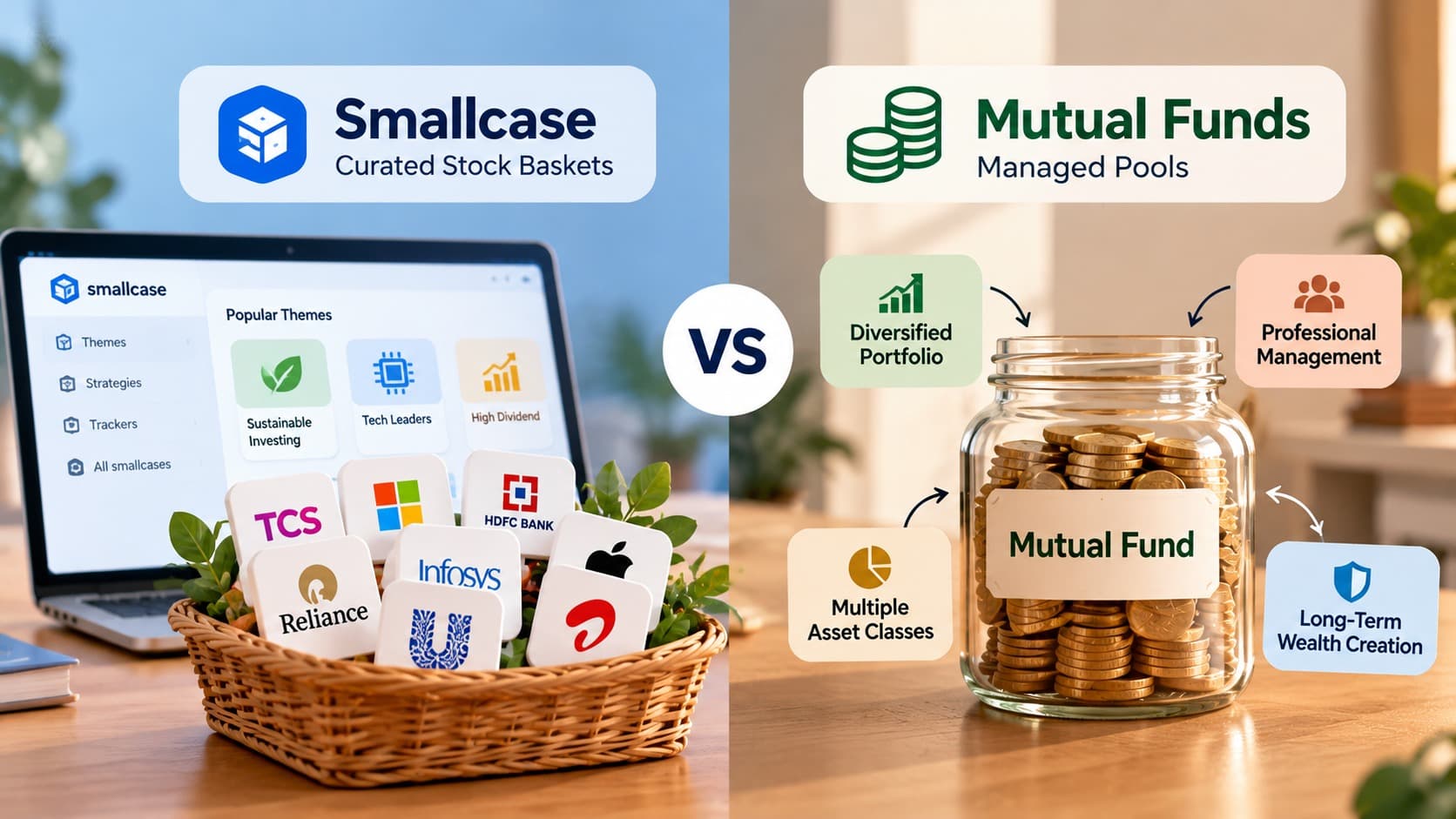
Investors today have more choices than simply buying individual stocks or putting money into a mutual fund. One option that has gained attention is a smallcase — a professionally curated or theme-based basket of stocks, ETFs or, in some cases, mutual funds. This creates an interesting comparison between smallcase vs mutual funds, particularly for investors who want diversification but also want more control over what they own.
At a basic level, the two approaches solve a similar problem in different ways. A mutual fund pools money from multiple investors and places it under the management of a fund manager according to a defined investment strategy. A smallcase, on the other hand, gives investors a basket of securities that follows a particular theme, strategy or objective, with the underlying stocks or ETFs held directly in the investor's demat account.
This difference in ownership and control is important. With a mutual fund, investors own units of the scheme rather than the underlying stocks directly. With a stock- or ETF-based smallcase, investors generally own the underlying securities in their own demat account. This can give them greater visibility and customisation, but it also means they need to understand the investments and manage portfolio changes when required.
The comparison also becomes more relevant when considering smallcase vs SIP. An SIP is simply a method of investing a fixed amount at regular intervals, most commonly in a mutual fund. Smallcases can also offer an SIP facility, but the underlying investment is a basket of securities rather than necessarily a pooled mutual fund portfolio.
So, is smallcase better than mutual funds? There is no universal answer. The better choice depends on how much control you want, your ability to evaluate individual securities, your investment horizon, risk tolerance, costs and willingness to participate in portfolio management.
For investors looking to review their existing mutual fund holdings, portfolio review can help assess fund performance, allocation, overlap, and costs.
Smallcase vs Mutual Funds: How Do They Work?
The most important difference is who makes the investment decisions and how you own the investments.
A mutual fund is managed by an AMC and its fund manager. The manager decides which securities to buy, sell or hold according to the scheme's mandate.
A smallcase is a basket created around a particular strategy or theme. It can be curated by a professional or created by the investor. When you invest in a stock- or ETF-based smallcase, the securities are held in your demat account rather than being pooled into a mutual fund scheme.
Feature | Small Case | Mutual Fund |
Ownership | Direct ownership of underlying stocks/ETFs | Units of a mutual fund scheme |
Investment decisions | Investor follows or customises a basket | Fund manager manages portfolio |
Diversification | Depends on the basket | Depends on scheme mandate |
Customisation | Generally higher | Limited |
Rebalancing | Investor applies portfolio updates | Managed by fund manager |
SIP | Available for eligible smallcases | Widely available |
Demat account | Required for stock/ETF smallcases | Not necessarily required |
Costs | Transaction, brokerage/statutory and possible subscription costs | Expense ratio and applicable charges |
Risk | Depends on securities and concentration | Depends on scheme and underlying portfolio |
Smallcase vs SIP: Are They Actually Comparable?
The smallcase vs SIP comparison needs one clarification: they are not exactly equivalent concepts. A smallcase is an investment product or portfolio structure, whereas an SIP is an investment method.
For example, an investor can invest ₹10,000 every month through an SIP into a mutual fund. The same investor may also use a smallcase's SIP facility to invest a fixed amount periodically into a basket.
Therefore, the more meaningful comparison is often smallcase vs mutual fund through SIP, rather than smallcase versus SIP itself.
The important question is what the regular investment is buying and who controls the portfolio.
If you are comparing different ways of investing regularly, understanding the difference between SIP and lump-sum investing can help you choose an approach that suits your investment goals.
Direct Equity Smallcase vs Fund Manager: Who Makes Better Decisions?
The direct equity smallcase vs fund manager question comes down to the level of control and responsibility an investor wants.
With a mutual fund, the fund manager is responsible for portfolio construction, security selection and rebalancing within the scheme's mandate.
With a smallcase, the basket may be professionally curated, but the investor ultimately owns the securities and executes the investment through their broker. Investors can also customise eligible smallcases, depending on the platform and portfolio structure.
This gives smallcase investors greater control but also greater responsibility.
If a smallcase is rebalanced, for example, the investor generally needs to apply the update, resulting in trades in the underlying securities. Smallcase states that rebalancing itself does not carry a separate platform rebalance charge, but normal brokerage and applicable taxes associated with the trades can apply.
Smallcase Rebalancing Cost: What Should Investors Consider?
Smallcase rebalancing cost is an important factor that can be overlooked when comparing returns.
When a basket is rebalanced, some securities may be sold while others are purchased. Even when there is no separate "rebalance fee", the transactions can involve brokerage and statutory charges.
There can also be tax implications when securities are sold at a gain.
This means an investor should not evaluate a smallcase solely on its published portfolio return. The actual investor experience can differ after transaction costs and taxes.
Smallcase also notes that its displayed historical performance calculations do not include transaction fees and related costs.
For investors who rebalance frequently, these costs can become more relevant.
Smallcase Charges vs Mutual Fund Expense Ratio: Which Costs More?
The smallcase charges vs mutual fund expense ratio comparison requires looking at how the costs are charged.
Mutual funds have a Total Expense Ratio (TER), which covers various costs of operating and managing the scheme. The expense is deducted from the scheme's assets and is reflected in the NAV.
Smallcases do not have a mutual-fund-style expense ratio simply because they are baskets of securities. However, investors can incur transaction charges, brokerage and statutory costs. Some smallcases may also have a separate subscription fee set by the smallcase manager.
As a result, the cost comparison should not be reduced to "expense ratio versus smallcase fee".
Consider:
Transaction frequency
Brokerage and statutory charges
Subscription fees, if applicable
Mutual fund expense ratio
Tax implications of portfolio changes
Investment amount
Holding period
For smallcase investors, frequent trading or rebalancing can make transaction-related costs more important.
Smallcase vs Mutual Fund Returns: Which Can Perform Better?
There is no reliable way to say that smallcase vs mutual fund returns will consistently favour one over the other.
A smallcase's performance depends on the securities it holds, their weights, the strategy followed and how effectively rebalancing is implemented.
A mutual fund's performance depends on its portfolio, fund manager, investment strategy, expenses and market conditions.
Smallcase itself states that its published performance calculations do not include transaction fees and other related costs.
Therefore, investors should be careful when comparing a smallcase's historical return with a mutual fund's return. The comparison should consider the same period, appropriate benchmark, investment method, costs and taxes.
Past performance is not a guarantee of future results.
Is Smallcase Better Than Mutual Funds For Beginners?
For someone asking if Smallcase is better than mutual funds, particularly a beginner, the answer depends on their level of understanding.
Mutual funds can be simpler for beginners because the fund manager handles security selection and portfolio rebalancing. Investors can choose a scheme based on its objective, risk profile and portfolio.
Smallcases can be useful for investors who want more transparency and control over individual holdings. However, direct ownership also means investors need to understand the underlying securities, portfolio concentration and changes to the basket.
A beginner should not assume that a curated basket is automatically low-risk. A smallcase concentrated in a particular sector, theme or investment style can experience significant volatility.
Smallcase Investment vs Mutual Funds: What About Diversification?
Diversification exists in both, but it can work differently.
A mutual fund can hold a large number of securities depending on its mandate. An investor buying one diversified mutual fund may therefore gain exposure to several companies and sectors.
A smallcase may contain fewer securities or focus specifically on a theme, strategy or market segment.
For example, a technology-focused smallcase could provide exposure to several technology-related companies but still leave the investor highly exposed to one sector.
Therefore, smallcase investment vs mutual funds should also be evaluated on the breadth of diversification rather than simply the number of holdings.
Smallcase Or Mutual Fund For Beginners: Which Approach Makes Sense?
For investors deciding between smallcase or mutual fund for beginners, the simplest starting point is to consider how much responsibility they want to take.
A mutual fund may be more suitable for someone who:
Wants professional portfolio management
Prefers a simpler investment experience
Does not want to track individual stocks
Wants to invest through an SIP
Is comfortable choosing from predefined schemes
A smallcase may appeal to someone who:
Wants direct ownership of stocks or ETFs
Wants greater portfolio transparency
Is comfortable understanding individual securities
Wants more control over portfolio composition
Can monitor or implement rebalancing decisions
Neither option eliminates market risk.
Conclusion
The smallcase vs mutual funds decision is ultimately a choice between two different approaches to portfolio construction.
Mutual funds offer pooled investing and professional management, making them relatively convenient for investors who prefer to delegate security selection and rebalancing. Smallcases provide curated baskets and, in many cases, direct ownership of the underlying securities, giving investors greater visibility and control.
The trade-off is responsibility. More control can also mean more decisions, more transaction-related costs and a greater need to understand the underlying investments.
For investors comparing smallcase vs SIP returns or smallcase vs mutual fund returns, historical performance alone should not determine the decision. Look at the strategy, diversification, risk, costs, taxation, investment horizon and the amount of involvement you are comfortable with.
Ultimately, the better choice is not the product with the most attractive recent return. It is the approach that you understand, can stay invested in, and that fits your broader financial goals.
Disclaimer: This article is for general educational purposes only and does not constitute personalised investment or financial advice. Smallcases and mutual funds are subject to market risks, and returns are not guaranteed. Costs, taxation and investment features can vary depending on the specific smallcase, securities, broker and mutual fund scheme. Investors should review the relevant documents and evaluate their risk tolerance and financial objectives before investing.
Frequently Asked Questions
What is the main difference between a smallcase and a mutual fund?
A smallcase is a basket of securities built around a particular theme or strategy, while a mutual fund pools investors' money into a scheme managed according to a defined investment objective. In a stock or ETF-based smallcase, investors generally own the underlying securities directly.
Is smallcase better than mutual funds?
Neither is universally better. Smallcases provide greater control and direct ownership, while mutual funds offer professional management and a simpler investment structure. The appropriate choice depends on the investor's knowledge, risk tolerance, goals and preferred level of involvement.
Is smallcase the same as an SIP?
No. A smallcase is an investment portfolio, while an SIP is a method of investing a fixed amount periodically. Smallcases can also offer SIP functionality, so investors can use regular contributions to invest in a basket.
Are smallcase charges higher than mutual fund expense ratios?
They cannot be compared directly. Mutual funds charge a TER that is reflected in the scheme's NAV, while smallcase investors may incur transaction charges, brokerage, statutory costs and, for some portfolios, subscription fees.