Mutual Fund Taxation Terms: STT, Stamp Duty, LTCG & STCG Meaning
By Amrita Sinha
About the Author
Amrita Sinha is a content strategist with experience in SEO, digital marketing, and financial content. She writes easy-to-understand, research-backed articles on investing, personal finance, taxation, and wealth management for Kuberzo.
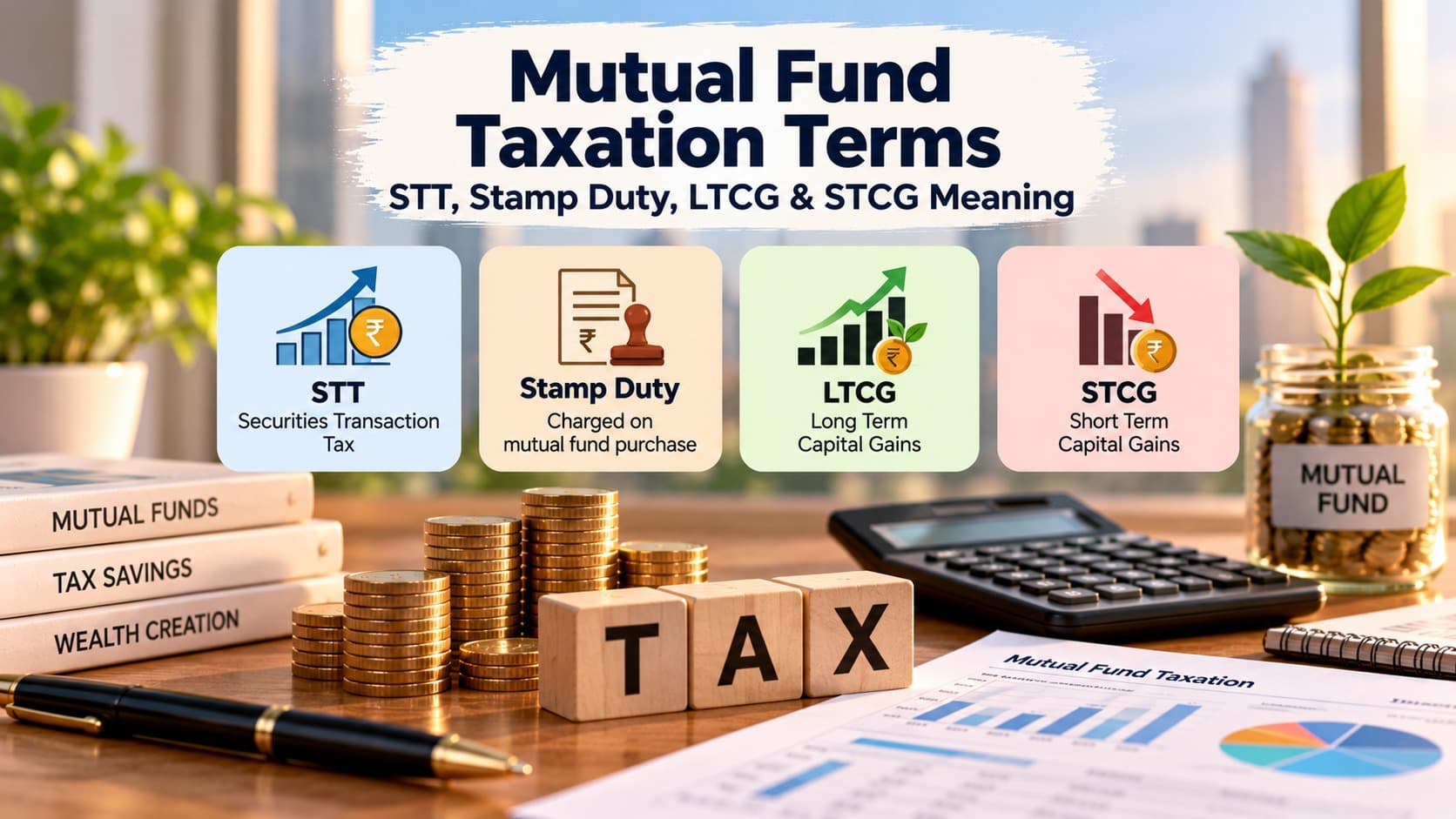
Understand mutual fund taxation terms, STT, stamp duty, LTCG, STCG, grandfathering, and how taxes affect your mutual fund returns.
When investing in mutual funds, most investors focus on returns, risk, and how much their investment could grow. But there is another factor that affects the money you ultimately receive: taxation.
From Securities Transaction Tax (STT) and stamp duty to Long-Term Capital Gains (LTCG) and Short-Term Capital Gains (STCG), mutual fund investments involve several tax-related terms. Understanding them can help you estimate your actual returns, plan redemptions, and avoid confusion when reviewing your investment statements.
The good news is that these concepts become easier once you understand what each charge applies to and when it is deducted.
In this guide, we explain the key mutual fund taxation terms, how they work, what the grandfathering clause means, and how to calculate post-tax mutual fund returns.
1. What Is STT in Mutual Funds?
Securities Transaction Tax (STT) is a tax levied on specified securities transactions in India. For mutual fund investors, it is particularly relevant when selling or redeeming units of equity-oriented mutual funds.
Under the applicable rules, STT is generally charged at 0.001% on the sale or redemption of equity-oriented mutual fund units. It is not generally applicable to the purchase or redemption of units in other mutual fund categories.
For example, suppose you redeem equity-oriented mutual fund units worth ₹1,00,000. At an STT rate of 0.001%, the charge would be ₹1, before considering any other applicable costs or taxes.
STT is separate from capital gains tax. Capital gains tax is calculated on the profit made from selling or redeeming units, while STT is based on the value of the relevant transaction.
How Does STT Affect Mutual Fund Returns?
STT is a small transaction cost, but it is still part of the overall cost of investing.
When calculating your final proceeds from an equity mutual fund redemption, consider STT alongside any applicable capital gains tax and other relevant charges.
It is also important to remember that STT paid on a transaction is generally not deductible when calculating capital gains for income-tax purposes.
2. What Is Stamp Duty on Mutual Fund Purchase?
Stamp duty on mutual fund purchase is a levy charged on applicable mutual fund transactions. In India, stamp duty is generally charged at 0.005% of the transaction value on applicable purchases, including SIP instalments, switch-in transactions, and IDCW reinvestments.
Unlike STT, which is relevant to specified securities transactions, stamp duty affects the number of mutual fund units allotted when an applicable purchase transaction takes place.
How Stamp Duty Affects SIP Allotment
Suppose you invest ₹10,000 in a mutual fund through a SIP. At an applicable NAV of ₹100, you might expect to receive 100 units.
However, stamp duty reduces the amount available for unit allotment.
At 0.005%, the stamp duty on ₹10,000 would be ₹0.50. The amount available for investment would therefore be ₹9,999.50, resulting in slightly fewer than 100 units at an NAV of ₹100.
This is the basic idea behind how stamp duty affects SIP allotment. The amount may appear small, but it is useful to understand why the units allotted can differ slightly from a simple investment-amount-divided-by-NAV calculation.
Stamp duty is generally deducted during the transaction process, so investors may not need to pay it separately.
3. LTCG and STCG Meaning in Mutual Funds
When you redeem mutual fund units at a value higher than their acquisition cost, you may realise a capital gain. The tax treatment depends on factors such as the type of fund, the holding period, and the applicable tax rules.
The LTCG and STCG meaning is straightforward:
STCG (Short-Term Capital Gains): Gains that qualify as short-term under the applicable tax rules.
LTCG (Long-Term Capital Gains): Gains that qualify as long-term under the applicable tax rules.
The holding period that determines whether a gain is short-term or long-term varies by investment category. Do not assume that every mutual fund follows the same threshold.
Taxation of Equity-Oriented Mutual Funds
For equity-oriented mutual funds, the broad tax treatment for transfers made on or after 23 July 2024 is as follows:
Type of capital gain | General tax treatment |
STCG | 20% under Section 111A, where the applicable conditions are met |
LTCG | 12.5% on eligible aggregate gains exceeding ₹1.25 lakh in a financial year under Section 112A |
These rates are generally subject to applicable surcharge and health and education cess. The LTCG threshold is an aggregate annual limit for eligible gains, not a separate exemption for every mutual fund scheme.
For equity-oriented funds, units held for 12 months or less generally qualify as short-term, while units held for more than 12 months generally qualify as long-term, subject to the applicable rules.
What About Debt and Other Mutual Funds?
The tax treatment of debt-oriented and other non-equity mutual funds can differ significantly.
For example, certain specified mutual fund units acquired on or after 1 April 2023 are covered by Section 50AA, under which gains are treated as short-term irrespective of the holding period. The definition of a specified mutual fund was also amended with effect from 1 April 2026.
Other fund categories may follow different holding-period and tax rules. Therefore, do not apply the equity fund tax rates or holding-period thresholds to every mutual fund.
Before redeeming, check the scheme category, acquisition date, redemption date, and the tax provisions applicable to your investment.
4. What Is the Grandfathering Clause in Mutual Funds?
The grandfathering clause in mutual funds is a tax provision introduced when long-term capital gains tax on certain equity investments was brought back in 2018.
Previously, eligible long-term gains from equity-oriented mutual funds were exempt under the rules then in force. From 1 February 2018, the tax treatment changed for eligible transfers.
To protect certain gains accrued before the change, a special cost-of-acquisition rule was introduced for eligible equity shares and equity-oriented mutual fund units acquired before 1 February 2018.
Broadly, the deemed cost for eligible assets is the higher of:
The actual cost of acquisition; and
The lower of the fair market value on 31 January 2018 and the sale value.
This calculation is subject to the detailed statutory conditions.
Why Does Grandfathering Matter?
Suppose an eligible equity mutual fund unit was purchased before February 2018 and had appreciated significantly by 31 January 2018.
The grandfathering rule may allow the prescribed fair market value to be used in determining the cost of acquisition, subject to the statutory formula. This can reduce the capital gain on which tax is calculated compared with using the original purchase price alone.
However, grandfathering is not a blanket exemption for all old mutual fund investments. It applies only to eligible assets and transactions covered by the relevant provisions.
5. What Is Indexation Benefit Meaning in Mutual Funds?
Indexation benefit in mutual funds refers to adjusting the cost of an investment for inflation when calculating taxable capital gains, where the law permits it.
The purpose of indexation is to account for the reduction in purchasing power over time. By increasing the eligible acquisition cost using the prescribed Cost Inflation Index, the taxable gain can be reduced.
However, indexation is not generally available for capital gains on equity-oriented mutual funds taxed under Section 112A.
For transfers on or after 23 July 2024, the general capital gains framework also removed indexation for many other long-term capital assets, subject to specific exceptions and transitional provisions.
Tax treatment for certain older acquisitions and particular asset categories can differ. Therefore, investors should not assume that holding a mutual fund for a longer period automatically makes indexation available.
6. Calculating Post-Tax Mutual Fund Returns
Understanding the difference between gross returns and post-tax returns is important when evaluating an investment.
Your gross capital gain is generally the difference between the redemption value and the applicable acquisition cost, adjusted for relevant expenses where permitted under the tax rules.
Your final proceeds may then be affected by applicable capital gains tax, transaction levies, and other relevant charges.
Consider this simplified example of an equity-oriented mutual fund investment:
Particulars | Amounts |
Initial investment | ₹1,00,000 |
Redemption value | ₹1,50,000 |
Capital gain | ₹50,000 |
Illustrative STCG tax at 20%, if the gain qualifies under Section 111A | ₹10,000 |
Illustrative STT at 0.001% on ₹1,50,000 | ₹1.50 |
In this simplified example, the gain after the illustrative STCG tax is ₹40,000 before STT and any other applicable costs. STT is a transaction levy and is not deducted when computing capital gains for income-tax purposes.
The example assumes that the entire ₹50,000 gain is taxable at the stated rate and does not account for surcharge, cess, losses, exemptions, or other individual circumstances. Actual tax liability may differ.
For long-term gains, the calculation may also depend on the applicable annual exemption threshold, the holding period, and any relevant grandfathering provisions.
7. How to Make Better Tax-Aware Mutual Fund Decisions
Understanding tax terminology can help you make more informed investment decisions, but tax efficiency should not be the only factor when choosing a mutual fund.
Keep these points in mind:
Know your fund category: Equity, debt, and hybrid funds can have different tax treatments.
Check acquisition dates: Rules may differ depending on when the units were purchased.
Understand the holding period: The redemption date can affect whether gains are classified as short-term or long-term.
Account for transaction levies: Stamp duty and STT may affect your transaction costs or unit allotment.
Calculate post-tax returns: Compare what you may retain after applicable taxes rather than looking only at gross returns.
Review your overall portfolio: Avoid making investment decisions solely to reduce tax if the investment does not suit your financial goals.
For a broader assessment of your investments, Kuberzo's mutual fund portfolio review can help you evaluate your holdings in relation to your financial objectives.
You can also use Kuberzo's goal-based financial planner to organise investments around future financial milestones, while its investment risk analyser can help you reflect on your risk profile before choosing investments.
Conclusion
Understanding mutual fund taxation terms can help you make better-informed decisions about investing, redeeming, and calculating returns.
STT applies to specified securities transactions, while stamp duty is charged on applicable mutual fund purchases and related transactions. STCG and LTCG determine how eligible profits are taxed, while grandfathering and indexation provisions can affect how gains are calculated in specific circumstances.
Tax rules can change, and the correct treatment depends on your fund category, acquisition date, redemption date, and individual tax situation.
For a practical Kuberzo tax terminology guide, remember to calculate your expected post-tax returns rather than focusing only on headline performance. When the tax treatment is unclear, or the investment amount is significant, consult a qualified tax professional before making a redemption decision.
Frequently Asked Questions
What is STT in mutual funds?
STT is Securities Transaction Tax. It generally applies at 0.001% to the sale or redemption of equity-oriented mutual fund units under the applicable rules. It is separate from capital gains tax.
What is stamp duty on mutual fund purchases?
Stamp duty is generally charged at 0.005% on applicable mutual fund purchase transactions, including SIP instalments and switch-ins. It reduces the amount available for unit allotment.
What is the difference between LTCG and STCG?
STCG refers to short-term capital gains, while LTCG refers to long-term capital gains. The applicable holding period and tax rate depend on the type of mutual fund, acquisition date, redemption date, and relevant tax provisions.
What is the grandfathering clause in mutual funds?
The grandfathering clause protects eligible gains accrued before the introduction of long-term capital gains tax on certain equity investments in 2018 by prescribing a special cost-of-acquisition formula for eligible units acquired before 1 February 2018.
Is indexation available for mutual fund investments?
Indexation is not generally available for equity-oriented mutual fund gains taxed under Section 112A. The treatment of other fund categories depends on the applicable provisions, acquisition date, and transfer date.