
What Is Folio Number in Mutual Fund? AMC, RTA, CAMS & KFintech
By Amrita Sinha
About the Author
Amrita Sinha is a content strategist with experience in SEO, digital marketing, and financial content. She writes easy-to-understand, research-backed articles on investing, personal finance, taxation, and wealth management for Kuberzo.
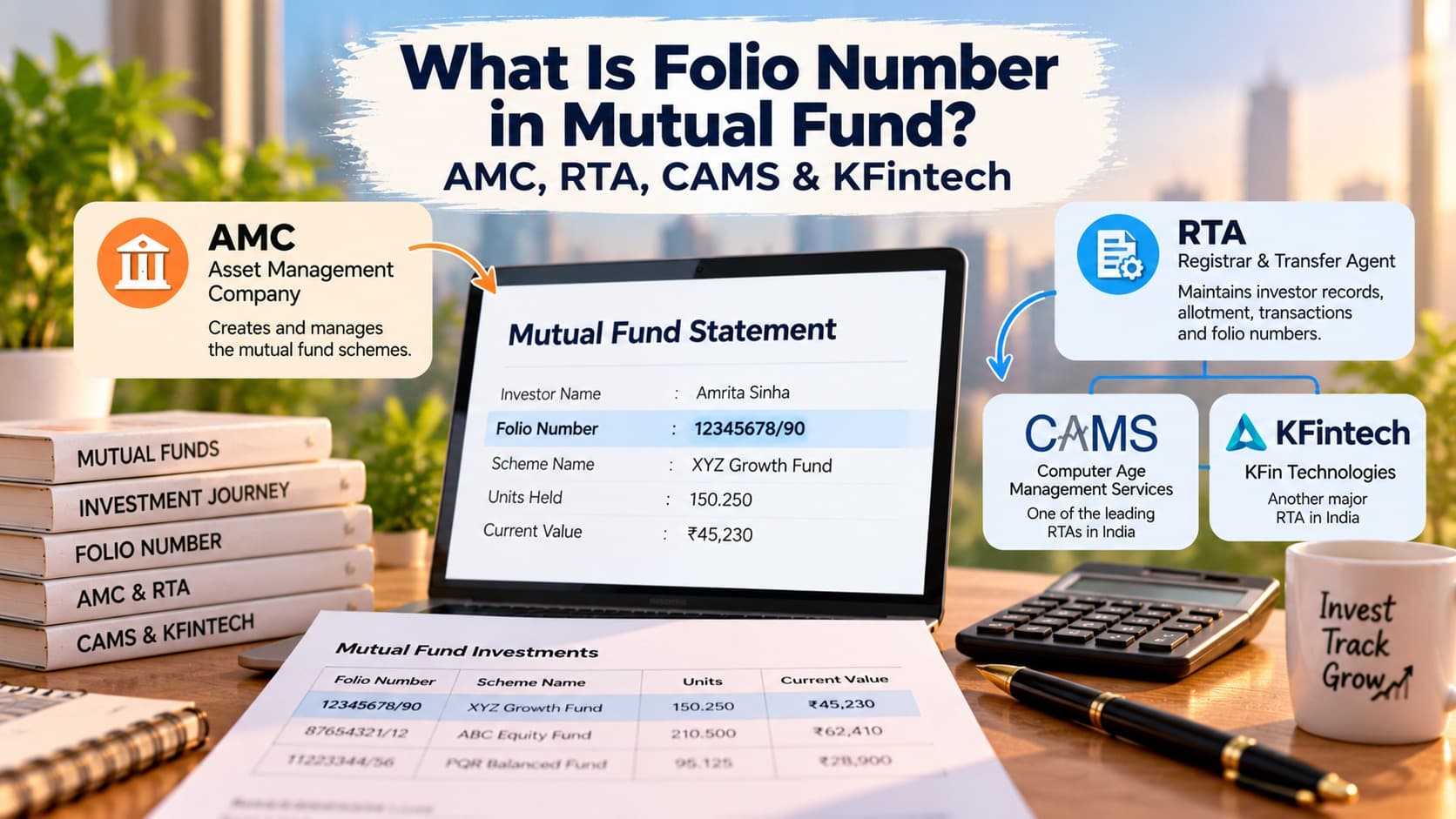
Learn what a mutual fund folio number is, what an AMC does, how CAMS and KFintech work, and how to find or consolidate your mutual fund folios.
When you invest in mutual funds, you may come across terms such as folio number, Asset Management Company (AMC), Registrar and Transfer Agent (RTA), CAMS, KFintech, sponsor and trustee. These terms might sound technical, especially if you are a first-time investor, but each plays an important role in managing and tracking your investments.
Understanding these terms can help you access your investment records, check transactions, update personal details and manage your mutual fund portfolio more confidently.
In this guide, we explain what is folio number in mutual fund, what an AMC does, the role of CAMS and KFintech, and how you can find or consolidate multiple folio numbers.
What is a Folio Number in a Mutual Fund?
A mutual fund folio number is a unique account reference used to identify and track an investor's holdings with a particular mutual fund house. Think of it as the account number associated with your mutual fund investments.
When you invest in a mutual fund, a folio is created to record relevant details, such as your investment transactions, units held, registered contact information, bank mandate and nominee details.
For example, suppose you invest in an equity mutual fund offered by ABC Mutual Fund. The fund house assigns a folio number to your investment. If you subsequently invest in another eligible scheme from the same fund house, you may be able to use the existing folio, subject to the fund house's rules and the holding pattern.
A folio can therefore help you keep track of multiple schemes under one fund house. However, investments made with different AMCs generally have separate folios.
Why Is a Folio Number Important?
Your folio number helps you:
Track mutual fund units and transaction history.
Access account statements and investment details.
Submit eligible purchase, redemption and switch requests.
Update registered bank details, contact information and nominations.
Raise service requests with the AMC or its RTA.
Keep your mutual fund records organised.
A folio number is not the same as your PAN, bank account number or demat account number. Each serves a different purpose in the investment process.
How to Find Mutual Fund Folio Number
If you are wondering how to find mutual fund folio number details, there are several ways to check.
1. Check your mutual fund account statement
Your account statement usually displays the folio number alongside the scheme name, investment value, units held and transaction details.
2. Check your email
Look for transaction confirmations, account statements or investment-related emails sent by the mutual fund house or its service provider. Your folio number may appear in these documents.
3. Log in to the AMC website or app
Visit the official website or app of the mutual fund house where you invested. After signing in and completing the required verification, you can generally access your portfolio and folio details.
4. Use a consolidated account statement
A Consolidated Account Statement (CAS) can help you view investments across multiple mutual fund houses linked to your registered details. You can request an electronic CAS through the available investor statement services.
5. Check the investor service portal
CAMS, KFintech and MFCentral provide investor services for eligible mutual fund holdings. These platforms can help you access statements and other investment information, depending on the fund house and service supported.
Keep your PAN, registered email address and mobile number accessible when checking your records. Never share your passwords or OTPs with someone claiming to retrieve your folio number.
What Is AMC in Mutual Funds?
AMC stands for Asset Management Company. It is the company responsible for managing a mutual fund's investment operations under the applicable regulatory framework.
An AMC launches and manages mutual fund schemes, appoints investment professionals, conducts research and makes portfolio decisions according to each scheme's investment objective.
For example, an equity mutual fund may invest primarily in shares, while a debt mutual fund may invest in eligible debt and money market instruments. The AMC manages the scheme's portfolio according to its stated mandate and applicable regulations.
How AMC Manages Investor Money
Understanding how AMC manages investor money is essential for understanding mutual funds.
The process generally involves the following activities:
Investment research: The AMC's investment team studies companies, sectors, markets and financial instruments.
Portfolio management: Fund managers make investment decisions in line with the scheme's objectives and strategy.
Risk management: The AMC monitors portfolio risks and follows applicable investment limits and compliance requirements.
Transaction management: The AMC oversees investment operations, working with service providers where necessary.
Investor communication: Investors receive scheme information, portfolio disclosures, factsheets and account-related communications through the relevant channels.
When you invest in a mutual fund, your money is pooled with investments from other unit holders in the scheme. You receive units based on the applicable NAV and transaction rules.
The AMC does not guarantee returns simply because it manages the scheme. Your investment value can rise or fall depending on the performance of the underlying portfolio and market conditions.
To understand whether a scheme's risk profile suits your financial goals, explore Kuberzo's Risk Analyser before making an investment decision.
What Is Registrar and Transfer Agent Meaning in Mutual Funds?
A Registrar and Transfer Agent, commonly called an RTA, is a service provider that handles investor records and various administrative activities on behalf of mutual fund houses.
While the AMC manages the scheme and its investment operations, the RTA supports the processing and maintenance of investor-related information and transactions.
What Does an RTA Do?
An RTA's responsibilities may include:
Maintaining investor and folio records.
Processing eligible purchase, redemption and switch transactions.
Generating account statements and transaction confirmations.
Handling service requests relating to bank details, contact information and nominations.
Supporting transmission requests and other changes to investor records.
Helping investors resolve account-related queries.
RTAs do not independently decide how a mutual fund's portfolio should be invested. Their primary role is administrative and operational.
Difference Between AMC and RTA
The difference between AMC and RTA becomes clearer when you compare their responsibilities.
Aspect | AMC | RTA |
Main role | Manages mutual fund schemes | Maintains investor records and supports transactions |
Investment decisions | Oversees portfolio management | Does not make scheme investment decisions |
Folio-related services | Oversees investor servicing for its schemes | Helps maintain folio records |
Investor support | Provides scheme and fund house information | Handles many account and transaction-related requests |
Examples | HDFC Mutual Fund, SBI Mutual Fund | CAMS and KFintech |
Both work together to support the mutual fund ecosystem. The exact service arrangement depends on the mutual fund house and the services it uses.
CAMS and KFintech Role in Mutual Funds
CAMS and KFintech are two prominent Registrar and Transfer Agents in India's mutual fund industry.
Their role is to help mutual fund houses maintain investor records and process various service requests. They are not mutual fund schemes themselves, and they do not act as substitutes for the AMC's investment management function.
What Is CAMS?
CAMS stands for Computer Age Management Services. It provides technology-enabled financial and investor servicing solutions, including RTA services for mutual funds.
Depending on the fund house and the service available, investors may use CAMS facilities to access account statements, review transactions, submit eligible service requests and update certain registered details.
What Is KFintech?
KFintech, or KFin Technologies, also provides registrar and transfer agent services to mutual fund houses. Its investor service platforms support activities such as viewing investment details, accessing statements and submitting eligible financial or non-financial requests.
An investor's RTA depends on the mutual fund house and its service arrangements. Not every AMC uses the same RTA, so you should check the relevant fund house's official website if you are unsure.
Can You Use CAMS and KFintech to View All Your Investments?
CAMS and KFintech offer services for the mutual fund houses they serve. To view holdings across multiple fund houses, investors can use a Consolidated Account Statement or MFCentral, subject to the platform's terms and the availability of their records.
MFCentral is a collaborative investor-services platform developed by CAMS and KFintech. It is designed to make it easier for investors to access eligible mutual fund holdings and service requests across participating fund houses.
This can be especially useful if you have invested through different platforms over the years and want a clearer view of your investments.
What Are Mutual Fund Sponsor and Trustee?
The sponsor and trustee are two other important entities in the mutual fund structure.
Mutual Fund Sponsor
The sponsor establishes the mutual fund and initiates the process of setting it up under the applicable regulations. The sponsor must meet the relevant eligibility and regulatory requirements.
A sponsor is broadly comparable to the promoter who establishes the mutual fund business, although the role is governed by specific mutual fund regulations.
Mutual Fund Trustee
The trustee is responsible for overseeing the mutual fund's operations in the interests of unit holders and ensuring that the fund operates in accordance with applicable regulations and the trust deed.
The trustee's oversight role is distinct from the AMC's day-to-day management of the schemes.
In simple terms:
Sponsor: Establishes the mutual fund.
Trustee: Provides oversight and safeguards unit holders' interests.
AMC: Manages the schemes and investment operations.
RTA: Maintains investor records and supports transactions.
These roles work together within the mutual fund's regulatory structure.
Consolidating Multiple Folio Numbers: Is It Possible?
Over time, investors may end up with several folio numbers with the same AMC. This can happen when investments are made through different platforms, using different application details or without selecting an existing folio.
Consolidating multiple folio numbers may make portfolio tracking and record management easier. However, consolidation is not automatic, and eligibility depends on the fund house's procedures.
Before requesting consolidation, check the following:
Same fund house: Folios generally need to belong to the same AMC.
Matching holding pattern: The names and ownership structure should meet the AMC's requirements.
KYC and personal details: Ensure the relevant KYC and investor records are in order.
Bank and nominee details: Review registered details and correct any discrepancies.
AMC or RTA process: Contact the relevant investor service team to understand the required form, documentation and procedure.
Do not assume that folios belonging to different AMCs can be merged into one folio. Each fund house maintains its own investor records.
If your investments are spread across different schemes, you can also review your portfolio to understand your asset allocation and whether it aligns with your financial goals. Kuberzo's Portfolio Review service can help you assess your mutual fund holdings.
How to Keep Your Mutual Fund Records Organised
A few simple habits can make managing your investments easier:
Keep account statements and transaction confirmations in a secure folder.
Ensure your registered mobile number and email address are up to date.
Review your nominee and bank details periodically.
Use official AMC, RTA or investor service platforms to check holdings.
Review your portfolio regularly instead of tracking investments only when you need to redeem.
Set clear financial goals before starting or increasing investments.
If you are investing towards a specific milestone, such as higher education, a home or retirement, Kuberzo's Goal-Based Financial Planner can help you think through your investment goals and time horizon.
For more information on choosing and understanding mutual fund investments, visit Kuberzo Mutual Funds.
Conclusion
Understanding folio numbers, AMCs, RTAs, CAMS, KFintech, sponsors and trustees helps you navigate mutual fund investments with greater confidence. Your folio number helps you identify your holdings, the AMC manages the scheme, the RTA supports investor servicing, and the sponsor and trustee fulfil distinct establishment and oversight roles.
Keep your investment records updated, use official investor service platforms and review your portfolio regularly. A little clarity about how the system works can make managing your mutual fund investments much simpler.
Frequently Asked Questions
What is folio number in mutual fund?
A folio number is an account reference used to identify and track your mutual fund holdings with a particular fund house. It helps maintain investment records, transaction history and relevant investor details.
Can one folio number contain multiple mutual fund schemes?
Yes. A folio may hold investments in multiple schemes offered by the same AMC, subject to the fund house's rules and the investor's holding pattern. Investors may still have more than one folio with the same AMC.
What is the difference between AMC and RTA?
An AMC manages mutual fund schemes and their investment portfolios. An RTA maintains investor records and supports administrative services, including eligible transactions, statements and account-related requests.
Are CAMS and KFintech mutual fund companies?
No. CAMS and KFintech are service providers that offer registrar and transfer agent services to mutual fund houses. They help maintain investor records and support transactions, but they do not perform the same role as an AMC.
Can I consolidate multiple folio numbers?
You may be able to consolidate eligible folios belonging to the same AMC, depending on its procedures and requirements. The holding pattern, investor details and other records may need to match. Contact the relevant AMC or RTA for the applicable process.