Nifty 50 vs Sensex: Does Benchmark Choice Matter for Index Investors?
By Amrita Sinha
About the Author
Amrita Sinha is a content strategist with experience in SEO, digital marketing, and financial content. She writes easy-to-understand, research-backed articles on investing, personal finance, taxation, and wealth management for Kuberzo.
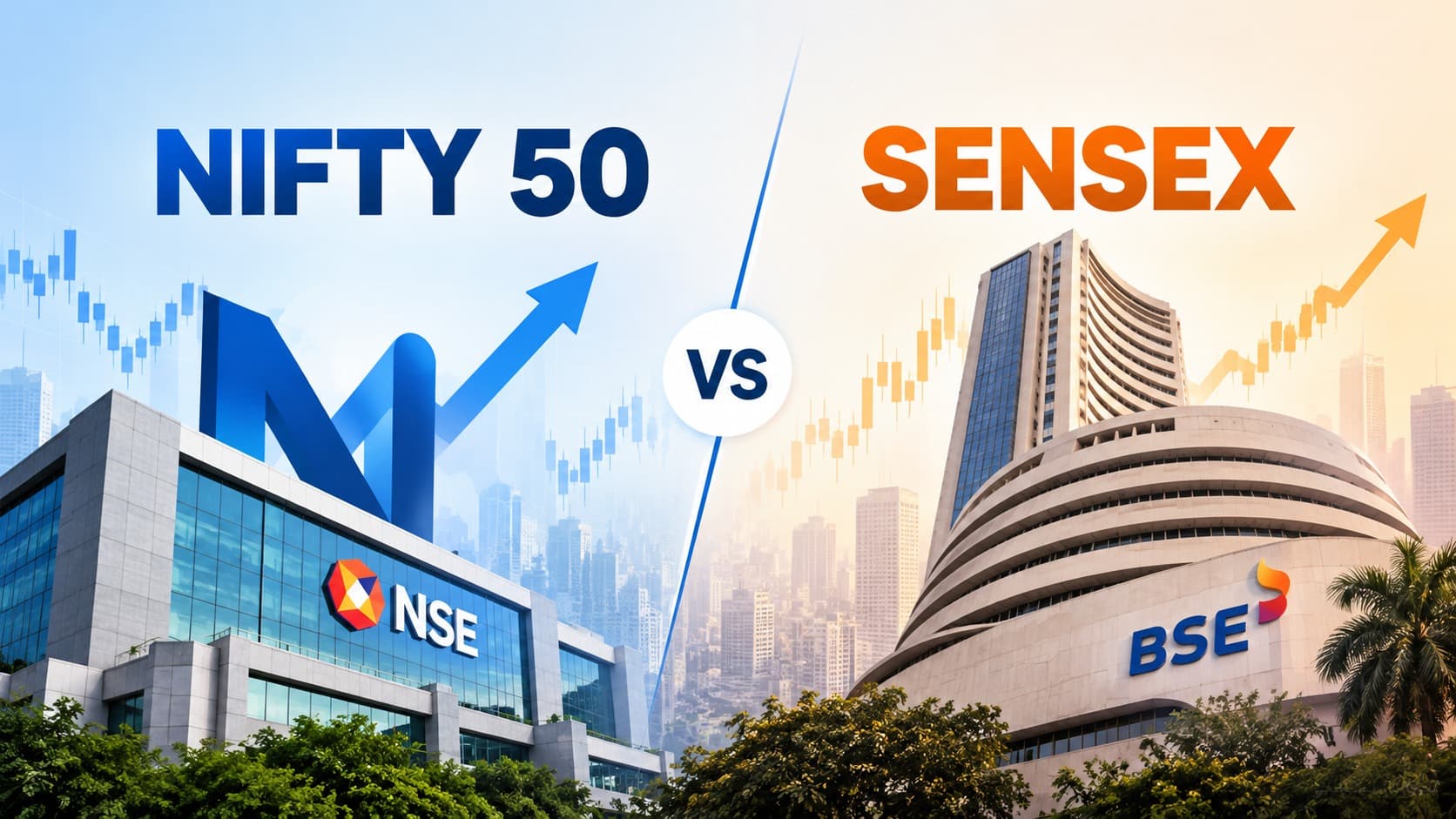
Compare Nifty 50 vs Sensex on stocks, sector exposure, weightage, returns and index funds to understand whether benchmark choice matters for investors.
For investors looking for a simple way to participate in India's equity market, index investing can be an attractive starting point. Instead of trying to identify individual stocks, an investor can choose an index fund or ETF that tracks a broad market benchmark. In India, two of the most widely recognised benchmarks are the Nifty 50 and the Sensex.
This makes the Nifty 50 vs Sensex comparison relevant for investors deciding where to begin with passive investing. Both indices represent large, established Indian companies and are widely used as market benchmarks. However, they are not identical. The Nifty 50 contains 50 companies, while the BSE SENSEX contains 30. They also have differences in their constituent selection, sector exposure, weightages and index methodology.
At the same time, these differences should not be overstated. Both indices are designed to represent leading companies in the Indian equity market and use free-float market-capitalisation-based weighting. As a result, their long-term performance can often move in a broadly similar direction, even though their returns can differ over individual periods.
For someone comparing NSE Nifty 50 vs BSE Sensex, the important question is therefore not simply, "Which index gives higher returns?" A better question is: Does the difference in constituents, diversification and weightage materially affect the portfolio I am building?
The answer can depend on the investment product, time horizon and the investor's preference for diversification. Understanding these differences can help investors make a more informed choice between a Nifty 50 index fund vs a Sensex fund, rather than choosing one based only on recent performance.
What Is The Difference Between Nifty And Sensex?
The simplest difference between Nifty and Sensex is the number of companies and the exchange ecosystem they represent.
The Nifty 50 is the flagship index of NSE Indices and tracks 50 large and liquid companies listed on the NSE. NSE Indices describes it as a diversified 50-stock index representing important sectors of the Indian economy. It is calculated using the free-float market-capitalisation methodology.
The BSE SENSEX consists of 30 large, well-established and financially sound companies across key sectors. BSE describes it as both a benchmark and an investable index.
Feature | Nifty 50 | Sensex |
Exchange | NSE | BSE |
Number of Stocks | 50 | 30 |
Broad Objective | Large and liquid Indian companies | Large and established Indian companies |
Weighting | Free-float market capitalisation | Free-float market capitalisation, subject to index rules |
Use | Benchmark, index funds, ETFs and derivatives | Benchmark, index funds, ETFs and other passive products |
Diversification | Higher number of constituents | More concentrated |
The difference in the number of companies means that the Nifty 50 has a broader basket, while the Sensex is somewhat more concentrated.
Nifty 50 Vs Sensex Stocks: How Are They Different?
The Nifty 50 vs Sensex stocks comparison shows considerable overlap. Several of India's largest companies can be constituents of both indices.
However, the two indices do not contain the same companies.
The Nifty 50 selects 50 stocks from the eligible NSE universe using its methodology, while the Sensex selects 30 companies using BSE's methodology. As a result, some companies may appear in one index but not the other.
This matters because the performance of an index depends on the companies it contains and their respective weights.
For example, if companies that have a higher weight in one index outperform during a particular period, that index may deliver stronger returns even if both indices broadly track large-cap Indian equities.
Weightage Difference Between Nifty 50 And Sensex: Why Does It Matter?
The weightage difference between Nifty 50 and Sensex is an important part of understanding their performance.
Both indices use free-float market capitalisation, which means companies with a larger investable market capitalisation generally have a greater influence on the index. Free-float methodology also reduces the influence of shares held by promoters and other strategic holders that are not readily available for trading.
This means an index is not simply an equal-weighted basket.
If a few large companies have substantial weights, their stock-price movements can have a meaningful impact on the overall index.
Because Nifty 50 and Sensex have different constituent lists and different weights, the same market event can affect the two benchmarks differently.
For an index investor, this is one reason why Nifty 50 vs Sensex performance can diverge over shorter periods.
Nifty Vs Sensex Returns: Which Performs Better?
There is no permanent winner in the Nifty vs Sensex returns comparison.
Returns can differ across months, years and market cycles because the indices have different constituents and weightings.
An investor should also be careful about comparing only the headline index levels or price returns. Both NSE and BSE provide Total Return Index versions that account for dividends. NSE specifically notes that the Nifty 50 Total Return Index includes dividend income and is a more appropriate benchmark when comparing with mutual funds that receive dividends from their holdings.
Therefore, when comparing Nifty 50 vs Sensex returns, investors should ideally compare:
The same investment period
Total return rather than only price return
Comparable index versions
The impact of dividends
The expense ratio of the investment product
Tracking difference or tracking error
Past performance should not be interpreted as a guarantee of future returns.
Nifty 50 Vs Sensex Performance: Why Can They Diverge?
The Nifty 50 vs Sensex performance gap can arise for several reasons.
Different Number Of Stocks
Nifty 50 has 50 constituents compared with 30 in the Sensex. The additional stocks can create differences in sector and company exposure.
Different Stock Weights
Even when a company appears in both indices, its weight may not be identical. A stock with a higher weight can have a larger impact on one index.
Different Sector Exposure
The two indices represent major sectors of the economy, but their sector weights can differ. Consequently, a period that favours a particular sector may benefit one benchmark more than the other.
Index Rebalancing
Index constituents and weights can change over time according to the respective index methodologies. This means today's comparison may not remain identical several years from now.
Therefore, a difference in one year's return does not necessarily indicate that one index is structurally superior.
Nifty 50 Index Fund Vs Sensex Fund: What Are You Actually Buying?
When an investor chooses a Nifty 50 index fund vs Sensex fund, they are not directly buying the index.
Instead, they invest in a mutual fund or ETF designed to replicate the performance of the underlying benchmark, before expenses and tracking differences.
For example, a Nifty 50 index fund attempts to replicate the Nifty 50, while a Sensex index fund attempts to replicate the Sensex.
This makes the fund's own characteristics important. Before investing, compare:
Expense ratio
Tracking error
Tracking difference
Fund size and liquidity
Exit load, if applicable
Investment minimums
Direct versus regular plan
SIP availability
Two funds tracking the same index can still produce slightly different investor outcomes because of costs, cash holdings, portfolio implementation and tracking differences.
Invest In Nifty Or Sensex: Which Is Better For An Investor?
The question "invest in Nifty or Sensex?" does not have a universal answer.
A Nifty 50 index fund may appeal to an investor who prefers exposure to a broader basket of 50 large companies.
A Sensex fund may appeal to someone who prefers tracking a more concentrated portfolio of 30 large and established companies.
However, the difference should not be treated as a choice between "diversified" and "undiversified". Both provide exposure to large-cap Indian equities and both remain subject to equity-market risk.
For a beginner, the more important decision may actually be whether an index fund fits their investment objective, risk tolerance and time horizon at all. For a beginner, the more important decision may actually be whether an index fund fits their investment objective, risk tolerance and time horizon at all.
Choosing between two similar large-cap benchmarks is generally a secondary decision compared with maintaining appropriate asset allocation and staying invested for the intended horizon.
Does Benchmark Choice Really Matter?
For a long-term index investor, benchmark choice does matter — but perhaps not as much as it first appears.
The Nifty 50 gives exposure to 50 large companies, while the Sensex tracks 30. Their different constituents and weightages can create periods of performance divergence.
However, both are designed to represent leading segments of India's equity market. Therefore, the decision between them should not be based on trying to predict which benchmark will outperform next.
Instead, investors should focus on the quality of the index fund or ETF tracking the benchmark, its costs, tracking performance and how it fits into the overall portfolio. Investors should also consider how the investment supports their long-term financial goals before choosing a benchmark.
In other words, Nifty 50 vs Sensex is a meaningful comparison, but the difference between two well-managed low-cost index products may be less important than having a disciplined, diversified and long-term investment strategy.
Disclaimer: This article is for general educational purposes only and does not constitute personalised investment or financial advice. Index investments are subject to market risks, and returns are not guaranteed. Past performance of an index or index fund does not guarantee future results. Investors should review the relevant scheme documents and consider their financial goals, risk tolerance and investment horizon before investing.
Frequently Asked Questions
What is the main difference between Nifty 50 and Sensex?
The Nifty 50 tracks 50 large and liquid companies, while the Sensex tracks 30 large and established companies. Both are free-float, market-capitalisation-weighted benchmarks representing major segments of India's equity market.
Which has given better returns, Nifty 50 or Sensex?
Neither has consistently outperformed the other across every period. Their returns can differ because they contain different companies and have different constituent weightings. Investors should compare comparable Total Return Index data rather than relying only on price returns.
Is Nifty 50 more diversified than Sensex?
Nifty 50 contains 50 stocks compared with 30 in the Sensex, so it has more constituents. However, both remain concentrated in large-cap companies, and the actual diversification also depends on their sector and stock weightings.
Should beginners invest in Nifty 50 or Sensex?
Both can provide relatively straightforward exposure to large-cap Indian equities through index funds or ETFs. A beginner should consider costs, tracking difference, risk tolerance and investment horizon rather than choosing solely based on recent returns.
Is a Nifty 50 index fund better than a Sensex index fund?
Neither is universally better. Both aim to track different benchmarks. Investors should compare the specific fund's expense ratio, tracking error, tracking difference, liquidity and overall suitability.