Difference Between Active and Passive Mutual Funds
By Anand
About the Author
Anand contributes to finance and personal finance content, with a particular interest in mutual funds, SIPs, financial planning and wealth creation. His work explores investment concepts and emerging trends in personal finance.

Understand how actively managed funds and index-based investments differ in strategy, cost, risk, and potential returns.
When investing in mutual funds, one of the most important choices is deciding between an actively managed fund and a passive fund. Both can provide exposure to the market, but the way they are managed is very different.
Understanding this difference can help investors choose an approach that matches their financial goals, risk tolerance, and investment horizon.
What Are Active Mutual Funds?
Active mutual funds are managed by professional fund managers who actively select securities with the objective of outperforming a specific benchmark.
The fund manager and research team study companies, industries, economic conditions, and market trends before deciding what to buy or sell.
The portfolio can change depending on the manager's view of market opportunities and risks.
The main objective is generally to generate returns above the fund's benchmark after considering expenses.
What Are Passive Mutual Funds?
Passive mutual funds generally aim to replicate the performance of a particular market index rather than trying to outperform it.
For example, an index fund may track a broad market index by holding securities in proportions similar to that index.
Instead of relying heavily on a fund manager's decisions, the portfolio follows the composition and methodology of its chosen benchmark.
This makes passive investing a relatively straightforward approach to gaining diversified market exposure.
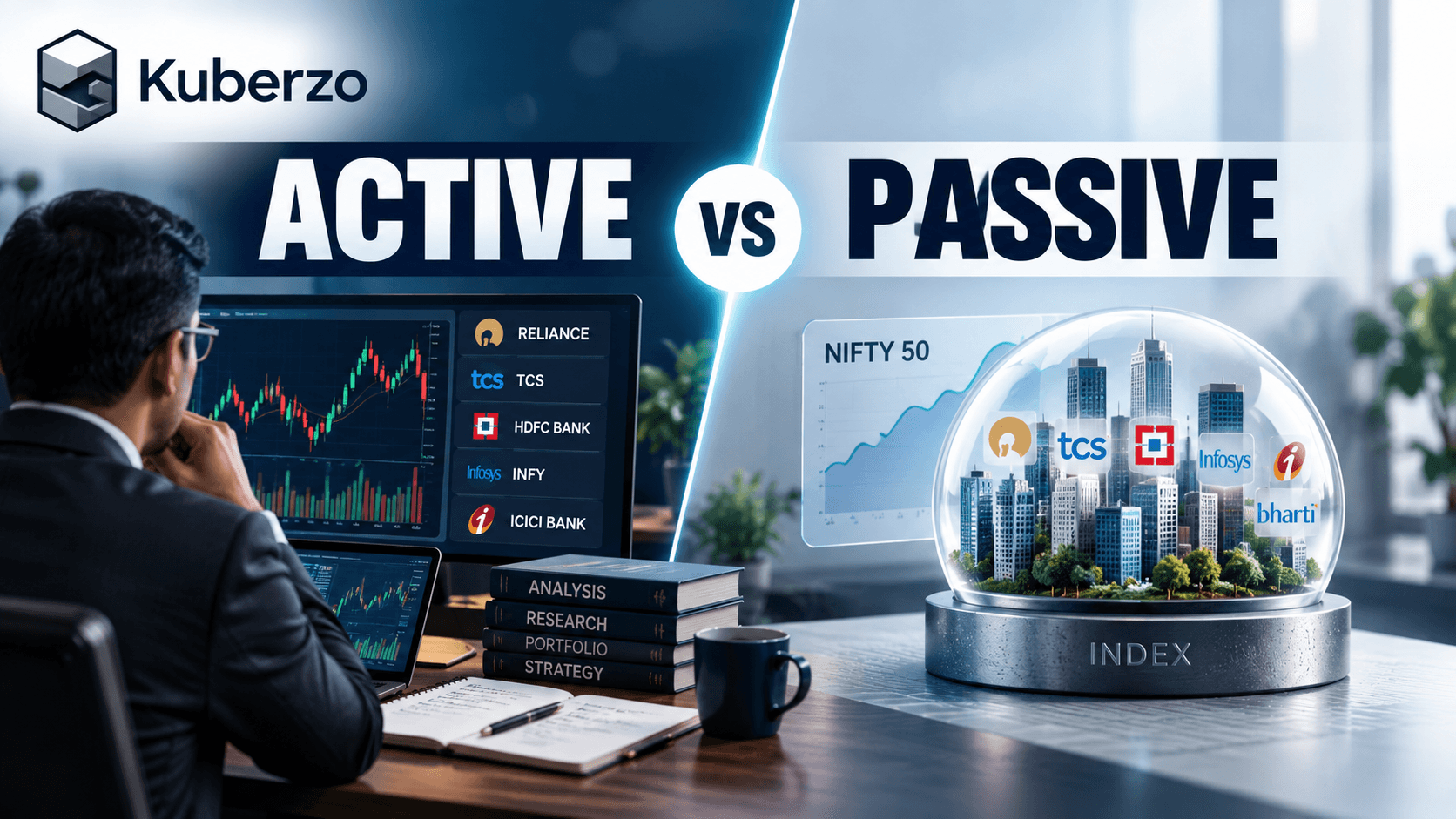
Active vs Passive: How Are They Different?
The biggest difference is the investment approach.
Active Funds
- Fund manager actively selects investments.
- Attempts to outperform a benchmark.
- Portfolio may change more frequently.
- Usually involves higher research and management costs.
- Performance depends partly on the fund manager's decisions.
Passive Funds
- Follows a specific market index.
- Attempts to track benchmark performance.
- Usually involves less frequent portfolio changes.
- Generally has lower management costs.
- Performance primarily reflects the underlying index, minus expenses and tracking differences.
What Are Index Funds?
Index funds are a common type of passive investment. They are designed to follow a particular market index.
Instead of trying to identify which individual stocks will perform best, an index fund provides exposure to the group of securities included in its benchmark.
This approach can be attractive to investors who prefer simplicity, broad diversification, and relatively lower costs.
What Is an ETF?
An ETF (Exchange Traded Fund) is an investment fund that trades on a stock exchange during market hours, similar to an individual stock.
Many ETFs follow market indexes, although ETFs can also use other investment strategies.
Because ETFs trade throughout the day, their market price can change during trading hours.
This is different from traditional mutual funds, where transactions are generally processed based on the applicable NAV.
Why Does Expense Ratio Matter?
The expense ratio represents the annual operating expenses charged by a mutual fund, expressed as a percentage of the fund's assets.
Costs matter because they can affect an investor's net returns over long periods.
Passive funds generally have lower costs because they don't require the same level of research and active portfolio decisions as actively managed funds.
However, investors should consider more than cost alone when evaluating an investment.
Which One Has Better Returns?
There is no universal answer.
An active fund may outperform its benchmark during certain periods, while another active fund may underperform. A passive fund generally aims to deliver returns close to its benchmark, after expenses and tracking differences.
Past performance does not guarantee future results.
Instead of choosing a fund solely because it has delivered strong returns recently, investors should consider the fund's objective, costs, risk, consistency, and suitability for their portfolio.
Which Approach Is Better for Beginners?
For beginners, passive investing can be easier to understand because the investment objective is straightforward: track a particular index.
However, active funds may also have a role in a portfolio when investors understand their objectives and are comfortable with the associated costs and risks.
The right choice depends on your financial goals, investment horizon, risk tolerance, and overall asset allocation.
Role in Portfolio Management
Good portfolio management isn't necessarily about choosing between active and passive investments exclusively.
An investor may use different approaches for different objectives.
For example, someone may use broad index exposure as a core holding while considering actively managed funds for specific strategies.
The important thing is to ensure that every investment has a clear purpose within the overall portfolio.
How Should You Choose?
Before selecting a fund, consider:
- What is your financial goal?
- How long will you remain invested?
- What level of risk can you tolerate?
- What benchmark does the fund follow?
- What are the costs?
- How consistent has the fund's performance been?
- Does it fit your existing portfolio?
Understanding these factors is more useful than simply choosing a fund because it is currently popular.
Conclusion
The difference between active and passive investing comes down primarily to how a fund tries to generate returns.
Active funds rely on professional decisions to attempt to outperform a benchmark, while passive funds aim to closely follow an index.
Neither approach is automatically better for every investor. The right choice depends on your financial objectives, investment horizon, risk tolerance, and portfolio structure.
Before investing, understand how the fund works, what it costs, and what role it plays in your overall financial plan.
To know more about financial planning and seek personalized financial guidance, visit Kuberzo and explore our smart financial planning tools.
Frequently Asked Questions
What is the main difference between active and passive mutual funds?
Active funds attempt to outperform a benchmark through active investment decisions, while passive funds generally aim to replicate the performance of a specific index.
Are passive funds cheaper than active funds?
Passive funds generally have lower operating costs because they require less active research and portfolio management, although costs vary between individual funds.
Are index funds passive investments?
Yes. Index funds generally follow a specific market index instead of attempting to select investments to outperform that index.
Is an ETF the same as an index fund?
Not necessarily. Many ETFs track indexes, but ETFs can also follow other strategies. An ETF is primarily defined by how it trades on an exchange.
Should beginners choose active or passive funds?
Either approach can be suitable depending on the investor's objectives, risk tolerance, investment horizon, and understanding of the product.