
What Is Tracking Error in Index Funds? Tracking Difference Explained
By Amrita Sinha
About the Author
Amrita Sinha is a content strategist with experience in SEO, digital marketing, and financial content. She writes easy-to-understand, research-backed articles on investing, personal finance, taxation, and wealth management for Kuberzo.
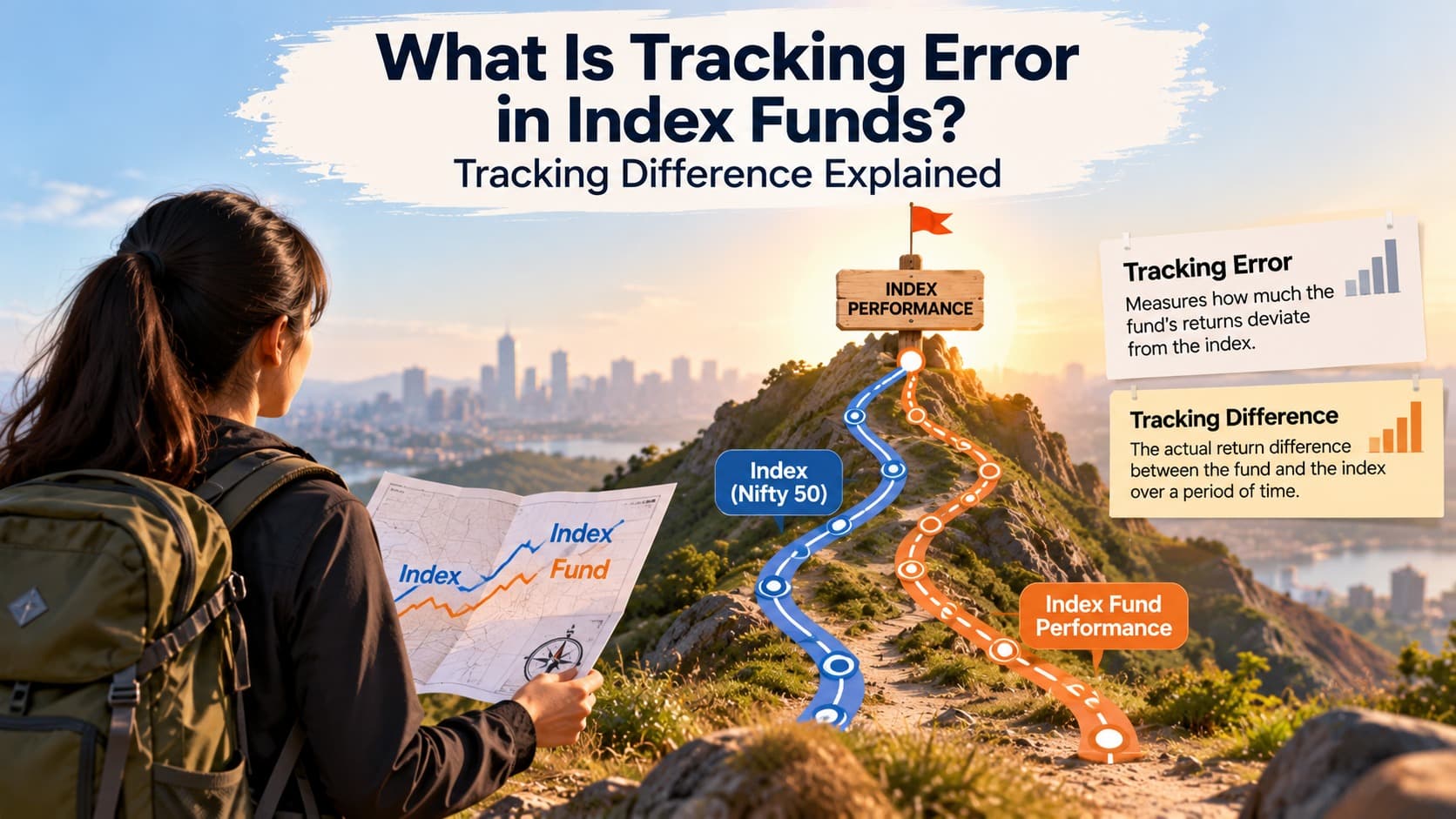
Learn what tracking error means, how it differs from tracking difference, why it occurs in index funds, and how to evaluate Nifty 50 index funds.
Index funds are designed to follow a market index, such as the Nifty 50 or Sensex. Instead of trying to outperform the market through active stock selection, these funds aim to replicate the performance of their chosen benchmark.
But there is a catch. An index fund may not deliver the same returns as the index it tracks.
This difference can arise due to expenses, transaction costs, cash holdings, changes in index constituents, and other operational factors. Two important metrics help investors understand this gap: tracking error and tracking difference.
Although these terms sound similar, they measure different aspects of an index fund's performance. Understanding them can help you compare funds more effectively and make informed investment decisions.
Let's explore what tracking error means, how it is calculated, why it occurs, and how to use it when selecting an index fund.
What Is Tracking Error?
Tracking error measures how consistently an index fund's returns differ from the returns of its benchmark over time.
For example, if a mutual fund aims to track the Nifty 50 Total Returns Index (TRI), its objective is to replicate the index as closely as possible. Tracking error indicates how much the daily return differences between the fund and the benchmark fluctuate.
A lower tracking error generally indicates that the fund follows its benchmark more consistently. A higher tracking error suggests greater variation in those differences.
Tracking error is particularly relevant for passive investments because the fund's objective is to replicate an index rather than outperform it through active stock selection.
However, a low tracking error does not automatically mean that a fund delivers higher returns. It tells you about the consistency of tracking, not the overall size of the return gap.
How Is Tracking Error Calculated?
To understand how tracking error is calculated, it helps to look at the difference between a fund's return and its benchmark's return for each day.
The daily return difference can be expressed as:
Daily Return Difference = Fund's Daily Return − Benchmark's Daily Return
Tracking error is calculated as the annualised standard deviation of these daily return differences, using the applicable methodology and observation period.
In simple terms, the calculation measures how much the daily gaps vary over time. A smaller variation generally means more consistent tracking.
Example of Tracking Error
Suppose a Nifty 50 index fund and its benchmark record the following daily returns:
Day | Fund Return | Benchmark Return | Difference |
Day 1 | 0.50% | 0.52% | -0.02 percentage points |
Day 2 | -0.30% | -0.28% | -0.02 percentage points |
Day 3 | 0.40% | 0.45% | -0.05 percentage points |
These figures are illustrative. The daily differences would be calculated over the full observation period, and their standard deviation would then be annualised according to the relevant methodology.
The three-day example alone is not sufficient to calculate a meaningful annual tracking error. Investors should check the disclosed figure using the appropriate reporting period.
In India, tracking error for index funds and ETFs is disclosed by asset management companies and through AMFI's tracking error and tracking difference resources.
What Is Tracking Difference?
Tracking difference measures the actual return gap between an index fund and its benchmark over a specified period.
For example, suppose an index fund delivers an annual return of 11.8%, while its benchmark delivers 12.2% over the same period.
The tracking difference, expressed as fund return minus benchmark return, is:
Tracking Difference = 11.8% − 12.2% = -0.4 percentage points
This means the fund underperformed its benchmark by 0.4 percentage points over that period.
Tracking difference is useful because it shows how much of the benchmark's return the investor actually received through the fund before considering any investor-specific taxes or costs outside the scheme.
When comparing figures, make sure the fund and benchmark returns use the same period and a consistent return basis, such as the Total Returns Index where applicable.
Tracking Difference vs Tracking Error: Key Differences
The difference between tracking difference and tracking error comes down to the question each metric answers.
Feature | Tracking Error | Tracking Difference |
What it measures | Variation in daily return differences | Actual return gap over a period |
Main purpose | Measures consistency of tracking | Measures the extent of relative underperformance or outperformance |
Calculation | Annualised standard deviation of daily return differences | Difference between fund and benchmark returns over a specified period, annualised where reported |
Lower value means | More consistent tracking, generally | A smaller return gap in absolute terms, but the sign matters |
What it reveals | How much the return gap fluctuates | How far the fund's return is from the benchmark |
Best use | Evaluating tracking consistency | Comparing the fund's actual relative performance |
A fund can have low tracking error but still show a negative tracking difference over time. This can happen when the fund consistently trails its benchmark by a relatively stable amount, for example because of expenses.
Likewise, a fund with a small tracking difference over one period can still have a higher tracking error if its daily return differences fluctuate considerably.
The takeaway: Use both metrics together rather than relying on one number.
Reasons for High Tracking Error in Mutual Funds
Several factors can cause tracking error in index funds. Even when a fund follows its benchmark closely, some differences are difficult to eliminate.
1. Expense Ratio and Operating Costs
Index funds incur expenses for managing the scheme, including the costs covered by the Total Expense Ratio (TER). These expenses can cause fund returns to lag the benchmark.
Transaction-related costs may also affect returns. However, the expense ratio and tracking error are separate measures and should be evaluated independently.
2. Cash Holdings
An index fund may temporarily hold some money in cash to manage redemptions, meet expenses, or handle operational requirements.
If the benchmark rises while part of the fund remains uninvested, the fund may not capture the full movement of the index. The effect can also differ when markets fall.
3. Changes in Index Constituents
Market indices are periodically reviewed. When companies are added, removed, or assigned different weights, the fund must adjust its portfolio accordingly.
Delays in executing these trades can temporarily create differences between fund and benchmark returns.
4. Transaction Costs and Market Liquidity
Buying and selling securities involves transaction costs. Some stocks may also be difficult to trade at the desired price or time, particularly during volatile markets.
These factors can affect how closely a fund replicates its benchmark.
5. Corporate Actions
Events such as mergers, rights issues, stock splits, and dividend payments can affect the portfolio and the benchmark's calculation. Differences in timing or processing can contribute to tracking error.
6. Fund Flows and Portfolio Rebalancing
Large inflows or redemptions can require the fund manager to buy or sell securities. Portfolio rebalancing can also create temporary differences, particularly when market liquidity is limited.
These factors explain why tracking error cannot always be reduced to zero.
Impact of Tracking Error on Long-Term Returns
Tracking error and tracking difference can both matter to long-term investors, but their effects are different.
Tracking error indicates how consistently the fund tracks its benchmark. Tracking difference shows how much the fund's return has actually diverged from the benchmark over a particular period.
For long-term investors, a persistently negative tracking difference can mean receiving lower returns than the benchmark over time. Even a seemingly small gap can matter when returns compound over many years.
For example, consider two hypothetical funds tracking the same index:
Metric | Fund A | Fund B |
Benchmark annual return | 10% | 10% |
Fund annual return | 9.8% | 9.5% |
Annual return gap | -0.2 percentage points | -0.5 percentage points |
These are simplified illustrations, not forecasts. Fund A has the smaller return gap in this example. If the gap persists, it could make a difference to long-term wealth accumulation.
However, investors should not assume that tracking error alone predicts future returns. Tracking difference, costs, fund size, liquidity where relevant, and consistency of tracking should all be considered. If you already hold index funds, a mutual fund portfolio review can help you assess their performance, costs, and alignment with your investment strategy.
Evaluating Nifty 50 Tracking Error
When comparing Nifty 50 index funds, begin by identifying the exact benchmark each scheme follows. For a fair comparison, use funds tracking the same index and check whether returns are measured against the appropriate Total Returns Index.
Use the following checklist:
Check tracking error: Compare the disclosed figures for the same or comparable observation periods.
Review tracking difference: Look at the one-year, three-year, five-year, and longer-period figures where available.
Compare the expense ratio: Lower costs can help reduce the gap between fund and benchmark returns, although costs are not the only factor.
Review the fund's history: A longer record can provide more context than a very short period of data.
Check the investment approach: Confirm that the scheme follows the index you want exposure to.
Consider operational factors: Assets under management, cash levels, transaction costs, and portfolio adjustments can influence tracking.
Do not select an index fund solely because it has the lowest tracking error on one date. Check whether its tracking difference is also competitive and whether the data covers a comparable period.
How to Find the Best Low Tracking Error Index Funds
Investors searching for the best low tracking error index funds should compare schemes that follow the same benchmark rather than ranking all index funds together.
A Nifty 50 index fund and a Nifty Next 50 index fund track different indices and have different underlying portfolios. Comparing their tracking error figures without considering their benchmarks may therefore be misleading.
A practical comparison should include:
Tracking error over a comparable period.
Tracking difference over multiple time horizons.
Expense ratio and other relevant costs.
Fund size and operational consistency.
The scheme's benchmark and investment objective.
AMFI provides a tracking error and tracking difference resource where investors can check disclosed information for available schemes. Before choosing an index fund, consider your investment risk profile to ensure that the fund's market exposure aligns with your financial goals and comfort with volatility.
For Kuberzo index fund selection, the aim should be to evaluate the fund's costs, tracking consistency, return gap, and suitability for your financial goals together. A low tracking error is a useful starting point, not a complete investment decision.
Conclusion
Tracking error and tracking difference are important index fund performance metrics, but they answer different questions.
Tracking error measures the variability of the return gap between a fund and its benchmark. Tracking difference measures the actual return gap over a period.
When evaluating index funds, especially Nifty 50 funds, consider both metrics alongside the expense ratio, benchmark, fund history, and investment objective. A fund that tracks its index consistently and keeps its return gap relatively small may be worth closer consideration.
Remember that neither metric guarantees future performance. The goal is to choose a fund that follows the intended benchmark efficiently and fits your broader investment plan.
You can also use Kuberzo's goal-based financial planner to connect your investment choices with long-term financial milestones.
Frequently Asked Questions
What is tracking error in an index fund?
Tracking error measures the variability of the daily return differences between an index fund and its benchmark. A lower figure generally indicates more consistent tracking.
What is the difference between tracking error and tracking difference?
Tracking error measures the variation in daily return differences, while tracking difference measures the actual gap between the fund's return and its benchmark's return over a specified period.
Is lower tracking error always better?
A lower tracking error generally indicates more consistent benchmark tracking. However, investors should also examine tracking difference, expenses, and the fund's investment objective before making a decision.
What causes high tracking error in mutual funds?
Tracking error can arise from expenses, transaction costs, cash holdings, index rebalancing, corporate actions, liquidity constraints, and the timing of portfolio adjustments.
How can I compare tracking error in Nifty 50 index funds?
Compare funds tracking the same benchmark, check the tracking error and tracking difference over comparable periods, and review the expense ratio and consistency of tracking. AMFI and the relevant asset management company's website provide disclosed information.