What Is Mutual Fund Factsheet? How to Read It Like an Expert
By Amrita Sinha
About the Author
Amrita Sinha is a content strategist with experience in SEO, digital marketing, and financial content. She writes easy-to-understand, research-backed articles on investing, personal finance, taxation, and wealth management for Kuberzo.
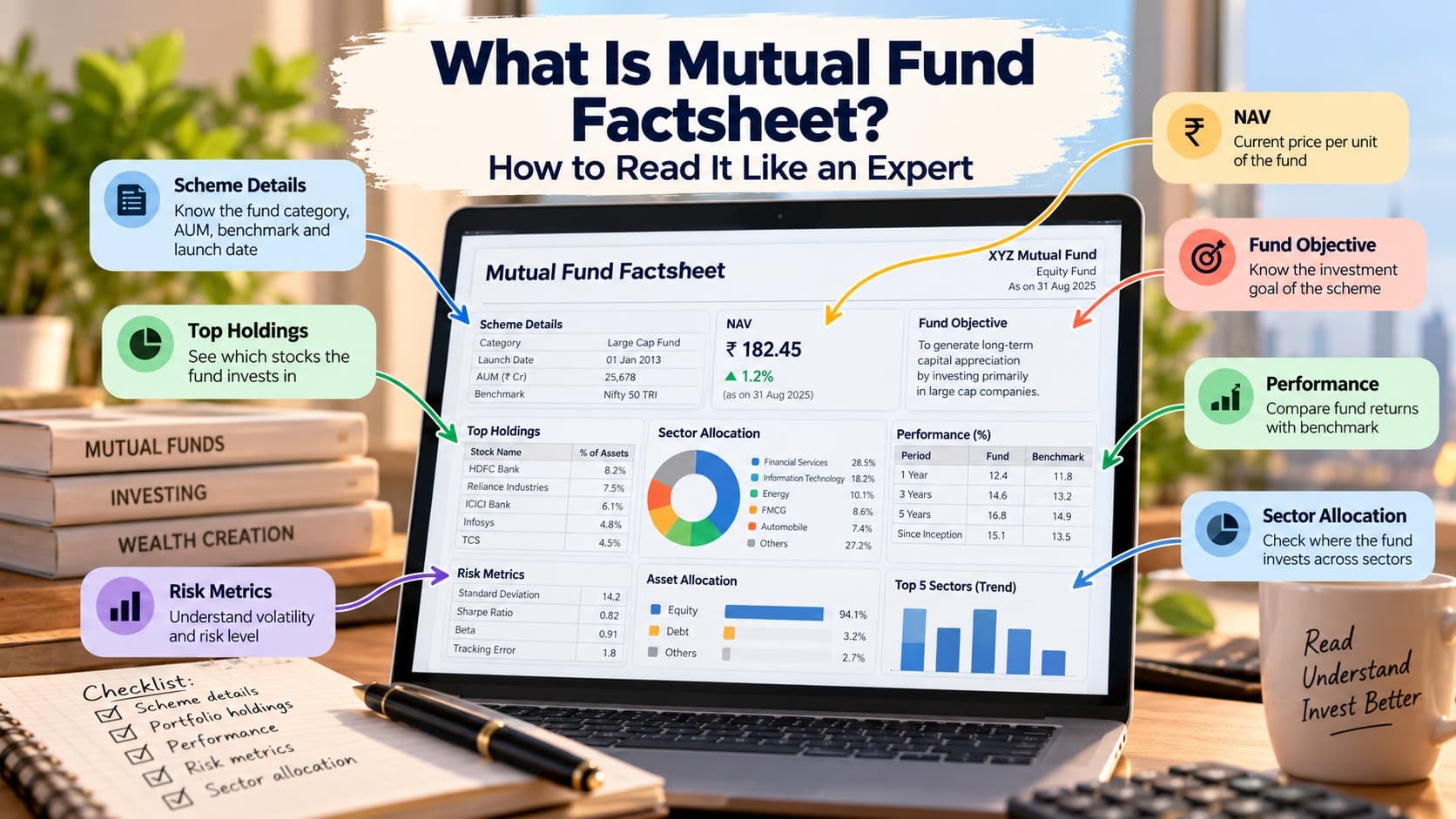
Learn how to read a mutual fund factsheet, understand portfolio allocation, returns, risk metrics, expense ratio, and fund manager commentary.
Introduction
Choosing a mutual fund based only on past returns can be misleading. A fund may have delivered impressive returns recently, but do you know where it invests, how much risk it takes, or how its portfolio has changed over time?
This is where a mutual fund factsheet becomes useful.
A factsheet brings together essential information about a mutual fund scheme, including its investment objective, portfolio holdings, performance, expense ratio, risk metrics, and fund manager details. It helps investors understand what they are investing in instead of relying only on ratings or recent returns.
However, reading a factsheet involves more than checking a few numbers. You need to understand what each metric means and how different details work together.
In this guide, we explain what a mutual fund factsheet is, how to read one step by step, and the key details to check before investing.
What Is a Mutual Fund Factsheet?
A mutual fund factsheet is a document published by an Asset Management Company (AMC) that provides a snapshot of a scheme's key information, usually for a particular month.
The monthly factsheet meaning is simple: it helps investors understand a fund's portfolio, performance, costs, and risk profile as of a specified reporting date.
A typical factsheet includes:
Scheme name, investment objective, and benchmark
Fund manager details
Assets Under Management (AUM)
Portfolio holdings and sector allocation
Historical returns
Expense ratio
Risk measures
Debt-related metrics, where applicable
Fund manager commentary
A factsheet is useful before investing and when reviewing an existing portfolio. It can help you understand whether a scheme follows its stated investment objective and whether its approach continues to suit your financial goals.
For an overview of investment options, you can also explore Kuberzo's mutual funds section.
Where to Download Mutual Fund Factsheet
You can generally download a mutual fund factsheet from the official website of the AMC managing the scheme. Look for sections such as Factsheets, Investor Corner, Scheme Documents, or Downloads.
Choose the relevant scheme and reporting month, then check the date mentioned in the document.
Remember that a factsheet represents information as of a particular date. Portfolio holdings, market values, and other figures can change after publication. Always check the reporting period before comparing two documents.
How to Read a Mutual Fund Factsheet: 5 Things to Check
If you are new to mutual fund investing, a factsheet can initially look overwhelming. These five checks can help you understand the most important information without getting lost in the numbers.
1. Check the Investment Objective and Benchmark
Start by understanding what the scheme aims to achieve.
The investment objective explains the fund's broad purpose. For example, an equity fund may invest primarily in large-cap companies, while a debt fund may focus on money market instruments or bonds.
The benchmark provides a reference point for evaluating the fund's performance. An index fund tracking the Nifty 50, for example, should be assessed against the relevant Nifty 50 benchmark.
Ask yourself:
Does the scheme's objective match my investment goal?
Is the benchmark appropriate for the fund's strategy?
Does the portfolio reflect the stated investment approach?
Do not select a fund simply because its name sounds suitable. Understand its objective and the type of investments it can hold.
2. Review Returns and Historical Performance
Most factsheets display returns across different periods, such as one year, three years, five years, or since inception, depending on the scheme's history.
These figures help you understand how a fund has performed over time. However, the most recent return should not be the only factor influencing your decision.
Compare the fund's performance with its benchmark and similar schemes over equivalent periods. Also consider how it behaved during different market conditions.
For lump-sum investments, returns over longer periods may be shown as Compound Annual Growth Rate (CAGR). For SIP investments, the factsheet may show returns based on the timing of individual instalments.
Keep in mind that past performance does not guarantee future returns. A fund that performs well during one market cycle may not deliver the same results in the future.
3. Understand Portfolio Holdings and Sector Allocation
The portfolio section shows where the scheme has invested its money. Depending on the category, this may include individual stocks, bonds, government securities, or other instruments.
Understanding sector allocation in factsheet data is particularly useful when analysing equity funds. Sector allocation tells you how the portfolio is distributed across industries such as banking, information technology, healthcare, energy, and consumer goods.
For example, consider a hypothetical equity fund with the following allocation:
Sector | Allocation |
Banking and financial services | 28% |
Information technology | 15% |
Healthcare | 10% |
Consumer goods | 12% |
Other sectors and holdings | 35% |
These figures are illustrative. They show how a factsheet can help identify which sectors account for a larger share of a portfolio.
A high allocation to one sector may make a fund more sensitive to developments affecting that industry. It is also important to review the fund's top holdings and check whether your other investments already have similar exposure.
For debt funds, pay attention to credit quality, issuer concentration, average maturity, and duration instead of equity sector allocation alone.
4. Check the Expense Ratio and AUM
The Total Expense Ratio (TER) represents the expenses charged to a mutual fund scheme relative to its assets, subject to applicable regulations and disclosures.
Expenses matter because they reduce the returns available to investors, all else being equal. When comparing similar schemes, check their expense ratios and understand whether you are looking at a Direct or Regular plan.
AUM, or Assets Under Management, tells you the size of the scheme. A larger AUM does not automatically mean that a fund is better, safer, or more profitable.
Consider AUM alongside the fund's investment strategy, portfolio composition, liquidity where relevant, and historical performance.
The goal is to understand the cost of investing and the scale at which the scheme operates, not to choose a fund based on size alone.
5. Examine Risk Metrics
Returns tell only part of the story. Risk metrics can help you understand how a fund has behaved and what kind of fluctuations investors may experience.
Some key metrics in fund factsheet documents include:
Metric | What It Tells You |
Standard Deviation | Measures the historical variability of returns |
Beta | Indicates sensitivity to benchmark movements |
Sharpe Ratio Portfolio Turnover Ratio | Measures historical excess return relative to volatility Indicates the extent of portfolio trading activity |
Tracking Error | Measures the variability of return differences between a passive fund and its benchmark |
Modified Duration | Estimates a debt portfolio's sensitivity to changes in yield |
Average Maturity | Summarises the weighted average remaining maturity of debt securities |
Not every metric applies to every mutual fund. Tracking error is especially relevant to index funds, while modified duration is useful when evaluating debt funds.
No single metric captures every risk. Interpret the figures alongside the investment objective, portfolio holdings, and other relevant information.
How to Read Mutual Fund Portfolio Disclosure
A mutual fund portfolio disclosure shows how a scheme has allocated its investments at a particular point in time. It may list individual securities, their portfolio weights, and the proportion of assets invested in each holding.
When reviewing a mutual fund portfolio disclosure, compare the latest available information with earlier factsheets. Look for changes in top holdings, sector allocation, credit quality, and cash exposure.
Changes are not necessarily a concern. Fund managers may adjust holdings because of changing valuations, company fundamentals, market conditions, or the scheme's investment strategy.
However, significant changes deserve closer attention. If a fund has increased its exposure to a particular sector, understand whether the shift is consistent with its investment objective.
Remember that a portfolio disclosure is a snapshot. It should not be treated as a live record of every holding on the day you read it.
Analysing Fund Manager Commentary
Many factsheets include commentary from the fund manager about market conditions, portfolio decisions, and recent performance.
Analysing fund manager commentary can help you understand the thinking behind the numbers. For example, the manager may explain why exposure to a particular sector has increased or decreased, or why the fund performed differently from its benchmark.
When reading the commentary, consider three questions:
Is the explanation specific? Look for a clear reason behind portfolio changes rather than broad market statements alone.
Does it match the portfolio? Check whether the holdings and sector allocation support the manager's explanation.
Is the strategy consistent? Review commentary across several months to understand whether the fund continues to follow its stated investment approach.
Fund manager commentary provides context, but it is not a promise of future returns. Use it alongside the actual portfolio and performance data.
Common Mistakes to Avoid When Reading a Factsheet
Even experienced investors can misinterpret factsheet information. Avoid these common mistakes:
Selecting a fund only because it delivered the highest recent returns.
Assuming a large AUM automatically makes a fund better.
Ignoring expenses and risk metrics.
Comparing funds with different objectives or benchmarks.
Treating one month's portfolio disclosure as a permanent picture of the scheme.
Assuming that fund manager commentary guarantees future performance.
A factsheet is one part of investment research. Your decision should also reflect your financial goals, investment horizon, risk tolerance, and overall portfolio.
If you already hold several schemes, Kuberzo's mutual fund portfolio review can help you assess your existing investments in the context of your financial objectives.
How to Use a Factsheet Before Investing
Before making an investment decision, use a simple process:
Read the investment objective and identify the benchmark.
Compare historical returns over appropriate periods.
Review portfolio holdings and sector or credit exposure.
Check the expense ratio and relevant risk metrics.
Read the fund manager's commentary for context.
Assess whether the fund matches your financial goals and risk tolerance.
You can also use Kuberzo's investment risk analyser to better understand your risk profile before evaluating suitable investment options.
For goal-oriented investing, Kuberzo's goal-based financial planner can help you organise your investment approach around specific financial milestones.
Conclusion
A mutual fund factsheet is more than a monthly performance report. It gives you a snapshot of a scheme's investment objective, portfolio holdings, expenses, risk metrics, and management approach.
When learning how to read mutual fund factsheet documents, begin with the investment objective and benchmark, review performance, examine holdings and sector allocation, compare costs, and understand the risk measures relevant to the scheme.
For a practical Kuberzo factsheet decoding guide, remember that no single metric can tell you whether a fund is suitable. The most useful insights come from evaluating performance, portfolio composition, expenses, and risk together.
Always check the reporting date and compare schemes with similar objectives. Most importantly, make investment decisions based on your financial goals, investment horizon, and ability to handle market fluctuations.
Frequently Asked Questions
What is a mutual fund factsheet?
A mutual fund factsheet is a document published by an asset management company that summarises a scheme's investment objective, portfolio holdings, performance, expenses, risk metrics, and other important details for a specified reporting period.
How often should I read a mutual fund factsheet?
Review the latest available factsheet periodically to understand changes in portfolio allocation, expenses, and performance. Avoid making decisions based on a single month's data; look for longer-term patterns and consistency with the scheme's objective.
Where can I download a mutual fund factsheet?
You can usually download a factsheet from the official website of the AMC managing the scheme. Look under sections such as Factsheets, Investor Corner, Scheme Documents, or Downloads, and check the reporting date before using the information.
What are the most important metrics in a mutual fund factsheet?
Start with historical returns, benchmark performance, expense ratio, AUM, portfolio holdings, and risk measures relevant to the fund. Equity funds may show standard deviation and beta, while debt funds may show YTM, average maturity, and modified duration.