
What Is KYC in Mutual Fund? Procedure and Documents
By Aviral Singh
About the Author
Aviral Singh is an MBA student at IIM Guwahati and a CSIR NET (JRF) qualifier with an M.Sc. from Hansraj College. A former Physics Wallah educator, he creates content on campus life and writes on finance, investments, businesses and education.
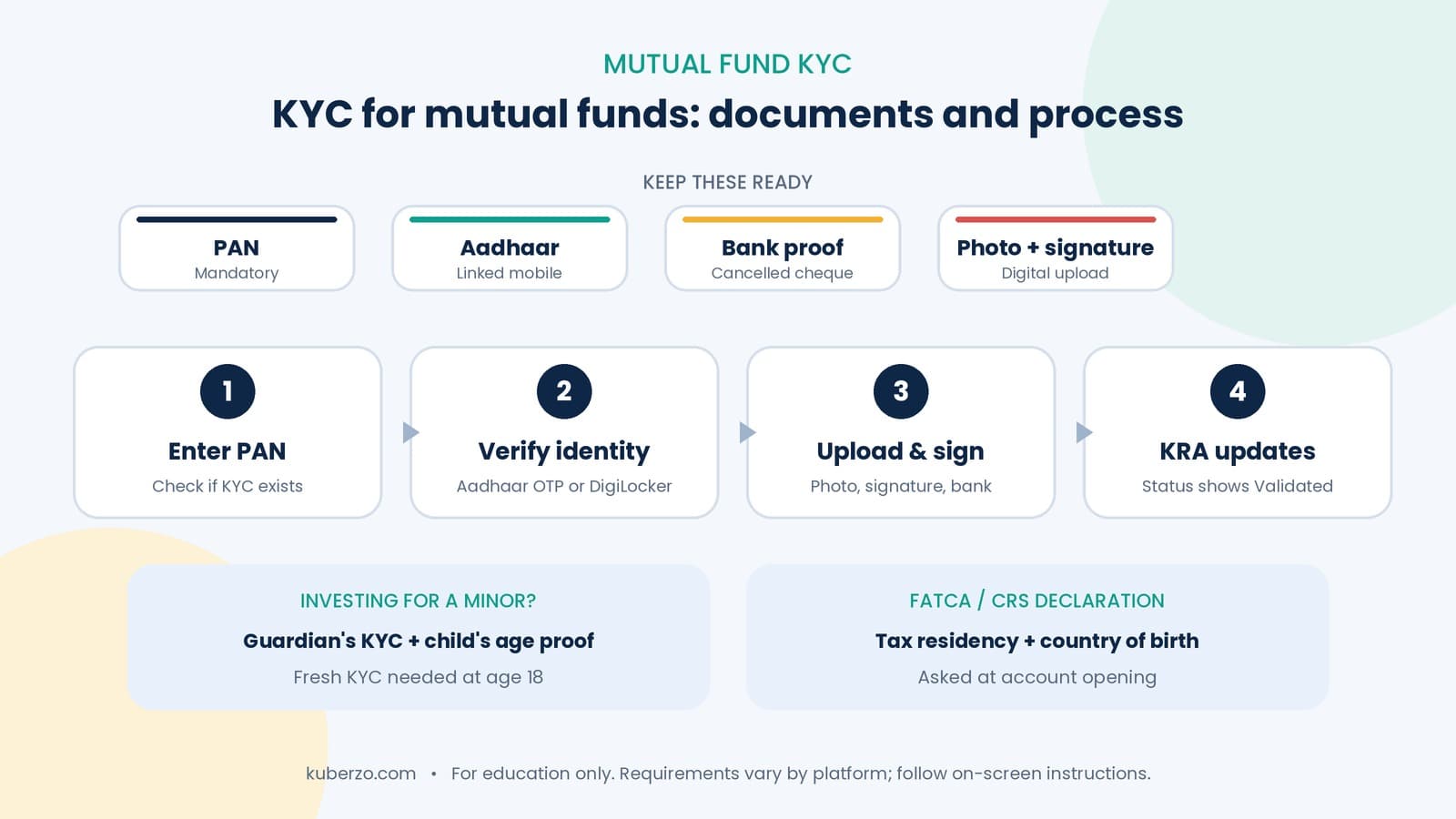
What is KYC in mutual funds? Learn the KYC procedure, documents required, how KRA fits in, how to open a mutual fund for a minor, and what the FATCA declaration is.
KYC (Know Your Customer) is a one-time identity and address verification that SEBI requires before you can invest in any mutual fund. You complete it once, with your PAN, Aadhaar, bank details, photo and signature. The record is stored with a KYC Registration Agency (KRA), and every fund house can then use it. For mutual funds, you also fill in a FATCA/CRS declaration about your tax residency when you open your first folio.
What is KYC in a mutual fund?
KYC means “Know Your Customer”. It confirms who you are and where you live, so fund houses can follow anti-money-laundering rules and protect you from fraud. Without a valid KYC, a fund house cannot accept your investment.
What is MF KYC?
MF KYC is simply KYC done for mutual fund investing. It is the same verification process, and the result is stored in the central KRA system. You do it once, not once per fund house.
What is KRA in a mutual fund?
KRA stands for KYC Registration Agency. It is a SEBI-registered body that stores your KYC record so that any fund house can check it with your consent.
Documents required for mutual fund KYC
Document | Why it is needed |
|---|---|
PAN card | Mandatory identity proof for investing |
Aadhaar (or other valid address proof) | Address and identity verification, often done via OTP or DigiLocker |
Bank account proof | Cancelled cheque, bank statement or passbook page, for payments and redemptions |
Passport-size photograph | Identity record |
Signature | Used on your KYC and application |
Mobile number and email | For OTPs, statements and alerts |
Requirements vary slightly by platform, and online KYC usually lets you upload digital copies. If you use Aadhaar OTP, make sure your mobile number is linked to Aadhaar.
KYC procedure for mutual funds: step by step
Check if your KYC already exists. Enter your PAN on a KRA or fund house page. If it says Validated, you can skip to investing. See [link →] “Kuberzo’s guide: How to Check Mutual Fund KYC Status Online” [to] (insert URL of block 10 once published).
Choose a platform. Use a fund house website or app, a bank app or an investing app.
Enter your PAN and basic details. Name and date of birth must match your PAN.
Verify your identity. Use an Aadhaar OTP, DigiLocker or another accepted method.
Upload your photo and signature. Follow the instructions on screen.
Complete verification if asked. Some platforms require a short video or in-person verification.
Wait for the KRA to update. Your status moves to Registered or Validated.
Start investing. Your first investment creates your folio.
How long does mutual fund KYC take?
Online KYC is usually quick, but how fast the KRA updates your record can vary. If your status does not change after a day or two, check it again on a KRA website, and contact the platform if it still shows a problem.
What is a FATCA declaration for mutual funds?
FATCA (Foreign Account Tax Compliance Act) and CRS (Common Reporting Standard) are global tax-transparency rules. When you open a mutual fund folio, you declare:
Your country of tax residency
Your country of birth
A tax identification number, if you are tax resident outside India
Most Indian residents simply confirm India as their tax residency. The declaration is mandatory for all investors, so fund houses can report to tax authorities where required. If your details change, such as moving abroad, update the fund house.
How to open a mutual fund for a minor
A minor can own a mutual fund folio, but a parent or court-appointed legal guardian must operate it.
Item | Details |
|---|---|
Who invests | A parent or legal guardian, on behalf of the minor |
Account holder | The minor is the sole holder; the guardian manages it |
Documents for the minor | Proof of date of birth, such as a birth certificate, passport or school certificate |
Documents for the guardian | Guardian’s KYC (PAN, address proof), photo and proof of relationship |
Bank account | Minor’s account, or a joint account of the minor and guardian |
Legal guardian (non-parent) | Court-appointed guardianship certificate |
What happens when the child turns 18? The account is usually frozen for transactions until the child completes their own KYC, updates their bank details and converts the folio from minor to major through the fund house’s “minor to major” form. Plan for this so SIPs don’t stop unexpectedly.
To think through goals like education or marriage, Kuberzo’s Goal Based Planner can help.
How to open a mutual fund account online
You don’t open a separate account with each fund house. You complete KYC once, and your first investment creates a folio.
Complete or confirm KYC (see the steps above).
Choose a platform and register with your mobile number and email.
Add and verify your bank account.
Fill in the FATCA/CRS declaration.
Add a nominee, or opt out as the platform requires.
Pick a fund and invest. Choose lump sum or SIP, Growth or IDCW, and Direct or Regular.
Complete payment or the auto-debit mandate.
Save your folio number and confirmation.
If you’re comparing options, Kuberzo’s SIP vs Lump Sum guide and Kuberzo’s ETF vs Mutual Fund guide can help you decide what to start with.
Common KYC mistakes
Mistake 1: Name mismatch between PAN, Aadhaar and bank account. It is a common reason for rejection.
Mistake 2: Using a mobile number not linked to Aadhaar. The OTP won’t arrive.
Mistake 3: Not linking PAN with Aadhaar. It can put your KYC On Hold.
Mistake 4: Skipping the FATCA declaration or filling it wrongly. It can block your first investment.
Mistake 5: Forgetting the minor-to-major step at 18. The folio gets frozen.
Mistake 6: Using unofficial websites for KYC. Only use official KRA, fund house or trusted platform links.
So, what should you do next?
Check whether your KYC already exists, keep your PAN, Aadhaar and bank details ready, and complete the missing steps online. Once your KYC is Validated, you can invest in any mutual fund without repeating it.
Contact us for personalised guidance.
Financial disclaimer
This article is for general education and does not constitute personal investment or tax advice. KYC, FATCA and minor account requirements are set by SEBI and fund houses and can change; check official sources for the latest rules. Mutual fund investments are subject to market risks; read all scheme-related documents carefully. Consult a qualified financial or tax professional before making investment decisions.
Frequently Asked Questions
Q: What is KYC in mutual fund?
It is a one-time identity and address verification required by SEBI before you can invest in any mutual fund.
Q: What documents are needed for mutual fund KYC?
PAN, Aadhaar or other address proof, bank account proof, a photograph, a signature, and a mobile number and email.
Q: Do I need to do KYC again for every fund house?
No. KYC is done once and stored with a KRA, so any SEBI-registered fund house can use it.
Q: What is a FATCA declaration for mutual funds?
A mandatory declaration of your tax residency and country of birth, made when you open your first folio, for global tax-transparency rules.
Q: Can I open a mutual fund account for my child?
Yes. A parent or legal guardian can invest in the minor’s name using the guardian’s KYC, the child’s age proof and proof of relationship.
Q: What happens to a minor’s folio at age 18?
The folio is generally frozen until the child completes KYC, updates bank details and converts it to a regular folio.




