
What Is Exit Load in Mutual Fund? Meaning, Charges and Example
By Aviral Singh
About the Author
Aviral Singh is an MBA student at IIM Guwahati and a CSIR NET (JRF) qualifier with an M.Sc. from Hansraj College. A former Physics Wallah educator, he creates content on campus life and writes on finance, investments, businesses and education.
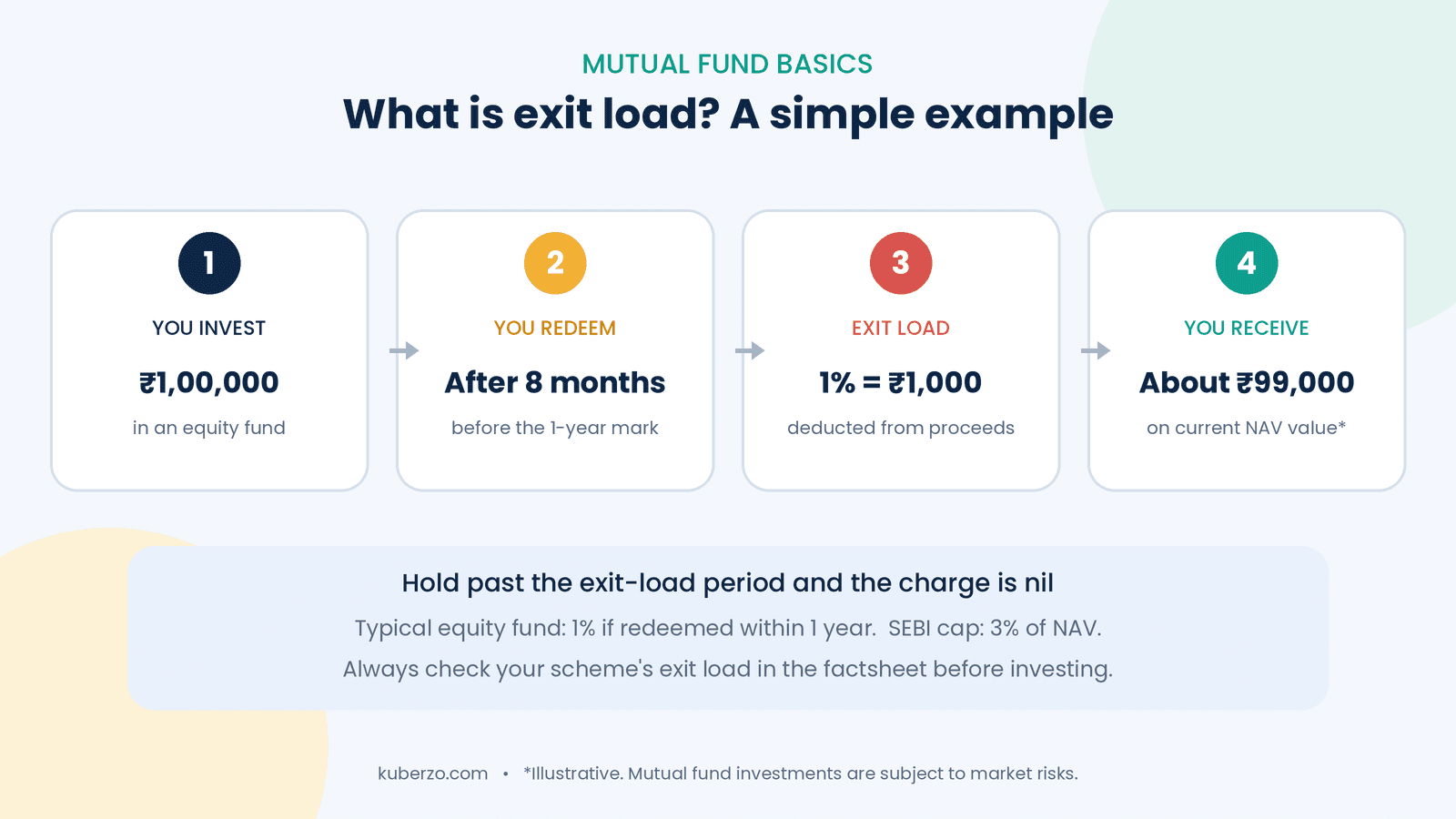
What is exit load in a mutual fund? Learn the meaning, how exit load charges are calculated, the SEBI cap, a worked example, and how to avoid paying it.
Exit load is a fee a mutual fund deducts when you redeem units before a set holding period ends. Most equity funds charge about 1% if you redeem within one year, and nothing after that. SEBI caps exit load at 3% of NAV. The charge is deducted from your redemption amount.
What is exit load in a mutual fund?
Exit load is the fee charged when you sell (redeem) mutual fund units before a minimum period. The period and rate are fixed by each scheme and published in its scheme documents.
Its purpose is to discourage short-term exits that force the fund manager to sell holdings at bad times. Under SEBI rules, exit load collected must be credited back to the scheme, not kept by the fund house. So it benefits the investors who stay invested.
What does exit load mean in simple terms?
Think of it as a “leaving early” fee. If you stay invested past the stated period, you pay nothing. If you leave earlier, a small percentage is cut from what you receive.
What are exit load charges in a mutual fund?
The rate depends on the fund category and the scheme’s own terms.
Fund type | Typical exit load structure |
|---|---|
Equity funds (large, flexi, mid, small cap) | Commonly 1% if redeemed within 1 year; nil after |
Hybrid / balanced advantage funds | Often 1% within a short period (e.g. 1 year); varies by scheme |
Liquid funds | Graded, only for the first 7 days; nil after |
Index funds and ETFs | Often nil or a small load for a short period |
ELSS (tax-saving) funds | Usually nil, since the 3-year lock-in already applies |
Life Cycle Funds (new SEBI category) | 3% in year 1, 2% in year 2, 1% in year 3 |
Indicative only. Always check the scheme’s latest factsheet or Scheme Information Document.
What is the SEBI limit on exit load?
SEBI has lowered the maximum exit load for open-ended schemes from 5% to 3% under the new Mutual Funds Regulations, 2026. In practice, most funds charge about 1% to 2%.
What is exit load in a mutual fund, with an example?
Suppose you invest ₹1,00,000 in an equity fund with a 1% exit load if redeemed within 1 year.
Redeem after 8 months: the fund value is, say, ₹1,00,000, so exit load = 1% × ₹1,00,000 = ₹1,000. You receive about ₹99,000.
Redeem after 14 months: exit load is nil. You receive the full value.
The load is charged on the redemption value at current NAV, not on your original investment. If your units grew to ₹1,20,000, a 1% load would be ₹1,200.
How does exit load work with SIPs?
Each SIP instalment is treated as a separate investment with its own exit-load clock. Units are redeemed on a first-in, first-out (FIFO) basis, so the oldest units go first. If you redeem after 15 months of a monthly SIP, the first 3 instalments are past the 1-year mark (no load), but the later ones may still attract exit load.
If you’re weighing SIP against a one-time investment, Kuberzo’s SIP vs Lump Sum guide explains how each behaves.
Is exit load charged on switches?
It can be. Switching from one scheme to another counts as a redemption from the first scheme, so exit load may apply. Switches within the same scheme (for example, Regular to Direct, or between plans) can also be treated differently. Check the scheme’s rules first.
Exit load vs tax: they are not the same
Exit load is a fund charge. Capital gains tax is separate, and you may pay both on an early exit.
Situation (equity fund) | Exit load | Tax |
|---|---|---|
Redeemed at 8 months | 1% (typical) | Short-term capital gains at 20% |
Redeemed at 14 months | Nil | Long-term gains above ₹1.25 lakh at 12.5% |
So an early exit can cost you twice: the load plus higher tax.
Exit load vs expense ratio
Expense ratio is a yearly running cost already built into the NAV. Exit load is a one-time charge when you leave early. You will not see an expense ratio deduction on your statement, but you will see exit load deducted from the redemption amount.
Fund choice matters here too: Kuberzo’s Debt Fund vs Equity Fund guide shows how horizon and risk differ across fund types.
How to avoid or reduce exit load
Match the fund to your time horizon. Don’t put money you may need within a year into a fund with a 1-year load.
Check the exit load before investing. It is in the factsheet and the Scheme Information Document.
Wait out the period. If you’re close to the cutoff date, waiting a few days can save the entire charge.
Use a liquid or low-load fund for short-term parking. For needs within months, compare options in Kuberzo’s Fixed Deposit vs Mutual Fund guide
Plan withdrawals. Use a goal-based approach so you don’t have to redeem early. Kuberzo’s Goal Based Planner can help.
Common mistakes investors make with exit load
Mistake 1: Ignoring exit load until redemption. Check it before you invest.
Mistake 2: Assuming every fund charges the same. Each scheme sets its own rate and period.
Mistake 3: Thinking exit load is charged on your original amount. It applies to the redemption value.
Mistake 4: Forgetting each SIP instalment has its own period. Recent instalments may still carry the load.
Mistake 5: Mixing up exit load with expense ratio. One is a one-time exit charge, the other is a recurring cost.
Mistake 6: Overlooking the tax impact of early exit. Short-term gains are taxed at a higher rate on top of the load.
So, should you worry about exit load?
For a long-term investor, exit load is a minor cost that disappears after the holding period. It becomes a problem only if you redeem early. The simple fix is to pick funds that fit your horizon and read the exit load terms before you invest.
Contact us for personalized guidance.
Financial disclaimer
This article is for general education and does not constitute personal investment or tax advice. Exit load rates, periods and tax rules vary by scheme and can change. Mutual fund investments are subject to market risks; read all scheme-related documents carefully. Consult a qualified financial or tax professional before making investment decisions.
Frequently Asked Questions
What is exit load in a mutual fund?
It is a fee charged when you redeem units before a set holding period. It is deducted from your redemption amount.
What is a typical exit load on mutual funds?
Most equity funds charge 1% if redeemed within one year and nil after that. The exact rate and period vary by scheme.
What is the SEBI limit on exit load?
SEBI caps exit load for open-ended schemes at 3% of NAV, down from 5%.
Who gets the exit load money?
It is credited back to the scheme, so remaining investors benefit.
Is exit load charged on SIP investments?
Yes. Each instalment has its own holding period, and the oldest units are redeemed first.
Is there exit load in ELSS funds?
Usually not, because ELSS has a mandatory 3-year lock-in and you cannot redeem earlier.




