
What Happens After ELSS 3 Years? Maturity Period and Tax
By Aviral Singh
About the Author
Aviral Singh is an MBA student at IIM Guwahati and a CSIR NET (JRF) qualifier with an M.Sc. from Hansraj College. A former Physics Wallah educator, he creates content on campus life and writes on finance, investments, businesses and education.
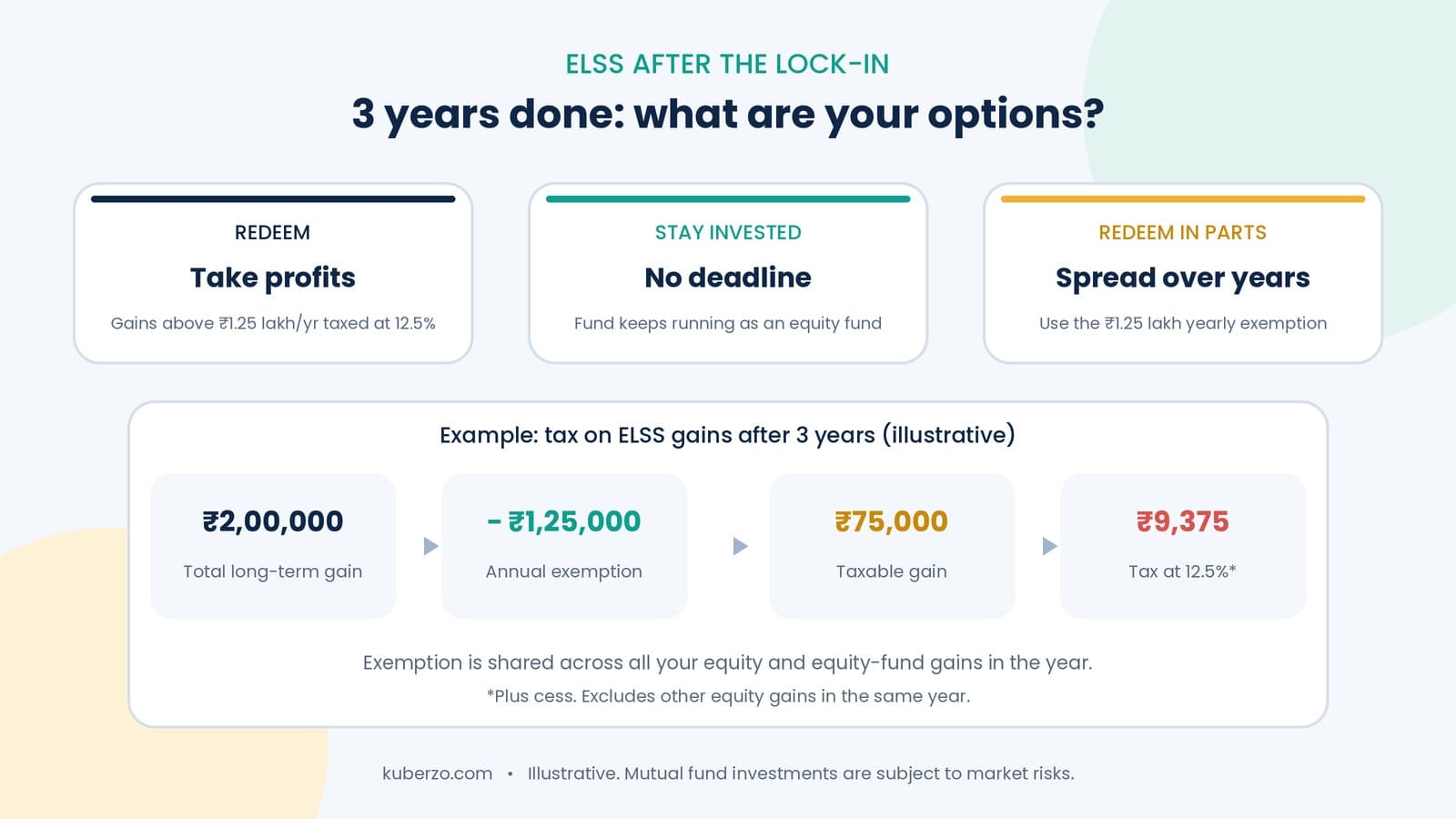
What happens after ELSS 3 years? Learn the maturity period, your options after the lock-in, how ELSS gains are taxed, and how to open a mutual fund account online.
The direct answer: after 3 years, your ELSS units are free to redeem, but nothing forces you to. ELSS has no maturity date, so you can sell now, stay invested, or sell in parts. Gains are taxed like any equity fund: long-term gains up to ₹1.25 lakh a year are exempt, and the rest is taxed at 12.5%.
What is the ELSS maturity period?
ELSS has no maturity period in the way an FD or NSC does. The 3-year lock-in is only a minimum holding period. Once it ends, your units behave like any open-ended equity fund, and you can hold them for as long as you like.
What is the ELSS holding period after the lock-in?
There is no maximum. For tax purposes, units held for more than 12 months are already long-term, so the 3-year lock-in always puts you in the long-term category. The holding period only matters for planning: the longer you stay invested, the more time your money has to compound, though equity returns are never guaranteed.
What happens to my ELSS after 3 years?
Option | What it means | Best when |
|---|---|---|
Redeem fully | Sell all unlocked units and receive the proceeds | You need the money for a goal |
Stay invested | Do nothing; units keep growing or falling with the market | Your goal is still years away |
Redeem in parts | Sell some units each year | You want to use the yearly tax exemption |
Switch | Move to another fund, which counts as a sale for tax | Your needs or risk comfort changed |
ELSS tax after 3 years: how are gains taxed?
After the lock-in, ELSS gains are taxed as long-term capital gains on equity funds:
Up to ₹1.25 lakh in a financial year: tax-free.
Above ₹1.25 lakh: taxed at 12.5% (plus cess), with no indexation.
No separate ELSS exemption: the ₹1.25 lakh limit is shared across all your equity shares and equity-oriented fund gains in that year.
ELSS tax after 3 years: a worked example
You invested ₹3,00,000 in ELSS and it grows to ₹5,00,000 after 3 years. You redeem everything.
Step | Amount |
|---|---|
Long-term gain | ₹2,00,000 |
Less annual exemption | ₹1,25,000 |
Taxable gain | ₹75,000 |
Tax at 12.5% | ₹9,375 (plus cess) |
If you had no other equity gains that year, this is your tax bill. If you have other gains, the exemption is used up first by whichever you sell, so your tax could be higher.
Illustrative example only. Your actual tax depends on your total gains and circumstances.
How to reduce ELSS tax after 3 years
Redeem in parts. Splitting a large gain across two financial years lets you use the ₹1.25 lakh exemption twice.
Plan around other gains. The exemption covers your total equity gains, so check what else you’ve sold this year.
Offset losses. Capital losses on other equity investments can reduce taxable gains. Confirm the rules with a tax professional.
Be careful with the timing. If you sell in March, you may use that year’s exemption. If you sell in April, you get a fresh one.
For a deeper look at how fund type affects tax, see Kuberzo’s Debt Fund vs Equity Fund guide
Is there exit load on ELSS after 3 years?
Usually not. Many ELSS funds charge no exit load, because redemption is only allowed after the lock-in anyway. But schemes differ, so check your fund’s factsheet.
Is there TDS on ELSS redemption?
For resident Indians, mutual fund houses generally do not deduct TDS on redemption. You are responsible for reporting the gains and paying any tax, including advance tax if your capital gains are large. NRIs face TDS on capital gains, so they should check the fund house’s rules.
What about the ₹1.5 lakh deduction I claimed earlier?
The deduction you claimed when investing (old regime only) stays valid. Selling after the lock-in does not reverse it. If you redeem and reinvest in a new ELSS, the new investment can qualify again, subject to the ₹1.5 lakh yearly cap and your tax regime, and it starts a fresh 3-year lock-in.
Should you redeem ELSS after 3 years?
There is no automatic answer. Ask:
Do I need this money soon? If yes, redeeming makes sense.
Is my goal more than 5 years away? If yes, staying invested may suit you better.
Is the fund still performing reasonably against its peers? If not, switching may make sense, but weigh the tax cost.
Is my portfolio too heavy in equity? If yes, redeem part and rebalance.
To map this to your goals, Kuberzo’s Goal Based Planner can help, and Kuberzo’s Risk Analyser Tool can help you check how much equity you’re comfortable with.
How to open a mutual fund account online
You don’t open a separate “account” with each fund house. You complete KYC once and then invest, which creates a mutual fund folio.
Complete KYC. Keep your PAN, Aadhaar, bank account details and a phone number linked to Aadhaar ready.
Choose a platform. Options include a fund house’s website or app, a bank app or an investing app.
Register or sign in with your mobile number and email, then verify with an OTP.
Add bank details and link your account for payments and redemptions.
Choose a fund and invest. Select lump sum or SIP. A folio is created with your first investment.
Complete payment or the auto-debit mandate via UPI or net banking.
Note your folio number and keep the confirmation. Your statement shows the allotment date, which fixes your lock-in end date if you chose ELSS.
If you’re deciding between SIP and lump sum for your next investment, Kuberzo’s SIP vs Lump Sum guide can help.
Common mistakes after the ELSS lock-in
Mistake 1: Assuming ELSS “matures” and closes at 3 years. It doesn’t. It continues until you redeem.
Mistake 2: Redeeming everything in one year and losing the exemption. Splitting can cut tax.
Mistake 3: Forgetting that the ₹1.25 lakh limit is shared. It covers all equity gains, not just ELSS.
Mistake 4: Selling out of fear after a market fall. The lock-in is over, but a long-term goal may still be years away.
Mistake 5: Reinvesting in ELSS only for the tax deduction. The new money is locked for another 3 years.
Mistake 6: Not reporting the gains. Capital gains must be disclosed in your income tax return even if the tax is nil.
So, what should you do after 3 years?
Treat the end of the lock-in as a decision point, not a deadline. Redeem if you need the money or want to rebalance, stay invested if your goal is far away, and split large withdrawals across years to use the tax exemption.
Contact us for personalised guidance.
Financial disclaimer
This article is for general education and does not constitute personal investment or tax advice. ELSS returns are market-linked and not guaranteed. Tax rates, exemptions and rules can change and vary by individual circumstances. Mutual fund investments are subject to market risks; read all scheme-related documents carefully. Consult a qualified financial or tax professional before making investment decisions.
Frequently Asked Questions
What happens after ELSS 3 years?
The lock-in ends and your units can be redeemed. You can sell, stay invested or sell in parts.
What is the ELSS maturity period?
ELSS has no fixed maturity. The 3-year lock-in is the minimum holding period, and the fund continues afterwards.
How is ELSS taxed after 3 years?
As long-term capital gains on equity funds. Gains up to ₹1.25 lakh a year are exempt and the rest is taxed at 12.5%.
Is there exit load on ELSS after 3 years?
Usually not, since redemption is only possible after the lock-in. Check your scheme’s factsheet.
Can I stay invested in ELSS after 3 years?
Yes. There is no deadline, and the units keep running as part of an equity fund.
How do I open a mutual fund account online?
Complete KYC with PAN, Aadhaar and bank details, choose a platform, add your bank account, then invest in a fund. A folio is created with your first investment.




