
Tier 1 vs Tier 2 Cities: Where Can You Save More for Your SIPs?
By Saahil Madhogaria
About the Author
Saahil Madhogaria is an MBA student at SOIL Institute of Management with a background in Game Art & Animation and experience as a 3D Artist. He writes about marketing, business, personal finance, careers, and MBA life.
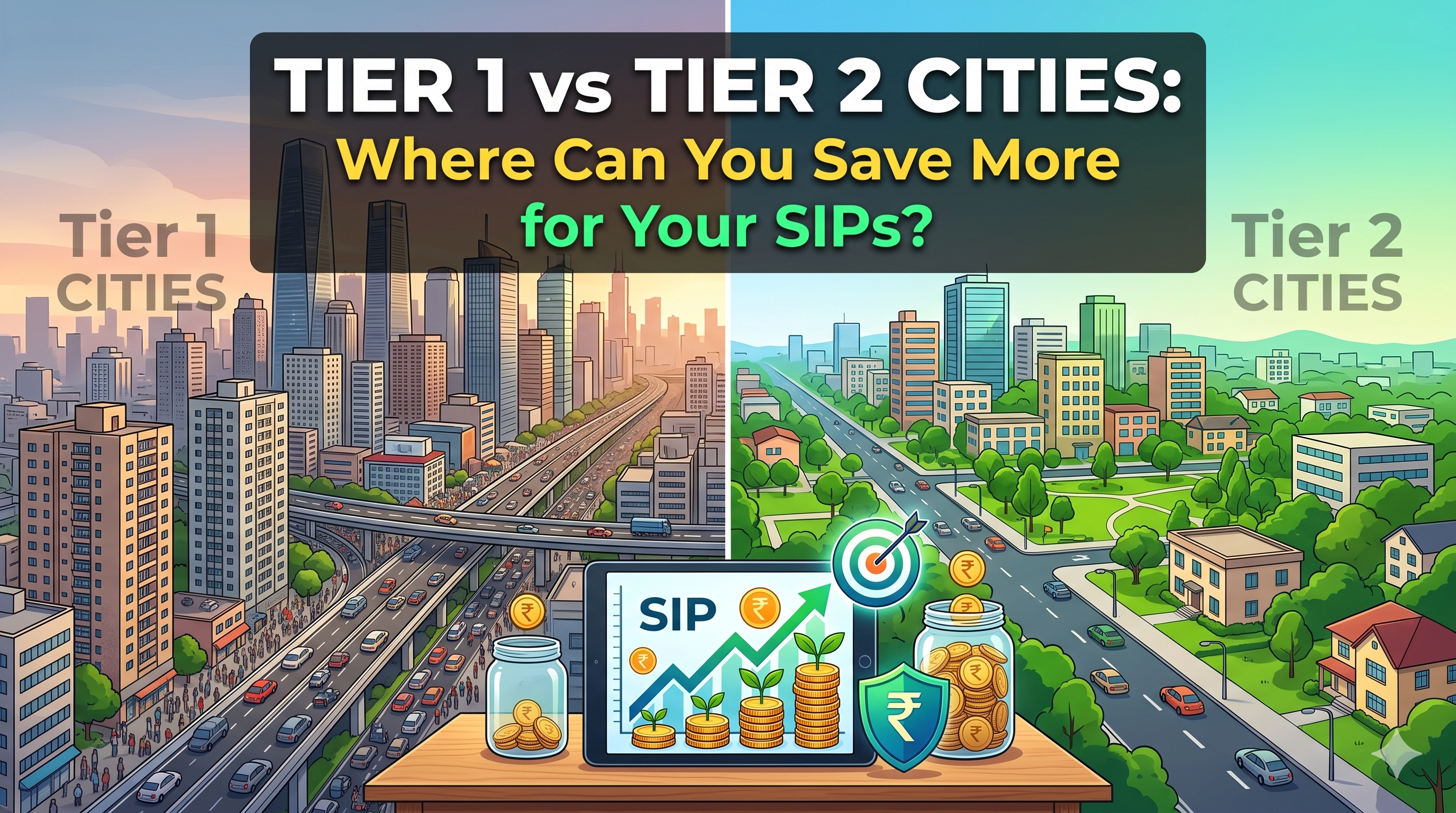
Compare Tier 1 vs Tier 2 city living costs in India, explore remote work savings, and learn how to use lower expenses to increase SIP investments and build wealth.
Tier 1 vs Tier 2 Cities: Where Can You Save More for Your SIPs?
Where you live can have a significant impact on how much money you save each month. A higher salary in a metropolitan city may come with expensive rent, commuting costs, and lifestyle expenses. Meanwhile, a professional earning a comparatively lower salary in a smaller city may have more money left over after essential spending.
This makes the Tier 1 vs Tier 2 cost of living comparison important for anyone trying to build long-term wealth through Systematic Investment Plans (SIPs). With remote and hybrid work becoming options for some professionals, choosing where to live can also become a financial decision.
However, a Tier 2 city is not automatically cheaper for everyone, and lower expenses do not guarantee higher savings. The real question is how much income remains after accounting for housing, transport, family responsibilities, and other costs.
1. Understanding Tier 1 vs Tier 2 Expenses
Tier 1 cities such as Mumbai, Delhi, Bengaluru, and Hyderabad are major employment centres with established corporate ecosystems. They may offer higher salaries and broader career opportunities, but housing and everyday expenses can be substantial in certain neighbourhoods.
Tier 2 cities such as Indore, Jaipur, Coimbatore, and Lucknow may offer more affordable housing and daily living options, depending on the location and lifestyle. However, employment opportunities, salaries, connectivity, and access to specialised services can differ.
The main expense categories to compare are:
Rent and housing: Compare rent, maintenance, deposits, and the cost of purchasing property.
Transportation: Include fuel, public transport, parking, and commuting time.
Food and groceries: Consider grocery prices, eating out, and food delivery habits.
Utilities: Account for electricity, internet, mobile bills, and household services.
Lifestyle: Include entertainment, shopping, fitness, and other discretionary spending.
Career-related costs: Consider professional training, travel, and expenses associated with maintaining your job.
A meaningful cost of living comparison in India should assess the complete household budget rather than comparing rent alone.
2. Tier 2 City Savings: How Much Difference Can It Make?
Consider two hypothetical professionals with different salaries and monthly expenses.
Monthly budget | Tier 1 city | Tier 2 city |
Take-home income | ₹90,000 | ₹70,000 |
Rent and maintenance | ₹25,000 | ₹12,000 |
Food and groceries | ₹10,000 | ₹8,000 |
Transport | ₹5,000 | ₹3,000 |
Utilities | ₹3,000 | ₹2,500 |
Lifestyle and other expenses | ₹17,000 | ₹14,500 |
Total expenses | ₹60,000 | ₹40,000 |
Potential monthly surplus | ₹30,000 | ₹30,000 |
These figures are illustrative examples, not verified averages for either city category.
Despite the difference in income, both professionals have the same monthly surplus in this example. This demonstrates why salary alone is not enough to judge financial progress.
If the Tier 2 professional could reduce expenses further without sacrificing essential needs, their investment capacity might increase. Conversely, higher transport costs, lower salary growth, or fewer job opportunities could reduce the advantage.
The right comparison is the amount you can sustainably save—not simply whether a city is considered affordable.
3. Remote Work Savings SIP: An Opportunity for Professionals
Remote work can make location-based financial planning more flexible for professionals whose employers allow them to work from anywhere.
If your salary remains unchanged after moving to a lower-cost city, the difference in expenses may create an opportunity to increase your SIP contributions. For example, a reduction of ₹8,000 in monthly living costs could potentially free up ₹96,000 annually for savings and investments.
Before relocating, however, consider the full picture:
Confirm that your employer permits permanent remote work from your chosen location.
Check whether relocation affects salary, allowances, or promotion opportunities.
Assess internet reliability, workspace availability, and travel requirements.
Consider proximity to family, healthcare, schools, and other essential services.
Account for moving expenses, rental deposits, and any additional travel to the office.
Moving to a smaller city purely to save money may not be worthwhile if it limits career growth or creates substantial new costs. Evaluate both your financial and professional priorities before making the decision.
4. SIP Investment in Tier 2 Cities: Turning Savings into Wealth
Once you identify a genuine monthly surplus, you can decide how much to invest towards your financial goals.
A SIP allows you to invest a fixed amount in a mutual fund at regular intervals. It can support a disciplined approach to long-term investing without requiring a large initial lump sum.
Suppose you invest ₹10,000 every month for 15 years. Your total contributions would amount to ₹18 lakh. At a hypothetical annualised return of 10%, compounded monthly, the investment could grow to approximately ₹41–42 lakh.
This is an illustration, not a guaranteed return or forecast. Actual returns depend on market performance, investment costs, taxes, and the mutual funds selected.
If relocating increases your monthly surplus, you could consider gradually raising your SIP rather than immediately committing every rupee saved. First account for emergency savings, insurance, debt payments, and short-term goals.
The amount you invest should remain sustainable even when unexpected expenses arise.
5. Moving to a Tier 2 City for Saving: What to Evaluate
A relocation decision should consider more than monthly rent.
Income stability: Will your salary remain unchanged, or could the move affect your earning potential?
Housing affordability: Are the savings meaningful after accounting for deposits, maintenance, and moving expenses?
Career growth: Will you retain access to the professional network, learning opportunities, and roles you need?
Family needs: Consider schools, healthcare, dependants, and the support network available in each location.
Quality of life: Evaluate commuting, connectivity, climate, leisure options, and personal preferences.
For professionals who must attend an office regularly, living closer to work may be financially and practically better than relocating far away. For remote employees with location flexibility, a smaller city may offer a more attractive balance between expenses and lifestyle.
Kuberzo's guide to different types of mutual funds can help investors understand how equity, debt, hybrid and passive categories differ.
6. Creating a Remote Work SIP Strategy
A practical strategy begins with understanding your actual financial position.
Calculate your monthly surplus: Subtract all essential expenses and financial commitments from your take-home income.
Build an emergency fund: Keep accessible savings appropriate to your household's needs and income stability.
Separate financial goals: Plan independently for short-term purchases, home ownership, education, and retirement.
Match investments to timelines: Equity mutual funds may suit certain long-term goals if you can tolerate volatility. Money needed soon generally requires greater emphasis on capital preservation and liquidity.
Automate your SIP: Schedule contributions after payday to maintain consistency.
Review annually: Reassess your budget, investment contributions, and goals whenever your circumstances change.
SIPs do not guarantee profits or eliminate market risk. Choose investments according to your time horizon, risk tolerance, and financial objectives rather than simply chasing recent returns.
Kuberzo's SIP Calculator can help investors model different monthly contribution scenarios.
7. Using a City Comparison Calculator
A city comparison calculator can help estimate how much your financial position might change if you move from a Tier 1 to a Tier 2 city.
Enter your expected take-home income and monthly expenses for each location. Include rent, transport, food, utilities, lifestyle costs, and other commitments. Then compare the resulting monthly surplus.
You can also estimate how much additional money might be available for SIPs after accounting for relocation costs and changes in income.
The Kuberzo Tier 2 SIP approach is to use this comparison as a planning tool rather than a guarantee. Estimates should reflect your own circumstances, and investment projections should use realistic assumptions while recognising that returns are uncertain.
Contact us for a more personalised guidance.
Conclusion
The choice between Tier 1 and Tier 2 cities can influence your ability to save, but the financial advantage depends on your income, expenses, career opportunities, and lifestyle. A smaller city may provide more room for investment, particularly when remote work allows you to retain your salary.
Compare complete monthly budgets before relocating, maintain adequate emergency savings, and invest a sustainable portion of your surplus through suitable financial products. Ultimately, the best city for your SIPs is the one that helps you balance financial progress with career growth and quality of life.
Frequently Asked Questions
Are Tier 2 cities always cheaper than Tier 1 cities?
No. Costs vary by neighbourhood, housing choice, lifestyle, and household needs. Compare actual expenses in the specific cities you are considering.
Can moving to a Tier 2 city help me increase my SIP?
It can if your total expenses decrease while your income remains stable. However, relocation costs, salary changes, and career considerations should also be included.
How much should I invest through SIPs after relocating?
Calculate your surplus after essential expenses, debt payments, emergency savings, and short-term commitments. Invest an amount that you can maintain comfortably.
Is remote work the best way to benefit from Tier 2 city savings?
Remote work can provide greater location flexibility, but the benefit depends on employer policies, income stability, internet access, career growth, and personal circumstances.
Should I choose a Tier 2 city only to save more money?
Not necessarily. Consider career prospects, family requirements, healthcare, connectivity, and quality of life alongside financial savings before deciding to relocate.




