
The Step-by-Step Guide to Retiring Early FIRE Using Mutual Fund SIPs
By Saahil Madhogaria
About the Author
Saahil Madhogaria is an MBA student at SOIL Institute of Management with a background in Game Art & Animation and experience as a 3D Artist. He writes about marketing, business, personal finance, careers, and MBA life.
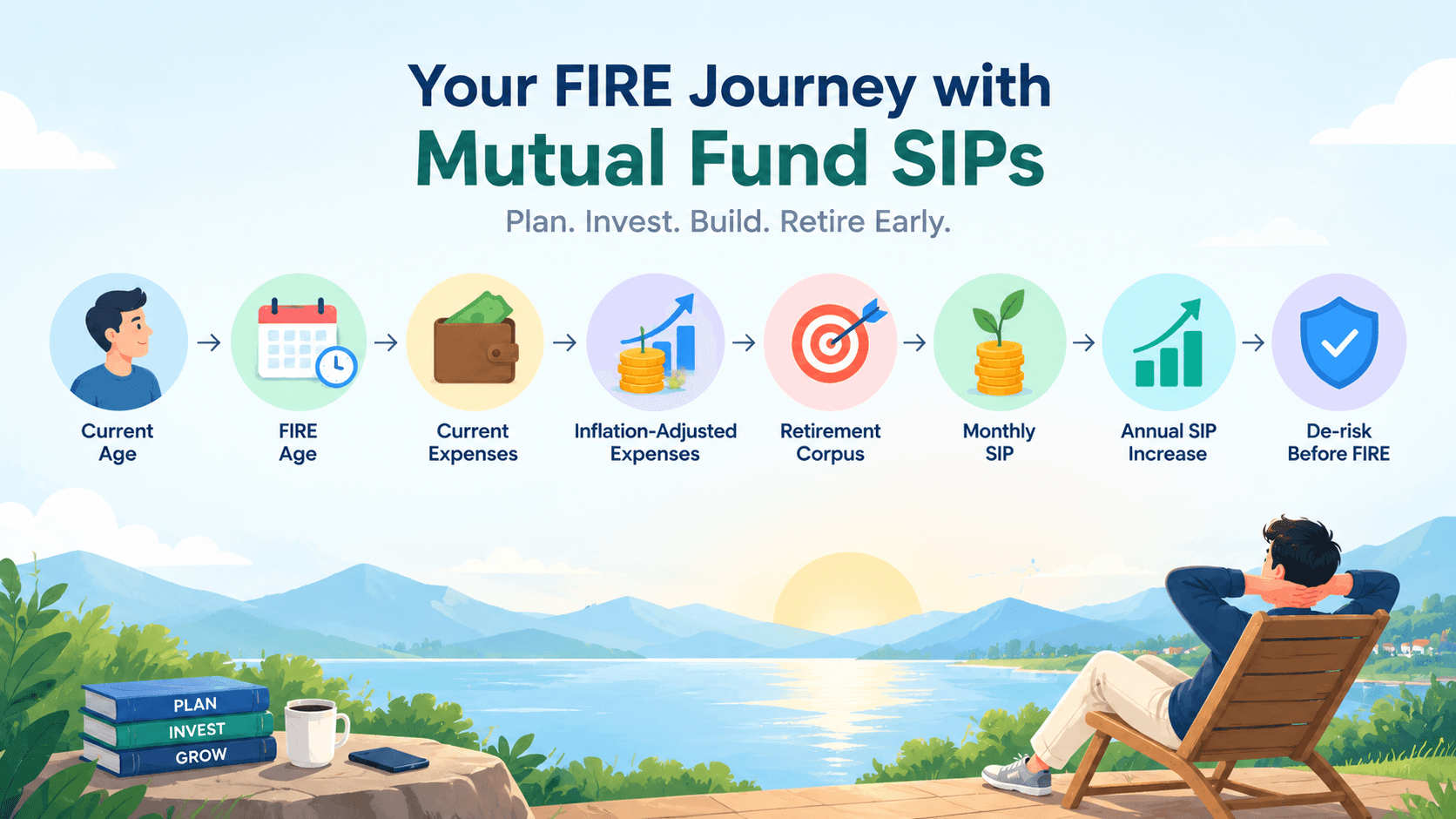
Retire early by investing a set amount each month. Learn how to figure out what you will spend in the future, how much total money you need saved, and how to adjust your investments along the way.
The Step-by-Step Guide to Retiring Early (FIRE) Using Mutual Fund SIPs
Retiring early sounds simple: spend less, save more and invest the difference. In practice, FIRE—Financial Independence, Retire Early—requires a clear target, disciplined investing and realistic assumptions about inflation, returns and future expenses.
For many Indian investors, mutual fund SIPs can be one way to build a long-term retirement corpus. But an SIP is only a method of investing. The actual retirement strategy depends on your goal, time horizon, asset allocation, savings rate and ability to manage risk.
Here is a step-by-step approach to planning an early retirement using SIPs.
Step 1: Decide when you want to retire
Start with a number, not a fund.
If you are 30 today and want to retire at 45, your investment horizon is 15 years. If you want to retire at 50, you have 20 years.
A longer investment horizon generally gives you more time to save, invest and potentially benefit from compounding. Starting early also reduces the amount you may need to invest each month compared with starting later.
Your first question should therefore be:
“How many years do I have before I need my retirement corpus?”
Step 2: Calculate your future retirement expenses
Your current expenses will not remain constant.
Suppose your household spends ₹60,000 per month today. Inflation means the same lifestyle could cost considerably more when you retire.
Therefore, a retirement plan should estimate:
Current expenses → Inflation → Future annual retirement expenses
SEBI's retirement planning guidance specifically highlights inflation, expenses, early saving and diversification as important parts of retirement planning.
Do not calculate your corpus using today's expenses alone.
Step 3: Estimate your retirement corpus
Once you know your expected retirement expenses, estimate how large a corpus you may need.
There is no single universally correct retirement-corpus number. Different FIRE approaches use different withdrawal assumptions, and the appropriate amount depends on factors such as life expectancy, inflation, asset allocation, taxes and other income sources.
For illustration, an investor might use a planning assumption such as 25 times the estimated first-year retirement expenses.
Illustrative example:
If projected first-year retirement expenses are ₹20 lakh, a 25-times planning assumption would produce a target corpus of ₹5 crore.
This is only an illustration—not a guaranteed or India-specific retirement rule.
Step 4: Calculate your retirement SIP
Now work backwards from the target corpus.
A retirement corpus SIP calculator can help estimate the monthly investment required based on:
Current corpus
Target retirement corpus
Years until retirement
Assumed investment return
Monthly SIP amount
Annual SIP increase
For example, a person with a 15-year retirement horizon may need a significantly larger monthly SIP than someone with a 25-year horizon for the same target corpus.
This is where goal-based retirement planning becomes useful: instead of asking “Which SIP should I start?”, ask “What SIP is required for my retirement goal?”
Step 5: Choose investments based on your time horizon and risk
There is no single “best SIP for early retirement.”
An SIP can be made into different types of mutual fund schemes, and each has a different risk-return profile.
For a long-term goal, investors may consider equity-oriented mutual funds because they provide exposure to growth assets. However, equity can experience substantial volatility and losses.
As retirement approaches, the priority changes from maximising long-term growth to protecting the money needed for near-term expenses.
SEBI recommends considering financial goals, risk tolerance, time horizon and overall financial situation when deciding asset allocation.
Step 6: Increase your SIP as your income grows
A fixed SIP may not be enough for an ambitious FIRE target.
Consider increasing the investment periodically as your salary or business income increases. This is often called a step-up SIP.
For example, instead of investing ₹40,000 every month forever, an investor could start at ₹40,000 and increase the SIP periodically as income rises.
The objective is simple:
Income growth → Higher savings → Higher SIP → Larger retirement corpus
The exact increase should depend on income stability, expenses, emergency savings and other financial goals.
Step 7: De-risk as retirement gets closer
One of the biggest mistakes in an early-retirement plan is focusing only on accumulation.
Suppose you plan to retire at 45. A large market fall immediately before retirement could significantly reduce the amount available when you stop earning.
Therefore, the portfolio should be reviewed as the retirement date approaches. Asset allocation may need to gradually shift based on the investor's risk capacity, retirement income requirements and time horizon.
SEBI notes that asset allocation should consider goals, risk tolerance and investment horizon, and its financial goal planner uses changing asset allocation as part of retirement illustrations.
Step 8: Review your FIRE plan every year
Your retirement target is not permanent.
Review at least once a year:
Current expenses
Inflation assumptions
Retirement age
Current corpus
SIP amount
Asset allocation
Insurance and emergency reserves
Expected retirement income
Tax implications
If your expenses rise faster than expected, you may need to increase your SIP or postpone retirement.
Kuberzo's SIP Calculator can help investors model different monthly contribution scenarios.
What are the risks?
Mutual funds are market-linked investments. SIPs do not guarantee profits or protect investors from losses.
Market volatility, poor fund selection, unsuitable asset allocation, inflation and retiring during a market downturn can all affect a FIRE plan.
Past performance also does not guarantee future performance.
Taxation matters as well. For example, equity-oriented mutual funds currently have different short-term and long-term capital-gains treatment, subject to applicable tax rules.
Therefore, your FIRE calculation should not assume that the entire investment corpus will be available after taxes.
Kuberzo's guide to different types of mutual funds can help investors understand how equity, debt, hybrid and passive categories differ.
Common mistakes to avoid
Starting with the fund instead of the goal: Calculate the required corpus first.
Ignoring inflation: ₹1 lakh today will not have the same purchasing power years later.
Using unrealistic return assumptions: Higher assumed returns can make the required SIP look artificially small.
Stopping SIPs during market falls: A long-term plan should be based on your goal and risk capacity rather than short-term market movements.
Taking excessive risk close to retirement: Your investment strategy should evolve as the withdrawal date approaches.
Ignoring healthcare and emergencies: Early retirement requires planning for expenses beyond regular household spending.
Contact us for a more personalised guidance.
The bottom line
FIRE through mutual fund SIPs is less about finding a magical investment and more about building a disciplined system.
Start with your desired retirement age. Estimate future expenses. Calculate a realistic corpus. Work backwards to determine the SIP required. Increase the SIP as income grows, review asset allocation regularly and gradually prepare the portfolio for withdrawals.
A SIP can help create investing discipline, but it cannot guarantee that you will retire early. Your savings rate, investment horizon, expenses, asset allocation, taxes and market performance all influence the outcome.
Illustrative examples are for educational purposes only. Mutual fund investments are subject to market risks. Investors should consider their own financial circumstances and consult a SEBI-registered investment adviser where appropriate.
Frequently Asked Questions
What is the FIRE method?
Financial Independence, Retire Early (FIRE) is a financial strategy that encourages aggressive saving, disciplined budgeting, and strategic investing. The goal is to accumulate a large enough corpus to support your lifestyle through passive income, allowing you to stop depending on a regular paycheck.
How much retirement corpus do I need for FIRE?
A popular guideline is the "Rule of 25," which estimates your required retirement corpus as 25 times your anticipated annual expenses. However, the exact amount varies based on inflation, life expectancy, healthcare costs, and expected investment returns.
Does a Mutual Fund SIP guarantee early retirement?
No, a SIP is simply a method of disciplined investing in market-linked assets that helps you benefit from long-term compounding. Early retirement relies heavily on your savings rate, investment horizon, asset allocation, and your ability to manage practical challenges like high inflation.
Should I increase my SIP amount over time?
Yes, you should consider an annual step-up SIP to increase your monthly investment percentage as your salary or income grows. This keeps your investments aligned with inflation and helps build your target corpus efficiently.
What should I do with my investments as retirement gets closer?
As you approach your FIRE age, it is crucial to review your portfolio and gradually de-risk your investments. Shifting your asset allocation away from high-risk equity and toward safer options like fixed income helps protect your accumulated wealth from unexpected market volatility just before you stop working.




