
Tax Saving + Goal Planning: Hitting Two Targets with ELSS SIPs
By Saahil Madhogaria
About the Author
Saahil Madhogaria is an MBA student at SOIL Institute of Management with a background in Game Art & Animation and experience as a 3D Artist. He writes about marketing, business, personal finance, careers, and MBA life.
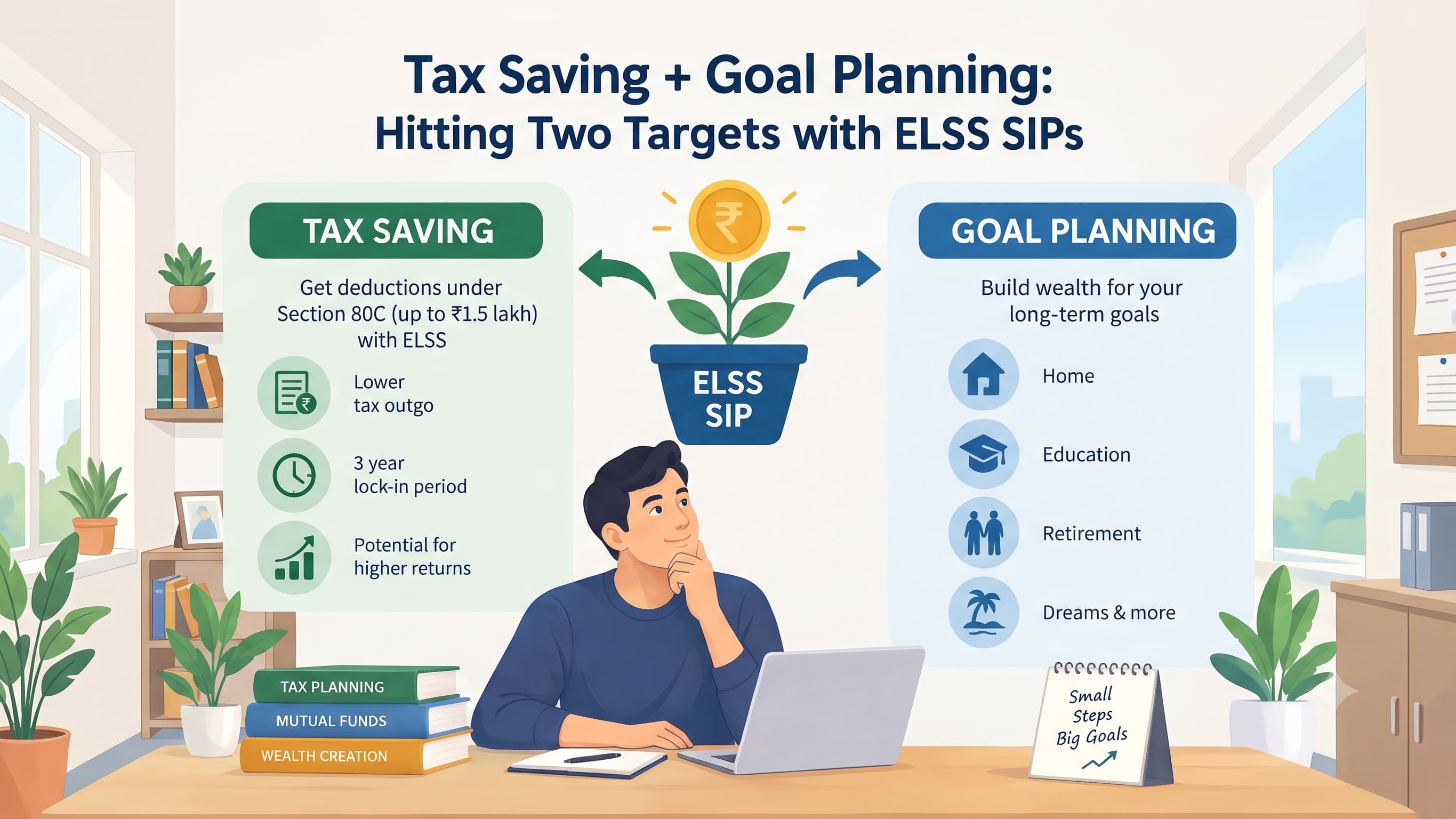
Learn how an ELSS SIP can combine tax planning with long-term goals, how the lock-in works, and when ELSS may or may not fit your financial plan.
Tax Saving + Goal Planning: Hitting Two Targets with ELSS SIPs
Can an ELSS SIP help with both tax saving and a long-term goal?
Yes—but the two objectives should be evaluated separately. ELSS is an equity-linked savings scheme that primarily invests in equity and equity-related instruments. It has a three-year statutory lock-in and can qualify for the applicable tax deduction for eligible investors. Its returns are market-linked and not guaranteed.
What is an ELSS SIP?
An ELSS SIP is a Systematic Investment Plan used to invest regularly in an Equity Linked Savings Scheme. ELSS funds must invest at least 80% of their assets in equity and equity-related instruments. It offers long-term wealth-creation potential but also carries market risk.
How does ELSS help with tax saving?
Under the tax framework, the specified savings deduction associated with the old Section 80C structure has an aggregate limit of ₹1.5 lakh for eligible individuals/HUFs. The Income Tax Department says this limit continues under the Income Tax Act, 2025, with eligible instruments placed under the new provisions.
However, the benefit depends on the applicable tax regime and eligibility. The new tax regime generally does not provide the old Chapter VI-A deductions such as the 80C deduction.
Also, ₹1.5 lakh is the deduction limit—not the amount of tax saved. If you already use EPF, PPF or other eligible investments, part of the limit may already be used.
Does every ELSS SIP instalment have a separate lock-in?
Yes. Each SIP instalment has its own three-year lock-in from the date of allotment of the relevant units.
For example, if you invest ₹10,000 each month, the April instalment completes its lock-in three years after allotment, the May instalment three years after allotment, and so on.
A three-year lock-in therefore does not mean ELSS is automatically suitable for a goal that is only three years away.
Can ELSS be used for long-term goals?
It can be considered when the investor is comfortable with equity risk and has enough time to handle market fluctuations.
Possible goals include retirement, children's education, a future home purchase or other goals several years away. A longer horizon can help investors stay invested through market cycles, but returns are not guaranteed.
As a goal approaches, investors should review their equity exposure rather than treating the three-year lock-in as the goal horizon.
ELSS vs PPF for goals: which is better?
There is no universal winner.
ELSS provides market-linked equity exposure and carries market risk. PPF follows a government-notified interest-rate structure and its own long-term account rules.
For an investor seeking equity exposure for a sufficiently long-term goal and comfortable with volatility, ELSS may have a role. For someone prioritising a different risk profile and the PPF structure, PPF may be more suitable.
Choose based on the goal, time horizon, risk tolerance, portfolio and tax situation—not simply the tax benefit.
Kuberzo's SIP Calculator can help investors model different monthly contribution scenarios.
A practical goal-based ELSS approach
Before starting an ELSS SIP, ask:
What is the goal and when will I need the money?
How much can I invest regularly without affecting essential expenses?
How much eligible tax-saving investment do I already have?
Can my portfolio handle equity-market volatility?
Illustrative example: An investor has ₹60,000 of unused eligible deduction capacity and a retirement goal 20 years away. An ELSS SIP could potentially address part of the retirement allocation while also using the available tax-saving capacity, if the investor is eligible.
The SIP amount should come from the goal and cash-flow plan—not simply from the desire to reach the ₹1.5 lakh deduction limit.
Kuberzo's guide to different types of mutual funds can help investors understand how equity, debt, hybrid and passive categories differ.
Common ELSS SIP mistakes
Investing only for tax saving: A tax benefit does not remove equity risk.
Confusing deduction with tax saved: ₹1.5 lakh invested is not ₹1.5 lakh of tax savings.
Ignoring existing 80C investments: EPF, PPF and other eligible payments can already use part of the limit.
Treating three years as a guaranteed investment horizon: Lock-in is a regulatory feature, not a return guarantee.
Waiting until the deadline: Last-minute tax investing can encourage decisions based on urgency rather than goals.
Contact us for a more personalised guidance.
Key takeaway
An ELSS SIP can potentially hit two targets: tax planning and long-term wealth creation. But tax saving should not be the only reason to choose it.
First define the goal, time horizon and risk capacity. Then check your eligible tax-saving capacity. If ELSS fits both the investment objective and your tax situation, an SIP can provide a disciplined way to invest regularly.
ELSS returns are market-linked, and tax rules can change. Check the rules applicable in the relevant financial year before investing.
Frequently Asked Questions
Is ELSS eligible for tax saving?
Eligible ELSS investments can qualify for the applicable deduction, subject to the prevailing tax rules, regime and limit.
Can I claim the benefit under the new tax regime?
Generally, the old Section 80C-style deduction is not available under the new regime.
Is ELSS suitable for retirement?
It can be considered as part of a retirement portfolio when the investor has a long horizon and is comfortable with equity risk.
Can I withdraw ELSS after three years?
Units can generally be redeemed after their applicable lock-in. Each SIP instalment has its own lock-in.
Is ELSS better than PPF?
Neither is universally better. ELSS is market-linked equity, while PPF follows a government-notified interest-rate structure.




