
SIP vs RD: Which is the Best Saving Tool for Short-Term Goals?
By Saahil Madhogaria
About the Author
Saahil Madhogaria is an MBA student at SOIL Institute of Management with a background in Game Art & Animation and experience as a 3D Artist. He writes about marketing, business, personal finance, careers, and MBA life.
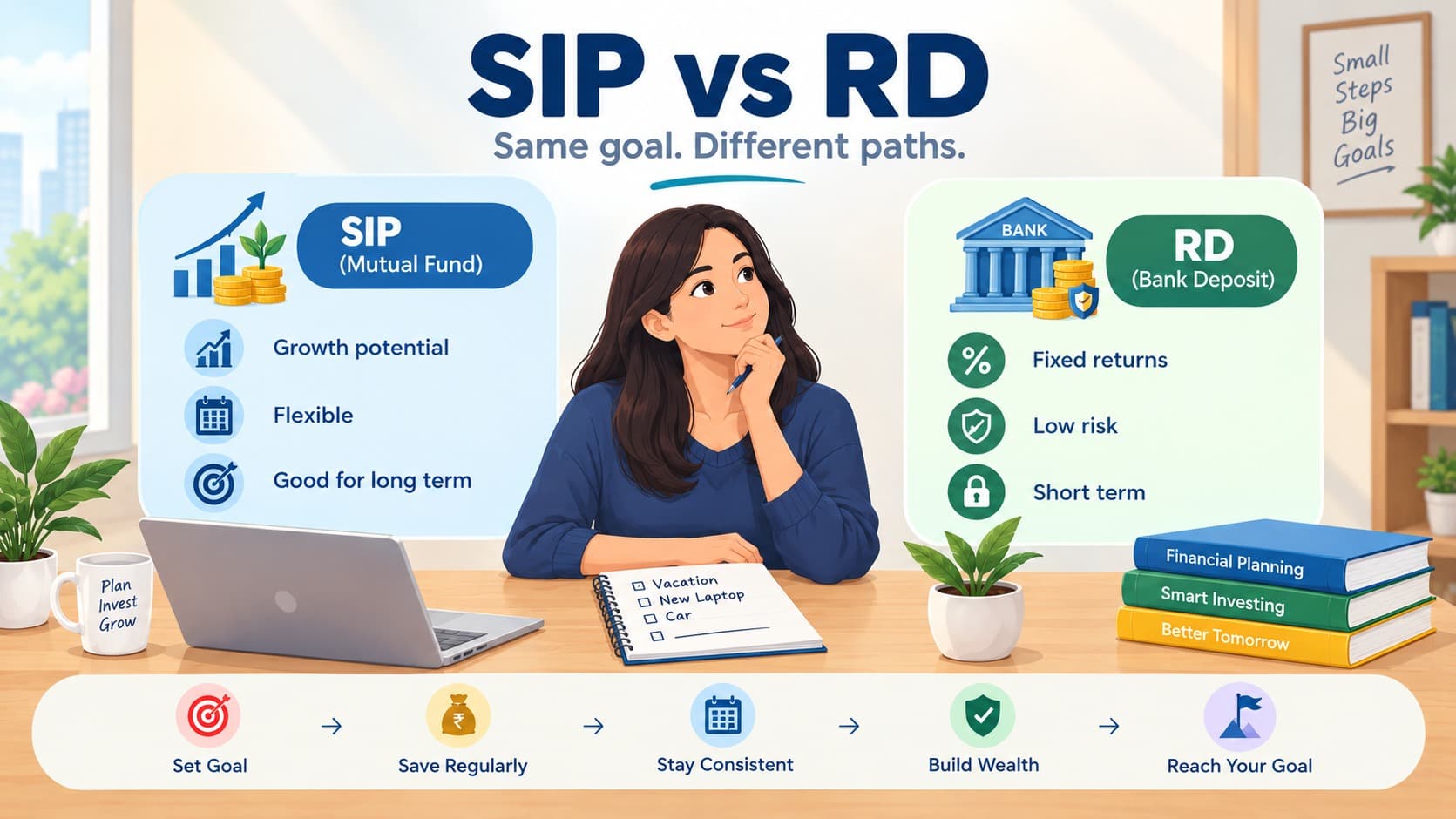
A Recurring Deposit provides guaranteed, fixed returns with zero market risk, making it ideal for strict deadlines within one to three years. A Systematic Investment Plan offers higher growth potential through mutual funds, but its market-linked returns can fluctuate when you need the money most.
SIP vs RD: Which is the Best Saving Tool for Short-Term Goals?
Saving for a short-term goal sounds simple. You decide how much you need, divide it across the months available and start putting money aside.
But where should that money go?
Two common options are a Systematic Investment Plan (SIP) and a Recurring Deposit (RD). Both allow you to contribute regularly, but they work very differently.
An SIP invests your money into a mutual fund scheme. An RD is a bank deposit where you make regular deposits and earn interest according to the applicable terms.
So, SIP vs RD is not simply a question of which gives higher returns. The more important question is: How certain do you need the value of your money to be when you need it?
What Is the Difference Between SIP and RD?
A SIP is a method of investing in mutual funds. You invest a fixed amount at regular intervals, such as every month. The eventual value depends on the performance of the mutual fund scheme.
An RD is a recurring bank deposit. You deposit a fixed amount periodically for a chosen tenure and earn interest according to the bank's applicable rate and terms.
Feature | SIP | RD |
What is it? | Investment method | Bank deposit product |
Underlying asset | Depends on mutual fund | Bank deposit |
Returns | Market-linked | Interest-based |
Value certainty | Not guaranteed | More predictable, subject to terms |
Market risk | Depends on fund | No market-linked NAV fluctuation |
DICGC insurance | No | Eligible bank deposits covered, subject to rules |
Suitable use | Depends on fund and goal | Predictable savings goals |
AMFI notes that mutual fund investments are not guaranteed or assured-return products and their value can rise or fall.
Is SIP Suitable for Short-Term Goals?
This depends heavily on which mutual fund you are investing in.
The word SIP does not automatically mean equity investing. You can use SIPs to invest in different types of mutual funds.
However, using an equity-oriented SIP for a short-term goal can expose your money to significant market volatility. SEBI's investor guidance specifically says that for short-term investments, investors should avoid risky investments such as equity markets and should match investments with their time horizon and risk tolerance.
For example, suppose you need ₹3 lakh exactly two years from now for a course fee.
If the money is invested in an equity fund and the market falls shortly before the payment date, your accumulated value could be lower than expected.
That creates a goal-mismatch risk.
When Can an RD Make More Sense?
An RD can be considered when your priority is predictability and disciplined saving.
Suppose you need ₹2 lakh after 18 months for a planned expense. An RD lets you contribute regularly while earning interest according to the bank's terms.
Eligible recurring deposits with insured banks are covered by DICGC insurance, subject to the applicable limit and conditions. The current DICGC limit is up to ₹5 lakh per depositor per bank, including principal and interest, for eligible deposits. Mutual funds are not covered by this deposit insurance.
This distinction can matter when the date of your financial requirement is relatively fixed.
SIP vs RD: What About Returns?
This is where many comparisons become misleading.
An RD has an interest rate determined according to the bank's applicable deposit terms. A mutual fund does not promise a fixed return.
A mutual fund's future value depends on the performance of the securities held by the scheme. AMFI also states that even rupee-cost averaging through SIP does not guarantee profits or protect against losses.
Therefore, comparing a hypothetical SIP return directly with an RD interest rate can create unrealistic expectations.
Illustrative example:
Suppose you invest ₹10,000 every month for two years.
With an RD, the maturity value can be estimated using the applicable interest rate and deposit schedule.
With an SIP, the final value depends on the mutual fund's performance during that period. The actual value could be higher or lower than the amount invested.
Kuberzo's SIP Calculator can help investors model different monthly contribution scenarios.
What If My Goal Is Only 1–3 Years Away?
Start with the goal date, not the product.
For a goal within the next year or two, capital stability and accessibility may matter more than trying to maximise returns.
For a slightly longer short-term horizon, some investors may consider lower-duration debt or money-market mutual fund categories depending on their risk profile. AMFI describes liquid and overnight funds as options for investors seeking liquidity and notes that liquid funds invest in instruments with maturities of up to 91 days.
But these are still mutual funds. They should not be treated as equivalent to a bank deposit or as risk-free products.
SIP vs RD: What About Liquidity?
Both options have withdrawal considerations.
An RD may have rules and penalties around premature withdrawal depending on the bank and deposit terms. RBI states that banks' policies determine the detailed procedure and applicable penalties for premature withdrawal.
Mutual funds can generally be redeemed, but the amount received depends on the applicable NAV, scheme rules and any applicable exit load. SEBI notes that exit-load structures vary across mutual fund schemes.
Therefore, don't assume that either option means instant access under every circumstance.
How Are SIP and RD Taxed?
Tax treatment is another important difference.
For an RD, the interest earned is taxable according to the applicable income-tax rules. The tax impact depends on your circumstances and the prevailing rules.
For an SIP, taxation depends on the type of mutual fund, the holding period and the applicable tax rules at the time of redemption.
This means you should compare post-tax outcomes, not simply the displayed return or interest rate.
Kuberzo's guide to different types of mutual funds can help investors understand how equity, debt, hybrid and passive categories differ.
Common Mistakes to Avoid
1. Choosing equity SIPs just because the goal is short-term saving
Higher potential returns come with higher uncertainty.
2. Assuming SIP means guaranteed monthly growth
SIP is only the investment method. The underlying mutual fund determines the investment risk.
3. Looking only at historical returns
Past mutual fund performance does not guarantee future results.
4. Ignoring the goal date
The closer the deadline, the less room you have to recover from a market decline.
5. Forgetting taxes and withdrawal rules
The amount you actually receive can differ from the headline return.
Contact us for a more personalised guidance.
So, SIP or RD for a Short-Term Goal?
There is no universally better option.
Think about the goal first.
If your priority is predictable accumulation through a bank deposit, an RD may fit the requirement.
If you want to invest through mutual funds, an SIP can provide disciplined periodic investing, but the suitability depends on the underlying fund, risk and time horizon.
For a short-term goal, especially one with a fixed and non-negotiable date, the key question is not “Which option can potentially earn more?”
It is:
“Which option is appropriate for the amount I need, the date I need it and the amount of risk I can actually accept?”
Key Takeaway
Use this simple framework:
Goal amount → Goal date → Required certainty → Risk tolerance → Product selection → Tax and liquidity check
SIP and RD may look similar because both involve regular contributions. But their underlying structures are different. For short-term goals, matching the product to the time horizon is more important than chasing a higher projected return.
This article is for general educational purposes and does not constitute personalised investment, tax or financial advice. Mutual fund investments are subject to market risks. Read all scheme-related documents carefully before investing.
Frequently Asked Questions
What is the fundamental difference between an RD and a SIP?
A Recurring Deposit (RD) is a safe bank deposit that guarantees fixed interest over a chosen term. A Systematic Investment Plan (SIP) is an investment route that puts a fixed amount into mutual funds every month, meaning your returns fluctuate based on market movements.
Are returns from a SIP guaranteed like an RD?
No. RDs offer predictable, locked-in interest rates unaffected by market ups and downs. SIP returns are linked directly to market performance, so the value can rise or fall, and profits are never guaranteed.
Is an equity SIP suitable for a financial goal that is only 1 to 2 years away?
Generally, no. Equity funds experience short-term market volatility. If the stock market drops right before your goal deadline, your accumulated savings could take a hit, leaving you short of your target.
Are RDs and SIPs covered by deposit insurance?
Eligible bank RDs are protected by DICGC insurance up to ₹5 lakh per depositor per bank (covering principal plus interest). Mutual fund SIPs are investment vehicles and do not come with any government or deposit insurance protection.
How do premature withdrawals work for both options?
Breaking an RD before maturity typically incurs a penalty or a reduced interest rate set by the bank. Redeeming mutual fund SIPs depends on the current market value (NAV) and may involve exit load fees or short-term capital gains tax.




