
SEBI Riskometer: Mutual Fund Risk Levels Explained (All 6 Levels)
By Amrita Sinha
About the Author
Amrita Sinha is a content strategist with experience in SEO, digital marketing, and financial content. She writes easy-to-understand, research-backed articles on investing, personal finance, taxation, and wealth management for Kuberzo.
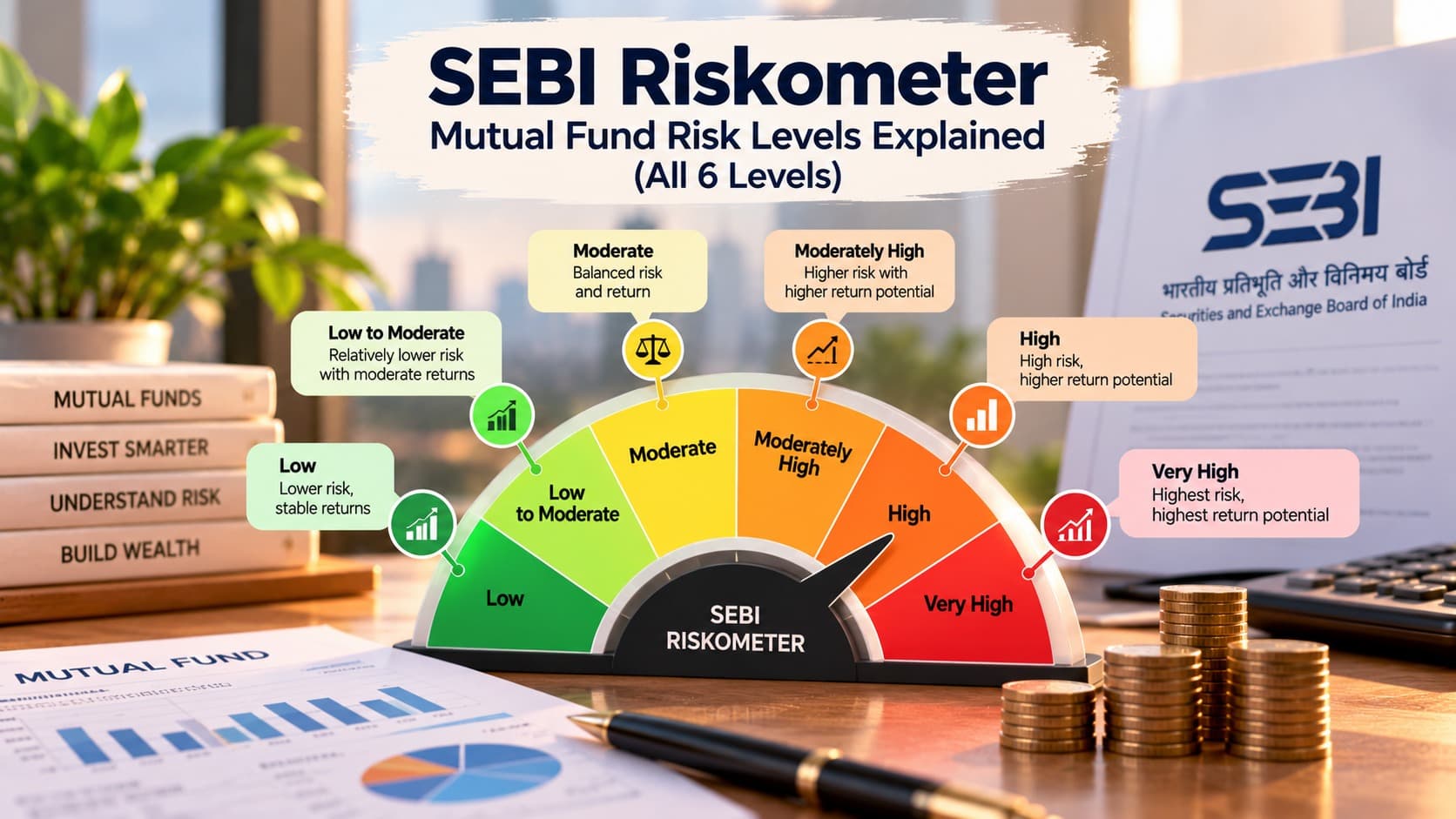
Understand the SEBI Riskometer, all six mutual fund risk levels, how risk is assessed, and what to check before starting a SIP.
Introduction
Choosing a mutual fund is not just about finding a scheme with attractive returns. You also need to understand how much risk you are taking and whether that risk matches your financial goals.
This is where the SEBI Riskometer becomes useful. It is a standardised tool that helps investors understand the risk level associated with a mutual fund scheme. Displayed as a visual scale, it classifies schemes into six categories, ranging from Low Risk to Very High Risk.
But what do these categories actually mean? Is a Moderately High Risk fund suitable for a long-term SIP? Does a Very High Risk label mean you should avoid the scheme altogether?
In this guide, we explain all six mutual fund Riskometer levels, how risk is assessed, why the rating can change, and how to use it when comparing funds.
What Is SEBI Riskometer?
The SEBI Riskometer is a mandatory risk-labelling tool used by mutual fund companies in India to communicate the risk level of a scheme to investors.
It helps simplify complex investment risks into six categories. Rather than requiring investors to analyse every portfolio holding before understanding the broad risk profile, the Riskometer provides an initial indication of the level of risk associated with the scheme.
The six mutual fund Riskometer levels are:
Low Risk
Low to Moderate Risk
Moderate Risk
Moderately High Risk
High Risk
Very High Risk
The Riskometer is a starting point for evaluating a fund, not a guarantee of returns or a prediction of losses. Two schemes carrying the same risk label may still differ significantly in their investment strategies, portfolio composition, and potential outcomes.
Before choosing a scheme, you can explore Kuberzo's mutual funds section to learn more about mutual fund investing.
All 6 SEBI Riskometer Levels Explained
1. Low Risk
The Low Risk category represents schemes with a relatively low assessed level of investment risk under the applicable methodology.
These schemes may suit investors who prioritise stability and have a relatively low tolerance for fluctuations. Certain short-duration or money market-oriented debt schemes may have lower risk profiles, depending on their actual portfolios.
However, Low Risk does not mean risk-free. Debt securities can still carry credit risk, liquidity risk, and interest rate risk. Even a scheme with a low risk label can experience changes in its NAV.
What to consider: Check the underlying securities, credit quality, investment horizon, and whether the scheme's risk profile matches your financial needs.
2. Low to Moderate Risk
Low to Moderate Risk indicates a higher assessed risk level than the Low category, but a lower level than Moderate.
Schemes in this category may offer exposure to investments that carry some degree of market, interest rate, or credit risk while retaining characteristics that keep the overall assessed risk relatively contained.
The exact risk depends on the scheme's investment mandate and portfolio. Do not assume that every debt fund or short-term investment automatically falls into this category.
What to consider: Review the portfolio, the types of securities held, and how changes in interest rates or credit conditions could affect the scheme.
3. Moderate Risk
Moderate Risk represents a middle level on the Riskometer scale. Such schemes may involve meaningful fluctuations in value, but their assessed risk is lower than that of the three higher categories.
Depending on the scheme, investors may be exposed to a combination of market movements, interest rate changes, or other investment risks.
The label does not mean the fund will deliver moderate returns or experience only moderate losses. It communicates the scheme's assessed risk level under the applicable framework.
What to consider: Assess whether you can tolerate fluctuations and whether your investment horizon allows you to manage periods of underperformance.
4. Moderately High Risk
Moderately High Risk indicates a higher assessed risk level than Moderate. These schemes can experience more significant changes in value, depending on their underlying investments.
Certain hybrid funds or debt schemes with greater interest rate or credit exposure may fall into this category, depending on their portfolios and the prescribed risk-assessment methodology.
For investors, this level calls for a closer look at the fund's investment strategy and the risks driving its rating.
What to consider: Review the scheme's asset allocation, portfolio concentration, risk measures, and suitability for your investment horizon.
5. High Risk
High Risk indicates a substantial level of assessed investment risk. Schemes in this category may be more sensitive to market movements, changes in valuations, credit events, or other portfolio-specific risks.
Some equity-oriented schemes may carry a High Risk label, depending on their portfolio and investment strategy. However, the category should not be assigned based on the scheme name alone.
A High Risk label does not guarantee higher returns. It indicates that investors need to be prepared for potentially significant fluctuations and the possibility of losses.
What to consider: Understand what drives the risk, whether the fund matches your financial goals, and whether you can remain invested through market volatility.
6. Very High Risk
What is Very High Risk in mutual funds? It refers to the highest category on the SEBI Riskometer scale.
Schemes in this category have a very high assessed level of investment risk under the applicable methodology. Their values may be significantly affected by market movements, portfolio concentration, volatility, or other relevant risks.
Certain equity schemes, sectoral funds, thematic funds, and other specialised strategies may carry a Very High Risk label, depending on their actual portfolio and the prescribed assessment.
A Very High Risk rating does not mean that a scheme will necessarily lose money. Equally, it does not promise higher returns as compensation for taking more risk.
What to consider: Understand the investment strategy, assess your ability to withstand losses, and avoid investing solely because of recent high returns.
Moderate vs Moderately High Risk: What's the Difference?
The distinction between Moderate and Moderately High Risk can be useful when comparing schemes that appear similar.
Moderate represents a lower assessed risk level than Moderately High. The latter indicates that the scheme's risk assessment places it in a higher category.
However, the difference should not be interpreted as a fixed percentage of additional risk or a specific expected loss. The Riskometer categories are labels, not direct forecasts of how much a fund may fall.
When comparing two schemes, look beyond the label. Examine their asset allocation, portfolio holdings, investment objectives, historical volatility, and other relevant risk measures.
For example, two funds may carry the same Riskometer label but invest in different sectors or types of securities. Their actual behaviour can therefore differ during market stress.
How Is the SEBI Riskometer Calculated?
Investors often assume that a fund's Riskometer is based only on its past returns or volatility. In practice, the assessment follows a prescribed methodology that considers the characteristics and risks of the scheme's portfolio.
Depending on the type of fund and its underlying investments, relevant factors can include market risk, credit risk, interest rate sensitivity, and the characteristics of the securities held.
The scheme's risk level is evaluated using the applicable SEBI framework. The fund house then displays the corresponding Riskometer category.
This means the rating is not simply the fund manager's personal opinion, nor is it a guarantee that the fund will behave in a particular way.
The Riskometer should also not be confused with a credit rating. A credit rating assesses the creditworthiness of a security or issuer, while the Riskometer communicates the overall assessed risk level of a mutual fund scheme.
SEBI Rules for Mutual Fund Riskometer and Monthly Changes
Under SEBI's mutual fund framework, asset management companies must display the Riskometer as part of scheme disclosures and relevant promotional material.
The risk level is evaluated monthly, and the Riskometer is disclosed alongside the portfolio within the prescribed timeline. A change in the risk label must be communicated to investors through the applicable disclosure process, including a notice and email or SMS notification.
This is why checking the latest Riskometer matters.
Why Can a Fund's Riskometer Change?
The monthly changes in a fund's Riskometer can reflect changes in the portfolio or the risks associated with its investments.
For example:
An equity fund's exposure to particular stocks or sectors may change.
A debt fund's interest rate sensitivity or credit exposure may shift.
Market movements may alter portfolio characteristics.
Portfolio changes may affect the scheme's assessed risk under the prescribed methodology.
A change in the Riskometer does not automatically mean the fund manager has made a poor decision. It means investors should review the updated information and understand what has changed.
When checking a factsheet, compare the latest Riskometer with previous disclosures and review the portfolio to understand the context.
Product Labelling in Mutual Funds: What Investors Should Check
Product labelling in mutual funds helps investors understand a scheme's broad risk profile before investing. The Riskometer is one part of this disclosure framework.
Before starting a SIP or making a lump-sum investment, check:
The scheme's Riskometer: Identify its latest risk category.
The benchmark Riskometer, where disclosed: Compare the scheme's risk level with its benchmark.
The portfolio: Understand the assets, sectors, or securities driving the fund's exposure.
The investment objective: Make sure the scheme serves the purpose for which you are investing.
Your own risk tolerance: Consider whether you can handle possible losses without disrupting essential financial plans.
For a more structured approach, use Kuberzo's investment risk analyser to reflect on your risk profile before evaluating investment options.
Checking Riskometer Before SIP: A Practical Checklist
A SIP spreads investments across multiple instalments, but it does not remove market risk or guarantee profits. Checking the Riskometer before starting a SIP helps you understand the scheme's assessed risk level.
Use this checklist:
Confirm the latest Riskometer category.
Understand why the scheme carries that risk label.
Compare the fund's objective with your financial goal.
Review the fund's portfolio and relevant risk metrics.
Consider how long you can remain invested.
Recheck the scheme periodically, particularly if its Riskometer changes.
For example, a SIP intended for a long-term goal may allow more time to manage market fluctuations than money required for an expense in the near future. However, the right scheme depends on your circumstances, not just the length of the SIP.
Kuberzo's goal-based financial planner can help you organise your investments around specific financial milestones.
If you already hold multiple schemes, a mutual fund portfolio review can help you assess whether their risk profiles and investment objectives remain aligned with your broader portfolio.
Conclusion
The SEBI Riskometer is a useful starting point for understanding mutual fund risk. Its six levels, from Low to Very High, provide a standardised way to communicate a scheme's assessed risk profile.
However, the label alone cannot tell you whether a fund is suitable for your financial situation. You should also review the portfolio, investment objective, relevant risk metrics, and your own ability to handle market fluctuations.
Check the Riskometer before starting a SIP, revisit it when new disclosures become available, and pay attention to any changes in the scheme's risk category.
The aim is not to choose the fund with the lowest or highest label. It is to select investments whose risks you understand and can manage in pursuit of your financial goals.
Frequently Asked Questions
What is the SEBI Riskometer in mutual funds?
The SEBI Riskometer is a standardised tool that communicates the assessed risk level of a mutual fund scheme. It uses six categories, ranging from Low Risk to Very High Risk.
What are the six mutual fund Riskometer levels?
The six levels are Low, Low to Moderate, Moderate, Moderately High, High, and Very High. Each category represents a different assessed level of risk under the applicable methodology.
Does Very High Risk mean a mutual fund will give higher returns?
No. A Very High Risk label does not guarantee higher returns. It indicates a very high assessed level of investment risk, and the scheme may experience substantial fluctuations or losses.
Can a mutual fund's Riskometer change every month?
Yes. The scheme's risk level is evaluated monthly, and its displayed category can change as portfolio characteristics and assessed risks change. Investors should check the latest disclosure rather than relying on an older rating.
Should I check the Riskometer before starting a SIP?
Yes. Checking the latest Riskometer helps you understand the scheme's assessed risk before investing. You should also review the portfolio, investment objective, time horizon, and personal risk tolerance because a SIP does not eliminate market risk.




