Portfolio Turnover Ratio: What It Means in Mutual Funds (High vs Low)
By Amrita Sinha
About the Author
Amrita Sinha is a content strategist with experience in SEO, digital marketing, and financial content. She writes easy-to-understand, research-backed articles on investing, personal finance, taxation, and wealth management for Kuberzo.
Learn what portfolio turnover ratio means in mutual funds, how to calculate PTR, interpret 100% turnover, and understand its impact on costs and returns.
When comparing mutual funds, investors often focus on returns, ratings, fund size, and expense ratio. But there is another metric worth checking: the portfolio turnover ratio.
This ratio offers a glimpse into how frequently a fund manager buys and sells securities within a mutual fund scheme. It can help investors understand whether a fund follows a relatively stable, long-term investment approach or makes frequent portfolio changes.
But is a high turnover ratio necessarily bad? And does a low ratio always mean better fund management?
Not necessarily. The right interpretation depends on the fund's investment strategy, category, performance, and costs. Let's understand what turnover ratio in mutual funds means, how it is calculated, and what investors should look for before making an investment decision.
What Is Turnover Ratio in Mutual Funds?
The portfolio turnover ratio (PTR) measures the extent of buying and selling activity within a mutual fund portfolio over a specified period, usually one year.
In simple terms, it indicates how much trading a fund manager has carried out relative to the fund's average net assets.
For example, a fund with a relatively low turnover ratio may hold many of its investments for an extended period. A fund with a high ratio may frequently buy and sell stocks to respond to market conditions, valuations, company performance, or its investment strategy.
PTR in mutual funds is therefore a useful indicator of portfolio activity. However, it does not directly tell you whether the fund manager's decisions were profitable.
Why Does Portfolio Turnover Matter?
Portfolio turnover can help investors:
Understand a fund manager's investment style.
Identify frequent trading or portfolio churning.
Evaluate potential trading costs.
Compare funds within the same category.
Check whether a fund's management style matches their investment preferences.
It should be used alongside other measures, including long-term returns, risk-adjusted performance, expense ratio, and investment objectives.
How Is Portfolio Turnover Ratio Calculated?
The commonly used formula is:
Portfolio Turnover Ratio = (Lower of total purchases or total sales of securities ÷ Average net assets) × 100
The exact calculation and reporting period should be checked in the fund's factsheet or relevant disclosure.
Let's understand this with an example.
Suppose a mutual fund reports the following figures for a year:
Particulars | Amount |
Total securities purchased | ₹80 crore |
Total securities sold | ₹60 crore |
Average net assets | ₹100 crore |
Since the lower amount is ₹60 crore, the calculation becomes:
PTR = (₹60 crore ÷ ₹100 crore) × 100
Portfolio Turnover Ratio = 60%
This means the value used in the turnover calculation was equivalent to 60% of the fund's average net assets during the reporting period.
It does not mean that exactly 60% of the individual stocks were replaced. The ratio measures trading activity using the stated formula, and repeated trades can affect the result.
High vs Low Turnover Ratio: What Is the Difference?
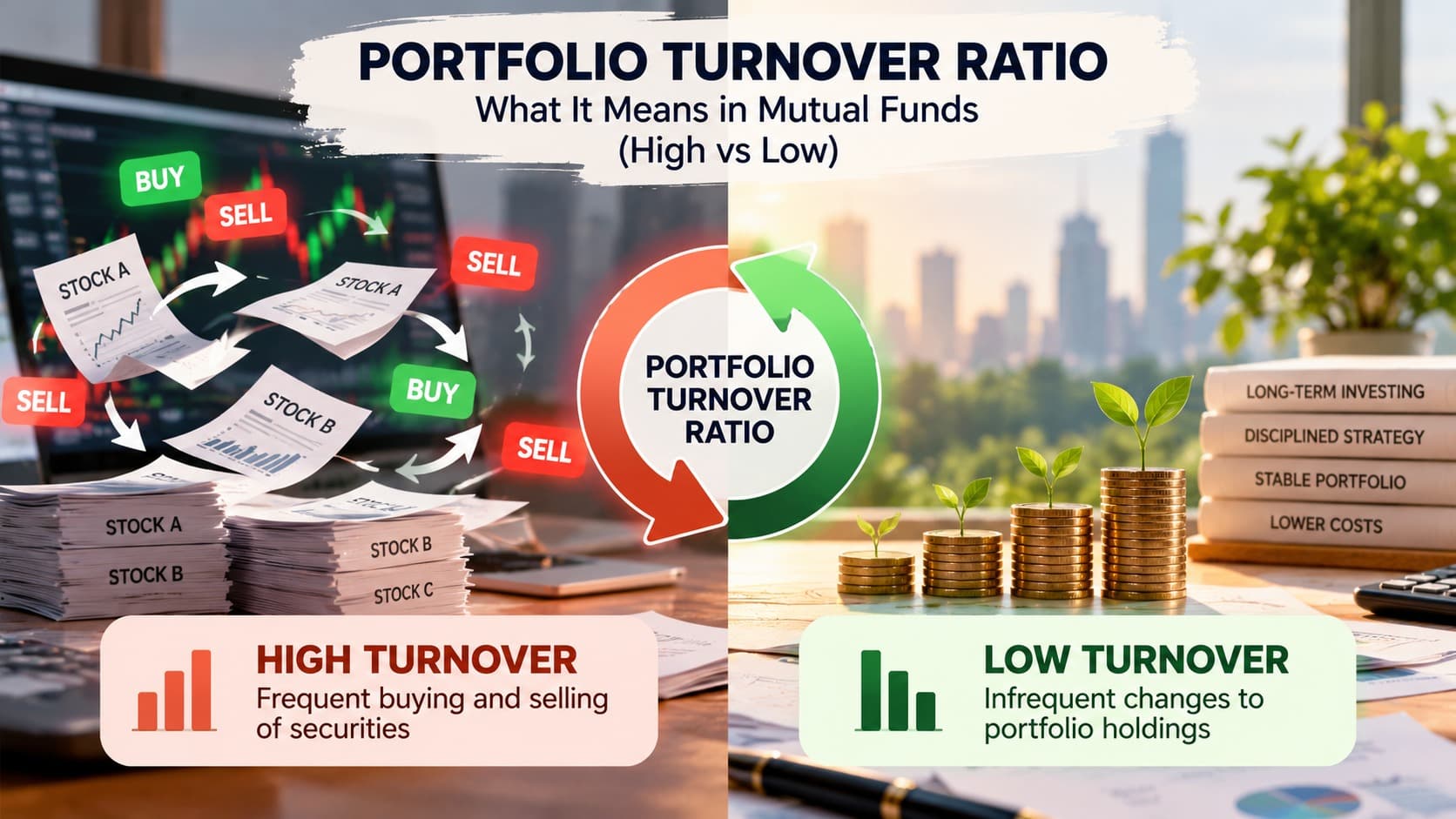
A high or low portfolio turnover ratio can reveal useful information about how a mutual fund is managed. Neither is automatically better.
What Does a High Turnover Ratio Mean?
A high turnover ratio indicates relatively frequent trading within the portfolio.
The fund manager may be actively adjusting holdings based on company fundamentals, changing valuations, sector opportunities, market conditions, or the fund's investment mandate.
Potential advantages:
The manager can respond to changing market conditions.
The portfolio can be adjusted when investment opportunities change.
Active strategies may benefit when trading decisions are effective.
Potential disadvantages:
More trading can increase brokerage and other transaction costs.
Frequent changes may make it harder to maintain a consistent investment approach.
Trading decisions can fail to generate enough additional returns to justify their costs.
Greater activity does not guarantee better performance.
A high turnover ratio is not a reason to reject a fund automatically. Instead, investors should check whether the strategy and results justify the level of trading activity.
What Does a Low Turnover Ratio Mean?
A low turnover ratio generally indicates less frequent buying and selling relative to the fund's average net assets.
This may reflect a buy-and-hold strategy, where the fund manager invests in companies believed to have long-term potential and holds them unless the investment case changes.
Potential advantages:
Lower trading activity may help reduce transaction costs.
A long-term approach can avoid unnecessary portfolio changes.
The investment strategy may be easier to understand and track.
Potential disadvantages:
The fund may be slower to respond to changing business fundamentals.
Holding an investment for longer is not always beneficial if its prospects deteriorate.
Low turnover does not guarantee lower total expenses or superior returns.
A fund with low turnover can still perform poorly if its holdings are unsuitable or its investment decisions are incorrect.
Interpreting 100% Turnover Ratio
A 100% portfolio turnover ratio is often misunderstood.
Broadly, it means that the turnover measure for the period was equivalent to the fund's average net assets. It is sometimes described as the equivalent of the portfolio being turned over once during that period.
However, interpreting 100% turnover ratio requires caution. It does not necessarily mean that every stock in the portfolio was sold and replaced exactly once.
For example, a fund might sell some holdings multiple times while continuing to hold other stocks throughout the year. These transactions can contribute to the overall turnover figure.
Similarly, a turnover ratio above 100% is possible. A ratio of 150% indicates trading activity equivalent to 1.5 times average net assets under the calculation, not necessarily that the entire portfolio was replaced one and a half times in a literal sense.
The most useful approach is to examine the ratio over time and compare it with funds following similar strategies.
What Is the Ideal Turnover Ratio for Equity Funds?
There is no universally ideal turnover ratio for equity mutual funds.
A fund's investment strategy largely determines what level of turnover may be reasonable. For example, a fund following a long-term value-investing approach may have lower turnover than a strategy that actively responds to market opportunities.
Rather than looking for one perfect percentage, investors can use these broad observations:
Relatively low turnover: May indicate a buy-and-hold approach.
Moderate turnover: May reflect periodic portfolio adjustments.
Relatively high turnover: May indicate frequent trading or a strategy that requires active changes.
These are general descriptions, not official thresholds or recommendations.
The ideal turnover ratio for equity funds depends on the fund's category, investment mandate, portfolio construction, and the manager's approach. A high ratio may be reasonable for one strategy but worth investigating in another.
How Portfolio Turnover Affects Expense Ratio and Returns
One important reason to examine PTR is its relationship with the costs of running a mutual fund.
Buying and selling securities can involve brokerage, exchange charges, taxes, and other transaction-related costs. Frequent trading may increase these costs and reduce the returns available to investors.
However, how portfolio turnover affects expense ratio requires a distinction: the portfolio turnover ratio is a measure of trading activity, while the Total Expense Ratio (TER) measures the scheme's expenses relative to its assets. The two are related through costs, but they are not the same metric.
A fund with high turnover may incur higher transaction costs, but its published TER does not necessarily rise in direct proportion to the turnover ratio. Investors should review the disclosed TER and trading costs separately.
Consider two hypothetical funds:
Metric | Fund A | Fund B |
Portfolio turnover ratio | 35% | 130% |
Investment style | Relatively long-term | More active |
Trading activity | Lower | Higher |
What to investigate | Portfolio quality and performance | Whether returns justify the trading activity |
These figures are illustrative. They do not establish that Fund A is better than Fund B.
If Fund B's active trading generates sufficient additional performance after costs, its approach may be justified. If not, frequent transactions could become a drag on investor returns.
Buy and Hold vs High Churning Funds
The difference between buy-and-hold vs high-churning funds lies mainly in how actively the portfolio is managed.
A buy-and-hold fund generally retains investments for longer periods, provided they continue to meet the fund manager's investment criteria. A high-churning fund changes its holdings more frequently.
Neither strategy guarantees superior returns.
When evaluating the two approaches, consider the following:
1. Investment philosophy: Does the fund have a clear, consistent investment process?
2. Performance after costs: Has its strategy delivered competitive results over suitable periods, after accounting for expenses?
3. Risk: How has the fund performed during market declines and periods of volatility?
4. Consistency: Does the turnover ratio remain broadly consistent with the fund's stated strategy, or have there been significant changes?
5. Portfolio changes: Review the factsheets to understand whether changes appear consistent with the investment mandate.
These checks help investors distinguish purposeful portfolio management from trading activity that may not add enough value.
How to Analyse Portfolio Turnover Ratio Before Investing
Use the following checklist when reviewing a mutual fund:
Check the latest factsheet: Find the disclosed turnover ratio and note the reporting period.
Compare similar funds: Compare schemes within the same category rather than directly comparing funds with very different mandates.
Review historical turnover: Check whether trading activity has changed significantly over time.
Examine the expense ratio: Consider TER alongside potential transaction costs.
Review performance and risk: Look at returns over suitable periods, volatility, and risk-adjusted measures.
Understand the strategy: Determine whether the turnover level fits the fund's investment philosophy.
Along with portfolio turnover, understanding your investment risk profile can help you assess whether a fund's investment approach aligns with your comfort with market fluctuations.
Conclusion
The portfolio turnover ratio is a useful metric for understanding how actively a mutual fund changes its holdings. A high ratio may reflect an active strategy, while a low ratio may indicate a longer-term investment approach.
Neither high nor low turnover guarantees better returns. Frequent trading can increase transaction costs, but an active strategy may still be appropriate when its decisions add value. Similarly, low turnover does not protect a fund from poor investment choices or market losses.
When analysing PTR in mutual funds, compare schemes with similar objectives, review the expense ratio, assess performance after costs, and understand the fund manager's investment philosophy.
The aim is not to find the lowest turnover ratio. It is to understand whether the fund's trading activity makes sense for its strategy and whether the scheme fits your own financial goals.
To connect your investment decisions with specific financial milestones, Kuberzo's goal-based financial planner can help you organise your approach around your long-term goals.
Frequently Asked Questions
What is portfolio turnover ratio in mutual funds?
Portfolio turnover ratio measures the extent of buying and selling activity in a mutual fund relative to its average net assets over a specified period, usually one year.
Is a high portfolio turnover ratio good or bad?
A high ratio is not automatically good or bad. It may indicate an active investment strategy, but frequent trading can increase costs. Investors should assess whether the strategy has delivered results that justify the activity.
What does a 100% turnover ratio mean?
A 100% turnover ratio means the turnover measure is equivalent to the fund's average net assets for the period. It does not necessarily mean every security was sold and replaced exactly once.
Does a high turnover ratio increase the expense ratio?
Frequent trading can increase transaction costs and affect investor returns. However, portfolio turnover and the Total Expense Ratio are different measures, and a higher turnover ratio does not automatically produce a proportional increase in the published TER.