
Liquid Mutual Funds vs Bank Fixed Deposits: Where to Park Your Emergency Fund?
By Amrita Sinha
About the Author
Amrita Sinha is a content strategist with experience in SEO, digital marketing, and financial content. She writes easy-to-understand, research-backed articles on investing, personal finance, taxation, and wealth management for Kuberzo.
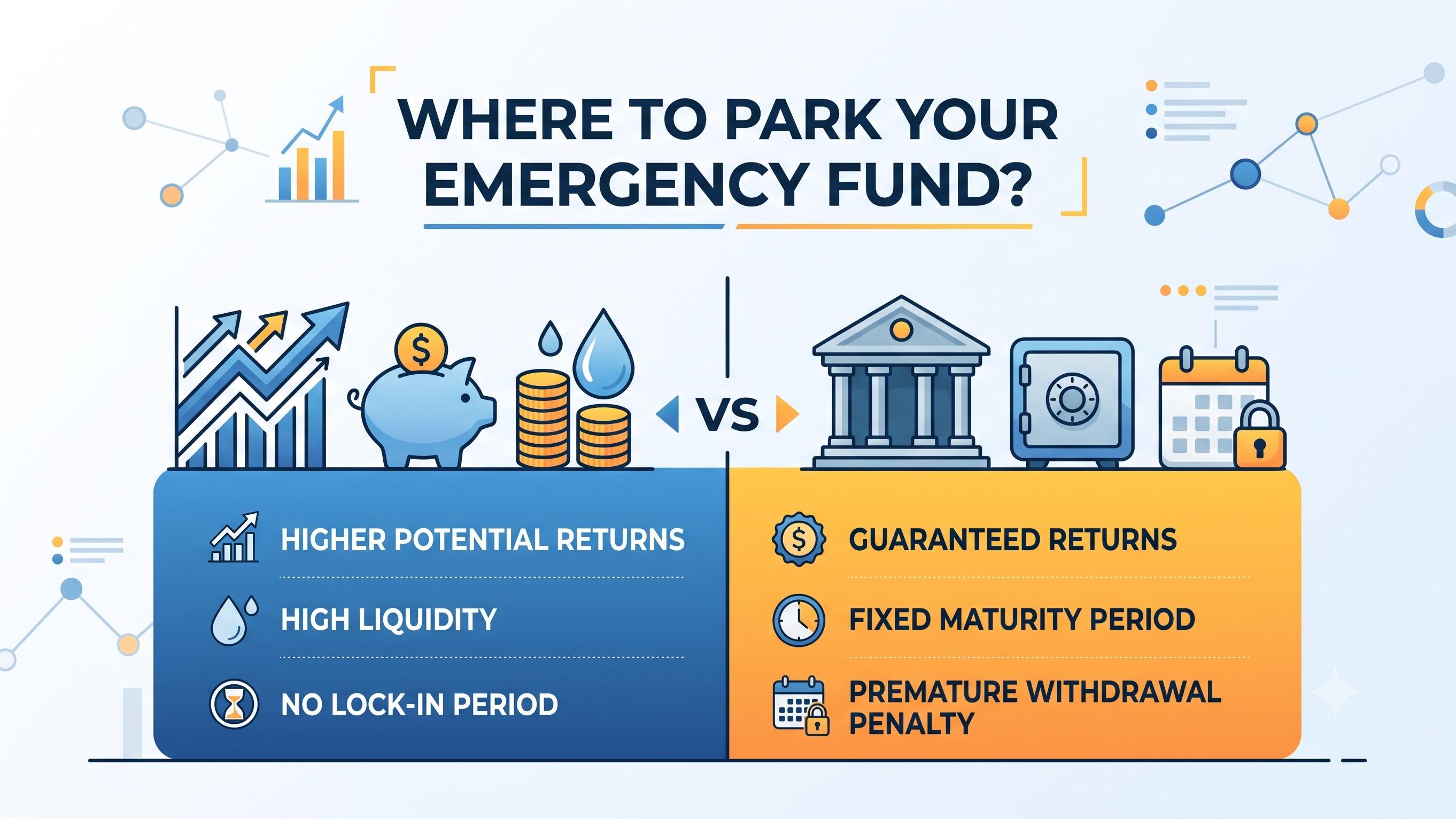
Compare liquid mutual funds vs FD for emergency funds based on returns, liquidity, taxation, safety and accessibility to choose where to park your money.
An emergency fund is money you may need at short notice—for an unexpected medical expense, job loss, urgent travel or a major household expense. Since the primary purpose of an emergency fund is financial security rather than wealth creation, where you keep this money matters.
For many Indian investors, the choice comes down to a liquid fund vs fixed deposit. A bank FD offers a fixed interest rate and greater certainty, while a liquid mutual fund invests in short-term debt and money-market securities and offers market-linked returns.
The right choice is therefore not simply about asking which one offers a higher return. You also need to consider liquidity, accessibility, taxation, risk and the possibility of needing the money during a market or financial emergency.
Liquid fund vs FD: What is the difference?
A liquid mutual fund is an open-ended debt mutual fund that invests in debt and money-market securities with a maturity of up to 91 calendar days.
A bank fixed deposit, meanwhile, allows you to deposit a lump sum with a bank for a predetermined tenure and interest rate. The bank pays interest according to the terms of the FD.
Feature | Liquid Mutual Fund | Bank FD |
Return | Market-linked | Fixed as per FD terms |
Underlying Investment | Short-term debt and money-market securities | Bank Deposit |
Capital Guarantee | No | No guarantee against every possible bank failure, but eligible deposits have DICGC cover |
Liquidity | Generally High | Depends on FD terms and premature withdrawal rules |
Interest Rate | Not Fixed | Fixed for the chosen FD |
Taxation | Depends on applicable mutual fund tax rules | Interest generally taxable at applicable rates |
Market Risk | Yes, though generally lower than longer-duration debt funds | No market-price fluctuation like a mutual fund |
Best Use | Short-term parking with liquidity | Stable, predictable savings |
For an emergency fund, these differences become more important than simply comparing headline returns.
Liquid fund vs savings account: Where should emergency money stay?
A liquid fund vs savings account comparison depends on how quickly you may need the money.
A savings account offers immediate access through UPI, debit cards, net banking and ATMs. That makes it particularly useful for the portion of your emergency fund that may be needed immediately.
A liquid fund requires a redemption request before the money reaches your bank account. Some schemes may offer faster redemption facilities subject to applicable limits and scheme terms, but investors should not assume that every liquid fund provides instant access to the entire investment.
A practical approach can therefore be to split an emergency corpus.
For example, if your emergency fund is ₹3 lakh, you could keep a portion in your savings account for immediate expenses and consider another portion in a suitable short-term investment such as a liquid fund or FD, depending on your needs.
The exact split should depend on your expenses, income stability and how quickly you might need the money.
Liquid fund returns vs bank FD: Which can earn more?
The liquid fund returns vs bank FD comparison has one important distinction: an FD provides a predetermined interest rate, while a liquid fund's returns are market-linked.
Liquid funds invest in short-term instruments, so their NAV can fluctuate. Although their portfolio maturity is short, they are still mutual funds and do not offer guaranteed returns.
An FD provides greater predictability because the applicable interest rate is known when the deposit is booked.
This means you should not select a liquid fund simply because its recent return is higher than an FD rate.
Similarly, an FD's predictable return can be valuable when the primary objective is preserving capital and knowing approximately how much money will be available at maturity.
For an emergency fund, certainty and accessibility can be more important than trying to maximise returns.
Is a liquid fund safe for an emergency fund?
A liquid fund for an emergency fund can be considered by investors who understand that it is not the same as a bank deposit.
Liquid funds carry risks associated with their underlying debt and money-market securities, including credit and interest-rate-related risks. Liquid funds carry risks associated with their underlying debt and money-market securities, so investors should consider their investment risk profile before choosing where to park emergency money. Their short portfolio maturity generally reduces interest-rate sensitivity compared with longer-duration debt funds, but it does not eliminate investment risk.
Most importantly, mutual fund investments are not covered by DICGC deposit insurance. DICGC explicitly states that mutual funds, stocks, bonds and ETFs are not covered under its deposit insurance scheme.
Eligible bank deposits, including savings accounts and fixed deposits, are insured by DICGC up to ₹5 lakh per depositor per bank, including principal and accrued interest, subject to the applicable rules.
This is an important distinction when deciding where to keep money that you may urgently need.
Taxation on liquid funds vs FD
Tax is another important factor in the taxation on liquid funds vs FD comparison.
For liquid funds, the applicable tax treatment depends on the mutual fund's classification and the date of acquisition. Current tax provisions treat specified mutual funds—generally funds investing more than 65% in debt and money-market instruments—as specified investments, with gains on units acquired on or after 1 April 2023 treated as short-term capital gains irrespective of the holding period. Such gains are taxed at the applicable rate for the investor.
Bank FD interest, on the other hand, is generally taxable as interest income at the applicable rate for the investor.
Therefore, FD vs liquid fund taxation should be assessed based on your individual tax situation and the applicable tax year rather than assuming one option is automatically more tax-efficient.
Tax rules can change, so investors should verify the provisions applicable when they invest and redeem.
What about liquidity during an emergency?
Liquidity is arguably the most important factor when evaluating emergency fund investment options.
With an FD, premature withdrawal may be possible, but the bank may impose a penalty or pay a lower rate depending on the product's terms.
With a liquid fund, you can generally submit a redemption request on a business day. The amount and timing of the payout depend on the scheme's applicable redemption process.
However, neither should be confused with the instant accessibility of money sitting in a savings account.
This is why an emergency fund should not be structured around the assumption that you will always have several days to arrange the money.
Liquid fund vs FD returns: What should you prioritise?
If you are making a liquid fund vs FD returns comparison, consider the purpose of the money first.
For example, suppose you have ₹2 lakh set aside specifically for emergencies.
If your priority is knowing the return in advance and avoiding market-linked fluctuations, an FD may be more appropriate for that portion.
If you want a short-term investment with relatively high liquidity and are comfortable with market-linked returns, a liquid fund may be an option to evaluate.
But the emergency fund should not be treated like a normal investment portfolio. Chasing an additional return may not be worth taking risks that could compromise access to your emergency money.
How much should you keep in a liquid fund or FD?
There is no universal emergency-fund amount. There is no universal emergency-fund amount. Your emergency corpus should be determined based on your expenses, income stability and broader financial goals.
A common approach is to calculate your essential monthly expenses and build a reserve based on your personal circumstances.
Consider:
Monthly essential expenses
Job stability
Number of dependants
Existing insurance coverage
EMIs and other fixed commitments
Availability of other liquid assets
Someone with a stable income and low fixed expenses may have different requirements from someone with variable income and significant financial commitments.
The important point is to build the emergency corpus before focusing on how to maximise its returns.
Liquid fund vs fixed deposit: Which is better for an emergency fund?
There is no universally better option.
A bank FD offers predictable returns, and eligible deposits receive DICGC insurance coverage up to ₹5 lakh per depositor per bank, subject to applicable conditions.
A liquid mutual fund provides exposure to short-term debt and money-market securities and can be useful for investors looking for a short-term parking option with redemption flexibility. However, it is market-linked and does not have DICGC protection.
For many investors, the answer may not have to be either-or. Keeping the immediately required portion in a savings account and placing another portion in an FD or suitable liquid fund can be considered, depending on individual circumstances.
The key is to ensure that your emergency money is accessible, appropriately low-risk for its purpose and not invested solely to chase higher returns.
Disclaimer: This article is for general educational purposes only and does not constitute personalised financial, investment or tax advice. Mutual fund investments are subject to market risks, and returns are not guaranteed. Bank deposits are subject to applicable terms and DICGC insurance rules. Tax treatment may vary based on the investor's circumstances and applicable tax laws. Investors should verify the latest scheme documents, bank terms and tax provisions before making an investment decision.
Frequently Asked Questions
Is a liquid fund better than an FD for an emergency fund?
Neither is universally better. An FD offers predictable returns, while a liquid fund offers market-linked returns and short-term debt exposure. Liquidity, risk tolerance, taxation and the level of capital certainty you require should guide the decision.
Are liquid funds completely safe?
No. Liquid funds are mutual funds and are not guaranteed investments. They can be affected by risks associated with their underlying securities. They are also not covered by DICGC deposit insurance.
Can I withdraw money from a liquid fund anytime?
Liquid funds are open-ended schemes and generally allow investors to submit redemption requests, subject to applicable scheme terms and cut-off rules. The actual time taken to receive the money depends on the scheme and redemption facility.
Is FD interest taxable?
Yes. Interest earned on a bank FD is generally taxable according to the applicable income-tax provisions and the investor's tax situation.
Are liquid fund returns guaranteed?
No. Liquid funds provide market-linked returns. Unlike an FD, they do not promise a predetermined interest rate.




