
HRA vs ELSS: Tax Saving Strategies for Metro City Renters
By Saahil Madhogaria
About the Author
Saahil Madhogaria is an MBA student at SOIL Institute of Management with a background in Game Art & Animation and experience as a 3D Artist. He writes about marketing, business, personal finance, careers, and MBA life.
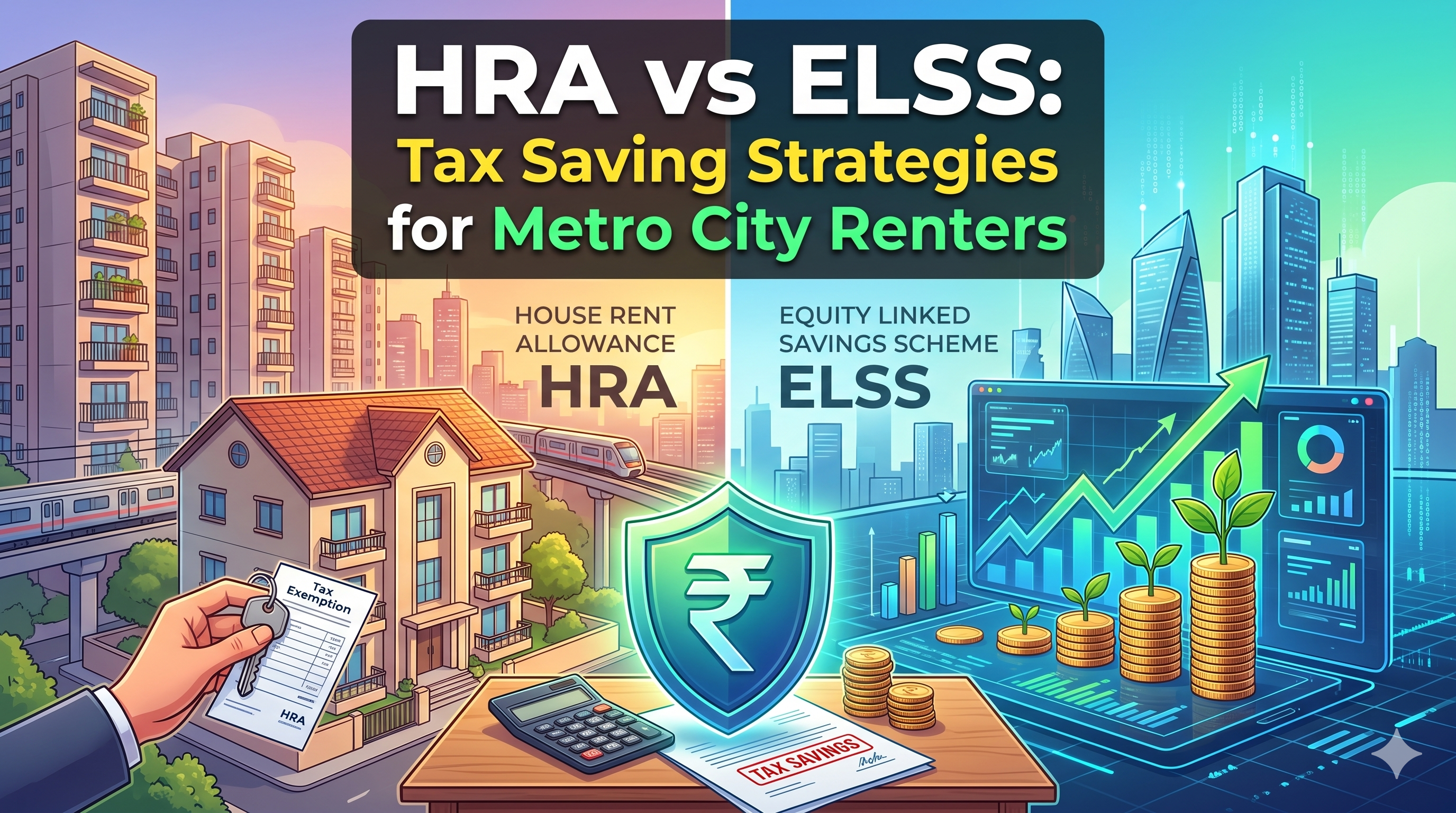
Compare HRA tax exemption and ELSS tax-saving SIPs, understand rent receipt requirements, and explore tax-planning strategies for salaried professionals in metro cities.
HRA vs ELSS: Tax Saving Strategies for Metro City Renters
Renting a home in a metro city such as Bengaluru, Mumbai, Delhi, or Hyderabad can consume a significant portion of a salaried professional's income. Alongside rent, employees must consider taxes, everyday expenses, savings, and long-term financial goals. Understanding available tax benefits can help them plan their finances more effectively.
Two commonly discussed options are House Rent Allowance (HRA) exemption and Equity Linked Savings Schemes (ELSS). HRA can reduce taxable salary for eligible employees who pay rent, while ELSS mutual funds offer a tax deduction under Section 80C when the applicable conditions are met.
However, HRA vs ELSS is not a direct either-or comparison. One relates to eligible rental expenses, while the other involves investing money in a tax-saving mutual fund. Whether you can benefit from either or both depends significantly on your chosen income-tax regime.
1. What Is HRA Tax Exemption?
House Rent Allowance is a salary component that employers may provide to employees to help cover rental expenses. Under the old tax regime, eligible salaried individuals can claim an exemption on part of their HRA under Section 10(13A).
The exemption is subject to prescribed conditions and is generally calculated using the lowest of these amounts:
Actual HRA received from the employer.
Rent paid minus 10% of eligible salary.
50% of eligible salary for specified metropolitan cities or 40% for other locations.
For this calculation, salary generally includes basic salary and qualifying dearness allowance and commission, where applicable. The rules also require actual rental accommodation and rent payment; simply receiving HRA does not automatically make the entire allowance tax-exempt.
For a renter in Bengaluru, for example, maintaining accurate rent records can help support an eligible claim. The exemption depends on the applicable calculation, not simply the total rent paid.
2. ELSS Tax Saving SIP: Investing While Reducing Taxable Income
An Equity Linked Savings Scheme is a type of mutual fund that invests primarily in equities and qualifies for Section 80C deductions under the applicable rules.
Under the old tax regime, eligible ELSS investments can contribute towards the combined Section 80C deduction limit of ₹1.5 lakh per financial year. This limit is shared with other eligible payments and investments, such as qualifying provident fund contributions, life insurance premiums, and certain other expenses.
ELSS funds have a three-year lock-in period for each investment. If you invest through a monthly SIP, each instalment has its own three-year lock-in period.
For example, if you invest ₹5,000 monthly in an eligible ELSS fund, your annual contribution would be ₹60,000. The potential tax deduction depends on your remaining Section 80C limit and eligibility under the chosen tax regime.
ELSS investments carry market risk. Although they offer the potential for long-term growth, returns are not guaranteed, and the value of your investment can fall.
3. HRA vs ELSS: Key Differences
Factor | HRA exemption | ELSS investment |
Purpose | Tax exemption linked to eligible rental expenses | Tax deduction linked to eligible investment |
Main requirement | Eligible salaried employee who actually pays rent | Investment in a qualifying ELSS fund |
Tax benefit | Exemption based on prescribed HRA calculation | Section 80C deduction, subject to the overall limit |
Money commitment | Rent is an actual living expense | Money is invested and locked in for three years |
Investment risk | Not an investment product | Equity market risk applies |
Under the new tax regime | HRA exemption generally unavailable | Section 80C deduction generally unavailable |
The two serve different purposes. HRA relates to the cost of housing, while ELSS involves committing money to a market-linked investment.
4. Can You Claim HRA and ELSS Together?
Eligible taxpayers may use both benefits under the old tax regime, provided they satisfy the respective conditions. However, the same expense or investment cannot be treated as qualifying for a deduction without meeting the relevant rules.
Consider a salaried employee renting an apartment in Bengaluru. If the employee receives HRA, pays eligible rent, and invests in ELSS, both may contribute to tax planning under the old regime. The HRA exemption is calculated separately, while ELSS investments count towards the overall Section 80C limit.
The key consideration is the tax regime.
Under the new tax regime, HRA exemption under Section 10(13A) and the standard Section 80C deduction for ELSS are generally not available. The new regime is the default, although eligible taxpayers may choose the old regime according to the applicable rules.
Therefore, before investing purely to save tax, compare your estimated tax liability under both regimes. An investment should also make sense for your financial goals, not just your tax bill.
5. Rent Receipt vs 80C: What Documents Do You Need?
Rent receipts and Section 80C investment records serve different purposes.
For an HRA claim, employees may need rent receipts, rental agreements, payment records, and other supporting documents as applicable. Employers may request a landlord's PAN when the prescribed reporting threshold and conditions require it.
For ELSS, retain investment statements, transaction confirmations, and other records needed to substantiate eligible contributions.
Submitting documents does not automatically guarantee a tax benefit. The claim must meet the applicable legal requirements, and employees should provide accurate information to their employer and when filing their income-tax return.
Keeping records organised throughout the financial year is easier than collecting everything shortly before a tax declaration deadline.
Kuberzo's guide to different types of mutual funds can help investors understand how equity, debt, hybrid and passive categories differ.
6. Maximizing Tax Saving in Metro Cities
Metro renters can approach tax planning through a few practical steps:
Review your salary structure: Check your basic salary, HRA component, and other relevant salary details.
Track rental payments: Maintain accurate records of rent paid and supporting documents.
Review existing Section 80C commitments: Account for eligible provident fund contributions and other qualifying payments before deciding how much ELSS to buy.
Compare tax regimes: Calculate the overall tax liability under both applicable options instead of focusing on one deduction.
Invest according to your goals: Consider ELSS only if its equity exposure, lock-in, and investment horizon suit your circumstances.
For employees managing Bangalore rent and tax planning, these steps can help organise finances without making unnecessary investments solely to claim a deduction.
Kuberzo's SIP Calculator can help investors model different monthly contribution scenarios.
7. A Smarter Kuberzo HRA ELSS Approach
A practical metro tax guide should connect tax planning with overall financial health.
Start by estimating your tax liability under the old and new regimes. If the old regime is suitable, calculate the HRA exemption you may qualify for and identify how much of the Section 80C limit is already used. Then assess whether ELSS fits your long-term investment strategy.
Do not assume that investing the full ₹1.5 lakh under Section 80C is always necessary or beneficial. Existing eligible contributions may already use part or all of the limit, and the old regime may not produce the lowest tax liability for every taxpayer.
If your situation involves substantial deductions, changing employment, business income, or complicated rental arrangements, consider consulting a qualified tax professional.
Contact us for a more personalised guidance.
Conclusion
HRA and ELSS can play different roles in tax planning for metro city renters. HRA exemption may reduce taxable salary when rental and employment conditions are met, while ELSS can provide a Section 80C deduction under the applicable regime and also offers equity investment exposure.
The most effective strategy is to evaluate the tax regimes, maintain proper rental and investment records, and make investments that support your financial goals. Tax savings matter, but they should complement—not replace—sound budgeting and long-term financial planning.
Frequently Asked Questions
Is HRA better than ELSS for tax saving?
They are not direct substitutes. HRA relates to eligible rent paid, while ELSS is a tax-saving mutual fund investment. Their benefits depend on eligibility and the chosen tax regime.
Can I claim both HRA and ELSS in the same financial year?
Eligible taxpayers can generally claim both under the old tax regime when they meet the respective conditions. These benefits are generally unavailable under the new tax regime.
What is the maximum tax deduction for ELSS?
Eligible ELSS investments fall under the combined Section 80C limit of ₹1.5 lakh per financial year under the old regime. Other eligible contributions and payments count towards the same limit.
Is an ELSS SIP locked in for three years?
Each SIP instalment has its own three-year lock-in period, calculated from its respective investment date.
Are rent receipts sufficient to claim HRA exemption?
Rent receipts can support an HRA claim, but the exemption also depends on eligibility, actual rent paid, salary details, and the prescribed calculation. Additional documentation may be required depending on the circumstances.




