
How to Plan for Your Child's Higher Education with Goal-Based SIPs
By Saahil Madhogaria
About the Author
Saahil Madhogaria is an MBA student at SOIL Institute of Management with a background in Game Art & Animation and experience as a 3D Artist. He writes about marketing, business, personal finance, careers, and MBA life.
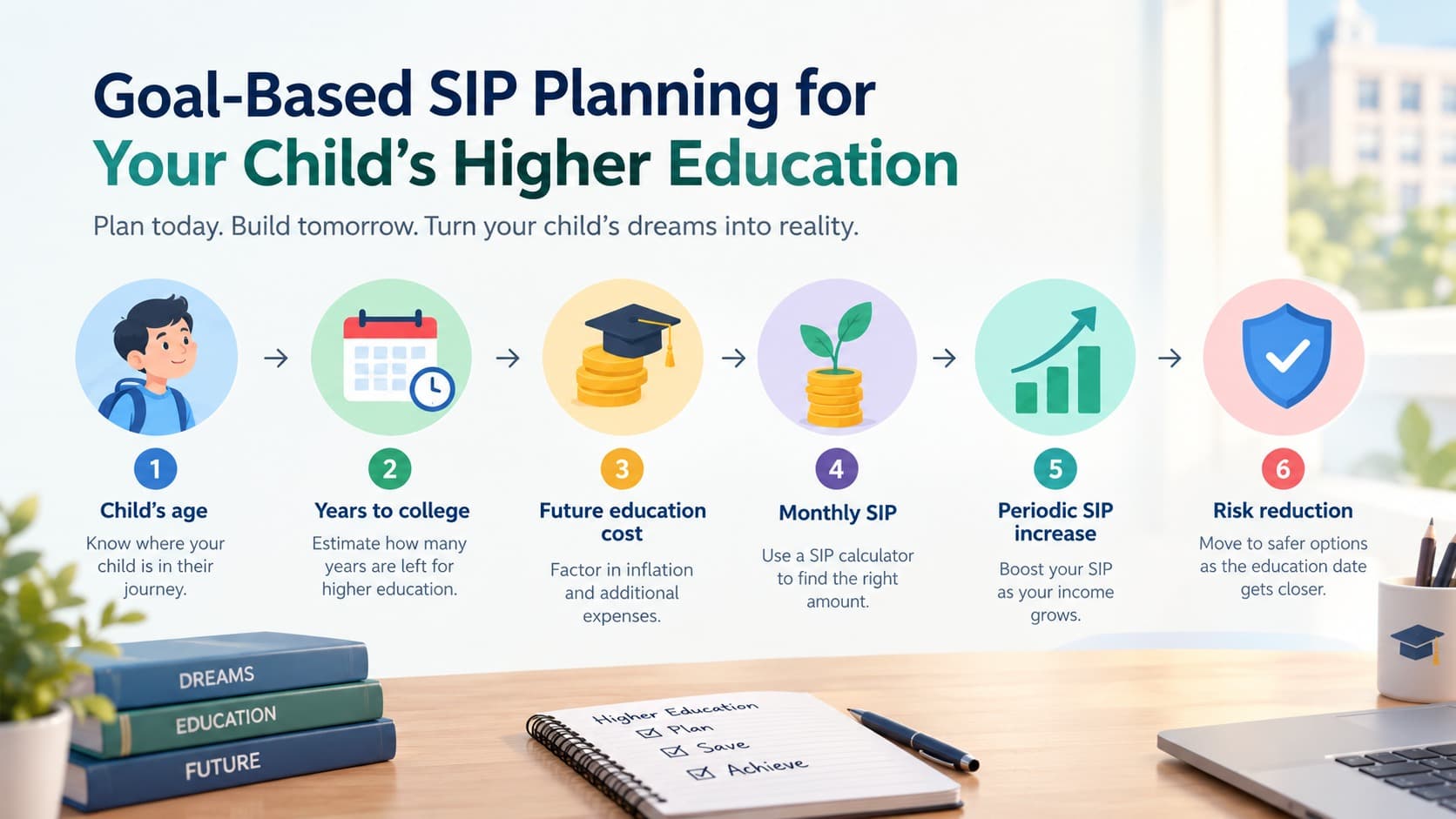
Secure your child's higher education by treating it as a financial goal. Learn how to estimate future costs, calculate your required SIP, and manage investment risks over time.
How to Plan for Your Child's Higher Education with Goal-Based SIPs
Planning for a child’s higher education is easier when you treat it as a financial goal rather than simply an investment. A child education SIP can help parents invest a fixed amount regularly towards a future education corpus. But the right SIP depends on the education goal, time available, expected costs and the level of investment risk you can accept.
A SIP is a method of investing a fixed amount in a mutual fund scheme at regular intervals. AMFI explains that SIPs can encourage disciplined investing and rupee-cost averaging, but they do not guarantee profits or protect against losses.
Step 1: Start with the future education goal
The first question is not “Which SIP should I choose?” It is “How much will my child’s education cost when the money is needed?”
Consider:
The child’s current age
Years until higher education
Current estimated education cost
Expected increase in education expenses
Whether the goal is in India or abroad
Other costs such as accommodation, books and living expenses
For example, if your child is 5 today and you expect the education goal at age 18, you have around 13 years to build the corpus.
An illustrative example: if today’s estimated education cost is ₹20 lakh, the amount required in the future could be significantly higher because prices may rise over time. Therefore, planning only for today’s cost can leave a funding gap.
Step 2: Calculate the SIP required
Once the future goal is estimated, use a child education SIP calculator to understand the approximate monthly investment required.
The calculation generally considers:
Future goal amount + investment period + assumed rate of return = indicative SIP requirement
The return used in a calculator is an assumption, not a promise. Mutual fund investments are market-linked, and actual returns can be higher or lower.
For example, suppose a parent wants to build ₹40 lakh over 12 years. Instead of simply choosing an arbitrary monthly SIP, the parent can work backwards from the target and test different monthly investments and return assumptions.
This is the core of goal based SIP investment: start with the goal and work backwards to the investment.
Step 3: Choose investments according to the time available
There is no universally best SIP for child future.
The appropriate mutual fund category depends on factors such as the time horizon, risk tolerance and investment objective. SEBI’s Risk-o-meter classifies mutual fund schemes across six risk levels, from Low to Very High Risk. Investors should consider the scheme’s risk level along with its objective and portfolio.
For a long-term goal, some investors may consider equity-oriented mutual funds because they provide exposure to growth assets. However, equity can experience significant fluctuations. As the education date approaches, protecting the accumulated corpus becomes increasingly important.
The key principle is therefore time-based risk management, not simply choosing the fund with the highest historical return.
Step 4: Increase your SIP as your income grows
A fixed SIP may become less effective if your income increases but your investment remains unchanged.
Parents can consider increasing the SIP periodically through a step-up approach. For example, a ₹10,000 monthly SIP could be increased as salary or household income rises.
This can help the investment keep pace with a growing education goal without requiring a very large contribution from the beginning.
However, the increase should remain affordable alongside emergency savings, insurance, debt repayments and other financial goals.
Kuberzo's Active Portfolio Tool can help investors understand hypothetical portfolio shifts and their mathematical impact. Its outputs are scenario estimates rather than predictions or guarantees.
Step 5: Review the goal, not just the portfolio
Planning child education through SIP is not a “set it and forget it” exercise.
Review the plan periodically:
Has the expected education cost changed?
Is the target amount still realistic?
Has your income changed?
Is the investment risk appropriate for the remaining time?
Is the SIP amount sufficient?
Is the goal approaching faster than expected?
As the goal gets closer, parents should pay greater attention to the risk of a large market fall shortly before the money is required.
Contact us for a more personalised guidance.
What if the SIP is in the child’s name?
A mutual fund investment can be held in a minor’s name through a parent or legal guardian, subject to the applicable requirements. AMFI states that the minor is the sole holder and that the guardian operates the account until the child reaches majority. When the minor turns 18, the account needs to be regularised and the required KYC and bank details updated before further transactions.
Parents should therefore understand the operational implications before deciding whether to invest in the child’s name or their own name.
Common mistakes to avoid
Starting too late: A shorter investment period can require a much higher SIP.
Ignoring inflation: Planning with today’s education cost may underestimate the future requirement.
Chasing returns: Past performance does not guarantee future returns.
Taking excessive risk near the goal: A large market decline immediately before college expenses can affect the available corpus.
Stopping during market volatility: SIPs are designed for regular investing, but investors should still review whether the underlying investment remains suitable.
Kuberzo's SIP Calculator can help investors model different monthly contribution scenarios.
Key takeaway
A successful SIP for higher education starts with the education goal, not the mutual fund. Estimate the future cost, calculate the required SIP, choose investments according to your time horizon and risk tolerance, increase contributions as your income grows, and gradually reassess risk as the education date approaches.
Disclaimer: This article is for general educational purposes only and does not constitute personalised investment, tax or financial advice. Mutual fund investments are subject to market risks. Read scheme-related documents carefully before investing.
Frequently Asked Questions
Is SIP good for child education?
An SIP can be a disciplined way to invest regularly towards a long-term education goal, but it does not guarantee returns.
How much SIP is required for child education?
It depends on the future education target, investment period and assumed return. A SIP calculator can help estimate the required monthly contribution.
Can I start a SIP for my minor child?
Yes. Mutual fund investments can be made in a minor’s name through a permitted guardian, subject to applicable documentation and rules.
Is there a best SIP for child education?
There is no universally best SIP. The choice should depend on the goal horizon, risk tolerance, investment objective and scheme characteristics.
What happens when my child turns 18?
The minor’s mutual fund account needs to be changed from minor to major, with the required KYC and bank-account updates. Existing standing instructions may also need to be re-established.
Can SIP guarantee my child’s education corpus?
No. SIP is an investment method, not a guarantee. Mutual fund investments are subject to market risk.




