
How to Build a ₹1 Crore Corpus with Goal-Based SIP Investing
By Saahil Madhogaria
About the Author
Saahil Madhogaria is an MBA student at SOIL Institute of Management with a background in Game Art & Animation and experience as a 3D Artist. He writes about marketing, business, personal finance, careers, and MBA life.
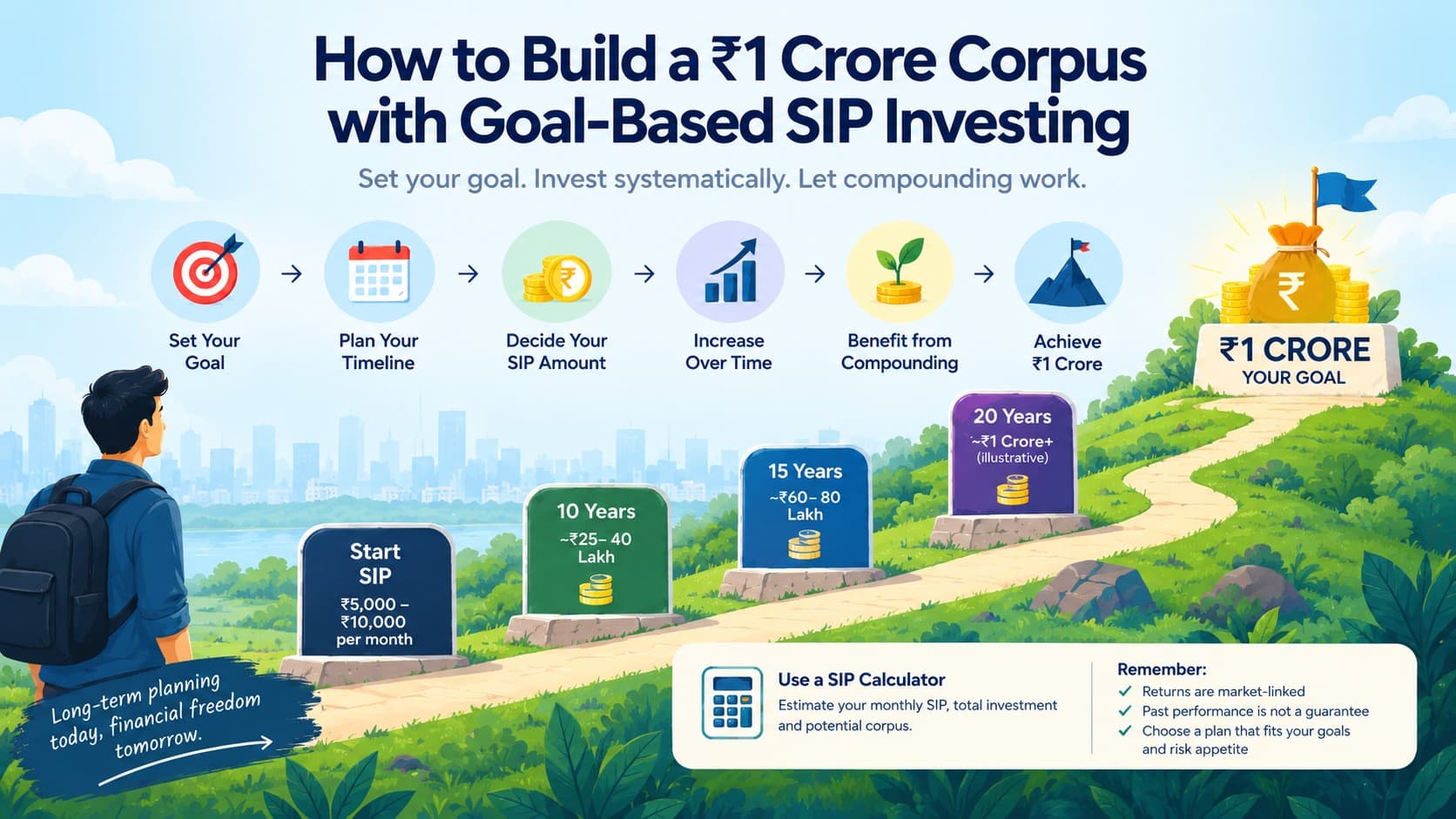
Building a ₹1 crore corpus is less about chasing high returns and more about starting early, staying disciplined, and letting compounding work over time. By aligning your monthly SIP with a realistic timeline and stepping up contributions as your income grows, you can turn a major financial milestone into an achievable plan.
How to Build a ₹1 Crore Corpus with Goal-Based SIP Investing
₹1 crore is a popular financial milestone for Indian investors. It may sound like a large number today, but building a ₹1 crore corpus is less about finding one “best” investment and more about starting early, investing regularly and giving your money enough time to compound.
A Systematic Investment Plan (SIP) can be one way to work towards such a long-term goal. But there is an important distinction: SIP is a method of investing in mutual funds, not a product that guarantees ₹1 crore.
So, how much should you invest every month? And how long could it take?
How Does SIP Help Build ₹1 Crore?
With an SIP, you invest a fixed amount at regular intervals into a mutual fund scheme. Over time, your contributions and any investment gains can grow together.
This is where compounding becomes important.
For example, if you invest ₹10,000 every month, you are not simply accumulating your monthly contributions. If the investment generates returns, those returns remain invested and can themselves contribute to future growth.
However, mutual fund returns are market-linked. AMFI states that mutual fund schemes are not guaranteed or assured-return products and that their value can go up or down. Past performance also does not guarantee future performance.
Therefore, a ₹1 crore SIP plan should always use a planning assumption, not a promised return.
How Much SIP Is Needed for ₹1 Crore?
The answer depends mainly on three variables:
Your monthly SIP amount
Your investment period
The return assumption used for planning
Consider the following illustrative calculations, assuming a 12% annualised return and monthly SIPs:
Investment Period | Approx. Monthly SIP |
10 years | ₹43,000 |
15 years | ₹19,800 |
20 years | ₹10,000 |
These numbers are only illustrations. Actual mutual fund returns will vary, and the final corpus can be lower or higher.
The table demonstrates an important principle of long-term SIP wealth creation:
Time can significantly reduce the monthly amount required to target the same corpus.
What Is the 15-15-15 Rule in Mutual Funds?
The 15-15-15 rule is a popular investing illustration, not an official SEBI or AMFI rule.
It generally refers to investing ₹15,000 per month for 15 years, assuming an annualised return of 15%, which produces approximately ₹1 crore under a standard SIP compounding calculation.
The important word is “assuming.”
A 15% return is not guaranteed. Actual market returns can vary substantially from year to year, and an investor cannot know in advance exactly what return a mutual fund will deliver over the next 15 years.
Therefore, use the 15-15-15 concept to understand the relationship between investment amount, time and compounding, rather than treating it as a formula that guarantees ₹1 crore.
Can You Reach ₹1 Crore Faster?
There are two broad ways to accelerate the path to ₹1 crore:
Increase the starting SIP
A higher monthly investment means more money is invested from the beginning.
For example, an investor targeting ₹1 crore in 10 years needs a substantially higher monthly SIP than someone who has 20 years.
Increase the SIP every year
This is known as a Step-Up SIP or Top-Up SIP.
Suppose you start with a ₹15,000 monthly SIP and increase your contribution as your income rises. Instead of keeping the SIP unchanged for 15 years, you gradually invest more.
This can increase the amount invested over time and potentially bring the investor closer to the target faster, subject to market performance.
Goal-Based Wealth Creation: Start With the Goal
A common mistake is to begin with:
“Which mutual fund should I invest in?”
A better starting point is:
“What am I trying to achieve, how much do I need and when will I need it?”
For a ₹1 crore goal, define:
Target corpus: ₹1 crore
Investment horizon: 10, 15 or 20 years
Monthly investment capacity
Expected annual increase in SIP
Risk tolerance
Appropriate asset allocation
Review frequency
SEBI's investor education material emphasises matching investments with financial goals, time horizon and risk tolerance. Mutual funds also offer different categories and risk profiles, so there is no universally suitable fund for every investor.
What If the Market Falls?
Market volatility is part of investing in market-linked mutual funds.
An investor building a long-term corpus should not assume that the portfolio will rise every month or every year.
AMFI explains that SIPs can support disciplined investing and rupee-cost averaging, but rupee-cost averaging does not assure profits or protect against losses in declining markets.
The important point is to review whether the investment remains aligned with the goal, rather than making decisions based only on short-term market movements.
As the ₹1 crore goal approaches, the investor should also review the portfolio's risk level and consider whether the allocation remains appropriate for the remaining time horizon.
Is ₹1 Crore Enough?
₹1 crore sounds substantial today, but a long-term goal should account for inflation.
For example, ₹1 crore 20 years from now will not have the same purchasing power as ₹1 crore today.
That means the real question may not be:
“How do I build ₹1 crore?”
It could be:
“How much money will I actually need when I reach my goal?”
This is why goal-based wealth creation should consider both the target amount and the time at which the money will be required.
Common Mistakes to Avoid
1. Treating 15% as a guaranteed return
The 15-15-15 concept is an illustration, not a promise.
2. Ignoring inflation
A future ₹1 crore target may need to be higher depending on the goal.
3. Choosing a fund only because of past returns
Past performance does not guarantee future performance.
4. Starting with an unrealistic SIP
Your SIP should be sustainable enough to continue through different market conditions.
5. Never increasing the SIP
As income grows, periodically reviewing and increasing the SIP can help keep the investment aligned with the goal.
6. Focusing only on the ₹1 crore number
The goal, timeline and purchasing power matter just as much as the corpus number.
The Path to ₹1 Crore via SIP
Building ₹1 crore through SIP is not about finding a magic formula.
It is about creating a repeatable process:
Set the target → Choose the timeline → Calculate the SIP → Invest regularly → Increase contributions → Review risk → Stay aligned with the goal
The earlier you start, the more time you give compounding to work. But the final outcome will depend on actual investment performance, contributions, costs, taxes and the time you remain invested.
Key Takeaway
A ₹1 crore SIP goal should be treated as a financial planning exercise, not a return promise.
The most important variables are your investment amount, time horizon and actual market performance.
Use an SIP calculator to understand different scenarios, compare 10-, 15- and 20-year timelines, and consider increasing your SIP as your income grows.
The goal is not simply to “make ₹1 crore from SIP”.
It is to build a sustainable investment plan that gives you a realistic path towards the corpus you need.
This article is for educational purposes only and does not constitute personalised investment advice. Mutual fund investments are subject to market risks. Read all scheme-related documents carefully before investing.
Frequently Asked Questions
How much SIP is needed for ₹1 crore in 10 years?
Under an illustrative 12% annualised return assumption, a monthly SIP of approximately ₹43,000 would be required for 10 years. Actual returns can differ, so this should not be treated as a guaranteed SIP amount.
Can ₹15,000 SIP become ₹1 crore?
The popular 15-15-15 illustration assumes ₹15,000 invested every month for 15 years at a 15% annualised return. It produces approximately ₹1 crore mathematically, but the 15% return is an assumption, not a guarantee.
What is the 15-15-15 rule in mutual funds?
It is a popular investing illustration: ₹15,000 monthly SIP + 15 years + 15% assumed annualised return ≈ ₹1 crore. It is not an official investment rule.
How much SIP is needed for ₹1 crore in 20 years?
At an illustrative 12% annualised return, the required monthly SIP is approximately ₹10,000. Actual results will vary with market performance.
Is SIP good for long-term wealth creation?
SIP can provide disciplined periodic investing into mutual funds. AMFI highlights discipline and rupee-cost averaging as features of SIP, but it does not guarantee profits or protect against losses.
Can I reach ₹1 crore faster with a Step-Up SIP?
Increasing your SIP periodically can increase the total amount invested and may help you target a larger corpus sooner, subject to actual investment returns. It is important to ensure that the higher contribution remains affordable.
Is ₹1 crore enough for retirement?
Not necessarily. The required retirement corpus depends on your current expenses, inflation, retirement age, expected retirement duration and other income or assets. ₹1 crore should therefore be treated as a target that needs context, not a universally sufficient retirement amount.




