
How a ₹1 Crore Portfolio Could Evolve as an Investor Gets Older
By Divay Diya
About the Author
Divay Diya is a business and digital marketing enthusiast with expertise in market research, SEO, and strategic planning. She explores business growth, marketing, investing, and financial markets, translating research into actionable insights.
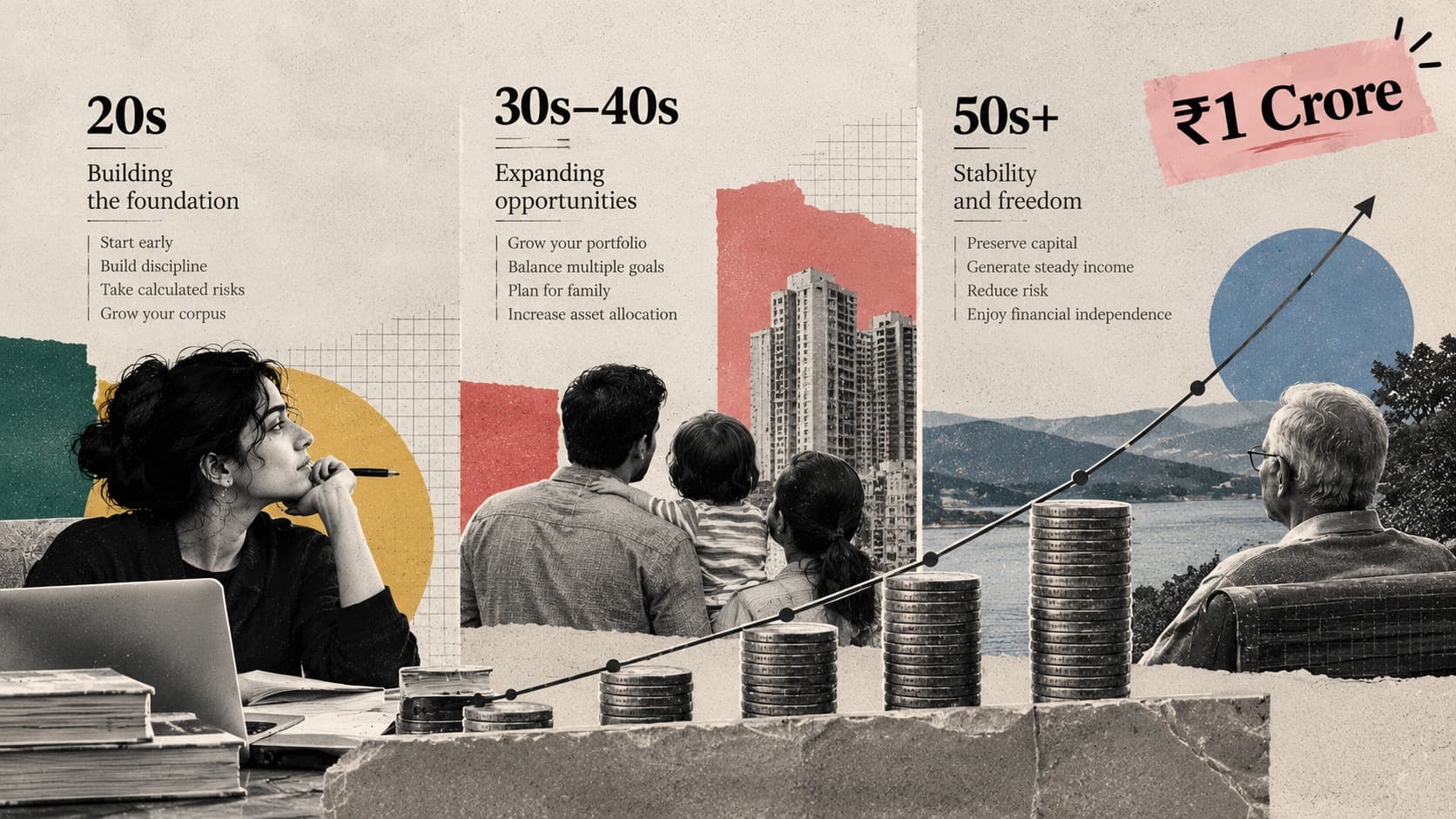
A ₹1 crore portfolio may serve different purposes at different stages of life. Explore how changing financial goals, investment timelines and risk tolerance could influence an investor’s approach to asset allocation and portfolio management.
Building a ₹1 crore investment portfolio is an important milestone, but reaching that number does not mean an investor’s financial journey is complete. The same portfolio may need to serve very different purposes depending on whether its owner is in their 20s, managing family responsibilities in their 40s, or preparing for retirement in their 60s.
A younger investor may have decades to pursue long-term growth. Someone approaching retirement may be more concerned about protecting money needed for living expenses. Between these stages, an investor may need to balance wealth creation with home ownership, children’s education, family responsibilities and other financial goals.
This is why portfolio management should evolve with an investor’s circumstances, not simply with their age.
Consider the hypothetical journey of Rahul, who builds a ₹1 crore portfolio over time. His financial priorities, investment horizon and ability to withstand market fluctuations change as he gets older. Rather than following one fixed allocation forever, he periodically reviews whether his investments still suit his needs.
This article explores how that approach could work in practice.
1. Why a ₹1 Crore Portfolio May Need a Different Strategy Over Time
The value of a portfolio tells only part of the story. To understand whether it is appropriate, an investor must also consider what the money is intended to achieve.
For example, ₹1 crore invested by a 30-year-old who does not expect to use the money for another 25 years has a different purpose from ₹1 crore held by a 62-year-old who expects to fund retirement expenses from it.
Several factors can influence how a portfolio should evolve:
Investment horizon: When will the money be needed?
Risk tolerance: How comfortable is the investor with fluctuations in portfolio value?
Financial responsibilities: Does the investor have dependants, loans or other major obligations?
Income stability: Is there a reliable income source to meet regular expenses?
Liquidity requirements: How much money may need to be accessed at short notice?
Financial goals: Is the portfolio intended for retirement, a future purchase, family needs or a combination of goals?
SEBI’s investor education guidance identifies financial goals, time horizon, risk appetite, diversification and asset allocation as important considerations when selecting investments. It also recommends reviewing a portfolio as life circumstances change. (SEBI Investor)
The practical implication is that age can be a useful prompt for reviewing a portfolio, but it should not be the only factor determining its allocation.
2. In Your 20s and Early 30s: Build the Foundation for Long-Term Growth
At the beginning of an investing journey, an investor may have a relatively long period before needing the money for retirement or other distant goals.
This can provide more time to withstand short-term market fluctuations, provided the investor has the financial capacity and willingness to accept the associated risks.
What should the portfolio focus on?
For Rahul, this stage is about establishing sound financial habits and building a portfolio that aligns with his long-term objectives.
His priorities might include:
Investing regularly rather than waiting for the perfect market entry point.
Learning about different asset classes and investment risks.
Diversifying instead of concentrating his money in a single fund or sector.
Increasing contributions as his income grows, where affordable.
Maintaining emergency savings and appropriate insurance outside his long-term investment plan.
Equity mutual funds may form part of a long-term portfolio for investors who can tolerate their volatility and potential losses. Debt investments and accessible savings may also play important roles, depending on the investor’s goals and financial circumstances.
However, having a long time horizon does not mean an investor should take unlimited risk. A person who would be unable to tolerate a substantial portfolio decline may need a different allocation from someone with a stronger financial cushion.
SEBI notes that a longer investment horizon can allow more time for compounding, while also emphasising the importance of understanding risk and selecting investments according to individual circumstances. (SEBI Investor)
Illustrative approach: Rahul might prioritise long-term growth while retaining enough accessible savings to manage emergencies without being forced to sell investments during a market downturn.
Explore Kuberzo’s Equity Mutual Funds to learn more about this investment category.
3. In Your 30s and 40s: Balance Growth With Competing Financial Goals
As an investor’s income and responsibilities change, the portfolio may need to support several objectives simultaneously.
Rahul may now be saving for retirement while also considering a home purchase, children’s education or other major expenses. These goals will not necessarily share the same timeline.
Money required in the next few years may need a different investment approach from money intended for retirement decades later.
What should change at this stage?
Separate investments by goal. Instead of treating the entire portfolio as one pool of money, identify which investments are intended for which objectives.
Review the balance between growth and stability. The appropriate allocation will depend on how much risk Rahul can take and when each goal must be funded.
Increase contributions when feasible. Salary growth may provide opportunities to invest more, without compromising essential expenses or other priorities.
Avoid excessive concentration. A portfolio that has grown because of one successful investment may become overly dependent on that holding or sector.
Review protection against financial shocks. Emergency savings, debt management and suitable insurance can help prevent unexpected expenses from disrupting long-term investments.
This stage does not automatically require a large shift away from equities. Rahul may still have a long investment horizon for retirement, even if some of his other goals are approaching.
Instead, he can assess each goal separately and adjust the investments associated with it.
For instance, money needed for a planned expense in three years should not necessarily remain exposed to the same level of volatility as retirement money that will not be required for another 20 years.
Kuberzo’s Goal-Based Financial Planner can help investors organise their financial objectives and consider their investment requirements.
4. In Your 50s: Prepare for the Transition From Accumulation to Retirement
By their 50s, many investors begin to focus more closely on whether their accumulated wealth can support their future lifestyle.
The key question changes from simply asking how much the portfolio could grow to asking how the money will be used.
Rahul may be approaching retirement, but that does not necessarily mean he should move his entire portfolio into low-risk assets immediately. His decision depends on his expected retirement age, pension or other income sources, health, dependants, expenses and the number of years the money may need to last.
What should he review?
Retirement readiness: Estimate future expenses and compare them with expected income and available assets.
Near-term cash requirements: Identify expenses that may arise during the transition into retirement.
Asset allocation: Consider whether the existing mix still matches his capacity to tolerate losses.
Portfolio concentration: Assess whether any one investment, sector or asset class dominates the portfolio.
Liquidity: Ensure that money needed soon is not unnecessarily exposed to short-term market volatility.
Inflation: Consider how living costs may change during retirement.
SEBI’s retirement-planning guidance highlights the value of starting early, maintaining emergency savings, diversifying investments and considering future living expenses. (SEBI Investor)
An investor approaching retirement may gradually adjust the portfolio towards a more suitable balance of growth, stability and liquidity. The appropriate pace of change depends on individual circumstances.
The aim is not to eliminate all investment risk. It is to avoid taking risks that could seriously compromise money needed for essential future expenses.
5. In Your 60s and Beyond: Balance Capital Preservation, Income and Continued Growth
Retirement does not necessarily mean that an investor can stop thinking about growth. In fact, a retirement portfolio may need to support living expenses for many years.
Rahul’s priorities may now include funding monthly expenses, managing healthcare costs, supporting family members and preserving enough wealth for later life.
The challenge is balancing three requirements:
Liquidity: Having money available for immediate and near-term expenses.
Stability: Reducing exposure to risks that could disrupt essential spending.
Long-term growth: Maintaining the potential to meet expenses that may arise many years into retirement.
An investor who moves the entire portfolio into cash or other low-growth assets may face a different risk: inflation can gradually reduce the purchasing power of the money. Conversely, keeping the entire portfolio in highly volatile investments may expose essential expenses to significant market fluctuations.
A balanced approach considers both risks.
What might Rahul consider?
Maintain a suitable reserve for expenses. Identify upcoming spending needs and keep an appropriate amount accessible through suitable savings or other liquid instruments.
Match investments to the time they will be needed. Money intended for immediate expenses generally requires a different approach from money that may not be needed for many years.
Retain growth-oriented investments where appropriate. Depending on his circumstances and risk tolerance, Rahul may still need investments with long-term growth potential.
Plan withdrawals carefully. Decide how regular expenses will be funded and periodically review whether the withdrawal amount remains sustainable.
Review the plan as circumstances change. Healthcare expenses, family responsibilities, inflation and investment performance can all affect how much income the portfolio needs to provide.
Retirement planning is not simply about protecting the amount accumulated. It is about making that amount support the investor’s needs throughout retirement.
6. How Could Asset Allocation Change as the Investor Gets Older?
Asset allocation refers to how an investor distributes investments across different asset classes. The appropriate mix depends on the purpose of the money, the investment horizon, risk tolerance and financial circumstances.
The following table illustrates how an investor’s priorities might evolve. These are examples of changing priorities, not recommended age-based allocations or personalised investment advice.
Life stage | Primary focus | Potential portfolio priorities |
|---|---|---|
20s–early 30s | Building wealth | Long-term growth, regular contributions and diversification |
30s–40s | Balancing multiple goals | Growth alongside suitable stability and liquidity for nearer-term goals |
50s | Preparing for retirement | Retirement readiness, reviewing risk exposure and planning future expenses |
60s and beyond | Funding retirement | Liquidity, sustainable withdrawals, suitable stability and continued long-term growth |
There is no universal rule that everyone must reduce equity exposure by a fixed percentage each year.
For example, a 60-year-old with a reliable pension, low expenses and substantial other assets may have different investment needs from a 60-year-old who depends almost entirely on the ₹1 crore portfolio for living expenses.
Similarly, a 35-year-old saving for a house deposit due in two years may need to take a more conservative approach to that particular goal than to retirement investments.
SEBI’s Asset Allocation Calculator offers an illustration of how allocation assumptions affect a portfolio’s estimated outcome. Its calculations are illustrative; market returns cannot be predicted or treated as fixed. (SEBI Investor)
Understanding the role of different investments
Equity mutual funds: May provide long-term growth potential but can experience substantial market declines.
Debt mutual funds: Provide exposure to fixed-income securities, but carry risks including interest-rate, credit and liquidity risks, depending on the scheme.
Hybrid mutual funds: Combine asset classes according to their investment mandates; their risks depend on the actual allocation and strategy.
Savings and other liquid instruments: May help meet immediate spending requirements, subject to the product’s terms and risks.
No single category is appropriate for every investor or every financial goal.
Explore Kuberzo’s Equity Mutual Funds, Debt Mutual Funds and Hybrid Mutual Funds to understand these categories.
7. A ₹1 Crore Portfolio Is Not the Same as ₹1 Crore of Spending Power
An investor’s portfolio value may remain unchanged in nominal terms while its purchasing power declines because of inflation.
Consider an illustrative example: if Rahul has ₹1 crore today and inflation averages 5% annually over the next 20 years, ₹1 crore in 20 years would have purchasing power equivalent to approximately ₹37.7 lakh today.
The calculation is:
Purchasing power in today’s money = Future amount ÷ (1 + inflation rate)ⁿ
₹1,00,00,000 ÷ (1.05)²⁰ ≈ ₹37.7 lakh
This is a mathematical illustration, not a forecast that inflation will remain at 5%.
The implication is important: an investor should consider what the portfolio needs to accomplish rather than focusing only on reaching a nominal number.
For a younger investor, this could mean revisiting the target as the financial goal approaches. For a retiree, it could mean planning for expenses that may rise over time.
Kuberzo’s Inflation Calculator can help illustrate the effect of inflation on future financial goals.
8. Avoid These Portfolio Management Mistakes
An investor can undermine a sensible long-term plan by making unnecessary changes or overlooking important risks.
Mistake 1: Changing the portfolio simply because of age
Turning 40, 50 or 60 does not automatically require a particular allocation. Life circumstances, goals and financial resources matter more than a birthday alone.
Mistake 2: Assuming that a larger portfolio is automatically safer
A ₹1 crore portfolio concentrated in a small number of volatile investments may carry significant risk. The total value does not reveal how diversified or suitable the portfolio is.
Mistake 3: Ignoring the timing of financial goals
Money required soon may not have enough time to recover from a market decline before it must be used.
Mistake 4: Moving everything into conservative assets too early
Reducing risk can be sensible, but excessive caution may expose a long retirement to inflation risk and insufficient growth.
Mistake 5: Taking excessive risk to compensate for inadequate savings
An investor who is behind on a financial goal may be tempted to pursue unusually high returns. Taking more risk does not guarantee a faster recovery and can make the shortfall worse.
Mistake 6: Withdrawing money without a plan
Retirement withdrawals should be considered in relation to spending needs, other income sources, portfolio risks and the length of retirement.
Mistake 7: Never reviewing the portfolio
A strategy that was appropriate several years ago may no longer fit the investor’s circumstances. Periodic reviews help identify when changes may be necessary.
AMFI cautions that mutual fund investments are not guaranteed-return products, their values can fluctuate, and past performance does not guarantee future performance. (AMFI — Risks in Mutual Funds)
9. How Rahul Could Keep His Portfolio Aligned With His Life
Rather than changing his investments every time markets move, Rahul could establish a simple review process.
Step 1: Revisit his financial goals. Identify what the portfolio needs to fund and when the money will be required.
Step 2: Assess his current financial position. Consider income, expenses, outstanding debt, emergency savings, insurance and other assets.
Step 3: Review the portfolio’s risk exposure. Understand the underlying holdings, concentration and allocation across asset classes.
Step 4: Compare the current allocation with his needs. Decide whether the portfolio remains suitable for the goals and investment horizons involved.
Step 5: Rebalance if necessary. Consider appropriate adjustments when the allocation has drifted or circumstances have materially changed, while accounting for costs and taxes.
Step 6: Repeat the process periodically. A review may be useful annually or after major life events, such as retirement, marriage or a change in financial responsibilities.
Kuberzo’s Portfolio Review tool can be a starting point for examining existing holdings.
The purpose of this process is not to predict market movements. It is to make sure the investment strategy continues to serve the investor as life changes.
Key Takeaway
A ₹1 crore portfolio does not have to follow the same strategy throughout an investor’s life.
In the earlier years, the focus may be on building wealth through regular contributions and suitable long-term investments. During the middle years, the investor may need to balance growth with family responsibilities and nearer-term financial goals. As retirement approaches, planning for future expenses, liquidity and potential withdrawals may become increasingly important.
However, getting older does not automatically mean that every investor should follow the same asset allocation. The right approach depends on financial goals, income sources, risk tolerance, investment horizon and the role the portfolio needs to play.
The real objective is to keep the portfolio aligned with the investor’s life—not to keep changing it simply because the investor’s age or market conditions have changed.
Disclaimer: This article is for educational and informational purposes only. It does not constitute personalised investment advice or a recommendation to buy or sell any particular investment. Mutual fund investments are subject to market risks, and returns are not guaranteed. Investors should read the relevant scheme documents carefully and consider their financial goals, investment horizon, risk tolerance and financial circumstances before investing. Illustrations are not forecasts of actual performance.
Frequently Asked Questions
Should a ₹1 crore portfolio become more conservative as an investor gets older?
It may be appropriate to reduce certain risks as the investor approaches a financial goal, particularly when essential expenses will depend on the portfolio. However, the decision should reflect the investor’s overall financial situation, other income sources, risk tolerance and investment horizon rather than age alone.
How should a young investor manage a ₹1 crore portfolio?
A young investor with a long time horizon may focus on long-term growth, diversification and regular investing, provided the portfolio’s risk is appropriate. Emergency savings, debt management and nearer-term goals should also be considered.
Should someone nearing retirement move the entire portfolio into debt mutual funds?
Not necessarily. Debt mutual funds carry risks, and moving the entire portfolio into one category may not meet every retirement need. The investor should consider liquidity, stability, growth, inflation and the timing of future expenses.
How often should an investor rebalance a portfolio?
An investor may review the portfolio periodically, such as annually, or when a major life event or material change occurs. Rebalancing should be based on the intended asset allocation and financial objectives, not simply on which investment has performed best recently.
Can a ₹1 crore portfolio generate retirement income?
It may help fund retirement expenses, but whether it is sufficient depends on the investor’s spending needs, other income, inflation, investment returns, taxes and retirement duration. A withdrawal plan should be based on the individual’s financial circumstances rather than a fixed assumption about how much the portfolio can safely provide.
Does inflation affect a ₹1 crore portfolio?
Yes. Inflation reduces the purchasing power of money over time. An investor should consider the future cost of their financial goals rather than assuming that a nominal ₹1 crore target will provide the same purchasing power in the future.
Is asset allocation determined by age?
Age can provide useful context, but asset allocation should also consider financial goals, risk tolerance, investment horizon, income, liabilities and other assets. Two people of the same age may require different portfolios.




