
Growth vs IDCW in Mutual Funds: What Is IDCW & Which Option to Pick
By Amrita Sinha
About the Author
Amrita Sinha is a content strategist with experience in SEO, digital marketing, and financial content. She writes easy-to-understand, research-backed articles on investing, personal finance, taxation, and wealth management for Kuberzo.
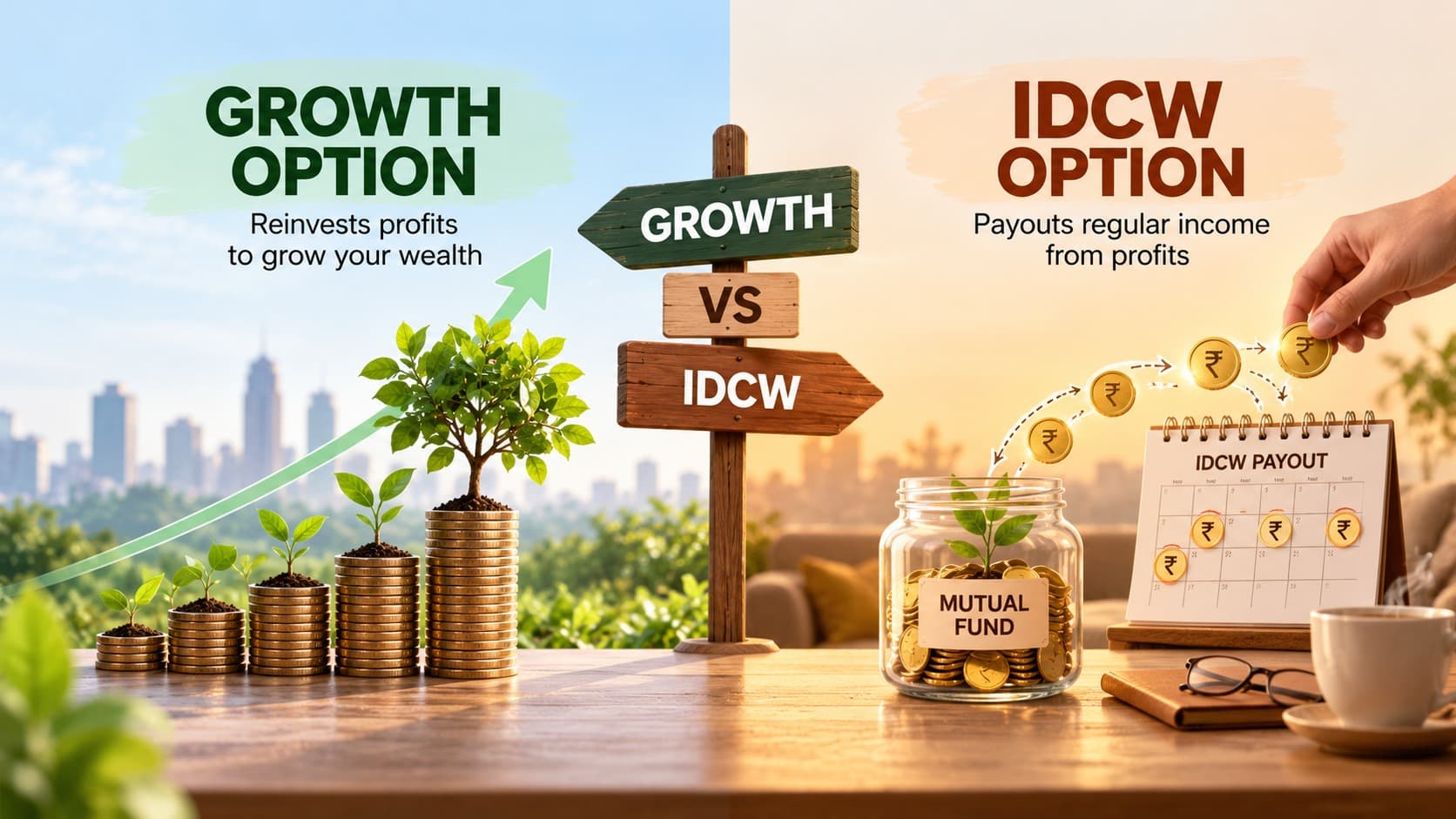
Understand growth vs IDCW in mutual funds, how IDCW payouts work, tax differences, compounding, and which option may suit your investment goals.
When investing in mutual funds, choosing the right scheme is only one part of the decision. You may also need to choose between the Growth and IDCW options. While both options can invest in the same underlying portfolio, they handle the returns differently.
The Growth option allows investment gains to remain invested in the fund, supporting long-term wealth creation through compounding. The IDCW option may distribute money to investors when the fund declares a distribution, subject to the availability of distributable surplus and the fund house's decision.
So, growth vs IDCW in mutual funds: which option should you choose? The answer depends on your financial goals, need for cash flow, investment horizon, and tax situation.
Let’s understand what IDCW means, how it differs from the Growth option, and which may be suitable for your needs.
What Is IDCW in Mutual Funds?
IDCW stands for Income Distribution cum Capital Withdrawal. It is the option under which a mutual fund may distribute a portion of its distributable surplus to investors, subject to applicable rules and the fund house’s decision.
Earlier, this option was commonly called the dividend option. SEBI changed the terminology to IDCW to make it clearer that the amount distributed is not necessarily income or profit alone. It may also involve a withdrawal of capital.
This is an important distinction because investors sometimes assume that a mutual fund dividend is additional income earned without affecting their investment value. In reality, when an IDCW distribution is made, the Net Asset Value (NAV) of the relevant option generally falls to reflect the distribution and applicable statutory levies.
IDCW meaning in mutual funds is therefore broader than simply receiving dividends. It refers to a distribution from the mutual fund that is not guaranteed and depends on the fund’s distributable surplus and the decisions made by the trustees or asset management company.
How Does the IDCW Option Work?
Suppose you invest ₹1,00,000 in an IDCW option. If the mutual fund declares a distribution, you may receive money in your registered bank account under the payout facility.
However, three things are important to remember:
IDCW is not guaranteed and may not be declared regularly.
The amount distributed is not necessarily a sign of the fund’s performance.
The NAV generally reduces by the distribution amount and applicable levies.
Therefore, IDCW should not automatically be treated as a fixed-income product or a reliable monthly income source.
What Is the Growth Option in Mutual Funds?
Under the Growth option, the mutual fund does not distribute its surplus to investors through IDCW. Instead, the gains attributable to the investment remain within the fund and are reflected in its NAV over time.
You generally realise your returns when you redeem some or all of your units. The amount you receive depends on the applicable NAV at redemption, the number of units sold, and any relevant charges or taxes.
For example, if you invest ₹1,00,000 in a Growth option and the value of your investment increases to ₹1,50,000, your unrealised gain is ₹50,000. You can realise some or all of that gain by redeeming units, subject to market value and applicable rules.
The key benefit is compounding in the Growth option. When gains remain invested, they can contribute to future growth. This may help long-term investors build wealth, although returns are not guaranteed and market fluctuations can reduce the value of an investment.
Growth vs IDCW in Mutual Funds: Key Differences
The main difference between Growth and IDCW lies in how returns are handled.
Feature | Growth Option | IDCW Option |
Treatment of returns | Gains remain invested in the fund | The fund may distribute money to investors |
Cash flow | No IDCW payout | Payout may be available if declared |
Compounding | Gains remain invested, supporting compounding | Payouts taken out of the investment do not continue compounding in the fund |
Distribution guarantee | No distribution is made under this option | Distribution is not guaranteed |
NAV | Reflects the value of the investment portfolio | Generally falls after a distribution to reflect the amount distributed and applicable levies |
Tax treatment | Tax generally arises on redemption through capital gains rules | Distribution is generally taxable in the investor’s hands; redemption may also create capital gains |
Common use case | Long-term wealth creation | Investors who want occasional cash distributions, if declared |
The two options may belong to the same scheme and invest in the same portfolio, but their NAVs and the way investors receive returns can differ. Neither option guarantees better investment performance.
Dividend Payout vs Growth Option: Which Is Better?
The choice between dividend payout vs growth option depends on what you want your investment to achieve.
Choose Growth If Your Goal Is Long-Term Wealth Creation
The Growth option may be worth considering if you are investing for goals such as retirement, a child’s education, buying a home, or building long-term wealth.
It can be particularly useful for investors who do not need regular cash distributions and prefer to leave gains invested. Over a longer period, compounding may help the investment grow, although the final outcome depends on market performance, expenses, and the time invested.
For example, if you are investing through a Systematic Investment Plan (SIP) and do not need the money immediately, the Growth option can help keep gains within the investment instead of distributing them.
Choose IDCW If You Want Potential Cash Distributions
The IDCW option may suit investors who prefer to receive distributions when declared rather than relying entirely on selling units to access money.
However, IDCW is not a substitute for a fixed deposit, pension, or guaranteed monthly income plan. A mutual fund may not declare a distribution when you expect one, and the amount may vary.
If you need a predictable amount every month, relying solely on IDCW may not meet your cash-flow requirements. Your financial plan should account for the possibility that no distribution is declared.
If you already invest in mutual funds, a mutual fund portfolio review can help you assess whether your existing investments align with your financial goals.
What Does IDCW Reinvestment Mean?
IDCW options may offer different facilities, including payout and reinvestment, depending on the scheme.
Under the payout facility, the declared distribution is paid to the investor, subject to applicable rules. Under the reinvestment facility, the distribution amount, after applicable deductions, is used to purchase additional units of the scheme.
This is the IDCW reinvestment meaning: instead of receiving the distribution as cash, you receive additional units.
Reinvestment does not make IDCW identical to the Growth option. A distribution is still declared, the NAV is adjusted accordingly, and tax treatment may differ. Reinvestment may also involve applicable transaction levies, such as stamp duty.
If your primary goal is long-term wealth accumulation and you do not need payouts, compare the Growth option carefully before selecting IDCW reinvestment.
Why Was Dividend Renamed to IDCW by SEBI?
The term “dividend” can make investors think that the fund is distributing profits in the same way a company might pay dividends to shareholders.
However, mutual fund distributions can include amounts that represent a withdrawal of capital, depending on the fund’s distributable surplus and applicable rules. The distribution also reduces the NAV of the relevant option.
SEBI introduced the term Income Distribution cum Capital Withdrawal (IDCW) to make the nature of these distributions clearer to investors.
This change was intended to reduce confusion and help investors understand that an IDCW payout is not necessarily extra profit or a guaranteed return. Investors should assess the fund’s overall performance, investment objective, costs, and suitability rather than choosing a scheme only because it declares distributions.
Taxation on IDCW vs Growth
Tax treatment is another important consideration when comparing these options in India.
Taxation Under the IDCW Option
IDCW distributions are generally taxable in the hands of investors at their applicable income-tax slab rates. Depending on the investor and applicable rules, tax may also be deducted at source when the relevant threshold and conditions are met.
The amount received should therefore not automatically be treated as tax-free income.
Taxation Under the Growth Option
Under the Growth option, investors generally pay tax when they redeem units and realise capital gains. The applicable tax rate depends on the type of mutual fund, the holding period, the date of acquisition, and the tax rules in force.
Equity-oriented funds and other mutual fund categories can have different capital gains tax treatment. Rules may also change over time.
Which Option Is More Tax-Efficient?
There is no single answer for every investor. The tax outcome depends on your tax slab, the type of fund, how long you hold it, when you redeem it, and the applicable tax rules.
When comparing taxation on IDCW vs Growth, consider both the tax on distributions and any capital gains tax that may arise when units are sold. For a significant investment or a complex tax situation, consult a qualified tax professional.
Choosing Growth Option for SIP Investments
For investors using a SIP to build wealth over several years, the Growth option is often worth considering because the gains remain invested rather than being distributed. To connect your SIP investments with specific milestones, use Kuberzo’s goal-based financial planner to organise your investment strategy around your financial goals.
For instance, if you are investing monthly for a long-term goal and do not need interim cash flow, the Growth option can keep the investment focused on accumulation. You can later plan redemptions based on your goal, financial needs, and prevailing market conditions.
Before investing, consider:
Your goal: Are you building wealth or seeking cash distributions?
Your time horizon: When will you need the money?
Your risk tolerance: Can you manage market fluctuations?
Your cash-flow needs: Do you need money now, or can you leave it invested?
Tax implications: How could distributions or redemptions affect your tax liability?
Remember, choosing Growth does not guarantee higher returns. It simply changes how returns are handled within the scheme.
How to Choose Between Growth and IDCW
A practical way to decide is to begin with your financial objective rather than the payout label.
If you want long-term accumulation and do not need regular cash distributions, the Growth option may be a better fit. If you value receiving distributions when available and understand that they are neither guaranteed nor necessarily additional profit, you may consider IDCW.
Do not compare the options only by looking at the amount of IDCW declared. Review total returns, risk, expenses, fund strategy, and tax implications. Also make sure the selected scheme matches your investment horizon and ability to tolerate losses.
Investors should read the scheme information document and consult a qualified financial adviser if they are unsure which option suits their circumstances. Before choosing a mutual fund option, use Kuberzo’s investment risk analyser to understand your risk profile and make more informed investment decisions.
Conclusion
Understanding growth vs IDCW in mutual funds can help you choose an option that matches your financial goals.
The Growth option keeps gains invested, making it useful to consider for long-term wealth accumulation. The IDCW option may provide distributions when declared, but those payments are not guaranteed and can reduce the NAV of the investment.
Neither option is universally better. Your choice should depend on your need for cash flow, investment horizon, tax situation, and overall financial plan. For many long-term SIP investors who do not need interim payouts, Growth is a sensible option to evaluate.
The goal is not simply to receive money from an investment. It is to choose an approach that helps you manage your finances and work towards your goals.
Frequently Asked Questions
What is IDCW in a mutual fund?
IDCW stands for Income Distribution cum Capital Withdrawal. It is an option under which a mutual fund may distribute money to investors when a distribution is declared, subject to applicable rules and the availability of distributable surplus.
Is Growth better than IDCW in mutual funds?
Growth may be more suitable for investors focused on long-term wealth creation who do not need interim cash distributions. IDCW may suit investors who prefer distributions when declared. The right choice depends on individual goals, cash-flow needs, risk tolerance, and taxes.
Is IDCW income guaranteed every month?
No. Mutual fund IDCW distributions are not guaranteed. The amount and frequency depend on the availability of distributable surplus and the fund house’s decision. IDCW should not be treated as a fixed or guaranteed monthly income.
What is the difference between IDCW payout and reinvestment?
With IDCW payout, the declared distribution is paid to the investor. With IDCW reinvestment, the amount, after applicable deductions, is used to purchase additional units. Reinvestment does not remove the tax implications associated with the distribution.
Which mutual fund option is suitable for a long-term SIP?
The Growth option is often worth considering for long-term SIPs when the investor does not need interim cash flow. It allows gains to remain invested, supporting compounding. However, returns depend on market performance, and the scheme should match the investor’s goals and risk profile.




