
Growth vs IDCW in Mutual Funds: How Compounding Impacts Your Portfolio
By Amrita Sinha
About the Author
Amrita Sinha is a content strategist with experience in SEO, digital marketing, and financial content. She writes easy-to-understand, research-backed articles on investing, personal finance, taxation, and wealth management for Kuberzo.
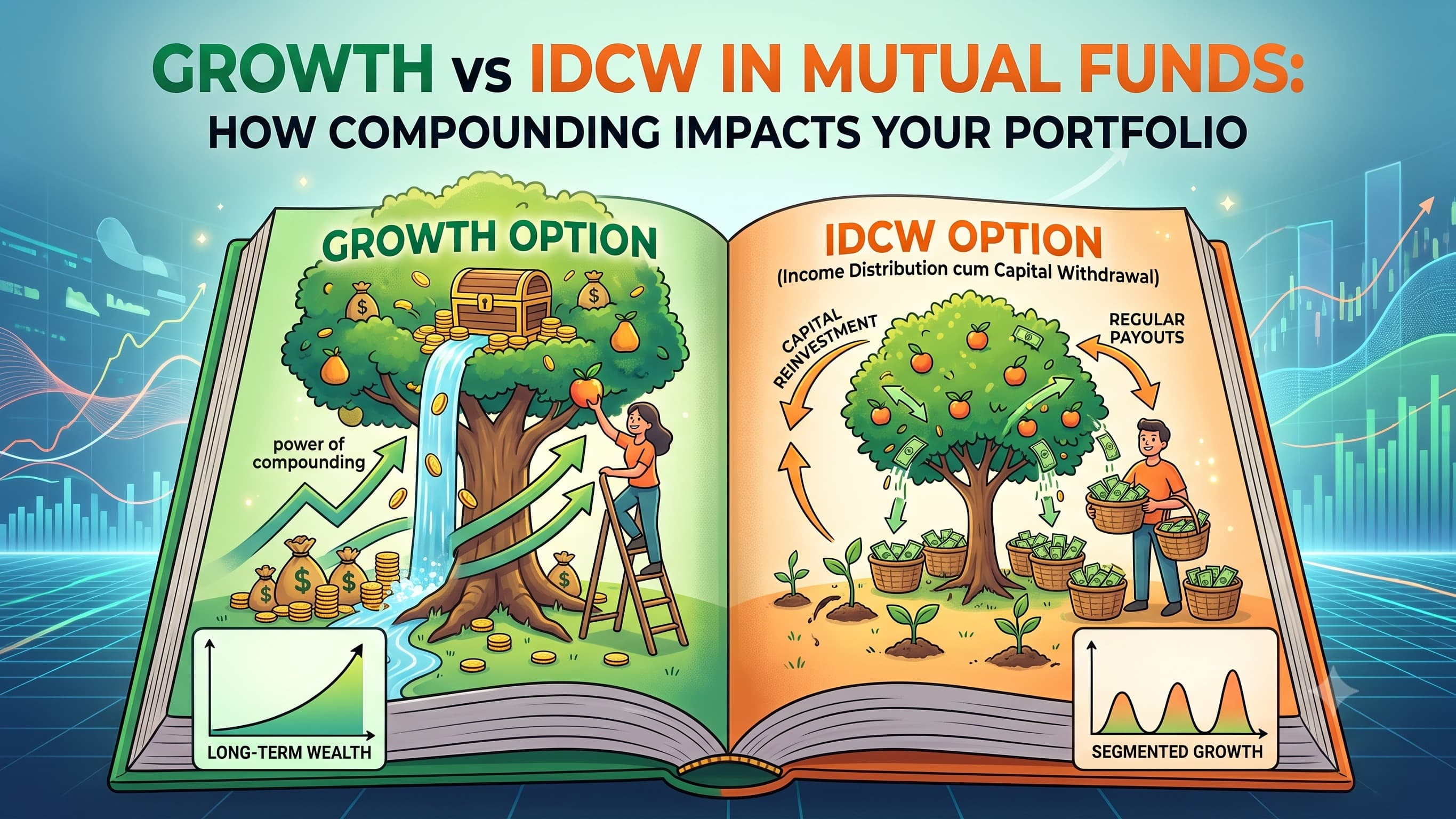
Understand Growth vs IDCW in mutual funds, including compounding, NAV differences, taxation, payouts and how each option can affect long-term wealth creation.
Growth vs IDCW in Mutual Funds: How Compounding Impacts Your Portfolio
When investing in mutual funds, selecting the right scheme is only one part of the decision. Investors may also need to choose between the Growth and IDCW options, particularly when the same mutual fund offers both. While the underlying portfolio and investment objective may be similar, the two options differ in how the returns generated by the scheme are handled.
Under the Growth option, gains remain invested in the scheme, allowing the accumulated value to participate in future market performance. This creates the potential for returns to compound over time, which can become particularly relevant when investments are held for several years. Under the IDCW (Income Distribution cum Capital Withdrawal) option, the mutual fund may distribute an amount to investors when an IDCW is declared, subject to the scheme's distributable surplus and applicable regulations. Such distributions are not guaranteed and are not equivalent to a fixed or assured income.
The choice between the two can therefore influence how an investor's portfolio evolves over the long term. An investor who does not require periodic cash distributions may prefer to keep returns invested and allow the corpus to compound, while someone who values receiving distributions when declared may consider the IDCW option.
Understanding the difference between Growth and IDCW, including their impact on compounding, NAV, taxation and cash flow, can help investors make a more informed choice based on their investment objective and time horizon.
Growth vs IDCW: What is the difference?
The simplest way to understand the Growth option vs IDCW is to look at what happens to the income generated by the mutual fund.
Growth option: The income and gains remain invested in the scheme. Investors do not receive periodic distributions merely because the fund has generated profits.
IDCW option: The mutual fund may distribute income to investors if the scheme declares an IDCW. IDCW stands for Income Distribution cum Capital Withdrawal.
Importantly, IDCW is not guaranteed and should not be confused with a fixed dividend or interest payment.
Feature | Growth Option | IDCW Option |
Distribution to investor | No periodic distribution by default | Distribution may be declared |
Reinvestment | Gains remain invested | Distributed amount leaves the investment unless reinvested separately |
Compounding | Automatic within the fund | Interrupted when distributions are paid out |
Cash Flow | No regular payout | Possible payout when IDCW is declared |
Tax Treatment | Capital gains on redemption, subject to applicable rules | IDCW taxable as income, subject to applicable rules |
Suitable Objective | Long-Term wealth Accumulation | Investors who prefer distributions when declared |
How does compounding work in the Growth option?
The compounding benefit of the Growth option comes from keeping investment gains within the mutual fund.
Suppose you invest ₹5 lakh and the investment earns returns over time.
When those gains remain invested, the next period's return can be generated on both your original investment and the accumulated gains.
This is the basic principle behind compounding.
For example, consider an illustrative example where ₹5 lakh earns a hypothetical 10% annual return:
After 1 year: ₹5.50 lakh
After 2 years: ₹6.05 lakh
After 5 years: approximately ₹8.05 lakh
After 10 years: approximately ₹12.97 lakh
This assumes a constant 10% annual return purely for illustration. Actual mutual fund returns fluctuate and are not guaranteed.
The Growth option allows this reinvestment to happen within the fund without the investor having to manually reinvest distributions.
What happens with IDCW?
Under the IDCW option, the scheme may declare a distribution from the distributable surplus, subject to the applicable regulatory framework and scheme terms.
When an IDCW is paid, the NAV of the IDCW option generally falls by the amount distributed, after considering applicable statutory adjustments.
This is why IDCW payout vs Growth should not be viewed as "income plus investment growth".
Suppose a mutual fund has an NAV of ₹100 and declares an IDCW of ₹5 per unit. Ignoring applicable adjustments for simplicity, the NAV would fall by approximately ₹5 after the distribution.
The investor receives ₹5, but the investment value also falls correspondingly.
In other words, IDCW does not create additional wealth by itself.
NAV difference between Growth vs IDCW
The NAV difference between Growth vs IDCW can sometimes confuse investors.
Two options of the same mutual fund can have different NAVs because of distributions made under the IDCW option.
For example:
Growth NAV: ₹120
IDCW NAV: ₹100
This does not mean the Growth option is automatically "more expensive" or that the IDCW option is cheaper.
The difference may reflect the distributions that have been paid out over time.
Therefore, comparing two options simply based on NAV is not meaningful.
A lower NAV does not mean an investor is getting the same mutual fund at a discount.
Tax on Growth vs IDCW mutual funds
Tax treatment is another important part of the tax on Growth vs IDCW mutual funds comparison.
For the Growth option, investors generally pay tax when they redeem units and realise a capital gain. The applicable tax depends on the type of mutual fund, holding period and prevailing tax rules.
With IDCW, the distribution is generally taxable in the hands of the investor at the applicable income-tax rate. The mutual fund may also deduct tax at source where applicable.
Therefore, Growth and IDCW can have different tax implications depending on the investor's circumstances and the underlying fund category.
Investors should not assume that IDCW is a tax-efficient way to receive regular income.
Tax rules can change, so always verify the provisions applicable to the relevant financial year.
Does IDCW provide regular income?
Not necessarily. A common misconception is that IDCW works like a fixed monthly dividend or guaranteed income stream. It does not.
Under the IDCW option, a mutual fund may declare a distribution when the scheme has distributable surplus and the applicable conditions are met. However, the amount and frequency of IDCW payments are not fixed or guaranteed.
This means IDCW may not be suitable for investors who need a predetermined amount of money every month. If regular and planned cash flow is the objective, an SWP (Systematic Withdrawal Plan) may offer greater control because the investor can specify the withdrawal amount and frequency, subject to the scheme's terms and available units.
In short, IDCW depends on the fund's distribution decisions, while an SWP allows the investor to plan their withdrawals.
Growth or IDCW: Which is better for long-term investing?
The question Growth or IDCW which is better cannot be answered universally because the choice depends on the investor's objective.
For investors focused on long-term wealth accumulation, the Growth option can be useful because returns remain invested and can continue compounding.
For investors who specifically want distributions when declared, IDCW may serve that preference.
However, investors should remember that choosing IDCW does not guarantee regular income or higher returns.
For example, an investor accumulating money for a 10- or 15-year goal may not need periodic distributions. In such a situation, taking money out of the investment may work against the objective of allowing the corpus to compound.
Kuberzo's SIP Calculator can help investors model different monthly contribution scenarios.
Growth option vs IDCW: A practical example
Consider two investors who each invest ₹10 lakh in the same mutual fund.
Investor A chooses Growth.
Returns remain invested in the scheme. Over time, the accumulated gains can themselves participate in future market performance.
Investor B chooses IDCW.
If the scheme declares distributions, Investor B receives those amounts. If the money is spent rather than reinvested, the investor's total invested corpus may not benefit from the same level of compounding.
This is an illustrative example, not a prediction of actual returns.
The actual outcome will depend on the fund's performance, distributions, taxes, investment period and what the investor does with any IDCW received.
Contact us for a more personalised guidance.
When might IDCW make sense?
IDCW can be relevant for investors who prefer receiving distributions when they are declared rather than leaving all gains within the scheme.
However, the decision should not be based solely on the expectation of receiving a particular amount every month or year.
Before selecting IDCW, consider:
Whether you actually need cash distributions
Whether distributions are likely to be reinvested
Your tax situation
Your investment horizon
The underlying fund's risk
Whether an SWP would provide more control over withdrawals
Kuberzo's guide to different types of mutual funds can help investors understand how equity, debt, hybrid and passive categories differ.
The Bottom Line
The biggest difference in the Growth vs IDCW comparison is what happens to the money generated by the investment.
The Growth option keeps gains invested, allowing the investment to compound within the scheme.
The IDCW option may distribute money to investors, but such distributions are not guaranteed and reduce the NAV of the option by the amount distributed, subject to applicable adjustments.
For long-term investors focused on building a corpus, the Growth option can make the compounding process simpler because gains remain invested.
But there is no universally "better" option. The right choice depends on whether your objective is wealth accumulation or receiving distributions, along with your tax position and investment horizon.
Disclaimer: This article is for general educational purposes only and does not constitute personalised investment or tax advice. Mutual fund investments are subject to market risks, and returns are not guaranteed. IDCW distributions are not assured and should not be treated as fixed income. Tax rules may change, so investors should verify the applicable provisions for their circumstances before investing.
Frequently Asked Questions
What is the difference between Growth and IDCW in mutual funds?
In the Growth option, gains remain invested in the mutual fund. Under IDCW, the scheme may distribute income to investors when a distribution is declared. IDCW distributions are not guaranteed.
Is Growth better than IDCW for long-term investment?
For investors focused on long-term wealth accumulation, the Growth option can allow gains to remain invested and compound. However, the appropriate choice depends on the investor's objectives, tax situation and need for cash distributions.
Does IDCW reduce mutual fund NAV?
Yes. When an IDCW is distributed, the NAV of the IDCW option generally falls by the distribution amount, subject to applicable statutory adjustments.
Is IDCW tax-free?
No. IDCW received by investors is generally taxable according to the applicable income-tax provisions and the investor's tax situation.
Does the Growth option guarantee higher returns?
No. The Growth option does not guarantee higher returns. Mutual fund returns depend on the performance of the underlying investments and market conditions.




