
First Salary to ₹1 Crore: How a Young Professional Could Start Investing
By Divay Diya
About the Author
Divay Diya is a business and digital marketing enthusiast with expertise in market research, SEO, and strategic planning. She explores business growth, marketing, investing, and financial markets, translating research into actionable insights.
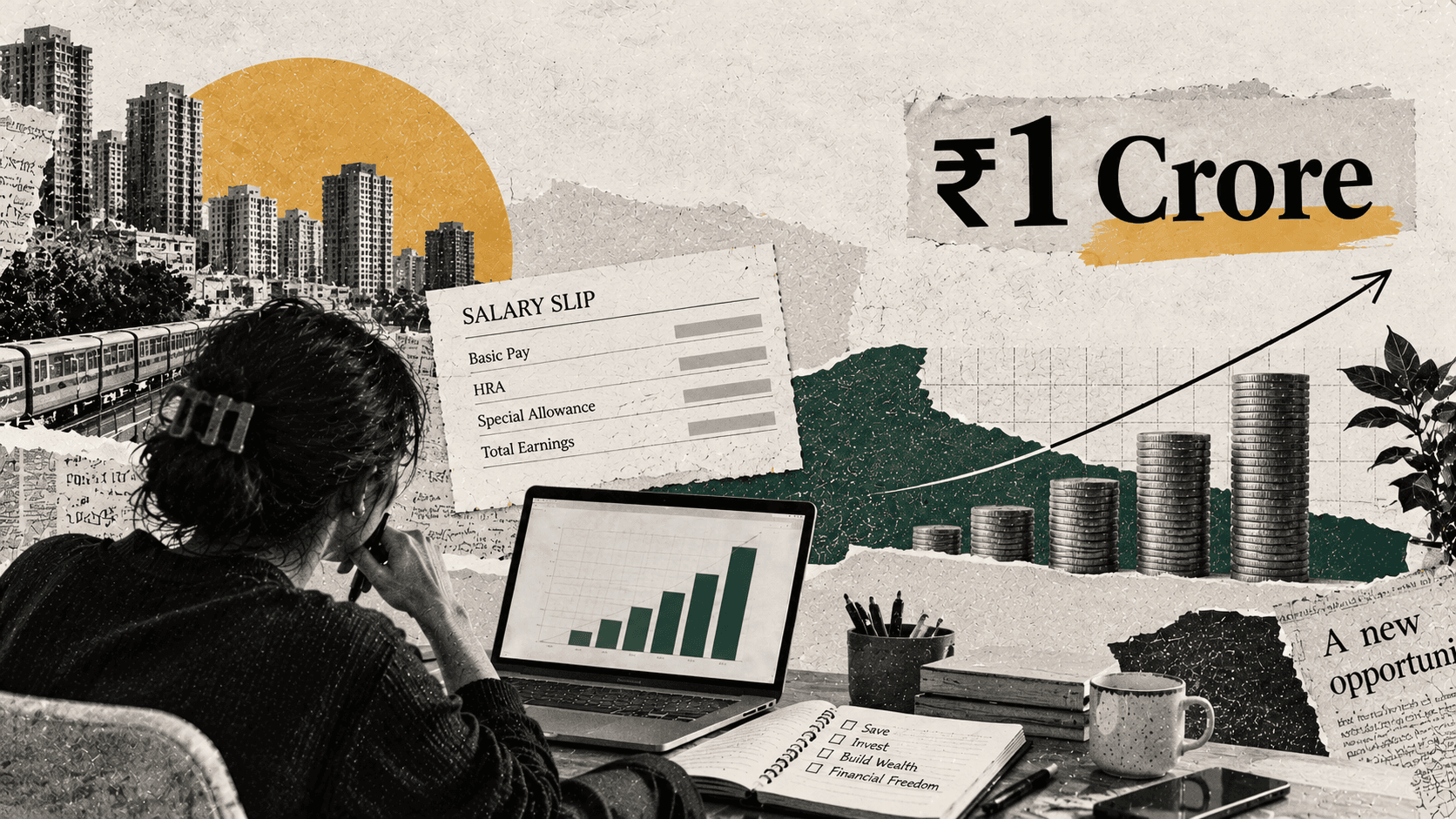
Your first salary is more than a monthly income; it is an opportunity to build lasting financial habits. Discover how a young professional could manage expenses, create an emergency fund, start investing through SIPs and work towards a ₹1 crore corpus over time.
Receiving your first salary is a milestone that feels different from any other payday.
For the first time, you may have money that you can call your own. You can contribute to household expenses, buy something you have wanted for a while, save for a trip or enjoy the independence that comes with earning.
But your first salary also presents a financial decision: what should you do with the money you earn?
It is tempting to focus entirely on spending during the first few months of working. After all, you have earned the freedom to make your own financial choices. At the same time, beginning to save and invest early could help you work towards larger goals over the years.
You do not need to earn a six-figure monthly salary to start building wealth. You need to understand your expenses, set aside money for financial security and invest an amount that fits your circumstances.
Consider a young professional who begins investing ₹5,000 a month after receiving their first salary. As their income grows, they gradually increase their contributions. Over time, they could build a substantial investment portfolio, depending on how much they contribute and the returns their investments actually earn.
The journey from a first salary to ₹1 crore will not look the same for everyone. Someone earning ₹30,000 a month will have a different starting point from someone earning ₹80,000. Family responsibilities, rent, debt and career growth also influence how much a person can invest.
The objective is not to invest the maximum amount from your very first salary. It is to establish financial habits that you can maintain as your income and responsibilities change.
This guide explains how a young professional could get started, organise their first salary, understand SIPs, calculate the investment required for a ₹1 crore goal and build a financial plan that can evolve with their career.
All investment projections in this article are illustrative calculations, not guaranteed outcomes. Mutual fund investments are subject to market risks.
1. Your First Salary Is the Beginning of Your Financial Journey
When you receive your first salary, you may have several competing priorities.
You might need to pay rent, commute to work, purchase professional clothing, contribute towards household expenses or repay an education loan. You may also want to enjoy your new financial independence.
These expenses are normal. Building wealth does not require you to eliminate every enjoyable purchase or save nearly all your income.
The first step is to understand how much money you have available after meeting your essential financial commitments.
SEBI’s investor education guidance recommends budgeting, tracking expenses, prioritising needs, maintaining an emergency fund and setting aside money for future goals.
Start by understanding your take-home salary
Suppose you receive a monthly salary of ₹40,000.
Your actual take-home pay may differ from your stated annual package because of deductions such as provident fund contributions, taxes and other employment-related deductions.
Your financial plan should be based on the amount that reaches your bank account, not simply the salary mentioned in your offer letter.
For this example, assume your monthly take-home salary is ₹40,000.
Expense Category | Illustrative Monthly Amount |
|---|---|
Rent and household contribution | ₹10,000 |
Food and groceries | ₹5,000 |
Transport | ₹3,000 |
Phone, utilities and subscriptions | ₹2,000 |
Personal spending and entertainment | ₹4,000 |
Family commitments and miscellaneous expenses | ₹4,000 |
Total Expenses | ₹28,000 |
Remaining Amount | ₹12,000 |
These figures are illustrative. Your actual expenses may be considerably higher or lower depending on where you live, whether you live with family, your commute and your responsibilities.
The remaining ₹12,000 does not automatically need to go into investments. You may still need to build an emergency fund, prepare for upcoming expenses or repay high-cost debt.
The purpose of this exercise is to identify what you can realistically save and invest.
Why your first financial habit matters
Your first salary may not be large enough to transform your financial position immediately. However, the way you manage it can establish habits that become increasingly important as your earnings grow.
If you learn to budget, save regularly and avoid unnecessary debt early in your career, you can use future salary increases to strengthen your financial position rather than allowing every increase in income to disappear into higher spending.
2. How Should You Divide Your First Salary?
There is no universal percentage that every young professional should save or invest.
A person living with their parents may have fewer fixed expenses than someone renting an apartment in a metropolitan city. Someone supporting their family may have less flexibility than someone whose income covers only their own needs.
Instead of following a rigid rule, create a budget that reflects your circumstances.
A practical starting framework
You can begin by dividing your take-home salary into four broad categories:
1. Essential expenses
These include housing, food, transport, utilities and necessary household contributions.
2. Financial security
This includes emergency savings, insurance needs and money set aside for upcoming expenses.
3. Investments
This is the amount you can commit towards long-term goals without compromising essential expenses or financial stability.
4. Lifestyle spending
This covers discretionary purchases, entertainment, hobbies, travel and other personal preferences.
The percentages assigned to these categories can change as your circumstances evolve.
For example, someone who has not yet built an emergency fund may temporarily direct more money towards savings. Once that reserve is established, they may be able to increase their monthly investment.
Similarly, if your salary increases, you could allocate part of the increase towards investments while retaining some money for lifestyle improvements.
A sustainable financial plan should leave room for both your future goals and your present life.
3. Build Financial Security Before Investing Aggressively
Before directing a large portion of your first salary towards long-term investments, establish a financial foundation.
A portfolio intended for a goal 15 or 20 years away may fluctuate in value. If an unexpected expense forces you to sell investments during a market downturn, you may realise a loss or disrupt your long-term plan.
Financial security can help reduce the likelihood of this happening.
Create an emergency fund
An emergency fund is money reserved for unexpected expenses, such as medical bills, urgent travel, repairs or a temporary loss of income.
The appropriate amount depends on your employment stability, essential expenses, family responsibilities and available support.
For illustration, someone whose essential expenses are ₹20,000 a month might initially aim to build a reserve covering several months of those expenses. The eventual amount should reflect their personal circumstances.
You do not need to accumulate the entire reserve before developing any investment habit. Depending on your situation, you may be able to begin a small, affordable SIP while building emergency savings.
However, do not invest money in volatile assets if you may need it immediately.
Review your insurance needs
Understand what health insurance coverage you have through your employer, whether it is sufficient for your needs and whether additional cover may be appropriate.
Employer-provided insurance may not continue on the same terms if you change jobs.
Life insurance may also be relevant if someone depends financially on you. Your requirements will depend on your circumstances and existing coverage.
Be careful with debt
Your first salary can make credit cards, personal loans and buy-now-pay-later facilities appear more manageable than they really are.
Before borrowing, understand the interest rate, fees, repayment obligations and consequences of missing payments.
High-cost debt can interfere with your ability to save and invest. Include repayments in your budget and avoid taking on unnecessary debt to maintain a lifestyle that your current income cannot comfortably support.
SEBI’s financial education resources discuss emergency funds, insurance, debt management and responsible financial planning as important parts of managing money.
4. Start Investing With an Amount You Can Maintain
Once you understand your budget and have a plan for financial security, you can decide how much to invest each month.
For a beginner, the most important question is not whether ₹5,000 or ₹10,000 is the perfect amount.
It is whether you can invest regularly without compromising your essential needs.
What could different starting amounts look like?
Consider three hypothetical young professionals.
Investor | Monthly Take-Home Salary | Initial Monthly Investment | Share of Take-Home Salary |
|---|---|---|---|
A | ₹25,000 | ₹2,000 | 8% |
B | ₹40,000 | ₹5,000 | 12.5% |
C | ₹60,000 | ₹10,000 | 16.7% |
These are examples, not recommended minimums or targets.
Investor A may have family responsibilities or high living expenses. Investor C may have fewer fixed commitments and more money available to invest.
The right amount is the one that fits the investor’s financial situation.
What is a Systematic Investment Plan?
A Systematic Investment Plan, or SIP, is a method of investing a fixed amount in a mutual fund scheme at regular intervals.
Instead of investing a large amount at once, an investor can contribute monthly, for example, through a standing instruction linked to their bank account.
A SIP is a way to make investments regularly. It does not guarantee a particular return or protect an investor from market losses.
AMFI explains how SIPs support regular investing and describes their role in helping investors develop a disciplined investment habit. It also makes clear that rupee-cost averaging does not guarantee profits or eliminate investment risk.
Why beginners may find SIPs useful
A SIP can help you:
Establish a regular investment routine.
Invest smaller amounts instead of waiting to accumulate a large lump sum.
Align investment contributions with monthly salary payments.
Build a habit of investing before spending all your income.
Work towards long-term financial goals through consistent contributions.
The amount you invest should remain affordable. If your financial circumstances change, review the contribution instead of continuing with an amount that puts pressure on your budget.
You can use the Kuberzo SIP Calculator to explore how different monthly investments and time horizons could affect your target corpus.
5. How Much Would You Need to Invest to Reach ₹1 Crore?
Once you have started investing, you may want to understand how long it could take to accumulate ₹1 crore.
The answer depends on three major variables:
How much you invest each month.
How long you remain invested.
The returns your investments actually earn.
To understand the relationship, consider a hypothetical young professional who starts with no existing investment corpus and makes equal monthly contributions.
Monthly SIP required to accumulate ₹1 crore
The following table estimates the monthly investment needed to reach ₹1 crore over different periods.
Investment Period | Approximate Target Age if Starting at 22 | At 8% Effective Annual Return | At 10% Effective Annual Return | At 12% Effective Annual Return |
|---|---|---|---|---|
10 years | 32 | ₹55,517 | ₹50,034 | ₹45,059 |
15 years | 37 | ₹29,620 | ₹25,098 | ₹21,211 |
20 years | 42 | ₹17,575 | ₹13,923 | ₹10,974 |
25 years | 47 | ₹11,001 | ₹8,108 | ₹5,930 |
30 years | 52 | ₹7,099 | ₹4,848 | ₹3,277 |
Figures are approximate calculations based on equal end-of-month contributions, no initial corpus and an effective annual return converted into an equivalent monthly rate. Actual returns may be higher or lower, and the target is not guaranteed.
What can a young professional learn from this table?
The longer your investment horizon, the lower the monthly contribution required under the same return assumption.
For example, under the illustrative 10% return scenario, reaching ₹1 crore in 10 years would require approximately ₹50,034 per month.
Extending the period to 20 years reduces the estimated monthly contribution to approximately ₹13,923.
This illustrates why starting early can be valuable. It gives you more time to contribute and allows potential investment growth to accumulate over a longer period.
However, a longer investment period does not eliminate risk. The final value will depend on the actual path of returns and the amounts contributed.
It is also important to distinguish between reaching a nominal target of ₹1 crore and having ₹1 crore of purchasing power today. Inflation can significantly reduce the future purchasing power of a fixed amount.
You can experiment with different investment amounts and time horizons using the Kuberzo SIP Calculator.
6. What If You Can Only Invest ₹5,000 From Your First Salary?
A common concern among first-time investors is that a modest monthly contribution will not make a meaningful difference.
The reality is that a smaller contribution can be a useful starting point, even if it is not enough to reach your ultimate target within your preferred timeline.
Suppose you begin investing ₹5,000 every month.
Your total contributions would be:
Investment Period | Total Amount Contributed |
|---|---|
5 years | ₹3 lakh |
10 years | ₹6 lakh |
15 years | ₹9 lakh |
20 years | ₹12 lakh |
25 years | ₹15 lakh |
These figures represent your contributions only. They do not include any investment gains or losses.
The eventual portfolio value will depend on the returns earned, costs and taxes.
A ₹5,000 monthly SIP may not be sufficient to reach ₹1 crore within a short period. However, it can help you begin developing an investment habit while your income and savings capacity are still growing.
The next step is to review the contribution as your career develops.
Do not confuse your starting amount with your long-term capacity
Your first salary may be ₹25,000 or ₹35,000 a month. Five years later, your income may be higher—or your financial responsibilities may have increased.
You cannot predict every change in advance. What you can do is review your budget periodically and decide whether your investment amount can increase.
The goal is to build a plan that adapts to your circumstances rather than forcing you to follow a contribution that no longer makes sense.
7. Use Salary Increases to Build Wealth Faster
For many young professionals, the first salary is only the beginning of their earning journey.
Promotions, job changes, additional qualifications and career development may increase their income over time.
One practical strategy is to increase your investment contribution whenever your financial circumstances permit.
This approach is often called a step-up SIP when the regular mutual fund contribution is increased periodically.
An example of a step-up investment plan
Suppose you begin investing ₹5,000 per month.
After a year, you increase the amount by 10%, provided your income and expenses allow it.
Year | Monthly SIP at the Start of the Year |
|---|---|
Year 1 | ₹5,000 |
Year 2 | ₹5,500 |
Year 3 | ₹6,050 |
Year 4 | ₹6,655 |
Year 5 | ₹7,321 |
Year 6 | ₹8,053 |
Year 7 | ₹8,858 |
Year 8 | ₹9,744 |
Year 9 | ₹10,718 |
Year 10 | ₹11,790 |
Amounts are rounded and illustrate a 10% annual increase in the monthly contribution.
A step-up approach can help you increase the amount invested as your earnings grow.
However, the example assumes that you can afford each increase. If you face higher living expenses, a period of unemployment or other financial commitments, you may need to adjust the plan.
A step-up SIP does not guarantee that you will accumulate ₹1 crore. It simply changes the contribution pattern.
Use the Kuberzo Step-Up SIP Calculator to explore how regular increases could affect your investment goal.
8. Where Should You Invest Your First Salary?
Once you are ready to invest, the next question is where your money should go.
There is no single investment product that suits every beginner. The appropriate choice depends on your goals, time horizon, financial responsibilities, risk tolerance and need for access to your money.
Before choosing an investment, understand how it works, what risks it carries, what it costs and when you may need the money.
SEBI recommends considering investment objectives, time horizon, risk appetite, liquidity, diversification and tax implications before making investment decisions.
Equity mutual funds
Equity mutual funds invest primarily in shares and can provide exposure to the long-term growth potential of businesses.
They also carry market risk. Their value can fluctuate significantly, and investors may lose money.
A young professional considering equity funds should understand the scheme’s objective, investment strategy, risk level and suitability for their intended time horizon.
Explore the Kuberzo Equity Fund category to learn more.
Debt mutual funds
Debt mutual funds invest primarily in fixed-income securities.
Depending on the scheme, risks may include interest-rate risk, credit risk and liquidity risk. Debt mutual funds are not the same as guaranteed deposits, and their returns are not assured.
They may have a role in a broader financial plan depending on the investor’s goals and risk tolerance.
Explore the Kuberzo Debt Fund category for more information.
Hybrid mutual funds
Hybrid mutual funds invest across more than one asset class, commonly equity and debt.
Their allocation and risk profile vary by scheme. A hybrid fund is not automatically suitable for every investor who wants a balance between growth and stability.
Explore the Kuberzo Hybrid Fund category to understand this category.
What should a beginner look for?
Before investing, consider the following:
Does the investment align with your goal?
How long can you remain invested?
Can you tolerate fluctuations or possible losses?
Do you understand the scheme’s investment strategy?
What costs and taxes may apply?
Do you have enough accessible savings for near-term expenses?
Do not choose a mutual fund solely because it has recently delivered high returns or because it is popular on social media.
AMFI cautions that mutual funds are not guaranteed-return products and that past performance does not guarantee future results.
9. Common First-Salary Investing Mistakes to Avoid
Your first few years of earning can shape your long-term financial habits. Avoiding a few common mistakes can help you build a more sustainable plan.
Mistake 1: Spending first and saving whatever remains
If you wait until the end of the month to decide whether to save, you may find that little money remains.
Once you understand your budget, consider setting aside your planned savings and investment contributions soon after receiving your salary.
Make sure you still retain enough money for essential expenses and upcoming obligations.
Mistake 2: Investing without an emergency reserve
Putting all your available money into long-term investments can leave you vulnerable to unexpected expenses.
Build an emergency reserve appropriate to your circumstances and keep money needed in the near term accessible.
Mistake 3: Chasing quick returns
The desire to reach ₹1 crore quickly can make speculative investments and unrealistic promises seem attractive.
Be cautious of anyone promising unusually high or guaranteed returns without meaningful risk. Understand the investment before committing your money, and use regulated financial products and authorised intermediaries.
Mistake 4: Copying someone else’s portfolio
A friend may invest heavily in equity funds because they have a high risk tolerance and a long investment horizon.
That does not mean the same approach is appropriate for you.
Your investment choices should reflect your own financial position, goals and ability to tolerate losses.
Mistake 5: Ignoring inflation
₹1 crore accumulated decades from now will not have the same purchasing power as ₹1 crore today.
Review the future cost of your financial goals rather than assuming that a fixed target will remain sufficient forever.
Use the Kuberzo Inflation Calculator to explore how different inflation assumptions could affect your goals.
Mistake 6: Stopping investments whenever markets fall
Market declines can be uncomfortable, especially when you are new to investing.
However, automatically stopping an investment whenever markets fall can disrupt a long-term plan.
Instead, understand why the portfolio is declining, whether the investment remains suitable and whether your financial circumstances have changed. Do not continue investing blindly if the product or risk level is no longer appropriate for you.
Mistake 7: Never reviewing the plan
Your salary, expenses and responsibilities will change.
Review your financial plan periodically, especially after significant changes in income, employment, family circumstances or goals.
The purpose is to ensure that your plan continues to fit your life—not to react to every short-term market movement.
10. A Practical First-Salary-to-₹1-Crore Roadmap
You do not need to make every financial decision perfectly from the beginning.
A simple sequence can help you get started.
Step 1: Understand your take-home salary
Calculate the amount you receive after deductions and list your essential monthly expenses.
Step 2: Create a realistic budget
Separate essential expenses, financial commitments, emergency savings, investments and discretionary spending.
Step 3: Build financial security
Start setting aside money for emergencies and review your insurance needs. Address expensive debt where appropriate.
Step 4: Start with an affordable investment
Choose a monthly amount that fits your budget and does not compromise essential needs.
Step 5: Set a clear target and timeline
Decide whether you want to reach ₹1 crore in 10, 15, 20 or more years.
Calculate the contribution required under several return assumptions instead of relying on a single optimistic projection.
Step 6: Increase your contribution when possible
As your income grows, review whether you can increase your monthly investment.
Step 7: Review the plan periodically
Check your progress, account for inflation and reassess your investment choices when your circumstances change.
A useful financial plan is not one that assumes everything will go perfectly. It is one that can be adjusted when life changes.
Key Takeaway
Your first salary may not make you wealthy, but it gives you an opportunity to start building financial habits that can support your future.
Begin by understanding your take-home pay, managing expenses, establishing financial security and investing an amount you can maintain. As your income grows, consider increasing your monthly contributions and reviewing your financial goals.
Under an illustrative effective annual return assumption of 10%, someone starting from zero would need to invest approximately ₹13,923 per month for 20 years to accumulate ₹1 crore. A longer timeline would require a lower monthly contribution under the same assumption, while a shorter timeline would require more.
These are mathematical projections, not guaranteed results. Actual returns can differ significantly, and inflation will affect the future purchasing power of the corpus.
You do not have to start with a large salary. You have to start with a plan that makes sense for your current financial situation—and keep adapting it as your life changes.
Disclaimer
This article is for educational and informational purposes only and does not constitute investment advice. All investment projections are illustrative and do not guarantee future results. Mutual fund investments are subject to market risks, and investors should read all scheme-related documents carefully. Actual returns, expenses, taxes and inflation may materially affect investment outcomes. Consider consulting a SEBI-registered investment adviser before making investment decisions suited to your circumstances.
Frequently Asked Questions
1. What should I do with my first salary?
Start by understanding your take-home pay and monthly expenses. Set aside money for essential needs, build an emergency reserve, review your insurance requirements and manage debt responsibly. Once you understand your financial position, decide how much you can invest towards longer-term goals.
2. How much of my first salary should I invest?
There is no universal percentage that suits everyone. Your investment amount depends on your take-home salary, essential expenses, family responsibilities, debt and savings. Begin with an affordable contribution and review it as your financial circumstances change.
3. Can I start investing with ₹5,000 per month?
Yes, if that amount fits your budget and financial priorities. A ₹5,000 monthly contribution can help you develop a regular investment habit. Whether it can help you reach ₹1 crore depends on the investment period, the contributions you make over time and the returns you earn.
4. How much should I invest monthly to reach ₹1 crore?
Under an illustrative effective annual return assumption of 10%, an investor starting from zero would need approximately ₹50,034 per month for 10 years, ₹25,098 per month for 15 years or ₹13,923 per month for 20 years. Actual investment returns are not guaranteed, so these amounts should be treated as planning estimates.
5. Is SIP a good way to start investing?
A Systematic Investment Plan allows you to invest a fixed amount in a mutual fund at regular intervals. It can help develop investing discipline and spread contributions over time. However, a SIP does not guarantee profits or protect you from market losses. The underlying investment must be suitable for your goals and risk tolerance.
6. Should I build an emergency fund before starting a SIP?
You should plan for emergencies before committing too much money to long-term investments. Depending on your circumstances, you may be able to start a small SIP while building an emergency reserve. Ensure that you have a plan for essential expenses and unexpected costs.
7. Should I invest my entire first salary?
Generally, your entire salary will be needed for some combination of essential expenses, savings, financial commitments and discretionary spending. Investing all your available money without considering emergency needs or upcoming expenses may create financial pressure. Decide on an amount that fits your budget.
8. Should I invest in equity mutual funds from my first salary?
Equity mutual funds may be appropriate for some long-term goals, but they carry market risk and can lose value. Consider your investment horizon, risk tolerance, financial security and the specific scheme’s characteristics before investing. There is no single fund category that is right for every beginner.
9. How can I increase my investments as my salary grows?
Review your budget whenever your income increases. If your essential expenses and financial commitments remain manageable, consider directing part of the additional income towards savings and investments. A step-up SIP is one way to increase regular contributions over time.




