ETF vs Index Fund: What's the Difference and Which to Choose?
By Rajnish
About the Author
An MBA student with an interest in finance and wealth management, contributing insights on mutual funds, investment strategies, market trends, and financial planning to help readers make informed investment decisions.
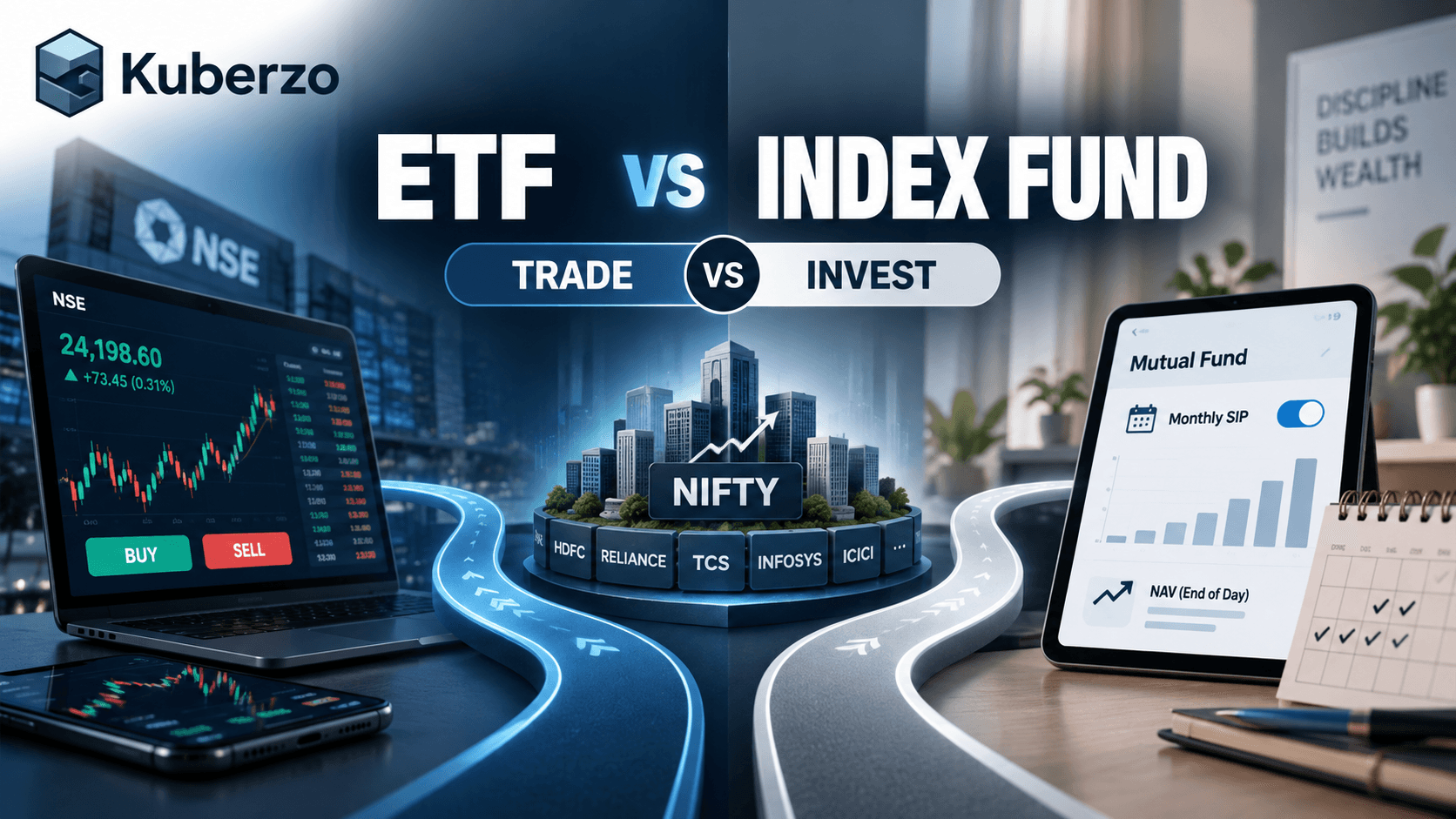
ETF vs index fund explained simply. Compare costs, NAV, liquidity, SIP investing, demat requirements, tracking error and suitability for Indian investors.
ETF vs Index Fund: What's the Difference and Which to Choose?
ETF and index fund are often placed next to each other because both can provide passive exposure to a market index such as the Nifty 50.
That creates a common question:
"If both follow the same index, why does it matter whether I choose an ETF or an index fund?"
It matters because the two products can differ significantly in how you buy them, how they are priced, how they trade, what costs you incur and how convenient they are for your investment style.
SEBI defines index mutual funds as passive funds that aim to replicate a specific index. ETFs also commonly track indexes, but they are listed and traded on stock exchanges.
What is an index fund?
An index fund is a mutual fund designed to replicate the performance of a particular index.
For example, an index fund may track the Nifty 50 by holding the index's constituents or otherwise replicating its exposure.
The fund is not primarily trying to identify the next winning stock.
Its objective is to track the benchmark as closely as reasonably possible.
That makes index funds a form of passive investing. AMFI describes passive funds as funds where investment holdings mirror and closely track a benchmark, including index funds and ETFs.
What is an ETF?
ETF stands for Exchange Traded Fund.
An ETF is a fund whose units are listed and traded on a stock exchange, similar to a share.
The important distinction is therefore not simply what the ETF invests in. It is also how the units are traded.
An ETF can track an index, but ETFs can also provide exposure to other asset classes or strategies. SEBI and AMFI both describe ETFs as exchange-traded investment vehicles, while AMFI notes that ETFs can track indices, commodities, bonds or baskets of assets.
ETF vs index fund: the key difference
Feature | ETF | Index Fund |
|---|---|---|
Structure | Exchange-traded fund | Mutual fund |
Buying/selling | Through stock exchange | Through mutual fund mechanism |
Price | Market price during trading | Applicable NAV |
Intraday trading | Yes | No |
Demat requirement | Generally required for exchange-traded units | Usually not required |
SIP convenience | Depends on broker/platform and process | Generally straightforward |
Liquidity | Depends on exchange trading volume | Based on mutual fund redemption mechanism |
Brokerage | May apply | No exchange brokerage for normal mutual fund purchase |
Passive strategy | Often, but not always | Yes, for an index fund |
NSE explains that ETFs trade like stocks throughout the trading day, whereas traditional mutual fund transactions occur at the applicable NAV.
Why does ETF price differ from NAV?
This is one of the most important differences for a beginner.
A mutual fund transaction occurs at the applicable NAV.
An ETF, however, has a market price because buyers and sellers trade its units on an exchange during market hours.
This means an ETF's market price can trade slightly above or below its underlying NAV at a particular moment.
That distinction is important because an investor buying an ETF is not simply entering an order at the fund's end-of-day NAV.
NSE highlights the difference between exchange trading and traditional mutual fund transactions and notes that ETF prices can move during the trading day.
Which is easier for a beginner?
For many beginners, index funds are operationally simpler.
You choose the mutual fund, enter the investment amount and receive units based on the applicable NAV.
With an ETF, you need to think like an exchange participant:
Is the market open?
What price is the ETF trading at?
Is the bid-ask spread reasonable?
Is trading volume sufficient?
What brokerage or other trading costs apply?
SEBI's ETF guidance specifically notes that ETFs may involve brokerage fees and, where applicable, demat-related charges.
This does not make ETFs bad. It simply means that lower fund expenses do not necessarily mean lower total investor friction.
Which is cheaper: ETF or index fund?
There is no universal answer based only on the label.
ETFs often have low fund-level costs, and NSE notes that ETF fees can be lower than those of traditional mutual funds and index funds.
But the investor's actual cost can include other factors such as brokerage and the bid-ask spread.
For a long-term investor making regular purchases, these practical transaction costs can matter.
Therefore, compare:
Expense ratio + brokerage + bid-ask spread + other applicable charges
rather than comparing expense ratios alone.
What is tracking error?
Tracking error measures how closely a fund follows its benchmark.
SEBI defines tracking error as a measure of the difference between portfolio returns and benchmark returns.
For example, suppose an index generates a 12% return over a particular period while an index fund generates 11.6%.
The 0.4 percentage-point difference is a simple example of tracking difference.
Tracking error is a statistical measure of the variability of those differences over time.
Tracking differences can occur because of:
Fund expenses
Cash balances
Corporate actions
Rebalancing
Trading costs
Delays in buying or selling securities
Market frictions
SEBI documentation explicitly identifies expenses, cash balances, index changes and trading-related factors among the causes of tracking differences.
Does a low tracking error make a fund better?
It is an important measure, but not the only one.
An investor should also consider:
Expense ratio
Tracking difference
Fund size
Liquidity, for ETFs
Investment convenience
Portfolio replication method
Reliability of the fund provider
Investment horizon
For an ETF, liquidity becomes particularly important because the investor buys and sells in the secondary market.
What if an ETF has low trading volume?
This is a practical concern that many articles overlook.
A low-volume ETF can have a wider difference between the price buyers are willing to pay and the price sellers are asking.
That difference is the bid-ask spread.
Suppose an ETF's units are quoted at:
Bid: ₹100.00
Ask: ₹100.50
An investor buying immediately may pay ₹100.50 rather than ₹100.
That 50-paise difference is a transaction friction.
Therefore, investors should not judge an ETF only by its expense ratio.
Which is better for SIP investing?
For a conventional monthly SIP, an index mutual fund is often operationally simpler because the fund purchase is processed through the mutual fund framework.
ETFs can also be used for systematic investment, but the investor is purchasing units on the exchange. The process therefore depends more on the broker/platform and the investor's execution approach.
For investors who value simplicity and automation, the index-fund format may be easier to maintain consistently.
For investors comfortable with exchange trading, ETFs can offer more control over execution.
Kuberzo's SIP Calculator can help you model how a regular investment amount may grow under different assumed return rates and periods.
ETF or index fund: which should you choose?
Consider an index fund when:
You want simple long-term investing.
You prefer the mutual fund investment process.
You want an easy SIP setup.
You do not want to monitor exchange prices.
You are relatively new to investing.
Consider an ETF when:
You are comfortable with exchange-based investing.
You have a demat account.
You want intraday tradability.
You understand bid-ask spreads.
You are comfortable checking liquidity and execution prices.
This is not a statement that ETFs are only for experienced investors. A beginner can use an ETF successfully. The point is that the ETF format creates additional operational considerations.
Illustrative example: the same Nifty exposure
Imagine two investors want exposure to the same Nifty 50 index.
Investor A buys an index fund.
Investor B buys a Nifty 50 ETF.
Both are trying to capture the performance of the same broad equity market benchmark.
But their experience is different:
Investor A invests ₹10,000 through a mutual fund transaction.
Investor B places an exchange order and obtains ETF units at the prevailing market price.
Over several years, both investments can move broadly in line with the same index, but their realised investor experience can differ because of expenses, tracking difference, trading spreads and execution.
That is why the underlying index alone does not tell you which format is better for you.
What about tax?
For taxation, do not assume that "ETF" automatically means one tax treatment and "index fund" another.
The tax outcome depends on the nature of the underlying investment and the applicable tax rules.
For equity-oriented funds and specified listed securities, the Income Tax Department currently lists a 20% rate for specified short-term capital gains under Section 111A, where the relevant conditions apply. It also states that long-term capital gains under Section 112A above ₹1.25 lakh are taxed at 12.5% for transfers on or after 23 July 2024, subject to applicable conditions.
Before investing, investors should check the current tax classification of the specific ETF or index fund rather than relying on the product label.
A simple decision framework
Ask four questions:
1. Do I want simplicity?
Choose the structure that makes disciplined investing easier.
2. Do I understand exchange trading?
If not, an index fund may be operationally simpler.
3. How important are transaction costs?
An ETF's expense ratio is only part of the cost.
4. Will I actually stay invested?
A theoretically cheaper product is not necessarily better if its complexity causes poor behaviour.
Final answer: ETF or index fund?
Choose an index fund when simplicity, automated investing and ease of use matter most. Choose an ETF when you value exchange-based trading, intraday pricing and potentially low fund costs and are comfortable managing the additional trading considerations.
The best choice is not the one with the lowest advertised expense ratio.
It is the one that provides suitable market exposure at a reasonable total cost and that you can use consistently.
Investors who want to compare their broader mutual fund holdings can also use Kuberzo's Mutual Fund Portfolio Review to examine allocation, fund overlap and portfolio structure.
Risk disclosure: ETFs and mutual funds are market-linked investments. Their value can rise or fall. Tracking an index does not eliminate market risk. Past performance does not guarantee future results. This article is for general educational purposes and is not personalised investment advice.
Frequently Asked Questions
Is an ETF the same as an index fund?
No. Both can be passive and track an index, but an ETF trades on a stock exchange while an index fund operates as a mutual fund.
Which is better for SIP: ETF or index fund?
An index fund is generally simpler for a conventional recurring SIP because purchases occur through the mutual fund mechanism. ETFs require exchange-based transactions.
Does an ETF have NAV?
Yes. An ETF has an NAV, but its units also trade at a market price on the exchange. Therefore, the purchase or sale price can differ from NAV at a particular point in time.
What is tracking error in an ETF?
Tracking error measures how much a portfolio's returns vary relative to the benchmark it aims to track.
Do ETFs require a demat account?
ETF units are generally held in demat form in India. AMFI explicitly states this for ETFs.