
Emergency Funds and Mutual Funds: Using Liquid Funds for Security
By Saahil Madhogaria
About the Author
Saahil Madhogaria is an MBA student at SOIL Institute of Management with a background in Game Art & Animation and experience as a 3D Artist. He writes about marketing, business, personal finance, careers, and MBA life.
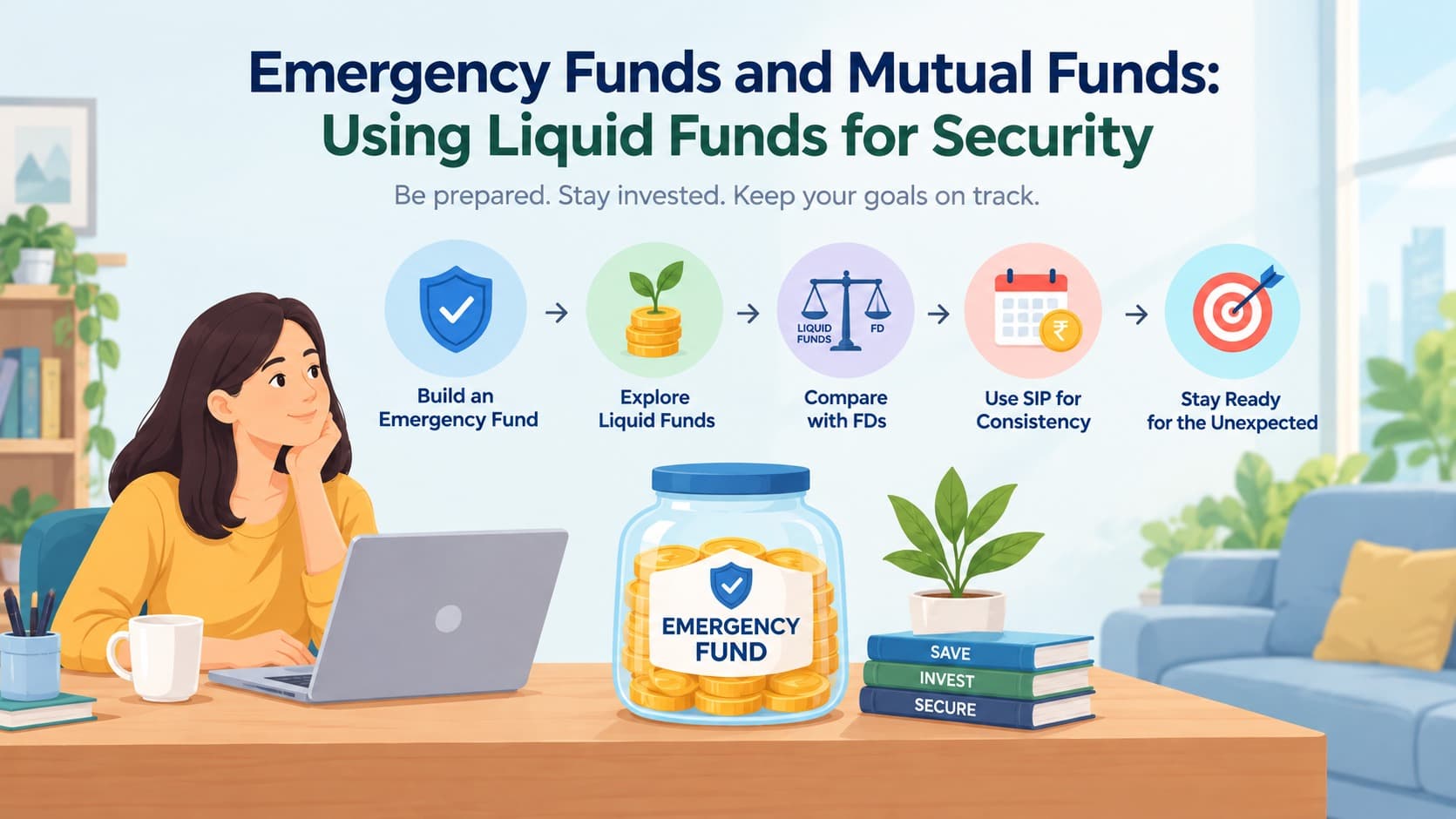
An emergency fund protects you from sudden expenses like medical bills or job loss without having to take loans. You can keep an immediate portion in a savings account and place another part in low-risk liquid mutual funds for short-term security.
Emergency Funds and Mutual Funds: Using Liquid Funds for Security
An emergency can arrive without warning.
A sudden job loss, medical expense, major repair or unexpected family responsibility can put pressure on your finances. Without an emergency fund, you may have to depend on credit cards, loans or sell long-term investments at an inconvenient time.
That is why an emergency fund should be one of the first building blocks of a financial plan.
For some investors, keeping the entire emergency fund in a savings account may be sufficient. Others may consider products such as liquid mutual funds for a portion of their emergency reserves.
But are liquid funds actually suitable for emergencies? How do they compare with FDs and savings accounts?
Let's understand.
What Is an Emergency Fund?
An emergency fund is money kept aside specifically for unexpected expenses.
It is different from money meant for:
Holidays
Buying a car
Investments
Shopping
Long-term wealth creation
The purpose is financial security and liquidity, not maximum returns.
A common starting point is to estimate several months of essential expenses.
For example, if your essential monthly expenses are ₹50,000, an emergency reserve of ₹3 lakh would cover six months of those expenses.
The right amount depends on your income stability, family responsibilities, insurance coverage, debt and other circumstances.
Should You Keep Your Emergency Fund in a Mutual Fund?
A mutual fund can be considered for part of an emergency reserve, but it is important to understand the difference between liquidity and guaranteed availability.
Liquid funds are debt-oriented mutual fund schemes that invest in short-term money-market and debt instruments. SEBI defines liquid funds around securities with maturity of up to 91 days.
They are designed for investors looking to park money for relatively short periods.
However, a liquid fund is still a mutual fund investment. Its value is linked to its underlying portfolio and it is not the same as a bank deposit.
Therefore, an emergency fund can potentially be split between a readily accessible bank account and an appropriate low-risk investment, depending on the investor's circumstances.
Liquid Fund vs Savings Account
A savings account provides direct access to your money and is generally the simplest place for immediate emergency expenses.
Liquid funds provide access through redemption, but the process is different from withdrawing money from a bank account.
AMFI notes that liquid and overnight funds can generally provide redemption proceeds on the next business day. Some liquid schemes may also offer an instant-access facility subject to applicable limits and conditions.
Feature | Savings Account | Liquid Fund |
Access | Direct | Redemption required |
Value | Bank deposit | Market-linked NAV |
Deposit insurance | Eligible bank deposits covered under DICGC limits | Not a bank deposit |
Return | Savings interest | Market-linked |
Emergency suitability | High for immediate needs | Can be considered for part of reserves |
Bank deposits, including savings and fixed deposits, are covered by DICGC insurance up to ₹5 lakh per depositor per bank, subject to the applicable conditions.
Liquid Funds vs FD
A fixed deposit can offer a predetermined interest rate for its tenure, subject to the product's terms.
A liquid fund does not work like an FD. Its returns are market-linked and can vary.
The key difference is therefore not simply "which gives higher returns?"
It is:
How quickly do I need the money, how certain does the value need to be, and how much liquidity do I require?
An FD may be useful for money that does not need to be accessed immediately, while a savings account can be more suitable for the first layer of emergency cash.
A liquid fund may be considered for another portion when the investor understands the associated risks and redemption process.
How to Build an Emergency Fund With SIP
A SIP can be used as a disciplined way to build an emergency reserve.
For example, suppose your target emergency fund is ₹3 lakh.
You could set aside a fixed amount every month towards the target rather than trying to create the entire reserve at once.
If you invest ₹15,000 per month, ignoring returns for simplicity:
₹15,000 × 20 months = ₹3 lakh
This is simply a contribution example, not a return projection.
Once the target is reached, you do not necessarily need to keep increasing the emergency fund indefinitely. Instead, review the target when your essential expenses, income or family responsibilities change.
What About Overnight Funds for Emergency Needs?
Overnight funds invest in securities with a maturity of one day, while liquid funds invest in securities with maturities of up to 91 days.
Both are designed around short-term investment needs, but they are not identical products.
When considering overnight funds for emergency money, investors should still check:
Riskometer
Portfolio
Liquidity
Redemption process
Applicable expenses
Tax treatment
Whether the product fits the specific emergency requirement
SEBI requires mutual fund schemes to display a Riskometer so investors can understand the risk level of the scheme.
How Much Should You Keep in Your Emergency Fund?
There is no universal number.
A salaried employee with stable income may have different requirements from a self-employed person with irregular cash flows.
Consider:
Essential monthly expenses
Number of dependants
Existing EMIs
Insurance coverage
Job stability
Income volatility
Expected large expenses
For example, someone with ₹40,000 of essential monthly expenses might initially target ₹2–3 lakh, while someone with irregular income may choose a larger reserve.
The important point is to calculate the target based on your own expenses, rather than copying someone else's number.
Kuberzo's SIP Calculator can help investors model different monthly contribution scenarios.
Common Emergency-Fund Mistakes
1. Investing the emergency fund in high-risk assets
Equity investments can fluctuate significantly and may not be suitable for money you could need immediately.
2. Keeping everything locked away
An emergency fund needs liquidity.
3. Treating liquid funds as risk-free
Liquid funds are lower-duration debt funds, but they are still mutual funds and do not offer a bank-deposit guarantee.
4. Forgetting to replenish the fund
If you use ₹1 lakh from your emergency reserve, rebuild it after the emergency passes.
5. Mixing emergency money with investment goals
Your emergency reserve should have a clearly defined purpose.
Kuberzo's guide to different types of mutual funds can help investors understand how equity, debt, hybrid and passive categories differ.
What Is a Goal-Based Emergency Fund?
A goal-based emergency fund starts with a specific target.
For example:
Monthly essential expenses: ₹50,000
Target: 6 months
Emergency fund: ₹3 lakh
You can then decide how much should remain immediately accessible and whether another portion should be held in an appropriate short-term investment.
The goal is not to maximise returns.
The goal is to ensure that an unexpected expense does not force you to disrupt your long-term investments.
Contact us for a more personalised guidance.
Key Takeaway
An emergency fund is primarily about liquidity, stability and financial resilience.
A savings account can provide immediate access for the first layer of emergency cash. Liquid funds and overnight funds may be considered for suitable portions of short-term reserves, but they are mutual fund investments and are not the same as insured bank deposits.
Instead of searching for the “best liquid funds for emergency”, start with three questions:
How much do I need? → How quickly might I need it? → Where can I keep it appropriately accessible?
Once your emergency fund is in place, your long-term investments can be given more time to work towards your other financial goals.
Mutual fund investments are subject to market risks. Read all scheme-related documents carefully before investing.
Frequently Asked Questions
Is a liquid fund good for an emergency fund?
It can be considered for an appropriate portion of an emergency reserve, but it is not a bank deposit and does not provide the same deposit-insurance framework as an eligible bank account.
Liquid fund vs savings account: which is better for emergencies?
A savings account provides direct access, making it useful for immediate expenses. A liquid fund requires redemption and is market-linked.
Liquid funds vs FD: which should I use?
They serve different purposes. An FD has a defined tenure and interest structure, while a liquid fund invests in short-term debt and money-market instruments with market-linked returns.
Can I build an emergency fund with SIP?
Yes. A SIP can provide a disciplined way to contribute towards an emergency-fund target. The investment vehicle should be selected based on liquidity and risk requirements.
Are liquid funds risk-free?
No. Liquid funds generally have lower duration and are designed for short-term parking, but they remain mutual fund investments and carry investment risks.
What are overnight funds?
Overnight funds invest in overnight securities with a maturity of one day. They are another short-duration mutual fund category that can be considered for short-term parking, subject to suitability.




