
ELSS Locking Period: How Long Is Your Money Locked In?
By Aviral Singh
About the Author
Aviral Singh is an MBA student at IIM Guwahati and a CSIR NET (JRF) qualifier with an M.Sc. from Hansraj College. A former Physics Wallah educator, he creates content on campus life and writes on finance, investments, businesses and education.
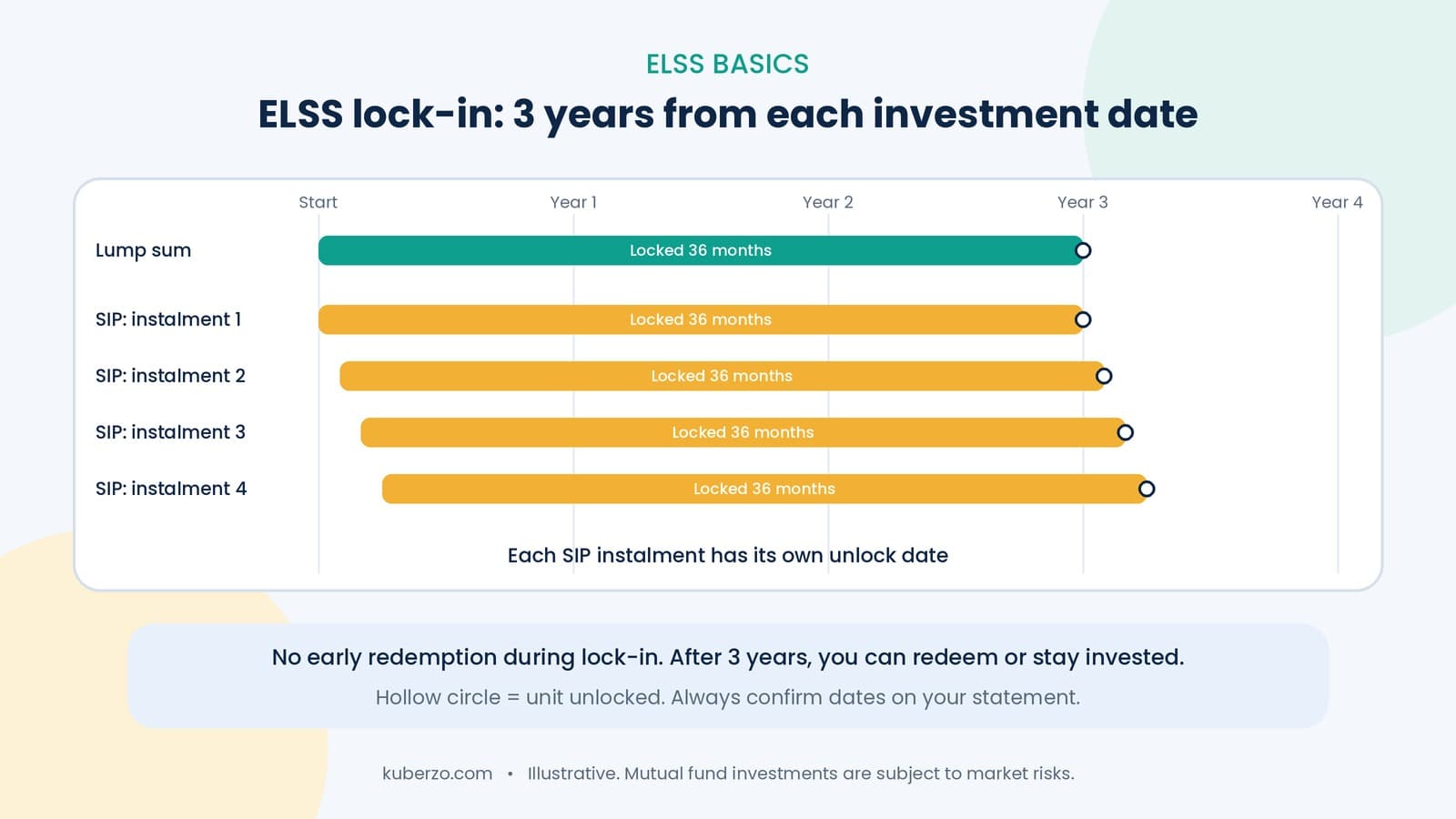
ELSS locking period explained: 3 years from each investment date, how it works for SIP vs lump sum, what happens after maturity, and how to open an ELSS account.
The direct answer: the ELSS locking period is 3 years from the date each unit is allotted. It is the shortest lock-in among major tax-saving options. You cannot redeem or switch out during this time. With a SIP, every instalment has its own 3-year lock-in, so the units unlock one instalment at a time.
What is the ELSS locking period?
ELSS (Equity Linked Savings Scheme) funds carry a statutory lock-in of 3 years. The 3 years are counted from the date of allotment of units, not from the date you first opened the fund or the start of the financial year.
During the lock-in you cannot sell the units. After 3 years, you can redeem some or all of them, or stay invested.
How does the lock-in work for SIP vs lump sum?
Mode | How the lock-in works | Example |
|---|---|---|
Lump sum | One 3-year lock-in from the allotment date | Invest in Month 0, unlocks at Month 36 |
SIP | Each instalment locked for 3 years separately | Month 0 instalment unlocks at Month 36, Month 1 instalment at Month 37, and so on |
So a 12-month SIP is not fully free after 3 years. Its last instalment unlocks 3 years after that final payment, around the end of year 4. Many investors miss this when planning withdrawals.
What is the ELSS holding period vs maturity period?
ELSS does not “mature” the way an FD does. There is no fixed maturity date. The 3-year lock-in is only the minimum holding period. After that, the fund continues as a regular open-ended equity fund, and you can hold it as long as you like.
ELSS lock-in compared with other tax-saving options
Option | Lock-in |
|---|---|
ELSS | 3 years |
Tax-saver FD | 5 years |
NSC | 5 years |
SCSS | 5 years (extendable by 3) |
PPF | 15 years (partial withdrawals allowed after a set period) |
NPS | Until retirement age, with limited exits |
Indicative. Rules for each scheme can change; verify before investing.
ELSS has the shortest lock-in, but it is an equity fund, so your capital can fall in value during or after the lock-in. For a comparison with fixed-income options, see Kuberzo’s Fixed Deposit vs Mutual Fund guide.
What is the Axis Long Term Equity Fund locking period?
Axis Long Term Equity Fund is now called Axis ELSS Tax Saver Fund. Its lock-in is the standard 3 years from the date of allotment of each unit. Its scheme document describes it as an open-ended ELSS with a statutory lock-in of 3 years. Exit load is nil, as redemption is only possible after the lock-in.
This applies to every ELSS, not just Axis. The lock-in is set by regulation, so no AMC can shorten or extend it for a given scheme.
Can I withdraw from ELSS before 3 years?
No. Redemption requests for locked units are not accepted. Units allotted earlier may be redeemed once they complete their own 3 years, while newer units stay locked. In special cases such as the death of a holder, the rules on transmission and redemption can differ, so check with the fund house.
What happens after the 3 years are over?
You have three options:
Redeem all or part of the unlocked units.
Stay invested. There is no deadline, and the fund continues to operate.
Switch to another fund, which counts as a redemption for tax purposes.
How is ELSS taxed after the lock-in?
Because units are held for over a year, gains are long-term. Long-term gains up to ₹1.25 lakh in a financial year are tax-free, and gains above that are taxed at 12.5%. The investment amount (up to ₹1.5 lakh) qualifies for a deduction only under the old tax regime.
How to open an ELSS account
You don’t open a separate “ELSS account”. You invest in an ELSS fund, and a mutual fund folio is created with your first investment.
Complete KYC. Keep your PAN, Aadhaar and bank details ready. If you’ve invested before, KYC may already be done.
Choose a platform. Options include the fund house’s own website or app, a bank app or an investing app.
Select an ELSS fund. Compare category, past performance, cost and fund house. Choose Direct if investing on your own.
Choose lump sum or SIP. Enter the amount and, for SIP, a monthly date.
Choose Growth or IDCW. Growth is generally used for long-term compounding.
Complete payment or approve the mandate. Use UPI, net banking or AutoPay.
Keep the confirmation. Your statement will show the allotment date, which fixes the lock-in end date.
To size your investment against your goals, Kuberzo’s Goal Based Planner can help. If you’re deciding between SIP and a one-time investment, Kuberzo’s SIP vs Lump Sum guide explains the trade-offs.
Common mistakes about the ELSS locking period
Mistake 1: Treating the whole SIP as unlocked after 3 years. Each instalment has its own clock.
Mistake 2: Needing the money within 3 years. There is no early exit.
Mistake 3: Investing only to save tax. ELSS is a very-high-risk equity fund, so judge it on fund quality too.
Mistake 4: Assuming the money must be withdrawn after 3 years. You can stay invested.
Mistake 5: Investing under the new tax regime. You get no deduction but keep the lock-in.
Mistake 6: Investing the whole year’s amount in March. SIPs spread across the year reduce timing risk, though remember the staggered unlock dates.
So, is the ELSS lock-in a problem?
For long-term money, usually not. The lock-in can even help, because it stops you from selling in a panic when markets fall. It is a problem only if you may need the money within 3 years, in which case ELSS is the wrong product.
Contact us for personalised guidance.
Financial disclaimer
This article is for general education and does not constitute personal investment or tax advice. ELSS returns are market-linked and not guaranteed. Tax rules, including regime-wise deductions, can change. Mutual fund investments are subject to market risks; read all scheme-related documents carefully. Consult a qualified financial or tax professional before making investment decisions.
Frequently Asked Questions
What is the locking period of ELSS?
3 years from the date of allotment of units. It applies to every ELSS fund.
Is the ELSS lock-in 3 years for SIP too?
Yes, but each SIP instalment is locked for 3 years from its own date.
Can I withdraw ELSS before 3 years?
No. Locked units cannot be redeemed or switched out until the period ends.
What is the Axis Long Term Equity Fund locking period?
3 years. The fund is now named Axis ELSS Tax Saver Fund.
Does ELSS mature after 3 years?
No. The lock-in ends, but the fund continues, and you can stay invested for as long as you want.
How do I open an ELSS account?
Complete KYC, pick an ELSS fund on a fund house or investing platform, choose lump sum or SIP, and complete payment or the auto-debit mandate.