
How a Near-Retirement Investor Could Move ₹50 Lakh Into a More Conservative Portfolio
By Divay Diya
About the Author
Divay Diya is a business and digital marketing enthusiast with expertise in market research, SEO, and strategic planning. She explores business growth, marketing, investing, and financial markets, translating research into actionable insights.
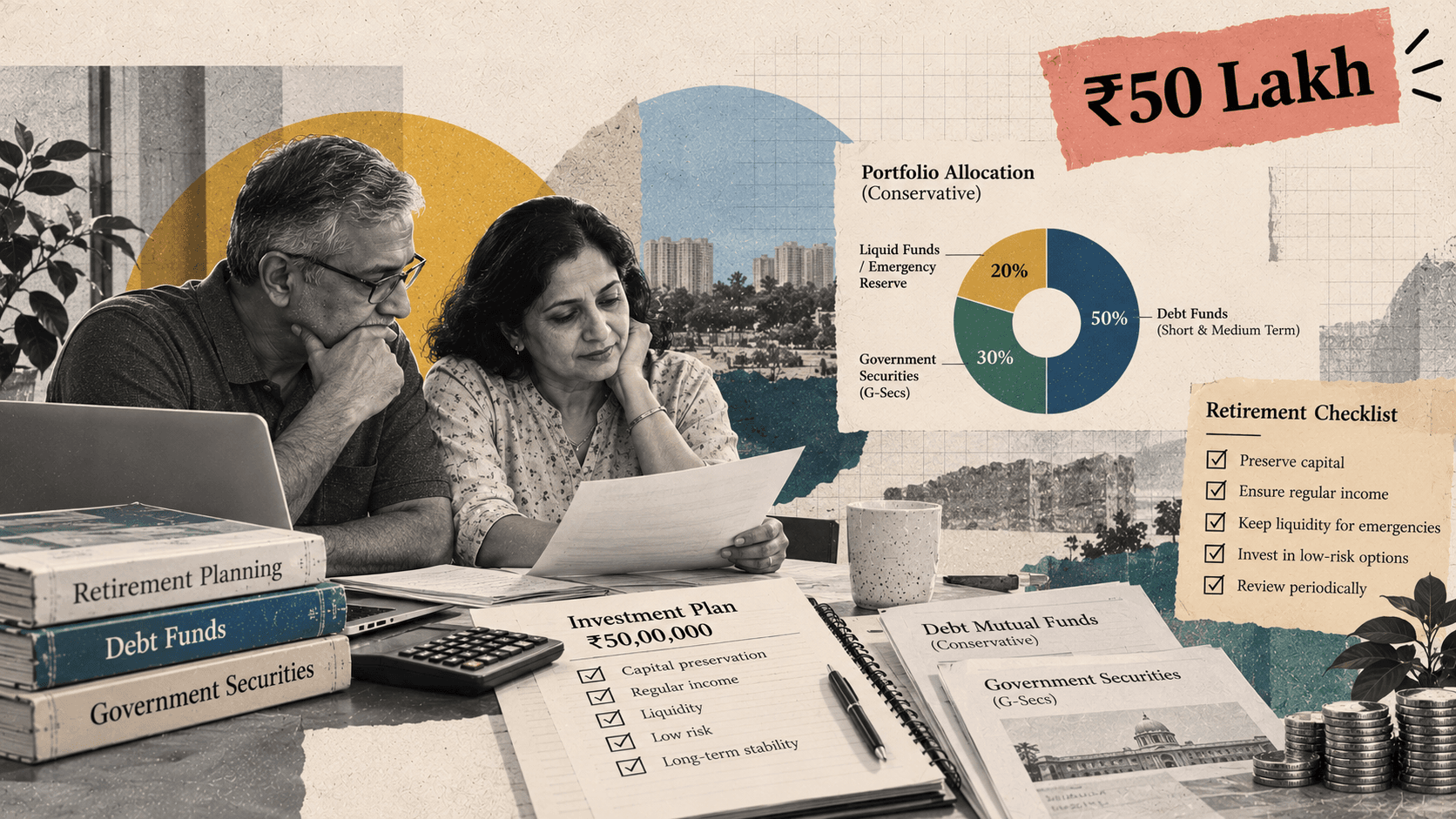
Approaching retirement changes the way you may need to invest. Explore how a hypothetical investor could reorganise a ₹50 lakh portfolio around liquidity, stability and sustainable retirement income without ignoring inflation.
Retirement changes the purpose of investing. During the early years of a career, an investor may be able to focus on growing wealth over several decades. As retirement approaches, however, the priorities often shift towards protecting accumulated savings, meeting upcoming expenses and creating a dependable source of income.
Consider Rajesh, a hypothetical 58-year-old investor with a portfolio worth ₹50 lakh. He plans to retire in two years. Most of his savings are currently invested in a mix of equity mutual funds, debt funds and bank deposits. He has built this corpus gradually, but a market downturn shortly before retirement could affect the amount available when his salary stops.
Rajesh is not necessarily looking to eliminate every investment risk. Instead, he wants to reduce the possibility that a large fall in his portfolio will disrupt his retirement plans.
His situation raises an important question: How could a near-retirement investor restructure ₹50 lakh to balance capital preservation, liquidity, regular income and the need for long-term growth?
The answer is not to move every rupee into one supposedly safe product. It is to match different portions of the portfolio to different needs, understand the risks involved and make a transition based on the investor’s personal circumstances.
Why Investment Priorities Change Before Retirement
An investor approaching retirement may have less time to recover from a significant market decline before needing to withdraw money. This makes the timing of losses particularly important.
For example, suppose an investor has ₹50 lakh invested across different assets. If the portfolio falls by 20%, its value declines to ₹40 lakh. Returning from ₹40 lakh to ₹50 lakh requires a gain of 25%, not 20%.
The situation becomes more challenging if the investor must withdraw money during the downturn to cover household expenses. Those withdrawals reduce the amount left to participate in a potential recovery.
This is one reason retirement planning involves more than selecting investments with attractive historical returns.
A near-retirement investor should review four priorities:
Capital preservation: Reducing exposure to risks that could significantly damage the corpus.
Liquidity: Keeping sufficient money accessible for planned and unexpected expenses.
Income planning: Identifying how regular expenses will be funded after employment income stops.
Long-term growth: Retaining an appropriate growth component to help the portfolio cope with inflation and a potentially lengthy retirement.
These priorities can conflict with one another. A bank deposit may provide more predictable terms than a market-linked investment, but the interest may not keep pace with inflation. Equity investments may support long-term growth, but their value can fall sharply in the short term.
The appropriate portfolio must therefore reflect the investor’s expected retirement expenses, pension or other income, health needs, investment horizon and willingness to tolerate fluctuations.
SEBI’s investor education guidance similarly highlights the importance of considering financial goals, investment horizon, risk appetite, liquidity, diversification and asset allocation before making investment decisions.
Understanding Rajesh’s ₹50 Lakh Portfolio
Before making changes, Rajesh should establish what he owns and why he owns it.
Suppose his current portfolio is structured as follows:
Investment category | Current value | Share of portfolio |
|---|---|---|
Equity mutual funds | ₹25 lakh | 50% |
Debt mutual funds | ₹10 lakh | 20% |
Bank deposits | ₹10 lakh | 20% |
Savings account | ₹5 lakh | 10% |
Total | ₹50 lakh | 100% |
This is an illustrative portfolio, not a claim about what every near-retirement investor should hold.
A 50% allocation to equity may be uncomfortable for Rajesh if he expects to start withdrawing from the corpus soon and has limited pension income. However, selling all his equity investments would not automatically solve his retirement problem either. He could live for decades after retiring, and inflation could gradually reduce the purchasing power of money held entirely in low-growth assets.
The first step is to divide his financial needs into time-based categories.
1. Immediate and emergency needs
Rajesh needs accessible money for medical expenses, urgent repairs and other unforeseen costs. This money should not depend on selling an investment during an unfavourable market.
2. Near-term retirement expenses
He should identify how much he may need during the first few years after leaving employment. The amount will depend on household spending, pension income, other regular income and any large planned expenses.
3. Longer-term retirement needs
Some of the corpus may not be required for several years. That portion can potentially remain invested for a longer horizon, subject to Rajesh’s risk tolerance and the rest of his financial position.
The key principle is to choose investments according to when the money may be needed, rather than choosing products first and looking for a purpose for them later.
A Possible Conservative Allocation for ₹50 Lakh
After assessing his circumstances, Rajesh could consider a more conservative structure. The following example illustrates one possible starting point for discussion.
Portfolio component | Illustrative allocation | Amount |
|---|---|---|
Bank deposits and other suitable capital-stability instruments | 30% | ₹15 lakh |
Debt mutual funds | 25% | ₹12.5 lakh |
High-liquidity reserve | 10% | ₹5 lakh |
Equity mutual funds for longer-term growth | 25% | ₹12.5 lakh |
Other suitable investments aligned with specific needs | 10% | ₹5 lakh |
Total | 100% | ₹50 lakh |
This is an educational illustration, not a personalised recommendation. The final 10% allocation should not automatically be placed into any particular asset. Its purpose must be defined after reviewing the investor’s needs; it could instead be reassigned to deposits, debt instruments or another suitable category.
Similarly, the 25% equity allocation is not a universal retirement rule. An investor with a reliable pension and a long investment horizon may be able to tolerate more equity exposure. Someone with significant medical costs, no other income or a low tolerance for market losses may need a different structure.
The objective is not to achieve a particular allocation simply because retirement is approaching. It is to create a portfolio whose risks and cash flows are compatible with the investor’s circumstances.
Why keep some equity exposure?
Equity investments can experience substantial volatility, so they are generally unsuitable for money that must be available at a fixed date in the near term. However, retirement may last 20 or 30 years or longer. Keeping an appropriate growth component may help the portfolio respond to rising living costs over time.
The decision should be based on the role equity needs to play in the investor’s long-term plan—not on the assumption that equity will deliver a particular return.
SEBI’s asset allocation calculator also cautions investors against treating expected returns as predictable and explains that equity exposure can involve significant portfolio declines.
Which Investments Could Play a Role?
A conservative portfolio is not simply a collection of investments labelled “low risk.” Different products carry different risks, and each should have a clearly defined role.
1. Bank deposits for planned expenses
Bank deposits can be useful when an investor wants a defined tenure and a known interest rate under the deposit’s terms. They may suit money earmarked for specific expenses, provided the maturity dates and withdrawal conditions fit the plan.
Before investing, Rajesh should compare the offered rate, tenure, premature-withdrawal conditions and tax implications. He should also understand the applicable deposit-insurance limits and conditions rather than assuming every deposit balance is fully insured.
He may choose a maturity schedule instead of locking the entire amount into one long-tenure deposit. Staggered maturities can make portions of the money available at different times, although they do not eliminate reinvestment risk or guarantee the best future interest rates.
2. Debt mutual funds for fixed-income exposure
Debt mutual funds invest in debt and money-market instruments. Depending on the scheme, the underlying portfolio may include government securities, corporate bonds and other debt instruments.
They can be considered for the fixed-income portion of a retirement portfolio, but debt mutual funds are market-linked investments, not guaranteed-return deposits.
Their value can be affected by interest-rate changes, the credit quality of underlying securities and liquidity conditions. A scheme holding longer-maturity securities may react differently to changing interest rates from one holding shorter-maturity instruments.
Rajesh should assess a scheme’s investment mandate, portfolio quality, maturity profile, expense ratio and current Riskometer before investing. He should also examine whether its risk profile matches the time when he expects to use the money.
SEBI explains that the Riskometer helps investors understand a mutual fund scheme’s risk level. It should be considered alongside the scheme’s portfolio and investment objective rather than used as the sole selection criterion.
For a near-retirement investor, the relevant question is not simply which debt fund has recently delivered the highest return. It is whether the fund’s underlying risks are suitable for the intended purpose.
3. A liquid reserve for emergencies
Rajesh could maintain an accessible reserve for emergencies and near-term expenses. A savings account or another suitable liquid option may serve this purpose, depending on the required access, terms and risks.
A liquid reserve can reduce the pressure to sell equity investments after a market fall. It may also prevent the investor from having to redeem a longer-term investment at an inconvenient time.
However, the appropriate amount should come from an expense calculation—not an arbitrary percentage.
For example, Rajesh should estimate his essential monthly retirement expenses, subtract reliable income such as a pension, and examine how much he needs to fund from his investments. He should then consider emergency costs, health-related needs and any large planned payments.
A reserve should be accessible when needed. It should not be selected primarily to maximise returns.
4. Equity mutual funds for longer-term goals
Equity mutual funds may remain part of a retirement portfolio when the investor has a sufficiently long horizon and can withstand market fluctuations.
Rajesh should distinguish between money required during the first few years of retirement and money that may remain invested for much longer. The first category may need greater emphasis on stability and liquidity. The second can potentially support a measured growth allocation.
This does not mean equity funds are appropriate for every near-retirement investor. If Rajesh cannot tolerate losses or needs the entire corpus soon, his equity allocation may need to be lower.
Likewise, he should avoid shifting a large sum into an equity fund merely because the market has recently risen or because he hopes to recover past losses quickly.
5. Other investments only when their purpose is clear
Some investors may have access to other suitable investments, including government-backed savings products or specific retirement-oriented instruments. Their eligibility, lock-in, withdrawal conditions, interest-rate terms and tax treatment must be examined before investing.
Rajesh should not add a product simply to make the portfolio appear diversified. Every component should have a clear purpose and fit his cash-flow needs.
How Could Rajesh Make the Transition?
Moving ₹50 lakh into a more conservative portfolio does not necessarily require one large transaction. A planned transition can help him avoid making decisions based on a single day of market movements.
Step 1: Review all existing investments
Rajesh should list each holding, its current value, purchase details, tax implications, exit loads where applicable and the purpose for which it was acquired.
He should also identify overlapping funds. Owning several mutual funds does not necessarily mean the portfolio is well diversified if they hold similar securities.
Step 2: Estimate retirement cash flows
He should prepare a realistic budget covering essential and discretionary expenses. The calculation should include housing, food, utilities, healthcare, insurance premiums, family responsibilities and occasional large purchases.
Next, he should identify expected income from pensions, rental property, annuities or other sources, where applicable.
The difference between expected expenses and reliable income gives a clearer picture of how much money must come from the portfolio.
Step 3: Identify money needed in the next few years
Rajesh should set aside an appropriate amount for expenses that are foreseeable or likely to arise soon. That amount should be based on his budget, emergency needs and other available resources.
Money required at a known date should not be exposed to unnecessary volatility just to pursue a higher return.
Step 4: Reduce risk deliberately
If Rajesh decides his equity exposure is too high, he can develop a transition plan based on his target allocation and tax position. This could involve redirecting new investments, making planned redemptions or adjusting holdings as existing investments mature.
He should not assume that every equity investment needs to be sold immediately. Tax liabilities, exit loads, market conditions and the time until withdrawals begin can affect the timing and method of reallocation.
Step 5: Check tax implications before switching
Selling or switching mutual fund units can trigger tax consequences. The treatment depends on the type of investment, acquisition date, holding period and applicable law.
Tax rules can change, so Rajesh should verify the current treatment before acting. The Income Tax Department’s capital-gains guidance is a useful starting point, but individual circumstances may require professional tax advice.
A portfolio transition should be evaluated on an after-tax basis rather than by looking only at the value transferred from one investment to another.
Step 6: Review the plan regularly
Once the portfolio has been restructured, Rajesh should review it periodically and after major changes in his circumstances. Retirement, health costs, a change in pension income or a large family expense can all alter the appropriate allocation.
The objective is to keep the portfolio aligned with his needs—not to react to every short-term market movement.
A Retirement Portfolio Must Also Address Inflation
Reducing volatility is important, but it is not the only consideration.
Suppose Rajesh’s household spends ₹40,000 per month today. If expenses increase by an illustrative 5% annually, the equivalent monthly spending requirement after 10 years would be approximately ₹65,200.
This is an illustration of how inflation compounds; actual inflation will differ.
It means that ₹50 lakh cannot be evaluated only by its present-day value. Rajesh must consider what the corpus may need to fund several years into retirement.
Keeping all his money in instruments with low nominal returns could reduce market volatility, but it may also expose him to the risk that his purchasing power erodes over time. On the other hand, pursuing higher returns by taking excessive market risk could threaten money he needs in the near future.
A balanced plan should therefore distinguish between short-term spending needs and longer-term purchasing-power needs.
An inflation calculator can help investors understand how future expenses may differ from today’s costs: Kuberzo Inflation Calculator.
Should Rajesh Generate Regular Income From the Portfolio?
Once Rajesh retires, he may need to draw money from his investments. The way he does so matters almost as much as the way he invests.
He should first calculate his monthly income gap after accounting for dependable sources of income. Then he can decide which investments should fund the gap and how frequently money needs to be withdrawn.
A Systematic Withdrawal Plan (SWP) allows an investor to request periodic redemptions from a mutual fund. However, an SWP is not an interest payment or a guaranteed income stream. Withdrawals reduce the number of units held, and the remaining investment value can rise or fall with the market.
If withdrawals are too large relative to the portfolio’s returns and the investor’s remaining horizon, the corpus can decline faster than expected.
Rajesh should not choose a withdrawal amount merely by multiplying ₹50 lakh by a desired percentage. He should model expected expenses, other income, inflation, taxes and different investment outcomes.
A useful starting point is the Kuberzo SWP Calculator. Its outputs should be treated as illustrations based on assumptions, not promises of future income.
Why withdrawal timing matters
Imagine that a portfolio suffers a substantial decline shortly after retirement. If Rajesh also needs to withdraw money to pay expenses, he may have to sell more units to obtain the same cash amount. Fewer units would then remain to participate in any recovery.
This is why maintaining a suitable reserve and matching investments to withdrawal timing can be important. Neither step removes investment risk, but both can help the investor avoid relying entirely on selling volatile assets at the wrong time.
Common Mistakes to Avoid When Moving to a Conservative Portfolio
A near-retirement investor may be tempted to make major changes quickly. Before restructuring ₹50 lakh, Rajesh should watch out for several common mistakes.
1. Moving everything into one investment
Concentrating the entire corpus in a single product or institution can create avoidable risks. Diversification across suitable investments and maturities can help manage some of these risks.
2. Assuming debt mutual funds cannot lose money
Debt funds are exposed to interest-rate, credit and liquidity risks. Their NAVs can fall, and returns are not guaranteed. The scheme’s actual portfolio and investment objective matter.
3. Chasing the highest advertised return
An investment offering a higher potential return may also carry greater risk, longer lock-in conditions or less convenient access to money. Rajesh should assess whether the additional risk is appropriate for his needs.
4. Ignoring taxes and exit costs
Selling existing investments may have tax implications or exit loads. These costs should be considered before making changes.
5. Forgetting healthcare and emergency expenses
A retirement plan that accounts only for routine household expenses may leave the investor unprepared for unexpected costs. Healthcare, insurance and other contingencies deserve explicit consideration.
6. Eliminating growth without considering longevity
Retirement does not necessarily mean that all investments must become short-term investments. Some money may need to last for decades. The appropriate growth allocation depends on the investor’s income, expenses, risk tolerance and horizon.
7. Treating illustrative returns as promises
Historical returns and calculator projections cannot guarantee future outcomes. A sound plan should remain workable under less favourable scenarios, not only under an optimistic assumption.
Key Takeaway
A near-retirement investor with ₹50 lakh should not view conservative investing as a choice between keeping every rupee in cash and continuing with an aggressive portfolio.
The more useful approach is to identify how much money may be needed soon, maintain adequate liquidity, assess the risks of existing investments and retain only the level of market exposure that fits the investor’s circumstances.
In Rajesh’s hypothetical case, a portfolio combining suitable deposits, debt investments, an accessible reserve and a measured growth component could be a starting point for discussion. The illustrative allocation in this article is not a universal prescription; the final mix must reflect his pension, expenses, health needs, taxes, existing assets and risk tolerance.
The real objective is to make the ₹50 lakh corpus serve a retirement plan—not to chase the highest possible return or eliminate every investment risk.
Before implementing substantial changes, an investor should consider consulting a qualified financial professional who can review the complete financial picture.
Frequently Asked Questions
How should a near-retirement investor invest ₹50 lakh in India?
There is no single allocation suitable for everyone. The investor should first estimate retirement expenses, identify dependable income sources, assess emergency needs and determine when the money will be required. Suitable investments may include bank deposits, debt instruments, debt mutual funds and an appropriate growth allocation, depending on individual circumstances.
Should someone nearing retirement exit equity mutual funds completely?
Not necessarily. Equity investments can experience significant losses over short periods, so money needed soon may be better suited to less volatile options. However, some investors may need long-term growth to help manage inflation during retirement. The appropriate equity allocation depends on the investor’s financial position, risk tolerance and time horizon.
Are debt mutual funds safe for retirement savings?
Debt mutual funds are market-linked investments and do not guarantee capital or returns. They can carry interest-rate, credit and liquidity risks. Investors should examine the scheme’s portfolio, investment objective, maturity profile, expenses and Riskometer before investing.
How much of a ₹50 lakh corpus should be kept liquid?
The amount depends on expected expenses, reliable income, health needs, emergency reserves and the accessibility of other assets. An investor should calculate the likely cash requirement rather than automatically applying a fixed percentage to the portfolio.
Can ₹50 lakh generate regular monthly retirement income?
It may contribute to monthly expenses, but the amount that can be withdrawn sustainably depends on the investment mix, market performance, inflation, taxes, other income and the length of retirement. No fixed withdrawal rate can guarantee that a corpus will last indefinitely.
Is a Systematic Withdrawal Plan suitable for a retired investor?
An SWP may help arrange periodic withdrawals from a mutual fund, but it does not guarantee income or preserve capital. The investor should evaluate the withdrawal amount, underlying investment risks and likely duration of withdrawals before using one.
When should a retirement portfolio be reviewed?
It should be reviewed periodically and whenever there is a material change in circumstances, such as retirement, a change in pension income, a major medical expense or a change in financial goals. Reviews should focus on whether the portfolio still meets the investor’s needs rather than reacting to every short-term market movement.




