
How a 30-Year-Old Could Build a ₹3 Crore Corpus for Financial Independence
By Divay Diya
About the Author
Divay Diya is a business and digital marketing enthusiast with expertise in market research, SEO, and strategic planning. She explores business growth, marketing, investing, and financial markets, translating research into actionable insights.
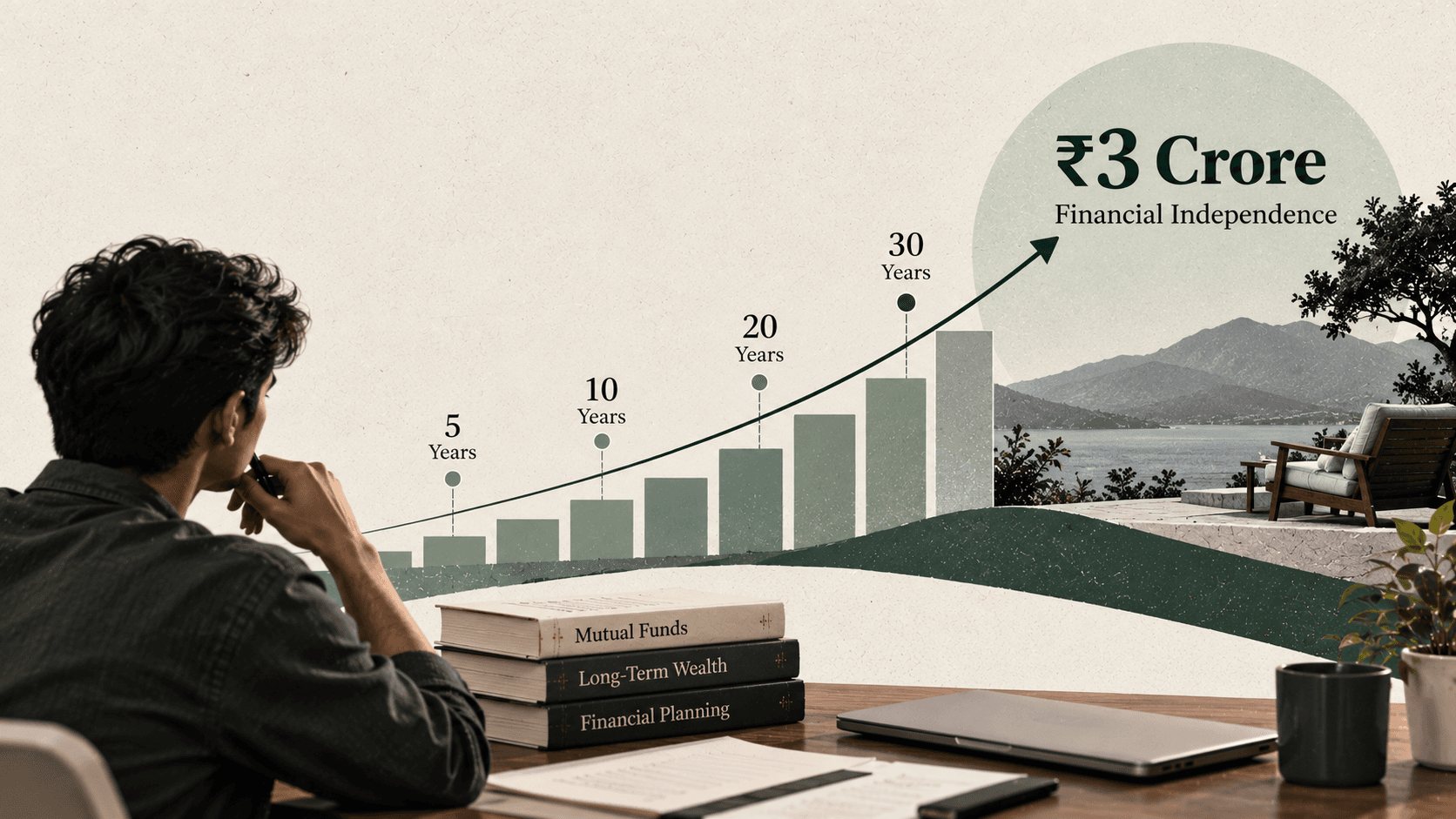
Financial independence begins with a clear understanding of how much money you may need and how long you have to build it. Explore how a 30-year-old could target a ₹3 crore corpus through regular investments, realistic return assumptions and a structured financial plan.
Financial independence is often associated with having enough money to make life decisions without depending entirely on a monthly salary. It could mean having the flexibility to change careers, start a business, take a professional break, support family members or eventually retire without worrying about every recurring expense.
For someone in their 30s, however, financial independence can feel like a distant goal. There may be rent or home-loan payments, family responsibilities, career-related expenses and other financial priorities competing for attention. Building a substantial investment corpus while managing these commitments requires a plan that balances today’s needs with tomorrow’s financial security.
Consider a 30-year-old who wants to accumulate ₹3 crore by the age of 60. Rather than treating this as an abstract target, the investor can break it down into a monthly investment amount, a realistic timeline and a strategy that can evolve as income and expenses change.
A Systematic Investment Plan (SIP) can help establish the habit of investing regularly. Over a long period, the combination of consistent contributions and potential investment growth may help build a substantial corpus.
However, financial independence is not defined by a particular corpus alone. It depends on how much money you need, when you need it, and whether your assets can support your intended lifestyle.
This article examines the monthly investment that could be required to target ₹3 crore, how the investment horizon affects the calculation, and what a 30-year-old should consider when building a long-term financial independence plan.
1. What Does Financial Independence Mean at 30?
Financial independence means having sufficient financial resources to support your needs and choices without relying entirely on active employment income.
It does not necessarily mean retiring at 30 or stopping work permanently. For some people, it means reaching a point where work becomes a choice rather than an immediate financial necessity. For others, it means building enough wealth to retire comfortably at a planned age.
The amount required depends on the individual’s circumstances.
Someone with low living expenses, a paid-off home and few financial obligations may need a different corpus from someone who rents in a major city, supports family members or expects substantial healthcare and education expenses.
Before deciding that ₹3 crore is the right target, an investor should consider several questions:
What are the current monthly living expenses?
How much might those expenses increase over time?
Is the objective to become financially independent before 60 or to accumulate wealth for retirement at 60?
Will the investor continue working after reaching the target?
Are there existing investments, property assets or retirement benefits?
Will the corpus need to support dependants?
How much investment risk is acceptable?
These questions matter because a ₹3 crore target can serve different purposes.
For someone planning to retire at 60, the corpus may be intended to support living expenses after employment ends. For someone aiming for financial independence at 45, it may need to fund several additional decades without a regular salary.
The same nominal corpus can therefore have very different implications depending on when financial independence begins and how long the money must last.
SEBI’s investor education guidance recommends defining financial goals, assessing the investment horizon and risk appetite, and reviewing diversification and asset allocation before investing. It also cautions investors that returns are not guaranteed.
2. How Much Should a 30-Year-Old Invest Monthly to Target ₹3 Crore?
The monthly contribution required to accumulate ₹3 crore depends on the time available and the return assumed for the investment.
To illustrate the relationship, assume the investor:
Is currently 30 years old.
Wants to accumulate ₹3 crore by age 60.
Has no existing investment corpus.
Makes a fixed contribution at the end of every month.
Does not withdraw money during the accumulation period.
Invests for 30 years, giving a total of 360 monthly contributions.
Under these assumptions, the following table estimates the monthly SIP required under three hypothetical annual return scenarios.
Monthly SIP required for a ₹3 crore target
Assumed annual return | Approximate monthly SIP | Total contributions over 30 years | Illustrative investment growth |
|---|---|---|---|
8% | ₹21,299 | ₹76.68 lakh | ₹2.23 crore |
10% | ₹14,543 | ₹52.35 lakh | ₹2.48 crore |
12% | ₹9,830 | ₹35.39 lakh | ₹2.65 crore |
Figures are approximate and rounded. Calculations assume an initial corpus of zero, 360 equal end-of-month contributions, and a monthly rate derived from the respective effective annual return. Actual investment results may differ materially.
The table illustrates how the assumed return changes the monthly contribution required to reach the same nominal target.
Under the 8% scenario, the investor would need to contribute approximately ₹21,299 per month. Under the 10% scenario, the estimate falls to approximately ₹14,543. Under the 12% scenario, it falls further to approximately ₹9,830.
However, the lowest monthly contribution is not automatically the most suitable choice.
A higher assumed return can make a target appear easier to reach mathematically, but investments with greater growth potential may also carry greater risk. The actual return may be lower than assumed, and market-linked investments can lose value.
AMFI explains that mutual fund schemes are not guaranteed-return products and that their NAVs can rise or fall with market conditions. Past performance does not guarantee future performance.
The monthly SIP should therefore be viewed as an estimate under a particular scenario—not as a promise that the investor will accumulate ₹3 crore.
What does the 10% scenario look like?
Suppose the investor selects the 10% scenario as an illustration for planning purposes.
A monthly SIP of approximately ₹14,543 over 30 years would result in total contributions of about ₹52.35 lakh. The remaining amount required to reach ₹3 crore would need to come from investment growth under the assumed calculation.
The important distinction is that the investor contributes the monthly amount consistently, while the investment’s actual value fluctuates over time.
There will not necessarily be a steady 10% return every year. Some periods may deliver stronger returns, while others may deliver weak or negative returns.
A long investment horizon provides time for potential growth, but it does not remove uncertainty.
For a more personalised calculation, the Kuberzo SIP Calculator can help explore how the monthly contribution, investment period and assumed return affect the projected corpus.
3. Why Starting at 30 Can Make a Difference
The time available for investing is one of the most important variables in long-term wealth creation.
Compounding occurs when investment growth remains invested and can contribute to further growth. When the investor also makes regular contributions, the corpus can potentially grow through both new investments and the returns earned on earlier investments.
The longer the money remains invested, the more time it has to potentially compound.
Consider an investor who begins at 30 and plans to accumulate ₹3 crore by age 60. The investor has 30 years to make contributions.
Someone who starts at 40 and wants to reach the same target by 60 has only 20 years.
Under the same hypothetical return assumption, the person starting later generally needs to invest considerably more each month because the contribution period is shorter.
This difference can become particularly important when the target is a large amount.
Starting at 30 also provides more time to respond to changes in income, family circumstances and financial goals. The investor can gradually increase contributions, review the investment strategy and adjust the plan as retirement approaches.
However, beginning early does not guarantee a particular outcome. Investment growth depends on actual market performance, and the final corpus may be lower or higher than projected.
AMFI’s investor education material discusses the potential benefits of starting early, investing regularly and allowing time for compounding, while noting that rupee-cost averaging does not guarantee profit or protect against losses.
The practical advantage of starting at 30 is that it gives the investor more time to build a sustainable investment habit rather than relying on large contributions in the final years before retirement.
4. How Does the Investment Timeline Affect the Monthly SIP?
Not everyone beginning at 30 intends to accumulate ₹3 crore by age 60. Some may want to reach the target earlier, while others may have a longer working horizon.
The following table illustrates how the monthly contribution changes under different investment periods.
Monthly SIP required to target ₹3 crore
Investment period | At an assumed 8% return | At an assumed 10% return | At an assumed 12% return |
|---|---|---|---|
15 years | ₹88,862 | ₹75,293 | ₹63,633 |
20 years | ₹52,724 | ₹41,768 | ₹32,924 |
25 years | ₹33,003 | ₹24,324 | ₹17,792 |
30 years | ₹21,299 | ₹14,543 | ₹9,830 |
35 years | ₹14,003 | ₹8,826 | ₹5,496 |
Figures are illustrative, rounded and calculated using end-of-month contributions, no initial corpus and monthly rates derived from the effective annual return assumptions. Actual outcomes will vary.
The difference between the 15-year and 30-year scenarios is substantial.
Under the assumed 10% return, the estimated monthly SIP is approximately ₹75,293 over 15 years, compared with ₹14,543 over 30 years.
This demonstrates why the timeline deserves as much attention as the target amount.
A shorter timeline does not necessarily mean that the goal is impossible. It means the investor may need a higher contribution, an existing corpus, a different target date or some combination of these adjustments.
The decision should reflect the investor’s financial circumstances rather than an assumption that higher returns can compensate for every shortfall.
What if the investor wants financial independence before 60?
A 30-year-old aiming for financial independence at 45 has only 15 years to accumulate the target.
Under the illustrative 10% scenario, the monthly SIP required to reach ₹3 crore over that period is approximately ₹75,293.
That amount may be unaffordable for many investors, particularly if they are also paying housing costs, supporting family members or building an emergency fund.
The investor may need to assess whether ₹3 crore is sufficient for the intended lifestyle, whether the target date can change, and whether existing investments can contribute towards the goal.
Financial independence before traditional retirement age also introduces a second challenge: the accumulated corpus may need to support expenses for a longer period.
The required amount should therefore be calculated from expected expenses and the intended date of financial independence, rather than chosen solely from a monthly SIP projection.
5. Is ₹3 Crore Enough for Financial Independence?
A corpus of ₹3 crore can appear substantial, but its adequacy depends on the expenses it must support.
Financial independence is not simply a question of reaching a round number. It requires comparing the available assets with the anticipated cost of living over the period during which employment income may be reduced or absent.
Consider two investors with a corpus of ₹3 crore.
The first owns a fully paid-off home, has relatively low expenses and receives some regular retirement income.
The second rents their home, supports family members and expects substantial healthcare and other expenses.
Although both have the same corpus, their financial needs are different.
The first may be able to fund a larger proportion of expenses from other income sources, while the second may need to withdraw more from investments.
A useful starting point is to estimate annual expenses and compare them with the corpus.
For example, if someone expects to spend ₹12 lakh per year, that represents 4% of a ₹3 crore corpus in the first year.
If annual expenses are ₹18 lakh, the initial amount represents 6% of the corpus.
These ratios are simple arithmetic illustrations, not withdrawal recommendations. They do not account for inflation, investment returns, taxes, unexpected expenses or how long the money must last.
A withdrawal strategy needs to consider these factors together.
An investor should also distinguish between financial independence and retirement. Someone who reaches financial independence at 45 may need their corpus to support them for several decades longer than someone retiring at 65.
Consequently, the same corpus may be more or less suitable depending on when withdrawals begin.
6. Why Inflation Matters When Setting a ₹3 Crore Target
One of the biggest mistakes in long-term financial planning is assuming that a future rupee will have the same purchasing power as a rupee today.
Inflation increases the cost of goods and services over time. Expenses such as housing, food, transport, education and healthcare may be considerably higher when a 30-year-old reaches 60.
Consider an illustration in which inflation averages 5% annually for 30 years.
Under that assumption, prices would rise by approximately 4.32 times over the period.
An expense costing ₹1 lakh today could therefore cost approximately ₹4.32 lakh in 30 years.
This is an illustration, not a prediction of future inflation. Actual inflation may be higher or lower, and individual expenses can rise at different rates.
The implication for financial independence is important: ₹3 crore accumulated at age 60 will not have the same purchasing power as ₹3 crore today.
The following table illustrates the present-day purchasing power of a future ₹3 crore corpus under different assumed inflation rates.
Assumed annual inflation | Purchasing power of ₹3 crore after 20 years, in today’s rupees | Purchasing power after 30 years, in today’s rupees |
|---|---|---|
4% | ₹1.37 crore | ₹93.6 lakh |
5% | ₹1.13 crore | ₹69.5 lakh |
6% | ₹93.6 lakh | ₹52.5 lakh |
These figures discount the future ₹3 crore amount using the assumed inflation rate. They are illustrative calculations, not inflation forecasts.
Under the 5% scenario, ₹3 crore accumulated 30 years from now would have purchasing power equivalent to approximately ₹69.5 lakh today.
This does not automatically mean that the target is inadequate. The investor may have other assets, pension income or a lower expected cost of living.
However, it does mean that a person seeking the equivalent of ₹3 crore in today’s purchasing power may need to target a substantially larger nominal amount at age 60.
The Kuberzo Inflation Calculator can help illustrate how inflation changes the future cost of a financial goal.
SEBI’s investor education material also emphasises the importance of accounting for inflation and maintaining a retirement plan that reflects the lifestyle the investor wishes to support.
7. How Could a Step-Up SIP Help Build the Corpus?
A fixed SIP assumes the investor contributes the same amount every month throughout the investment period.
However, a person’s income rarely remains unchanged for 30 years.
A professional may begin with an entry-level salary, receive annual increments, change jobs, take on greater responsibilities or establish a business. At the same time, household expenses and family commitments may increase.
A step-up SIP allows the monthly investment to increase periodically as financial capacity improves.
For example, an investor might begin with a monthly SIP of ₹10,000 and review the contribution every year. If income increases and expenses remain manageable, the investor could raise the monthly investment.
This approach may make it easier to begin investing without committing to a contribution that is unaffordable at the start.
However, a step-up SIP does not guarantee that the investor will reach ₹3 crore. The final corpus depends on actual contributions, investment performance and the time available.
A practical approach is to:
Start with an affordable monthly contribution.
Review income and expenses at regular intervals.
Increase contributions when financial circumstances permit.
Recalculate the projected corpus after significant changes.
Avoid compromising emergency savings or essential expenses to fund a higher SIP.
A step-up strategy should be based on realistic expectations about income growth rather than assuming that earnings will increase at a fixed rate every year.
The Kuberzo Step-Up SIP Calculator can help investors explore how increasing contributions may affect a projected corpus.
8. How Should a 30-Year-Old Structure an Investment Portfolio?
The SIP amount determines how much money is contributed. The portfolio determines where that money is invested and the risks involved.
For someone with a 30-year horizon, investment selection should reflect financial goals, risk tolerance, liquidity needs and existing assets.
Equity mutual funds
Equity mutual funds invest primarily in shares and equity-related instruments. They offer the potential for long-term capital appreciation but can also experience substantial losses.
An investor with a long time horizon may consider equity exposure as part of a diversified portfolio if it is consistent with their risk tolerance and financial circumstances.
However, a long horizon does not eliminate market risk. An investor should avoid relying entirely on one optimistic return assumption.
Explore Equity Mutual Funds.
Debt mutual funds
Debt mutual funds invest primarily in debt and money-market instruments. Depending on the scheme, they provide exposure to different maturities, credit profiles and interest-rate risks.
They may be considered as part of a portfolio’s debt allocation, but they are not risk-free. Investors should review each scheme’s objective, portfolio characteristics, liquidity and relevant disclosures.
Explore Debt Mutual Funds.
Hybrid mutual funds
Hybrid mutual funds combine equity and debt exposure according to their investment strategies.
They may be considered by investors seeking exposure to multiple asset classes within a single scheme. However, risk levels vary, and investors should review the actual asset allocation rather than assuming that every hybrid fund is conservative.
Explore Hybrid Mutual Funds.
Existing investments and other assets
Financial independence planning should also account for existing investments, retirement savings, property assets and other eligible sources of income.
Not every asset should automatically be treated as available for spending. A home in which the investor lives, for example, may contribute to financial security but may not generate cash for everyday expenses unless the investor changes how it is used.
Similarly, retirement benefits may have specific access conditions, tax treatment or withdrawal rules.
The investor should distinguish between total net worth and the assets available to fund living expenses.
The objective is to develop a coordinated financial plan rather than accumulate a large number of investments without understanding how each contributes to the goal.
SEBI recommends considering diversification, asset allocation, liquidity, safety, returns and tax implications when evaluating investments.
9. Build Financial Independence Without Neglecting Financial Security
A large investment corpus is only one part of financial independence.
An investor who directs nearly all available income towards SIPs but has no emergency savings may be forced to withdraw investments or borrow money when an unexpected expense arises.
A sustainable financial plan should therefore account for short-term financial security alongside long-term wealth creation.
Maintain emergency savings
An emergency fund can help cover unexpected expenses such as temporary loss of income, urgent repairs or medical costs.
The appropriate amount depends on employment stability, household responsibilities, insurance coverage and other factors.
Money required for emergencies should not automatically be placed in investments that may fluctuate significantly in value.
Review insurance needs
Health insurance and other appropriate protection can help manage certain financial risks.
The type and amount of cover should reflect the investor’s circumstances, existing policies and potential financial responsibilities.
Insurance should be evaluated as a protection measure, not simply as another investment product.
Manage high-cost debt
Outstanding debt repayments reduce the income available for investing.
Before committing to an ambitious SIP, review the cost of existing loans and the consequences of carrying expensive debt.
The appropriate approach depends on the loan terms, liquidity requirements and the investor’s broader financial position.
Keep short-term goals separate
A person in their 30s may be saving for a home, a child’s education, travel or other significant expenses while also building a financial independence corpus.
Money needed for a near-term goal may require a different investment approach from money intended to remain invested for decades.
Keeping goals separate helps prevent a short-term financial requirement from disrupting the long-term plan.
SEBI’s investor education guidance recommends maintaining emergency provisions, considering insurance needs and diversifying investments according to financial goals.
10. How Should the Plan Evolve Between Age 30 and 60?
A 30-year investment horizon is long enough for an investor’s circumstances to change substantially.
The monthly contribution, financial responsibilities and retirement expectations that apply at 30 may look very different at 40, 50 or 60.
A financial independence plan should therefore be reviewed periodically rather than treated as a calculation that never changes.
Age 30–40: Establish the foundation
The first decade can focus on developing a consistent investment habit, maintaining emergency savings and selecting investments suited to the long-term objective.
The investor should review whether the monthly contribution remains affordable and whether the target reflects expected future expenses.
If income rises, increasing contributions may help accelerate progress.
Age 40–50: Review progress and adjust
During the middle years, family responsibilities, housing costs and other financial commitments may become more significant.
Review the actual corpus against the target and reassess whether the investment strategy remains suitable.
If the projected amount falls short, consider whether the monthly contribution can increase, the investment period can change or the target needs to be recalculated.
Avoid increasing investment risk simply because the portfolio is behind schedule.
Age 50–60: Prepare for the transition
As the target date approaches, consider how much of the corpus may need to fund expenses in the near future.
A market decline shortly before financial independence can have a meaningful effect on the amount available.
Depending on the investor’s circumstances, the portfolio may need to be reviewed for liquidity, volatility and the timing of anticipated withdrawals.
This does not mean that every investor should move all investments into a single asset class at a predetermined age. The appropriate approach depends on expected expenses, other income sources, risk tolerance and the length of time the corpus must support the investor.
After reaching financial independence: Manage withdrawals
Accumulating ₹3 crore and using it to fund financial independence are different stages of the plan.
Once the investor begins withdrawing money, the corpus must support expenses while also responding to inflation and investment performance.
Withdrawals during a market downturn can reduce the amount left invested to participate in a subsequent recovery. The effect may be particularly important when the investor has no regular employment income to supplement the portfolio.
A withdrawal plan should therefore account for the amount needed each year, the availability of other income, liquidity requirements and the possibility that the money may need to last for several decades.
The investment strategy should continue to reflect the investor’s circumstances after the initial target has been reached.
11. A Practical Checklist for Building a ₹3 Crore Corpus
Before starting or revising an investment plan, consider the following steps.
Define financial independence. Decide whether the goal is early retirement, greater flexibility in employment or financial security at a planned retirement age.
Estimate future expenses. Calculate current spending and consider how inflation may change the cost of living.
Set a realistic target. Determine whether ₹3 crore is a suitable nominal corpus or whether a different amount is needed to fund future expenses.
Calculate the monthly contribution. Compare different investment periods and hypothetical returns rather than relying on a single scenario.
Start with an affordable amount. Ensure that the SIP fits within the budget after essential expenses, debt repayments and emergency savings.
Consider increasing contributions. Review whether a step-up SIP is practical as income grows.
Choose investments according to risk tolerance. Assess scheme objectives, asset allocation, liquidity, costs and risk disclosures.
Separate short-term and long-term goals. Avoid placing money needed soon into investments that may be unsuitable for the deadline.
Review progress regularly. Reassess the target, contributions and investment strategy when financial circumstances change.
Plan for the withdrawal stage. Consider how the corpus will fund expenses after financial independence and how liquidity will be managed during market downturns.
The purpose of this checklist is not to eliminate uncertainty. It is to establish a framework for making financial decisions as circumstances evolve.
Key Takeaway
A 30-year-old has three decades to work towards a ₹3 crore corpus, provided the intended target date is age 60. Under the illustrative assumptions in this article, the required monthly SIP is approximately ₹21,299 at an assumed annual return of 8%, ₹14,543 at 10%, or ₹9,830 at 12%.
These estimates are mathematical illustrations, not guaranteed outcomes. Actual investment returns may differ, and the amount required for financial independence depends on future expenses, inflation, existing assets, other income sources and the age at which withdrawals begin.
Starting early, investing consistently and increasing contributions as financial circumstances permit may help an investor work towards the target. Regular reviews can also help ensure that the plan remains aligned with changing responsibilities and financial goals.
Ultimately, financial independence is not just about reaching ₹3 crore. It is about building a financial foundation that can support the choices, responsibilities and lifestyle the investor wants over the long term.
Disclaimer
This article is intended for educational and informational purposes only and does not constitute personalised investment advice. All return assumptions and calculations are illustrative and should not be treated as forecasts or guarantees. Mutual fund investments are subject to market risks, including the possible loss of capital. Investors should review relevant scheme documents, assess their financial circumstances and risk tolerance, and seek appropriate professional advice where necessary.
Frequently Asked Questions
1. How much SIP is required to build ₹3 crore by age 60 if I start at 30?
Under the assumptions in this article, the estimated monthly SIP is approximately ₹21,299 at an assumed annual return of 8%, ₹14,543 at 10%, and ₹9,830 at 12%. The calculation assumes no initial corpus and 360 end-of-month contributions. Actual investment outcomes will vary.
2. Can I build a ₹3 crore corpus by investing ₹10,000 per month?
Whether ₹10,000 per month reaches ₹3 crore depends on the investment period and actual returns. Over 30 years, total contributions would amount to ₹36 lakh, excluding investment growth. A SIP calculator can help model different scenarios, but the final corpus is not guaranteed.
3. Is ₹3 crore enough for financial independence in India?
It depends on the investor’s age, living expenses, housing situation, healthcare needs, other sources of income and the duration over which the corpus must support expenses. Inflation can also significantly affect the future purchasing power of the amount.
4. What is the difference between financial independence and retirement?
Retirement usually refers to leaving regular employment, while financial independence means having sufficient financial resources to support expenses without relying entirely on employment income. Someone may reach financial independence and continue working by choice rather than necessity.
5. Should I use a step-up SIP to reach ₹3 crore?
A step-up SIP may help investors increase contributions as income grows. Its effectiveness depends on actual contribution increases, investment performance and the time available. Future salary growth should not be treated as certain, and a step-up strategy does not guarantee the target corpus.
6. Are SIP returns guaranteed?
No. A SIP is a method of investing regularly in a mutual fund scheme. It does not guarantee a particular return or final corpus. Mutual fund investments are subject to market risks, and their values may rise or fall.
7. How does inflation affect a ₹3 crore financial independence target?
Inflation reduces the purchasing power of money over time. A future corpus of ₹3 crore may buy substantially less than ₹3 crore buys today. Investors should estimate future expenses and decide whether their target needs to account for inflation.
8. Should I stop investing once I reach ₹3 crore?
Not necessarily. Whether the corpus is sufficient depends on future expenses, inflation, other income and how long the money must last. After reaching the target, the investor should assess how the corpus will be used and develop an appropriate withdrawal strategy.
9. How often should I review my financial independence plan?
Review the plan periodically and whenever a major change occurs, such as a change in income, family responsibilities, retirement expectations or financial goals. The review should consider the target, investment horizon, contributions and portfolio suitability—not only recent investment performance.




