
Balanced Advantage Funds vs Aggressive Hybrid Funds: Managing Volatility vs Growth
By Amrita Sinha
About the Author
Amrita Sinha is a content strategist with experience in SEO, digital marketing, and financial content. She writes easy-to-understand, research-backed articles on investing, personal finance, taxation, and wealth management for Kuberzo.
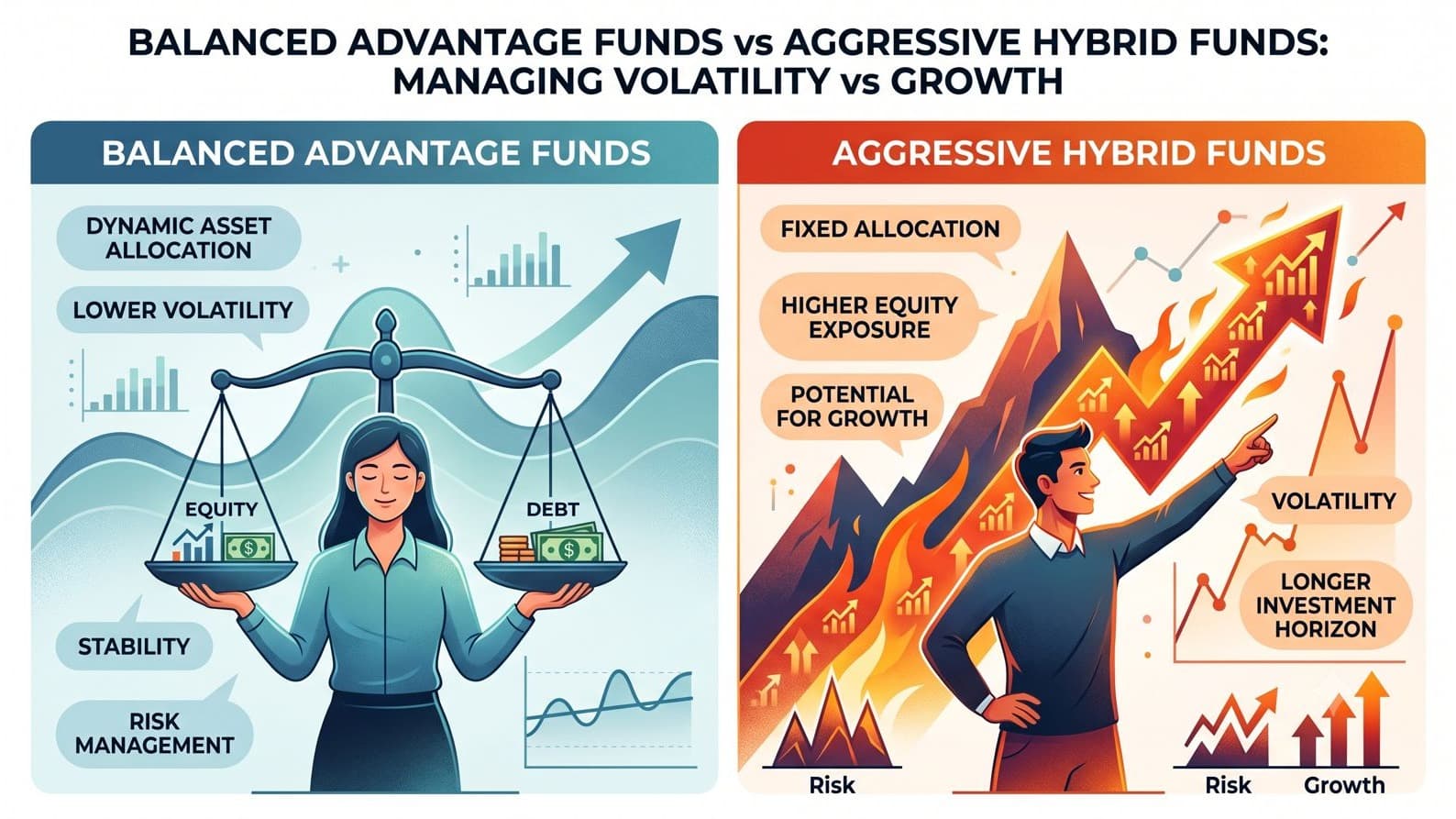
Compare Balanced Advantage Fund vs Aggressive Hybrid on asset allocation, volatility, returns, risk and taxation to understand how each approach manages growth.
Balanced Advantage Funds vs Aggressive Hybrid Funds: Managing Volatility vs Growth
Choosing a mutual fund is not only about deciding how much equity exposure you want. It is also about understanding how that equity exposure is managed when market conditions change. This becomes particularly important for investors who want long-term growth but may not be comfortable with the full volatility of a predominantly equity portfolio.
This is where the comparison of Balanced Advantage Fund vs Aggressive Hybrid becomes relevant. Both are hybrid mutual fund categories that combine equity and debt, but they approach asset allocation differently.
An Aggressive Hybrid Fund maintains a relatively defined allocation range, with 65% to 80% in equity and equity-related instruments and 20% to 35% in debt and money-market instruments, under SEBI's categorisation framework. This gives the fund a clear equity-oriented structure, while the debt component provides some diversification.
A Balanced Advantage Fund (BAF), also known as a Dynamic Asset Allocation Fund, takes a more flexible approach. Its equity and debt allocation can be dynamically adjusted based on the fund's investment strategy and market conditions. SEBI's category framework permits dynamic allocation across equity and debt, including a broad 0% to 100% range for each asset class.
This fundamental difference can influence how each fund behaves during rising markets, corrections and changing market conditions. An Aggressive Hybrid Fund generally maintains a substantial equity allocation, while a BAF has greater flexibility to alter its allocation.
So, the question is not simply which is safer, BAF or hybrid fund? Instead, investors should understand how each category manages equity exposure, what kind of volatility they may experience and how the strategy fits their investment horizon and risk tolerance.
Balanced Advantage Fund vs Aggressive Hybrid: What Is The Difference?
The biggest difference lies in asset allocation.
An Aggressive Hybrid Fund has a relatively stable equity-oriented structure. Under SEBI's category definition, it invests 65%–80% in equity and equity-related instruments and 20%–35% in debt and money-market instruments.
A Balanced Advantage Fund, on the other hand, uses dynamic asset allocation. The fund manager can increase or decrease equity and debt exposure depending on the strategy adopted by the scheme.
Feature | Balanced Advantage Fund | Aggressive Hybrid Fund |
Core Strategy | Dynamic allocation between equity and debt | Predominantly equity with debt allocation |
Equity Allocation | Can change substantially | Generally 65%–80% |
Debt Allocation | Can change substantially | Generally 20%–35% |
Primary Objective | Balance growth and volatility | Equity-led growth with some stability |
Flexibility | Higher | More defined allocation |
Risk Profile | Depends on current allocation | Generally higher equity-market exposure |
Suitable Horizon | Typically medium to long term | Typically long term |
The actual portfolio of an individual scheme can vary, so investors should always check its Scheme Information Document (SID).
Dynamic Asset Allocation vs Hybrid Fund: How Does The Strategy Work?
The dynamic asset allocation vs hybrid fund distinction is essentially about how actively the equity-debt mix can change.
A BAF may increase equity exposure when the fund's valuation or market indicators suggest that equities are relatively attractive. It may reduce equity exposure when its investment model indicates higher risk or less attractive valuations.
The exact methodology differs from one fund to another. Some may use valuation-based models, while others may consider market indicators, economic factors or quantitative signals.
An Aggressive Hybrid Fund does not generally have the same degree of flexibility. Its equity allocation remains within the category's prescribed range, meaning the fund remains substantially exposed to equities even during market corrections.
This difference matters because asset allocation itself can influence portfolio volatility.
Which Is Safer: BAF Or Hybrid Fund?
The question of which is safer, BAF or hybrid fund, does not have a universal answer.
A BAF can potentially reduce equity exposure during periods when its strategy indicates elevated risk. This can provide a mechanism for managing downside, but it does not guarantee downside protection.
Similarly, an Aggressive Hybrid Fund's debt allocation can provide diversification, but the fund remains substantially invested in equities.
Therefore, neither category should be considered a safe or capital-protected investment.
The actual risk of a BAF can vary considerably depending on its current equity allocation. Investors should examine the scheme's portfolio, asset allocation and Risk-o-Meter rather than assuming that every BAF will behave conservatively.
Balanced Advantage Fund Downside Protection: What Should Investors Know?
Balanced Advantage Fund downside protection is one of the reasons investors are attracted to this category, but the phrase needs to be understood carefully.
Dynamic allocation can potentially reduce equity exposure when the fund's model signals caution. This may help moderate the impact of a market correction compared with remaining fully invested in equities.
However, a BAF cannot eliminate losses.
For example, if the fund continues to hold a meaningful equity allocation during a market decline, its NAV can fall. Its debt investments can also experience fluctuations due to interest-rate and credit-related risks.
Therefore, dynamic asset allocation should be viewed as a risk-management approach, not as a guarantee against losses.
Balanced Advantage vs Aggressive Hybrid Returns: What Should You Expect?
The Balanced Advantage vs Aggressive Hybrid returns comparison should not be based solely on which category delivered higher returns over a particular period.
Aggressive Hybrid Funds maintain a substantial equity allocation, which can provide greater participation in equity-market rallies. However, this also means they can experience greater equity-market volatility.
BAFs have greater flexibility to change their equity exposure. If a fund reduces equity exposure during a rising market, it may participate less in that rally. Conversely, reducing equity exposure before or during a market decline may help moderate losses.
This creates a fundamental trade-off:
Aggressive Hybrid: More consistent equity exposure, potentially stronger participation in equity rallies, but higher dependence on equity-market performance.
BAF: Greater allocation flexibility, potentially better suited to managing changing market conditions, but outcomes depend heavily on the fund's asset-allocation model.
Past performance does not guarantee future returns, and category-level returns can vary significantly across market cycles.
BAF Vs Hybrid Fund Risk: What Are The Key Risks?
When evaluating BAF vs hybrid fund risk, investors should look beyond the equity percentage.
BAFs can face:
Equity-market risk
Debt-market and interest-rate risk
Credit risk in debt securities
Model or asset-allocation risk
Risk of reducing equity exposure at an unfavourable time
Aggressive Hybrid Funds can face:
Higher equity-market exposure
Equity valuation risk
Debt and interest-rate risk
Credit risk
Portfolio concentration risk
A BAF's dynamic strategy does not necessarily mean it will always reduce equity exposure before a correction. Similarly, the debt component of an Aggressive Hybrid Fund does not eliminate equity-market risk.
Aggressive Hybrid vs Balanced Advantage: Who May Consider Each?
An Aggressive Hybrid vs Balanced Advantage decision should start with the investor's risk tolerance and investment objective.
An Aggressive Hybrid Fund may be considered by investors who:
Want substantial equity exposure
Have a long investment horizon
Can tolerate equity-market volatility
Want debt exposure within the same portfolio
A BAF may be considered by investors who:
Want a dynamically managed equity-debt allocation
Prefer some flexibility in managing market exposure
Want long-term growth with an allocation strategy designed to manage volatility
Are comfortable with the fact that the fund's equity exposure can change significantly
Neither category is appropriate simply because an investor wants "high returns with low risk." There is no mutual fund category that can guarantee both.
Kuberzo's guide to different types of mutual funds can help investors understand how equity, debt, hybrid and passive categories differ.
Hybrid Fund Taxation: Does The Category Matter?
Hybrid fund taxation depends on the fund's classification and applicable tax rules, so investors should not assume that all hybrid funds receive the same tax treatment.
For equity-oriented mutual funds, units held for more than 12 months generally qualify as long-term capital assets. Under the current framework, short-term capital gains on specified equity-oriented units are taxed at 20%, while long-term capital gains above ₹1.25 lakh are taxed at 12.5%, subject to applicable conditions.
The tax classification of a particular BAF can depend on its actual structure and equity exposure. Some BAF schemes are structured to maintain equity exposure above 65% and may therefore qualify for equity-oriented taxation. Investors should verify the specific scheme's tax treatment rather than relying only on its category name.
Aggressive Hybrid Funds, with their prescribed 65%–80% equity allocation, are generally structured as equity-oriented hybrid funds. However, investors should verify the applicable tax treatment for the specific scheme and investment period.
Tax laws can change, so the applicable provisions should be checked before making an investment decision.
Kuberzo's SIP Calculator can help investors model different monthly contribution scenarios.
Balanced Advantage Fund Vs Hybrid Fund: Which Should You Choose?
There is no universally better choice between Balanced Advantage Fund vs Hybrid Fund.
The decision depends on what role the investment is expected to play in your portfolio.
If you want a relatively defined equity-oriented allocation and are comfortable with substantial exposure to equities, an Aggressive Hybrid Fund may fit that requirement.
If you prefer a fund that can dynamically change its equity-debt allocation based on its investment strategy, a BAF may be worth evaluating.
Before investing, compare:
Current asset allocation
Historical allocation changes
Investment strategy
Risk-o-Meter
Portfolio quality
Expense ratio
Fund manager and process
Investment horizon
Tax classification
Most importantly, do not choose a fund category only because it has delivered strong returns in the recent past.
Contact us for a more personalised guidance.
Conclusion
The Balanced Advantage Fund vs Aggressive Hybrid comparison ultimately comes down to how equity exposure is managed.
An Aggressive Hybrid Fund maintains a substantial equity allocation within a defined range, making it more consistently equity-oriented. A Balanced Advantage Fund has greater flexibility to move between equity and debt based on its investment strategy.
That flexibility can help a BAF manage changing market conditions, but it does not guarantee downside protection. Similarly, the debt allocation in an Aggressive Hybrid Fund can diversify the portfolio but cannot eliminate market risk.
For investors deciding between the two, the focus should be on asset allocation, volatility, investment horizon, risk tolerance, taxation and the fund's specific strategy, rather than simply looking for the category with the highest past returns.
Disclaimer: This article is for general educational purposes only and does not constitute personalised investment, tax or financial advice. Mutual fund investments are subject to market risks, and returns are not guaranteed. Dynamic asset allocation does not guarantee protection from losses. Investors should read the scheme documents and evaluate their financial goals, risk tolerance and investment horizon before investing.
Frequently Asked Questions
What is the difference between a Balanced Advantage Fund and an Aggressive Hybrid Fund?
A Balanced Advantage Fund dynamically changes its allocation between equity and debt based on its investment strategy. An Aggressive Hybrid Fund generally maintains 65%–80% equity and 20%–35% debt and money-market exposure.
Is a Balanced Advantage Fund safer than an Aggressive Hybrid Fund?
Not necessarily. A BAF has greater flexibility to reduce equity exposure, but it remains market-linked and can experience losses. An Aggressive Hybrid Fund has a substantial equity allocation and can also experience significant volatility.
Does a Balanced Advantage Fund provide downside protection?
A BAF may attempt to manage downside risk by dynamically adjusting its equity exposure. However, this is not guaranteed capital protection, and the fund can still lose value during adverse market conditions.
Which has higher return potential: BAF or Aggressive Hybrid?
Neither category guarantees higher returns. Aggressive Hybrid Funds generally maintain higher and more consistent equity exposure, while BAFs can alter their allocation. Actual returns depend on market conditions, portfolio positioning and the specific fund's strategy.
Are Balanced Advantage Funds taxed like equity funds?
Some BAFs are structured to maintain sufficient equity exposure to qualify for equity-oriented taxation, but this should be verified for the specific scheme. Tax treatment depends on the fund's actual structure and applicable tax rules.
Are BAFs suitable for long-term investment?
BAFs are generally designed for investors seeking a combination of equity-led growth and dynamic asset allocation. However, suitability depends on the investor's financial goals, risk tolerance and investment horizon.